Primary Creep Kinetics in Corrugated Board under Humidity
Primary creep kinetics in corrugated board accelerate exponentially above 75 percent relative humidity, requiring strict load safety factors under cyclic moisture.
Deformation
Containerboard structures subjected to constant mechanical loads undergo continuous, time-dependent strain across three distinct phases: instantaneous elastic deformation, primary viscoelastic creep, and secondary or tertiary plastic rupture. As relative humidity rises, water molecules absorb into the amorphous regions of cellulose, acting as a molecular plasticizer that weakens inter-fiber bonding. This initial strain response increases non-linearly with moisture content, lowering the threshold where primary creep turns into runaway failure.
In dry ambient conditions, primary creep slows over time and eventually stabilizes during extended storage. Humidity disrupts this balance by increasing macromolecular mobility within the cell wall, allowing cellulose microfibrils to slip past each other at much lower sustained loads than dry testing predicts. The kinetic rate of primary creep follows a power-law relationship driven by matrix moisture equilibrium; at high relative humidity, the time needed to reach critical secondary yield drops from months to mere days.
At 85 percent relative humidity, primary creep strain rates in containerboard double within forty-eight hours under static compressive loads exceeding forty percent of short-term strength.
Transient moisture conditions induce an accelerated kinetic state known as the mechanosorptive effect. When corrugated board experiences cyclic relative humidity, its compressive strain rate exceeds the creep rate measured at any static humidity within that same range. Moisture sorption creates temporary internal stress gradients across the paperboard cross-section that add to external top-load compression, accelerating hydrogen bond breakage and physical cell wall buckling.
Because this shortens the primary creep stage drastically during cyclic absorption, structural design models must account for dynamic moisture swings rather than relying on static equilibrium averages.
| Material Grade | Grammage (g/m²) | 50% RH Creep Rate (%/hr) | 85% RH Creep Rate (%/hr) | Mechanosorptive Strain Ratio |
|---|---|---|---|---|
| Unbleached Softwood Kraftliner | 175 | 0.0012 | 0.0084 | 2.41 |
| Recycled Testliner Grade 2 | 160 | 0.0028 | 0.0210 | 3.85 |
| Semi-Chemical Hardwood Fluting | 127 | 0.0009 | 0.0061 | 2.10 |
| Recycled Waste Fluting Medium | 120 | 0.0035 | 0.0340 | 4.20 |
The interaction between atmospheric moisture and compressive load depends heavily on exposure duration. Standard testing assumes dry environments, but under elevated humidity, primary creep accounts for over eighty percent of total observed vertical deflection within the first two hours of static loading. This initial strain rate determines whether a pallet stack stays stable or begins to lean.
Whether hydrogen bond renewal during desorption cycles fully restores the original elastic modulus remains an open question in cellulose physics.
Ply
Structural performance in corrugated combined board depends directly on its constituent paperboard layers. Facing plies of linerboard absorb tensile and compressive bending stresses, while fluted inner plies provide shear resistance and maintain separation between the facings. Because recycled fibers absorb water rapidly, the physical chemistry of each individual ply dictates how moisture diffuses through the wall structure and drives localized primary creep.
Fiber Composition and Lignin Integrity
Unbleached softwood kraft pulp retains high native fiber length and structural stiffness even when absorbing moisture. Residual lignin within these virgin fibers acts as a natural hydrophobic binder that restricts water molecules from inserting between cellulose chains, allowing kraftliner to resist moisture sorption longer. In contrast, recycled fibers undergo repeated repulping cycles that shorten fiber length, weaken internal fibrillar bonding, and create micro-voids.
These micro-voids accelerate capillary transport of condensed moisture, causing rapid primary creep in recycled containerboard under humid conditions.
Semi-chemical virgin fluting retains dimensional stiffness significantly longer than recycled fluting mediums under high moisture absorption conditions.
Fluting Geometry and Interface Shearing
The arch architecture of fluted mediums converts vertical stack loads into combined bending and shear stresses. When relative humidity rises above seventy-five percent, the adhesive bond line between flute tips and linerboard facings undergoes hygroscopic swelling. As starch adhesive softens under moisture ingress, micro-slippage occurs at the interface, reducing the combined board’s effective moment of inertia.
With the fluting losing transverse shear rigidity, the linerboard plies absorb a greater share of the compressive load, accelerating primary creep kinetics in the outer facings.
- Crease line micro-cracking opens direct pathways for moisture diffusion into inner fiber networks, accelerating localized primary creep along packaging score lines.
- Recycled fiber hornification reduces swollen fiber flexibility, promoting brittle micro-fractures under sustained compressive load when relative humidity fluctuates rapidly.
- Adhesive line plasticization permits flute profile rolling under top load, shifting structural compression into eccentric bending stresses across linerboard plies.
- Anisotropic moisture expansion causes differential cross-direction swelling, generating out-of-plane shear stresses that degrade internal ply bond strength.
Because lignin content limits moisture swelling, selecting containerboard combinations rich in long, virgin softwood fibers reduces primary creep strain rates under tropical transport conditions. Virgin softwood kraftliners resist moisture-induced secondary creep failure far longer than recycled testliners of identical basis weight.
Assay
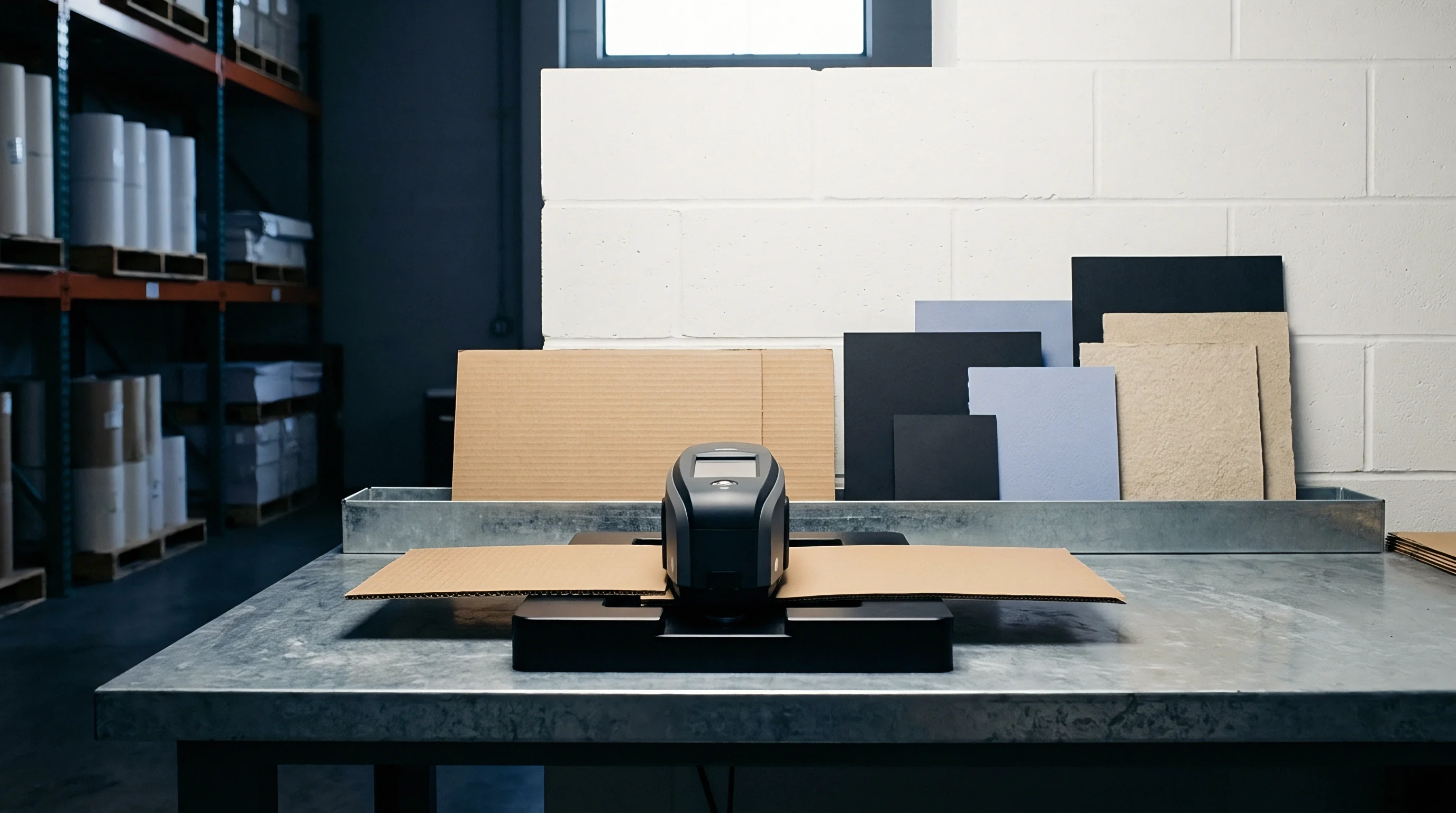
Standardized physical testing provides quantitative parameters for load-bearing endurance under atmospheric control. Short-term evaluations like the Box Compression Test or Edgewise Compression Test measure ultimate breaking strength under rapid loading, but these static values fail to capture long-term creep behavior in humid warehouses. Accurately evaluating creep kinetics requires specialized bench rigs that apply constant static compressive forces while environmental chambers cycle relative humidity levels.

What Accelerates Compressive Creep under Cyclic Moisture?
Oscillating relative humidity produces rapid moisture gradients across paperboard walls. As ambient humidity shifts, outer linerboard layers absorb or desorb water faster than internal fluting plies. This uneven moisture distribution creates internal hygroscopic stress waves that continuously disrupt inter-fiber hydrogen bonds under sustained top load, driving mechanosorptive creep strain far faster than static creep measured under constant high humidity.
ISO 12048 compressive strength ratings overestimate stack life by more than half when storage relative humidity oscillates past seventy-five percent.
Standard Test Protocols and Environmental Control
Laboratory evaluation of static load endurance relies on controlled climate chambers defined by ISO 2234 and ASTM D4577. Testing protocols specify pre-conditioning samples at low humidity before exposure to target test climates to ensure consistent sorption histories.
- Precondition corrugated test specimens in a dry atmosphere below thirty percent relative humidity for twenty-four hours to erase prior moisture history.
- Equilibrate specimens in a standard atmosphere of twenty-three degrees Celsius and fifty percent relative humidity until sample mass stabilizes within precise limits.
- Transfer test specimens into pneumatic static load frames mounted inside environmental chambers pre-set to specified test humidity levels.
- Apply a sustained static load equal to a defined percentage of the short-term Box Compression Test value and measure vertical deflection continuously via digital displacement transducers.
| Standard Designation | Test Focus | RH Conditioning Band | Load Duration | Primary Kinetic Measure |
|---|---|---|---|---|
| ISO 2234 | Static Stacking Resistance | 50% to 90% RH | 24 to 720 Hours | Total Deflection vs Time |
| ASTM D4577 | Sustained Load Creep Life | Controlled or Cyclic RH | Until Structural Failure | Primary Creep Strain Rate |
| ISO 12048 | Compression Deflection Rate | Standard 50% RH | Quasi-static Load Rate | Ultimate Compression Force |
| FEFCO Method 50 | Cyclic Climate Creep Assay | 40% to 90% RH Swings | 48 to 168 Hours | Mechanosorptive Creep Factor |
Because box compression strength deteriorates over time, accurate lab characterization demands continuous displacement logging to isolate primary creep from initial load settlement. Under ISO 12048 Annex B provisions, long-term stack life calculations require revision whenever relative humidity fluctuations exceed ten percent over a twelve-hour operational window.
Arithmetic
Predicting box lifespan in humid warehousing requires mathematical models calibrated against short-term compression values. Total strain over time sums initial elastic strain, primary viscoelastic creep strain, and accumulated mechanosorptive strain. Primary creep kinetics follow an exponential power-law function governed by moisture ratio, stress intensity, and elapsed time under load.
Worked Load Model for Humid Warehouse Storage
Consider a standard box construction with a nominal Box Compression Test rating of 4,000 N under standard conditioning. Under a sustained top-load of 1,600 N per box ~ a forty percent load ratio ~ in a dry environment at fifty percent relative humidity, the primary creep strain rate averages 0.0015 percent per hour. This yields an estimated primary creep duration of over 1,200 hours before secondary yield begins.
When conditions shift to eighty-five percent relative humidity, material stiffness drops and effective Box Compression Test capacity falls to approximately 2,200 N. The same 1,600 N static load now represents seventy-two percent of that adjusted capacity, pushing the primary creep rate up to 0.0280 percent per hour. As a result, the critical strain threshold of 3.0 percent vertical compression is reached within 107 hours, triggering buckling failure in bottom-tier packaging.
| Board Construction | Virgin/Recycled Ratio | Dry BCT (N) | 85% RH Creep Rate (%/hr) | Projected Time to Secondary Yield (hrs) |
|---|---|---|---|---|
| Double-Wall Kraftliner / Semi-Chem Fluting | 100 / 0 | 4,800 | 0.0082 | 365.8 |
| Single-Wall Kraftliner / Recycled Fluting | 60 / 40 | 4,000 | 0.0280 | 107.1 |
| Single-Wall Testliner / Recycled Fluting | 0 / 100 | 3,400 | 0.0890 | 33.7 |
When dynamic loads compound static stresses during humidity cycling between sixty and ninety percent relative humidity, the effective strain rate rises by a mechanosorptive factor of 2.85. The time to failure for a mixed virgin-recycled box drops from 107.1 hours to 37.5 hours. Underestimating primary creep rates in high-humidity transit leads to severe stack leaning, creasing, crushed bottom cartons, and rejected shipments at distribution hubs.
Dock
Supply chain logistics introduce severe environmental stress during maritime transit and unconditioned tropical storage, where pallet loads stacked five high face extreme creep drivers. Compliance verification ensures that containerboard specifications incorporate necessary creep resistance allowances for targeted shipping routes.
Safety Margin Selection and Environmental Derating
Design engineers offset creep risk by applying multiplicative derating factors to dry compression test values. Standard environmental safety factors adjust nominal Box Compression Test targets based on maximum expected relative humidity and anticipated storage duration; selecting inadequate multipliers leads directly to bottom-tier box failure during long-haul ocean transit.
- Route-specific climate mapping aligns box performance specifications with seasonal relative humidity profiles across origin, ocean transit, and destination ports.
- Pallet footprint alignment prevents overhang, which accelerates localized primary creep kinetics by increasing corner post stress concentrations.
- Stretch-wrap tension calibration prevents excess radial compression from accelerating vertical flute shear creep under warm, humid conditions.
- Chain of custody verification confirms FSC or PEFC certification for raw fiber origin without validating physical board creep resistance standards.
Under ASTM D4577 testing provisions, failure to account for moisture adsorption curves invalidates stack stability guarantees in tropical logistics corridors.
Compliance Documentation and Audit Rigor
Verifiable packaging performance demands comprehensive trace files that pair mill test certificates with lab creep reports. Under EU Packaging and Packaging Waste Regulation mandates, packaging optimization requires proof that board weight was minimized without compromising structural stacking integrity. Declarations must explicitly state the relative humidity design limits and safety factor formulas used in structural calculations.
Auditors check certified test reports against ISO 12048 creep testing criteria, while sourcing teams confirm that supplier declarations match the physical grammage and fiber composition in the original qualification file. Unexpected box failure under humid storage can stem from post-converting warehouse moisture spikes rather than structural linerboard fatigue or inadequate glue line formation.