Acoustic Dispersion across High Yield Chemi Thermomechanical Pulp Layers under Dynamic Crease Indentation
Inline acoustic wave attenuation isolates internal BCTMP core delamination during dynamic scoring, preventing score cracking without over-crushing board caliper.


Mechanics
Dynamic crease indentation of folding boxboard containing high-yield bleached chemi-thermomechanical pulp (BCTMP) subjects the multi-ply architecture to localized transverse shear and out-of-plane compression. The mechanical response of the board depends on the structural integrity of the middle BCTMP layer relative to the outer chemical pulp liners. High-yield pulps retain a significant fraction of lignin, giving individual fibers high wall stiffness while lowering inter-fiber hydrogen bonding potential compared to fully delignified kraft fibers.
Ultrasonic wave dispersion provides an immediate non-destructive indicator of how these hybrid fiber networks dissipate energy during high-speed scoring passes on flatbed or rotary die-cutters.
High-frequency longitudinal acoustic waves propagate through the caliper z-direction at speeds governed by the elastic stiffness matrix of the board. As the creasing rule enters the substrate, local compaction alters density while micro-fracturing fiber bonds across the core. Acoustic dispersion measurements capture the resulting shift in phase velocity and frequency-dependent wave attenuation.
Sound waves scatter rapidly when encountering micro-voids and delamination planes created within the BCTMP matrix during peak indentation strain. Evaluating dispersion patterns across a frequency band from 100 kilohertz to 2.2 megahertz reveals the precise threshold where controlled ply-separation transitions into destructive fiber shear.
Peak stress during dynamic scoring at 8000 sheets per hour reduces the out-of-plane ultrasonic phase velocity across a 350-micrometer BCTMP core by 34 percent under a standard 23.3-millimeter creasing rule height.
Middle plies absorb shear. When the creasing rule presses the board into the female channel, outer kraft plies endure combined tension and bending while the middle core undergoes severe shear deformation. High-yield CTMP fibers yield plastically through intra-fiber deformation and inter-fiber slip.
Acoustic dispersion maps reveal that damaged core zones exhibit pronounced velocity attenuation, particularly at higher frequencies where the acoustic wavelength approaches the scale of individual fiber bundles. Converting lines operating without real-time acoustic monitoring risk setting crease clearance too tight, which crushes the core structure beyond recovery and degrades box stackability downstream.

Strata
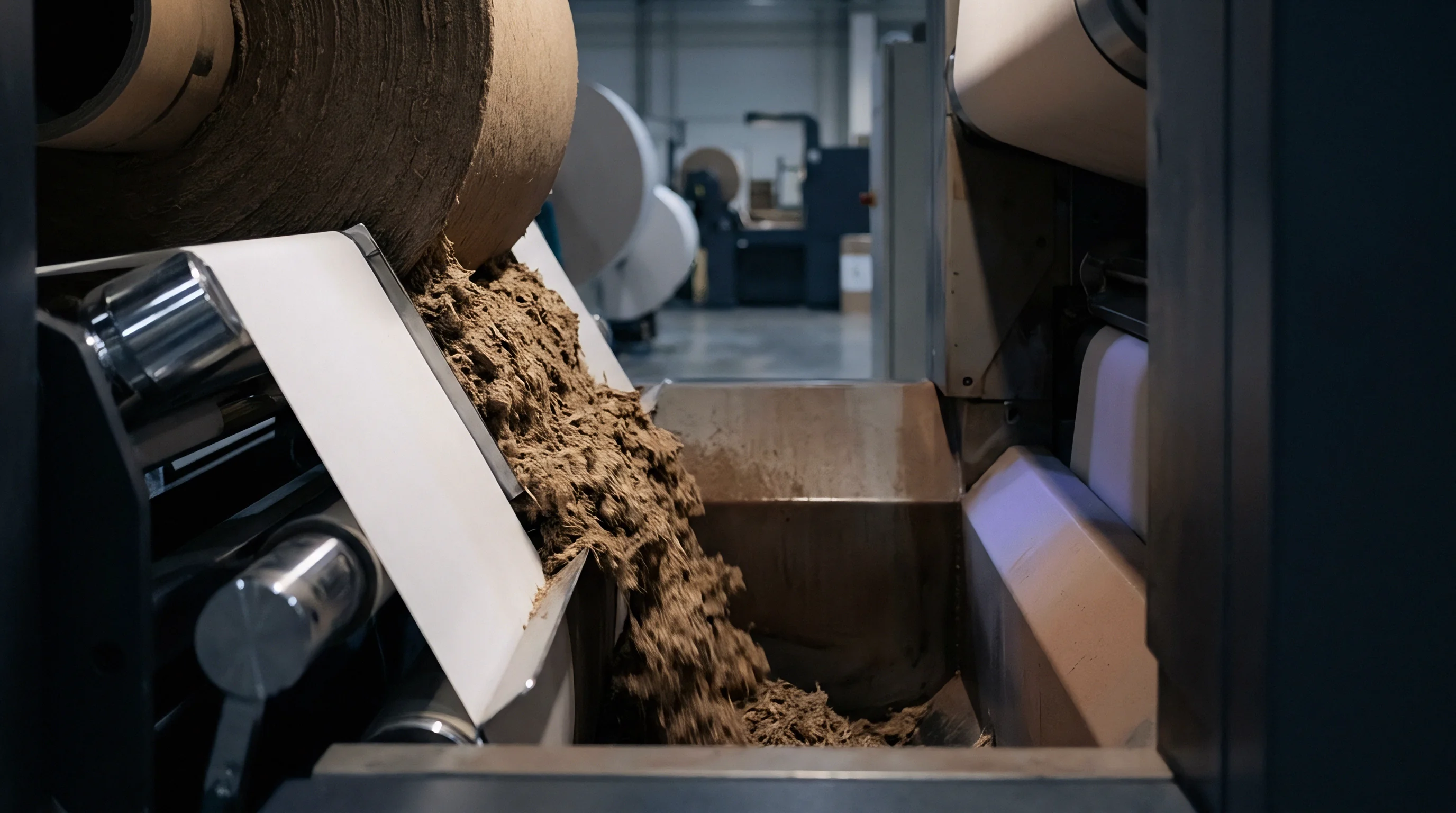
Multi-ply paperboard structures exploit engineered heterogeneity to maximize bending stiffness per unit basis weight. Outer layers typically consist of dense, fully bleached chemical softwood or hardwood kraft pulp, heavily refined to optimize tensile strength, surface smoothness, and print receptivity. The middle layer utilizes high-yield CTMP or BCTMP, characterized by bulky, stiff fibers that generate high spatial volume at low density.
This density gradient creates a substantial acoustic impedance mismatch at the interface between the top liner and the middle core.

Acoustic Impedance Gradients across Multi-Ply Profiles
Acoustic impedance equals the product of material density and ultrasonic propagation velocity. Long softwood kraft fibers in the top ply form a tight, well-bonded network with high longitudinal wave velocity and elevated density. The middle CTMP layer exhibits lower bulk density and a porous matrix containing un-collapsed fiber walls.
When an acoustic pulse travels vertically through the caliper, a portion of the wave energy reflects at the interface between the chemical liner and the mechanical core. The amplitude ratio of the reflected to transmitted wave defines the structural continuity of the inter-ply bond.
The table below details physical properties and baseline acoustic wave characteristics measured across individual structural plies of a standard 350 gram per square meter folding boxboard prior to dynamic creasing indentation.
| Layer Position | Pulp Composition | Density (kg/m³) | Elastic Modulus E33 (MPa) | Z-Direction Velocity (m/s) | Acoustic Impedance (MPa·s/m) |
|---|---|---|---|---|---|
| Top Liner | 100% Bleached Kraft Hardwood/Softwood | 860 | 1450 | 1300 | 1.118 |
| Top Interface | Starch Binder / Fiber Interlock Zone | 780 | 980 | 1120 | 0.874 |
| Middle Core | 100% High-Yield BCTMP (Spruce/Aspen) | 520 | 420 | 890 | 0.463 |
| Back Interface | Starch Binder / Fiber Interlock Zone | 760 | 950 | 1110 | 0.844 |
| Back Liner | 100% Bleached Kraft Softwood | 810 | 1320 | 1270 | 1.028 |

Failure Modes under Dynamic Strain
Tool clearance dictates deformation. Indentation forces generated by the creasing tool break specific structural elements inside the board layers depending on the local moisture content, caliper, and mechanical pulp ratio. Converting lines process these boards at high web speeds, making failure identification difficult through visual inspection alone.
- Inter-Ply Delamination occurs along the weak interfacial zone between the top kraft liner and the low-density BCTMP core when transverse shear stress exceeds starch adhesive bonding capacity.
- Core Micro-Cracking originates within the stiff, lignin-rich BCTMP layer where un-collapsed lumen structures fracture under compressive nip loading.
- Top Liner Tensile Splitting develops along the outer radius of the fold when creasing depth is insufficient to induce controlled middle-layer shear collapse.
- Back Liner Compression Rupture results from excessive rule penetration depth forcing the bottom ply into the female channel edges with excessive friction.
Mill technical datasheets frequently cite high bulk as proof of superior board stiffness while downplaying the corresponding drop in Z-direction shear strength. When converting operations report cracking along the score line, paper suppliers often attribute the defect to dry ambient humidity or improper creasing rule selection rather than inconsistencies in middle-ply BCTMP fiber bonding.


Indentation
Dynamic crease indentation represents an unstable mechanical event occurring over milliseconds. As the male creasing rule strikes the board against the female matrix die, the substrate undergoes complex transient loading. High strain rates alter the viscoelastic behavior of both the cellulosic fibers and residual lignin.
High-speed video combined with high-frequency acoustic transducers demonstrates that the internal displacement profile differs significantly from static lab tests.

Kinematics of High-Speed Score Formation
Dynamic scoring passes through distinct structural deformation phases. Initial contact applies pure Z-direction compression beneath the tip of the male rule. Fiber networks in the middle BCTMP layer compress, reducing void fraction and raising local acoustic wave velocity over the first fraction of penetration.
As the rule advances deeper into the female groove, transverse shear forces rapidly surpass compressive forces.
Moisture loss stiffens matrix. The middle CTMP layer begins to yield along pre-defined shear planes. This controlled internal rupture reduces the structural bending stiffness of the board along the crease line, allowing a clean ninety-degree fold without outer liner cracking.
If the acoustic velocity drop across the creasing zone is too small, internal delamination remains incomplete, forcing the outer liner to absorb excessive bending strain during cartoon erection.
- Position the board sample in the dynamic mechanical test frame with the top kraft liner facing the male creasing rule.
- Calibrate dual ultrasonic contact transducers above and below the crease axis operating at a center frequency of 1.0 megahertz.
- Execute a dynamic stroke at a velocity of 1.5 meters per second matching automated flatbed die-cutter speeds.
- Capture the transient acoustic attenuation curve across the 0.5-millisecond impact window.
- Record the permanent caliper reduction and residual Z-direction ultrasonic phase velocity immediately post-impact.
- Adjust female matrix groove width until acoustic attenuation indicates a 40 to 50 percent drop in core structural continuity without top-liner velocity collapse.
Correct crease depth produces controlled internal core shear while preserving outer liner tensile continuity.
The table below summarizes dynamic mechanical strain data and acoustic signal response across varying male rule penetration depths on a 400-micrometer BCTMP-based folding boxboard.
| Rule Depth (mm) | Groove Width (mm) | Penetration Ratio (%) | Peak Shear Strain (γ) | Velocity Shift ΔV (%) | Attenuation α (dB/mm) |
|---|---|---|---|---|---|
| 0.70 | 1.40 | 40 | 0.18 | -12 | +4.2 |
| 0.85 | 1.40 | 50 | 0.31 | -28 | +9.6 |
| 1.00 | 1.40 | 60 | 0.48 | -46 | +18.1 |
| 1.15 | 1.40 | 70 | 0.69 | -68 | +31.4 |
| 1.30 | 1.40 | 80 | 0.88 | -89 | +48.7 |
Softwood fibers resist compression. A score lines properly formed when core velocity drops predictably while maintaining high signal transmission through the surface plies. Operating outside these dynamic limits guarantees structural folding failures downstream.

Dispersion
Acoustic dispersion describes the phenomenon where the phase velocity of a wave propagating through a medium depends on its frequency. In heterogeneous structures like multi-ply BCTMP paperboard, dispersion arises from both material viscoelasticity and structural wave-guiding effects across the layered caliper. Micro-structural damage induced by dynamic crease indentation modifies the wave-guide boundaries, altering the dispersion curves measured across the deformed score line.

Can Ultrasonic Velocity Detect Microscopic Fiber Shear?
Ultrasonic phase velocity measurements isolate microscopic fiber shear long before visible surface cracks appear. At lower frequencies around 100 kilohertz, the acoustic wavelength exceeds the total board caliper, causing the wave to propagate as a flexural plate mode. The phase velocity of this mode relates directly to the global bending stiffness of the un-creased sheet.
High bulk reduces density. At higher frequencies above 1.0 megahertz, the acoustic wavelength shrinks to a size comparable to individual BCTMP fiber lumens and inter-ply interface thicknesses.
Delamination reduces bending stiffness. When dynamic indentation introduces micro-cracks into the BCTMP matrix, high-frequency sound waves encounter intense phase scattering. High-frequency phase velocity drops sharply, while attenuation increases proportionally to the square of the acoustic frequency.
Measuring the ratio of high-frequency attenuation to low-frequency phase velocity yields a sensitive damage parameter that quantifies internal core destruction independently of surface appearance.
Standard ISO 5628 bending resistance metrics fail to capture localized core delamination across dynamic creases, whereas high-frequency ultrasonic attenuation isolates internal shear zones with sub-millimeter precision.
Uncoated liner absorbs energy. Mathematical modeling of wave dispersion across damaged multi-ply networks uses phase velocity equations derived from orthotropic plate theory. The phase velocity of the fundamental symmetric mode depends on the effective out-of-plane elastic constants C33 and C55.
Dynamic creasing primarily degrades the shear modulus C55 within the middle BCTMP layer. A reduction in C55 shifts the high-frequency acoustic dispersion curve downward, providing clear physical proof of internal core shear relaxation.
It remains unclear whether online high-speed acoustic transducers can maintain sufficient signal-to-noise ratios on fast moving converting webs without direct contact coupling fluid altering board hydration dynamics.

Testing
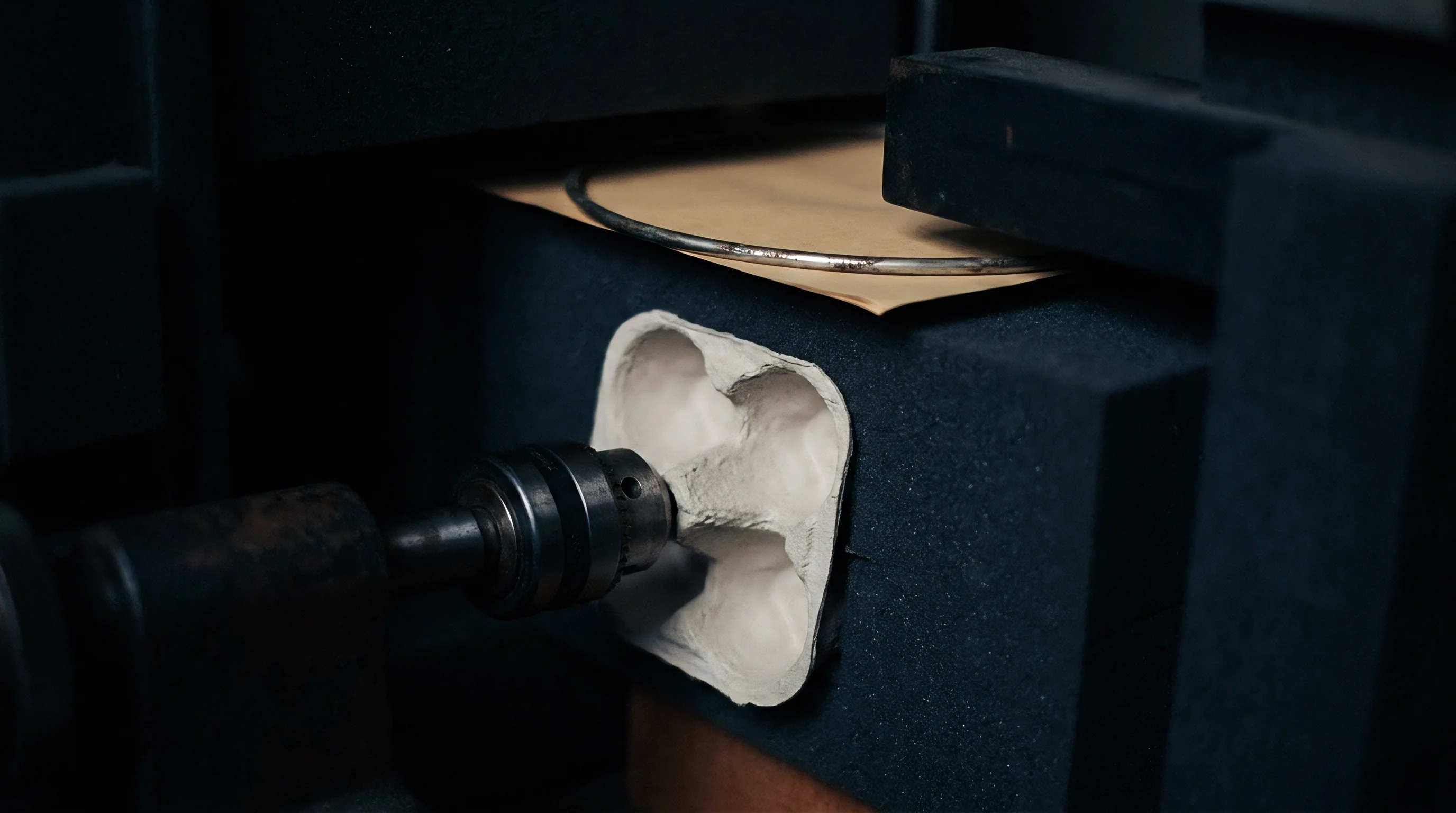
Implementing acoustic dispersion measurements on production lines requires specialized transducer arrays and robust Signal Processing hardware. Non-contact air-coupled ultrasonic transducers (ACUT) and laser ultrasonic systems allow inline monitoring of crease quality without disturbing the moving web. These systems evaluate the structural integrity of every score line in real time, alerting operators to tool wear or sheet caliper variations.
Inline Acoustic Transducers versus Laboratory Crease Testers
Traditional quality assurance relies on benchtop instruments such as L&W Crease Proof devices or Marbach hand-held score testers. These benchtop methods evaluate static moment-angle relationships after the board has relaxed. Inline acoustic dispersion testing captures the dynamic wave response immediately after indentation, detecting micro-structural defects before elastic recovery alters the crease geometry.
The table below compares key technical features and operating bounds of inline acoustic dispersion systems against traditional off-line laboratory score testing methods.
| Parameter | Inline Air-Coupled Ultrasonic System | Offline Laboratory Crease Tester |
|---|---|---|
| Measurement Principle | High-frequency acoustic phase dispersion | Static bending moment at 90-degree angle |
| Sampling Speed | Real-time continuous web (up to 400 m/min) | Manual destructive sample test (1 per stack) |
| Defect Detection Sensitivity | Detects sub-surface BCTMP core micro-voids | Detects total crease stiffness and surface cracks |
| Non-Destructive Status | Fully non-destructive online measurement | Destructive test performed on cut off-strips |
| Operating Frequency / Strain Rate | 100 kHz to 2.0 MHz acoustic pulses | 0.1 to 5.0 degrees per second deformation rate |
| Primary Failure Metric | High-frequency attenuation coefficient α | Crease recovery ratio (R-value) |

Quality Assurance Protocols for Converting Lines
Make-ready parameters shift rapidly. Production lines running BCTMP folding boxboard require structured verification checks during initial die make-ready and throughout long production runs.
- Transducer Alignment Calibration verifies that air-coupled acoustic sensor heads align precisely within 0.2 millimeters of the central crease axis.
- Baseline Waveform Profiling establishes un-creased sheet acoustic velocity and impedance metrics for every new board mill batch prior to die engagement.
- Dynamic Attenuation Mapping measures signal drop across the score line at full machine production speed during first-off sheet approval.
- Tool Wear Monitoring tracks subtle shifts in phase dispersion over thousands of impressions to detect micro-chipping on male creasing rules.
Under standard packaging supply agreements incorporating DIN 55437-1 guidelines for creasing quality, a shipment may be rejected if inline acoustic dispersion testing proves that more than 1.5 percent of scored cartons exhibit core delamination values falling below the specified minimum phase velocity limit.
Finance
Substituting virgin solid bleached board (SBB) with BCTMP-based folding boxboard yields substantial raw material cost savings due to the higher bulk and lower fiber consumption of high-yield pulps. A 350-micrometer BCTMP board achieves equivalent bending stiffness to an SBB grade while using up to 20 percent less fiber by weight. These raw material savings diminish quickly if poor crease setting causes unpredicted line stoppages, score splitting, or high spoilage rates on high-speed gluing lines.
Varnish layers crack first. When a crease fails during automated high-speed carton erection, the economic impact extends beyond the scrap value of the damaged board. Secondary passes such as plastic lamination, foil stamping, or overprint varnish add non-recoverable value to the sheet before die-cutting.
Splitting along the score line invalidates food-contact compliance declarations when barrier coatings fracture, allowing mineral oils or moisture to migrate into the packaged product. Extended Producer Responsibility (EPR) fee structures in multiple European jurisdictions penalize multi-layer packaging containing plastic laminates added solely to prevent score cracking on low-grade mechanical pulp cores.
Attenuated signals flag micro-cracks. Sourcing practices that specify high-yield CTMP board grades must factor crease performance tolerances directly into purchasing contracts. Investing in online acoustic dispersion monitoring reduces make-ready scrap while protecting the financial yield of complex multi-pass converting jobs.