Hygrothermal Curling Strain Mechanics in High Speed Polyethylene Surface Lamination
Polyethylene lamination curl stems from thermal quench contraction opposing substrate hygro-expansion, governed by chill roll cooling and moisture balance.
Swell
Cellulose fibers absorb or shed moisture until their internal chemical potential matches the ambient partial pressure of water vapor. In high speed extrusion coating or adhesive lamination, an impermeable barrier layer covers one side of a porous paperboard substrate. Liquid water and vapor can no longer enter or leave through that face.
Sorption kinetics instantly become asymmetric across the caliper. While the unlaminated reverse face reacts to relative humidity shifts within seconds, the interior fiber plies underneath the polyolefin film experience an altered boundary condition. An imbalance in dimensional expansion through the thickness develops immediately.
Paperboard exhibits anisotropic hygro-expansion because fibers align predominantly in the machine direction during web forming on the Fourdrinier wire. The cross direction expansion coefficient typically runs three to five times higher than that of the machine direction. The hygro-expansion coefficient in cross direction ranges between 0.00015 and 0.00028 strain per percentage point of moisture content change for bleached sulfate folding boxboard.
A moisture change of two percent across an unchecked converting hall expands the cross direction fibers by nearly 0.05 percent. The polymer layer does not swell with water.
The difference in strain across the bond line generates an internal bending moment. When the paperboard absorbs ambient humidity, the cellulose network expands against a dimensionally stable polyethylene film. This expansion forces the sheet to cup toward the polymer side.
When dry ambient air removes water from the fibrous substrate, the board contracts while the polyolefin retains its dimensions. The sheet then curls toward the exposed fibrous reverse face.
Ambient relative humidity shifts trigger immediate dimensional differential across an asymmetric moisture barrier.
Extruded polyethylene films present a moisture vapor transmission rate below 15 grams per square meter per day under tropical conditions of 38 degrees Celsius and 90 percent relative humidity for a standard 18-gram-per-square-meter coating. The raw board side breathes freely. The moisture gradient across the caliper ceases to be linear during humidity transitions.
Mathematical representations of the resulting strain profile require transient diffusion equations coupled with multi-layer elastic plate mechanics.

Fiber Orientation Anisotropy in Base Substrates
Headbox delivery speeds and jet-to-wire velocity ratios dictate the mechanical stiffness ratio between machine direction and cross direction. Commercial solid bleached sulfate boards exhibit elastic modulus ratios between 2.0 and 3.2. Recycled cartonboards with high mechanical pulp fractions reach elastic modulus ratios exceeding 3.8.
Fiber alignment restricts hygro-expansion along the axial grain while magnifying transverse dimensional movements.
The mechanical anisotropy determines curl directionality. Laminated sheets subject to moisture sorption curl primarily across an axis parallel to the machine direction. The curl axis aligns with the direction of maximum bending resistance.
Because the cross direction offers less flexural rigidity and greater hygro-expansion, the primary curvature forms a trough or cylinder along the web run. Diagonal curling surfaces when the principal fiber orientation deviates from the manufacturing axis by more than four degrees.
Base board moisture content upon entering the lamination nip influences the baseline equilibrium state. Mill specifications typically target a moisture content between 6.5 and 8.0 percent by weight for standard folding boxboard. Rapid chilling of the molten polyolefin locks the fibrous surface into its instantaneous dimensions.
Laminating an over-dried board at 4.5 percent moisture guarantees positive curl once the finished material acclimates to a convertor floor operating at 55 percent relative humidity.
| Substrate Grade | Caliper (Microns) | MD Elastic Modulus (GPa) | CD Elastic Modulus (GPa) | CD Hygro-Expansion (Strain/% MC) |
|---|---|---|---|---|
| Solid Bleached Sulfate (SBS) | 350 | 6.8 | 2.9 | 0.00019 |
| Folding Boxboard (FBB) | 420 | 7.4 | 2.4 | 0.00024 |
| Coated Recycled Board (CRB) | 400 | 5.2 | 1.7 | 0.00028 |
| Unbleached Kraft Liner (UKL) | 280 | 8.1 | 3.1 | 0.00016 |
Surface sizing formulations on the base board dictate the initial wetting and thermodynamic adhesion of extruded polymers. Modified starches and synthetic surface sizes reduce the penetration of molten polyethylene into the surface macropores. Mechanical interlocking decreases while the boundary layer shear stiffness rises.
A stiff boundary layer transfers all lateral hygrothermal strain directly to the polymer-fiber interface without mechanical relaxation.

Equilibrium
Balancing thermal shrinkage against moisture expansion forms the central thermodynamic challenge in polyethylene extrusion coating. Molten low-density polyethylene exits the extrusion die at temperatures between 295 and 320 degrees Celsius. The molten web undergoes rapid quenching against a water-cooled chill roll within ten to twenty milliseconds.
This thermal drop from melt to roll temperature causes severe volumetric contraction in the polymer layer.
The linear thermal expansion coefficient of low-density polyethylene is approximately 0.00020 per degree Celsius. Cooling from an effective crystallization temperature near 105 degrees Celsius down to an ambient plant temperature of 23 degrees Celsius induces a thermal shrinkage strain of roughly 1.6 percent in an unconstrained film. The rigid paperboard substrate restrains this contraction.
The resulting interface locks in high residual tensile stress inside the polyethylene skin.
Cellulose fibers respond simultaneously to the heat imparted by the extruded curtain. Surface moisture in the paperboard vaporizes at the nip entrance. This desorbed moisture creates a dry, contracted top fiber boundary layer precisely at the instant of bonding.
As the composite cools, the paperboard attempts to reabsorb ambient moisture from the factory atmosphere. Subsequent moisture uptake causes substrate expansion that counteracts the initial thermal contraction of the polymer layer.
A thermal contraction of 1.6 percent inside the polyolefin skin opposes the hygro-expansion of the fibrous base under ISO 187 conditioning.
Internal stress distribution depends on the relative thickness and stiffness of the constituent plies. In a two-ply laminate of paperboard and polyethylene, total residual strain is calculated by summing thermal, hygroscopic, and mechanical components:
Total strain in polymer = Thermal strain + Mechanical draw strain – Viscoelastic relaxation
Total strain in paperboard = Hygro-expansion strain + Mechanical web strain
Thermal contraction dominates at high cooling rates. High chill rates suppress secondary crystallization in the polyolefin, yielding lower final film density and reduced ultimate thermal shrinkage. Low cooling rates permit greater chain folding, raising polymer density toward 0.930 grams per cubic centimeter and increasing contractile stresses.
Coupled Hygrothermal Strain Equations
Laminate curvature follows classical bilayer thermostat mechanics modified for moisture-sensitive hygroscopic media. The composite acts as an elastic plate subjected to an internal bending moment generated by differential free strains. When the net free strain of the paper layer exceeds the net free strain of the polyolefin layer, the structure curves toward the polyolefin.
The inverse strain condition curves the structure toward the paperboard face.
The mathematical radius of curvature depends on the elastic moduli ratio and the thickness ratio of the two materials. The governing relationship derives from structural plate analysis:
Curvature = 6 (Strain Difference) (1 + m)^2 / (h (3 (1 + m)^2 + (1 + m n) (m^2 + 1 / (m n))))
Here m denotes the ratio of layer thicknesses, n represents the ratio of elastic moduli, and h indicates the total composite caliper. This equation holds strictly for linear elastic materials under small deflections. Deviations emerge because polyethylene undergoes pronounced viscoelastic stress relaxation over hours and days post-conversion.
Moisture sorption isotherms for cellulose follow a sigmoidal hysteresis loop between adsorption and desorption cycles. Board seasoned at 50 percent relative humidity reaches a lower equilibrium moisture content during adsorption than when desorbing from high humidity. A laminated sheet exposed to fluctuating warehouse humidity traces a non-linear path of hygrothermal strain.
The residual internal stress oscillates, leading to delayed packaging distortions.
Extrusion processors sometimes adjust line variables hoping that room storage will resolve sheet distortion. Whether ambient humidity conditioning can permanently neutralize frozen-in thermal crystallization strains remains contested across mill technical departments.
Drum
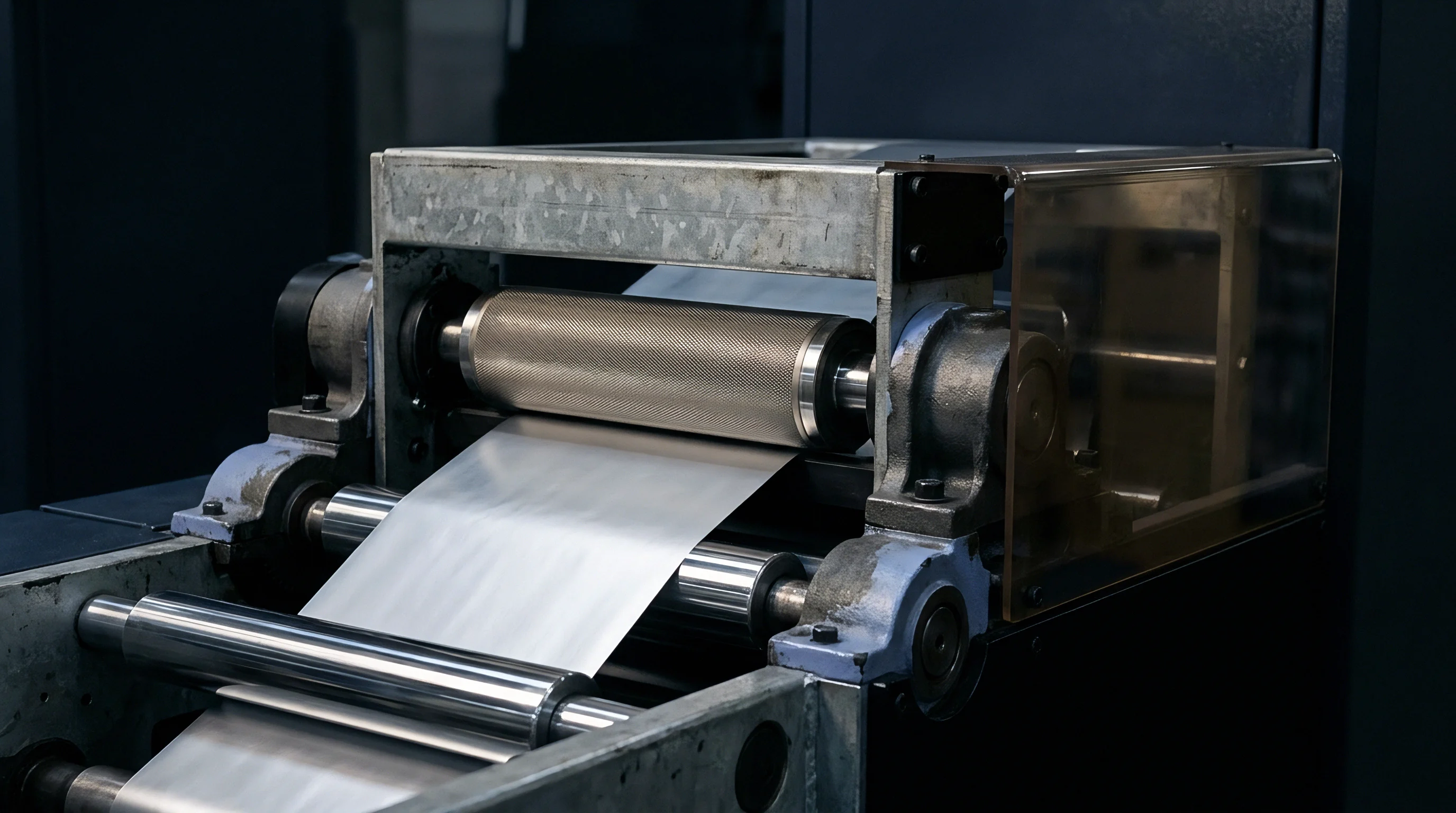
Surface geometry and thermal transfer efficiency of the chilling cylinder govern the rate of polyolefin phase change. The chill roll consists of a double-shelled steel cylinder with spiral internal baffling. Water velocities within the baffling exceed 1.5 meters per second to preserve a uniform surface temperature across the machine width.
A surface temperature variation of three degrees Celsius across the roll face creates measurable curl variations between outer and center sheet positions.
High line speeds between 300 and 500 meters per minute reduce web dwell time in the laminating nip to less than fifteen milliseconds. The rubber-covered pressure roll forces the paperboard and molten polymer curtain against the polished chill roll under linear nip loads between 30 and 60 kilonewtons per meter. This high pressure forces molten polyethylene into the surface topography of the board.
The mechanical interlocking forms instantly before the polymer crystallizes.
Melt draw ratio also determines longitudinal strain. The molten polymer emerges from a die gap of roughly 0.7 to 1.0 millimeters and stretches down to a coating thickness between 12 and 30 microns. This severe extensional flow aligns polymer backbones along the machine direction.
The molecular alignment increases thermal contraction along the web axis while reducing transverse shrinkage. Extensional draw strains combine directly with web transport tension.
Web transport tension differential across the nip sets the mechanical pre-strain before thermal crystallization begins.
Substrate moisture flash-off during lamination alters web behavior. The 300-degree polymer melt heats the board surface instantaneously, converting free moisture into micro-steam. If the nip pressure holds the web tightly against the chill roll, steam cannot escape toward the front face.
It drives inward into the fiber network, creating a steep internal moisture gradient across the board thickness. The reverse board plies dry more slowly than the lamination interface.
Operational Parameters and Machine Variables
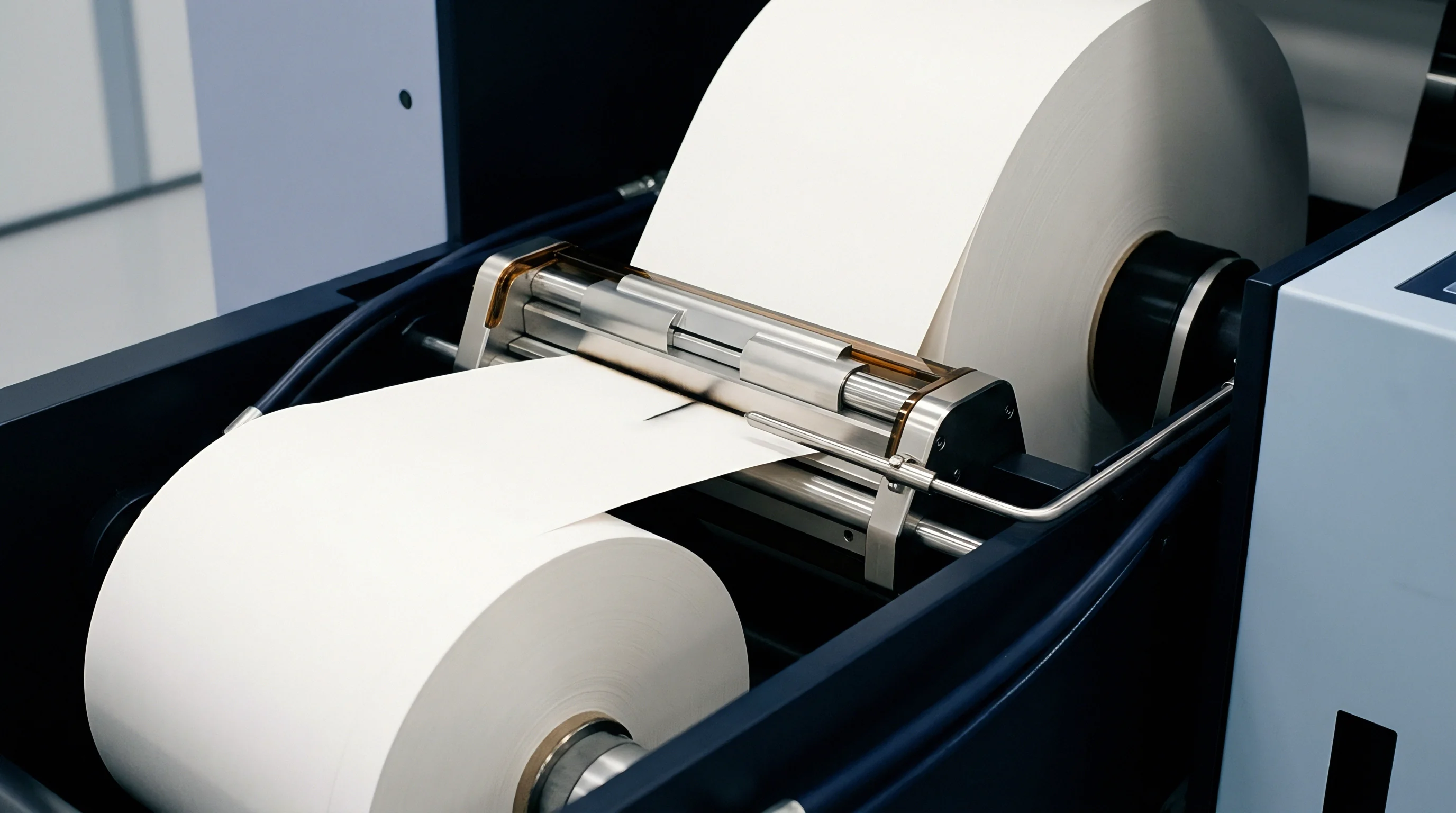
Web handling tension control on both substrate unwind and polymer draw rolls sets the initial baseline mechanical strain. An excessive brake torque on the paperboard unwind creates high elastic elongation in the fiber substrate. When the composite exits the chilling nip and the web is slit, the paperboard contracts elastically against the hot, newly formed polyethylene skin.
This elastic recovery drives severe curl toward the paperboard side.
The following line parameters control mechanical stress formation during extrusion coating:
- Melt Temperature Control sets the polymer viscosity and oxidation level, where higher extrusion heat improves wetting but intensifies ultimate cooling contraction.
- Chill Roll Surface Finish governs air gap formation between polymer and steel, directly altering local cooling rates and spherulitic crystallization.
- Nip Pressure Adjustment regulates fiber penetration depth, balancing boundary mechanical interlocking against base board caliper crushing.
- Unwind Brake Modulation maintains steady substrate strain, preventing elastic snap-back upon tension release after the rotary slitter.
Treating the paperboard with corona discharge prior to the nip alters surface polarity and contact mechanics. Corona output levels between 1.5 and 3.0 kilowatts per square meter per minute increase surface energy above 54 dynes per centimeter. This oxidation ensures chemical bonding between cellulose hydroxyl groups and oxidized polyolefin chains.
Perfect interfacial bonding prevents shear slippage at the laminate interface, transferring all hygrothermal contraction into bending moments.
| Process Variable | Low Limit | Standard Target | High Limit | Primary Defect Below Target | Primary Defect Above Target |
|---|---|---|---|---|---|
| Melt Temperature (°C) | 285 | 305 | 325 | Delamination and Low Adhesion | Severe Thermal Shrinkage Curl |
| Chill Roll Temperature (°C) | 12 | 18 | 24 | Surface Condensation Blistering | Polymer Sticking to Roll Surface |
| Nip Linear Force (kN/m) | 25 | 40 | 55 | Pinholing and Voids | Board Caliper Loss and Crushing |
| Web Speed (m/min) | 200 | 350 | 500 | Low Production Economics | Incomplete Crystallization in Nip |
Machine alignment errors across the chill cylinder track directly into asymmetrical stress states. If the rubber nip roll exhibits a durometer hardness variance across its length, pressure distribution skews. The resulting asymmetric quench rate locks in uneven residual tensile stresses.
The web exits the chill station with an inherent twist defect. Converters frequently attribute this diagonal distortion to raw board fiber instability rather than laminator roll deflection.
Curvature
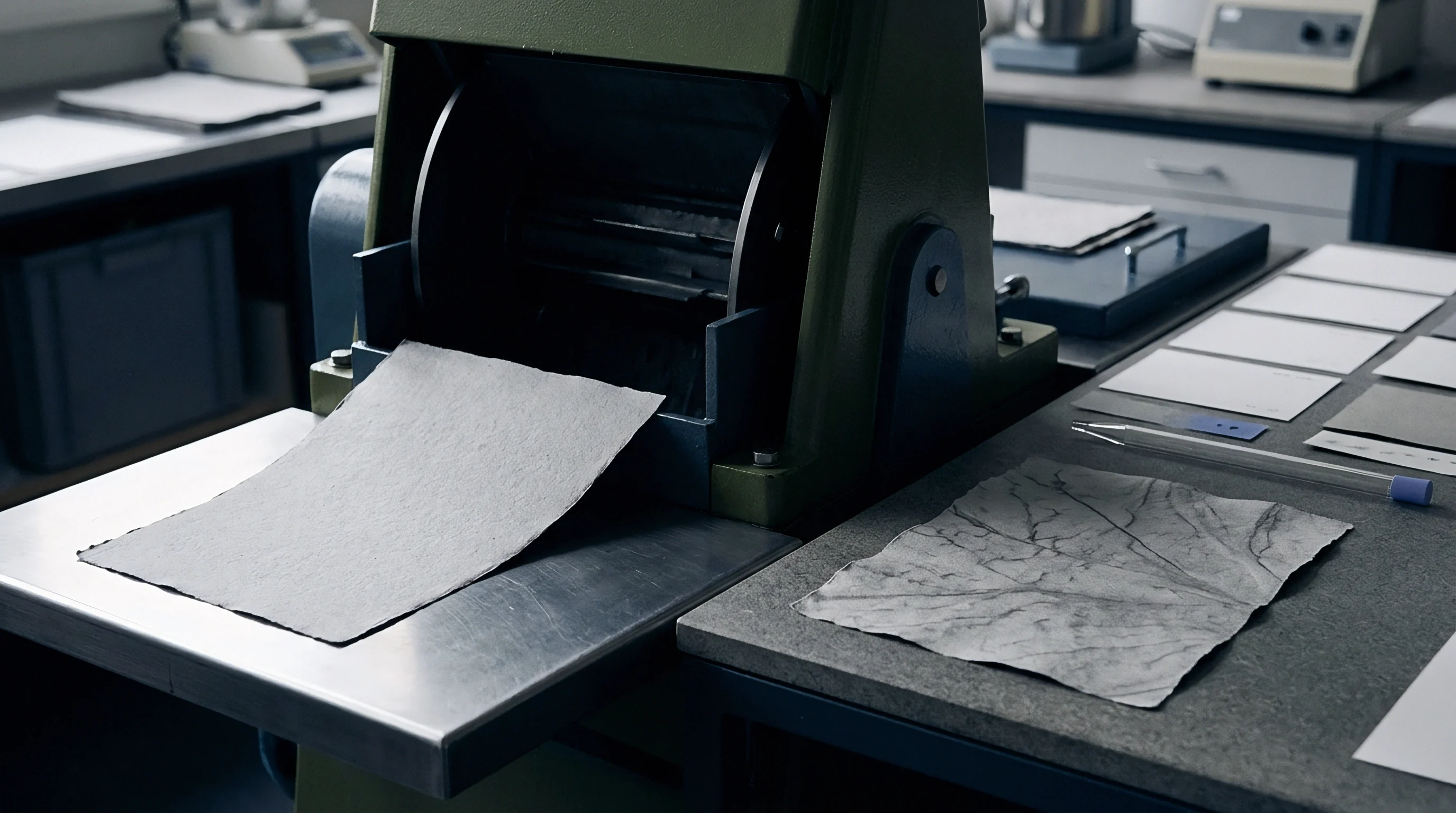
Evaluating sheet flatness requires isolating mechanical curl from environmental hygrothermal distortion. Industrial quality inspection measures the out-of-plane deflection of specimen blanks conditioned under controlled atmospheres. Testing according to ISO 11556 dictates conditioning specimens at 23 degrees Celsius and 50 percent relative humidity before reading deviation from a flat reference plate.
The height of the lifted corners yields the radius of curvature.
A second standard method employs rotary optical scanning or dial gauge profilometers to measure the curvature value, expressed as the reciprocal of the bend radius in meters. A completely flat sheet records a curvature value of 0.00 reciprocal meters. Curvature exceeding 1.50 reciprocal meters causes catastrophic feeding failures in modern automated packaging lines.
Tolerances on high speed carton gluers are tight. A lift of 3 millimeters across a 200-millimeter blank halts blank extraction.
The time dependency of curl complicates verification audits. Extruded polyethylene relaxes internal stress over extended periods following web winding. Immediately after the slitter, the composite may exhibit slight paper-side curl due to web tension elastic recovery.
Over the next forty-eight hours, secondary crystallization within the polyethylene matrix contracts the film layer. The sheet shifts gradually toward severe polyolefin-side curl.
A measured curvature of 1.25 reciprocal meters under ISO 187 conditioning shifts by more than forty percent when warehouse humidity drops to twenty-five percent.
A worked engineering calculation demonstrates how these mechanisms interact across a production run. Assume a standard packaging construction: 300-micron solid bleached sulfate base board laminated with 25 microns of low-density polyethylene. The board exhibits an elastic modulus of 6.0 GPa in the machine direction and a cross-direction modulus of 2.5 GPa.
The polyethylene layer possesses an elastic modulus of 0.25 GPa at room temperature. The moisture expansion coefficient of the board in cross direction equals 0.00022 strain per percent moisture content.
Assume the base board enters the extrusion nip at 7.0 percent moisture content. It loses 1.0 percent moisture during hot melt contact, then re-equilibrates back to 7.0 percent moisture after warehouse storage. The net hygro-expansion strain during storage equals zero.
The thermal contraction of the polyolefin from crystallization temperature down to ambient induces an unconstrained tensile strain of 0.014 in the film. Using the bilayer plate equation with a thickness ratio m of 0.0833 and a modulus ratio n of 0.10 in the cross direction, the calculated internal bending moment yields a theoretical cross-direction curvature of 1.38 reciprocal meters.
This calculated value represents an unrelaxed structural limit. Real converting runs demonstrate that approximately thirty to forty percent of this frozen strain dissipates through room-temperature viscoelastic creep in the amorphous zones of the low-density polyethylene within seventy-two hours. The actual stable curvature settles between 0.85 and 0.95 reciprocal meters.
That value borders the maximum operational tolerance of high speed folding lines.
The desk cannot fully defend an exact universal creep relaxation constant for low-density polyethylene coatings across diverse resin suppliers. Resins with identical melt flow indices exhibit varying degrees of short-chain branching and polydispersity that alter long-term stress decay. When faced with this raw material variance, a packaging buyer must audit the resin supplier density specifications to three decimal places rather than relying on melt index alone.
A simple operational procedure identifies whether delivered curl stems from moisture imbalance or thermal extrusion draw:
- Specimen Extraction cuts ten square blanks measuring 200 by 200 millimeters from center and edge lanes across the web width.
- Initial Profilometry measures the vertical height of all four corners relative to a granite surface plate under prevailing ambient conditions.
- Controlled Desiccation places five specimens in an oven chamber held at 50 degrees Celsius and ten percent relative humidity for two hours.
- Equilibrium Rehydration subjects the remaining five specimens to a tropical chamber operating at 38 degrees Celsius and 85 percent relative humidity for four hours.
- Curvature Comparison checks the direction of dimensional migration, where thermal strain curl remains stable during drying while moisture-driven curl reverses completely.
Converting specifications typically incorporate strict curl thresholds tied to specific standards. A purchasing contract line specifying compliance with ISO 11556 at a maximum deflection of 2.5 millimeters across a 200-millimeter chord shifts all liability for carton feeder jams onto the lamination converter.
Spoilage
Feeding warped blanks through automated packaging lines creates direct commercial loss. High speed folding-gluing machinery relies on timed suction cups and reciprocating mechanical pushers to draw flat blanks from the bottom of an infeed hopper. When blanks carry a curvature greater than 1.5 reciprocal meters, the vacuum cups pull air around the warped periphery.
Blank extraction fails, triggering emergency machine shutdowns at operating speeds above 40,000 cartons per hour.
Downstream carton erecting on horizontal cartoning lines suffers identical operational friction. A curved carton blank binds inside the magazine feed rails. If the blank extracts successfully, asymmetric stiffness forces the carton sleeve to erect out of square.
Gluing flaps fail to register against reciprocal adhesive zones, causing open seams, liquid container leakers, or misaligned tuck flaps. Running waste on the packaging floor multiplies rapidly during cold winter months when low warehouse humidity exacerbates moisture contraction.
Converters deploy mechanical decurler devices directly on the extrusion lamination web line to counteract thermal contraction. A decurler drives the laminated web across a small-diameter rotating shaft or tungsten-carbide breaker blade under high wrap angles. This severe reverse bend induces plastic deformation in the fiber substrate while yielding the polymer layer under compression.
Decurler blades effectively reduce immediate curvature, but they degrade the internal Scott bond strength of the board by fifteen to twenty-five percent.
Steam showers positioned immediately prior to web rewinding offer an alternative mitigation route. Directing pressurized dry steam onto the unlaminated reverse board face restores lost moisture and relieves surface tensile stresses. A steam addition of 1.0 to 1.5 percent by weight expands the reverse fibers, establishing a counter-balancing hygrothermal moment.
Operating a modern multi-zone steam shower adds roughly 4.50 dollars per metric ton in direct energy costs and requires automated closed-loop infrared moisture scanners.
Symmetrical extrusion coating represents the absolute mechanical solution to single-sided hygrothermal curling. Applying an identical weight of polyethylene to both board faces balances thermal shrinkage moments across the composite neutral axis. A two-side laminated structure retains near-perfect planarity across wide humidity variations.
This structural stability carries a substantial commercial premium.
Applying an extra extrusion pass of 18 grams per square meter of low-density polyethylene adds resin cost, machine time, and transport freight. The extra polymer skin also shifts the board recyclability classification under modern packaging taxation systems. In jurisdictions operating under the European Packaging and Packaging Waste Regulation, adding a second polyolefin barrier layer can downgrade the fiber yield during repulping below the 85 percent threshold.
The carton then attracts higher modulated extended producer responsibility fees.
| Strategy | Capital Equipment Cost (USD) | Variable Cost per Ton (USD) | Flatness Retention Range (% RH) | Recyclability Impact |
|---|---|---|---|---|
| Mechanical Decurler Bar | 15,000 – 35,000 | 0.00 | 40 – 60 | No Impact on Chemistry |
| Controlled Steam Shower Rehydration | 85,000 – 160,000 | 4.50 – 7.20 | 30 – 70 | Preserves Single-Side Pulpability |
| Symmetrical Two-Side Extrusion | 600,000 – 1,200,000 | 85.00 – 140.00 | 15 – 85 | Downgrades Recyclability Grading |
| Off-Line Conditioning Chamber | 40,000 – 90,000 | 12.00 – 18.00 | 45 – 55 | No Impact on Chemistry |
Failure to balance hygrothermal curling mechanics results in entire production truckloads being rejected at the filler plant dock when distorted blanks consistently choke the magazine feed tracks.