Predicting High Speed Mechanical Erecting Dynamics from Air Coupled Ultrasonic Web Dispersion Profiles
Air-coupled ultrasonic web dispersion mapping predicts dynamic erecting forces, allowing inline scoring adjustments that prevent box jams at high speed.

Acoustics
Lamb Wave Propagation in Moving Webs
Non-contact ultrasonic transducers operate across air gaps between 10 and 30 millimeters to project flexural energy into running paper sheets. Airborne acoustic excitation couples poor vibrational energy into dense fiber structures due to the impedance mismatch between air at roughly 415 Rayls and paperboard exceeding two million Rayls. High-efficiency piezoceramic elements with porous matching layers overcome this boundary loss, sending focused ultrasonic pulses at frequencies between 20 kilohertz and 500 kilohertz into the web.
Air gaps cause energy loss. The acoustic excitation generates guided plate waves, known as Lamb waves, that travel along the sheet continuum.
As these guided waves travel through the moving material, the energy splits into two distinct fundamental modes. The fundamental symmetric mode (S0) represents extensional wave propagation along the mid-plane, governed primarily by the in-plane elastic modulus (E11 or E22) and Poisson’s ratio. The fundamental antisymmetric mode (A0) manifests as a flexural out-of-plane motion.
Fiber alignment governs stiffness. In thin paperboard structures where acoustic wavelengths exceed total caliper, the phase velocity (cA0) of the flexural mode depends directly on the frequency-thickness product and the out-of-plane flexural rigidity (D). Snell’s law governs the angle of acoustic reception (sin thη = cair / cA0), dictating the spatial pitch of transmitter and receiver transducer pairs mounted across the web width.
Air-coupled fundamental antisymmetric phase velocities in 350 gsm folding boxboard average 1,420 meters per second in the machine direction at a test frequency of 80 kilohertz.
Phase Velocity Separation across Frequency Ranges
Signal processing algorithms separate fundamental symmetric modes from transverse structural wave components in digitized sound records. At low frequency-thickness products below 0.2 megahertz-millimeters, the antisymmetric mode exhibits strong frequency dispersion. Transverse wave speed increases with the square root of angular frequency according to the relation cA0 = (D / barρ)1/4 sqrtω, where barρ represents basis weight in kilograms per square meter and ω represents angular frequency.
Sheet caliper changes wave speed. Measuring phase velocity across discrete acoustic frequencies yields the orthotropic flexural rigidities of the paperboard without mechanical contact or destructive sampling.
Continuous spatial scanning across a converting rewinder reveals localized stiffness variations caused by fiber orientation drift, wet-end press nip non-uniformity, or moisture gradients across the paper machine wire. High tension distorts signal phase. By capturing phase shift across an array of receivers spaced along both machine direction (MD) and cross-direction (CD) axes, the acoustic profile maps localized mechanical anisotropy ratios (E11/E22) along thousands of meters of web.
These acoustic dispersion profiles record internal fiber structure variations before the board is sheeted, die-cut, and fed into erecting machinery.
| Board Grade | Caliper (mm) | Basis Weight (gsm) | A0 Velocity MD (m/s) | A0 Velocity CD (m/s) | Anisotropy Ratio (MD/CD) |
|---|---|---|---|---|---|
| Solid Bleached Sulfate (SBS) | 0.45 | 340 | 1,580 | 1,020 | 2.40 |
| Folding Boxboard (FBB) | 0.48 | 320 | 1,420 | 890 | 2.54 |
| Coated Recycled Board (CRB) | 0.50 | 380 | 1,250 | 860 | 2.11 |
| Unbleached Kraftboard | 0.52 | 360 | 1,690 | 980 | 2.97 |
| Data acquired using air-coupled ultrasonic pitch-catch transducers at 80 kHz under standard atmospheric conditions of 23 degrees Celsius and 50 percent relative humidity. | |||||
Whether micro-delamination within internal fiber layers during high-tension rewinding alters low-frequency phase velocity profiles before converting lines receive the rolls remains unquantified.

Flexure

Stiffness Derivation from Acoustic Transients
Calculating directional mechanical rigidity relies on fourth-power relationships between non-contact pulse transmission speeds and sheet elastic moduli. The flexural stiffness (Sb) measured via static two-point bending methods according to ISO 5628 correlates directly with the fourth power of the antisymmetric phase velocity. The relationship is governed by the expression Sb = D = barρ · cA04 / ω2.
Small shifts in measured phase velocity produce pronounced variations in calculated bending resistance. Bending resistance dictates fold timing. A five percent drop in acoustic phase velocity along the cross-direction corresponds to an eighteen percent reduction in sheet flexural rigidity.
Paperboard exhibits orthotropic symmetry, requiring four independent elastic constants (D11, D22, D12, D66) to describe out-of-plane plate bending. Non-contact ultrasonic web dispersion profiling calculates D11 from machine-direction phase velocity and D22 from cross-direction phase velocity. Out-of-plane shear moduli (G13 and G23) are extracted from the high-frequency dispersion slope where phase velocity approaches a horizontal asymptote dominated by transverse shear deformation.
Internal shear stiffness governs how middle fiber plies deform when paperboard is scored and folded.
Crease Deformation and Score Resistance
Mechanical indenter rules pressed into paperboard fracture internal fiber bonds, creating localized impedance steps that attenuate guided sound waves. Scoring reduces local flexural stiffness along the crease line to permit controlled folding at precise geometric locations. The residual bending moment (M(thη)) required to fold a scored blank through ninety degrees depends on the initial uncreased bending stiffness (Sb) and the shear delamination induced within the central plies of multi-ply folding boxboard or coated recycled board grades.
When cross-direction stiffness varies unpredictably across a paperboard roll, uniform die-cutting scoring rule depth produces inconsistent crease compliance. Low-stiffness web zones suffer excessive fiber fracture under standard scoring rules, leading to score line cracking during folding. High-stiffness web zones resist female matrix penetration, leaving the crease stiff and increasing score spring-back torque.
Non-contact dispersion profiling identifies these stiffness boundaries prior to sheeting, defining the precise scoring depth adjustments required for counterplate die tooling.
- Transverse Phase Splitting occurs when internal ply delamination breaks acoustic wave continuity, causing multiple arrival peaks at the receiving transducer and signaling weak z-direction bond strength.
- Asymmetric Attenuation Drift indicates localized moisture accumulation along web edges, causing high-frequency acoustic damping without altering dry basis weight metrics.
- Shear Damping Spikes reveal areas of poor starch dispersion or raw material inconsistencies within recycled middle plies, lowering out-of-plane shear modulus (G23).
- Dispersion Mode Coupling appears when web caliper fluctuations cause fundamental symmetric and antisymmetric acoustic modes to overlap in time-of-flight domain analysis.
ISO 5628 specifies static two-point bending stiffness tolerances at fifteen degrees, yet web dispersion profiles predict dynamic creasing behaviour under millisecond erecting rates where static standards fail.
Board mills frequently assert that off-line Taber stiffness readings meeting mill specification sheets guarantee folding carton runnability, disregarding high-strain rate velocity variations identified across the web width.

Dynamics
Mechanical Erecting Force Profiles
Pusher plungers entering box-forming dies subject flat paperboard blanks to localized acceleration spikes exceeding fifteen gravitational units within forty milliseconds. Mechanical carton erecting machinery feeds die-cut blanks into forming cavities at speeds ranging from 300 to 700 cartons per minute. At these production rates, a complete erecting cycle consumes less than 100 milliseconds.
The folding sequence occurs within a transient duration of 20 to 35 milliseconds, subjecting score lines to deformation strain rates exceeding 1,500 radians per second.
During plunger insertion, the flat blank encounters entry guides that apply compressive forces against side panels to initiate folding along creased scores. The total mechanical erecting force (Ferect) combines panel flexural resistance and crease folding resistance: Ferect = k1 Sb + k2 Mcrease + m · a. If the machine-direction flexural stiffness (Sb) drops below design thresholds, the erecting plunger deforms the uncreased main carton panels before the score line initiates its fold.
Panel structural integrity collapses under transient impact loading.

Can Ultrasonic Profiling Prevent Erecting Line Jams?
Automated feeds from web scanning systems alter feeder timing and stroke depth before low-rigidity board reaches the forming tool. Real-time predictions of erecting force profiles stem directly from inline ultrasonic dispersion measurements. By integrating MD and CD acoustic phase velocity data, control systems calculate the instantaneous ratio of panel stiffness to crease resistance.
When this ratio drops below a critical limit, erecting plungers generate excessive panel bowing.
Assume an automated erecting line operates at 450 solid bleached board cartons per minute, yielding a cycle duration of 133 milliseconds per carton with a 35-millisecond plunger dwell stroke. Blanks measure 300 by 200 millimeters, manufactured from 0.45-millimeter (18 pt) SBS board with a basis weight of 340 gsm. Under nominal conditions, machine-direction flexural stiffness equals 16.5 millinewton-meters, and cross-direction crease resistance moment equals 7.2 millinewton-millimeters.
Plunger force peaks at 24.5 Newtons, producing a controlled panel deflection of 0.8 millimeters, well within the 1.5-millimeter clearance limit of the forming die cavity.
If web dispersion profiles show a localized drop in machine-direction phase velocity from 1,580 to 1,310 meters per second, calculated MD flexural stiffness drops to 11.2 millinewton-meters while crease moment remains constant at 7.2 millinewton-millimeters. Speed spikes multiply jam risk. The reduced panel resistance causes out-of-plane panel deflection to expand to 3.2 millimeters during plunger entry.
Die clearance governs panel margin. The deflected panel catches against the die entry shoe, stopping the machine and causing an operational jam.
| Anisotropy Ratio (MD/CD) | MD Bending Stiffness (mN m) | Score Resistance Moment (N mm) | Panel Deflection (mm) | Die Clearance Margin (mm) | Calculated Jam Rate (per 10k) |
|---|---|---|---|---|---|
| 2.55 | 17.2 | 6.8 | 0.6 | +0.9 | 0.1 |
| 2.40 | 16.5 | 7.2 | 0.8 | +0.7 | 0.4 |
| 2.10 | 14.1 | 7.8 | 1.4 | +0.1 | 3.8 |
| 1.85 | 12.2 | 8.1 | 2.3 | -0.8 | 42.0 |
| 1.60 | 10.5 | 8.6 | 3.6 | -2.1 | 280.0 |
Panel Bulge and Corner Locking Failure
Transient displacement of carton side walls reduces mechanical catch tab clearance, forcing automated pack ejection on machinery operating above five hundred cartons per minute. Corner lock erect systems rely on precise mechanical tab alignment, where die-cut male locks snap into female slots under lateral compression. Excessive panel bulging shifts male tab positions by fractions of a millimeter relative to female receiver slots.
If the tab fails to penetrate the slot within the 15-millisecond mechanical dwell window, the erected carton springs back open upon die exit.
Score depth dictates folding torque. Non-contact web dispersion metrics capture subtle out-of-plane shear variations that govern score spring-back behaviour. Higher out-of-plane shear stiffness (G23) increases elastic strain energy storage within folded score joints, resulting in larger spring-back angles after die exit.
When spring-back force exceeds corner lock resistance, erected cartons experience structural failure on downstream conveyor transfers, spilling product and polluting high-speed packaging lines.
When cross-direction flexural stiffness drops below critical web thresholds, mechanical erecting dies crush score lines rather than folding them.
Ignoring web dispersion gradients leads to catastrophic jam cascades on high-speed erecting lines, accumulating scrap board costs and forcing unbudgeted shift downtime.
Bench

Transducer Calibration and Sensor Geometry
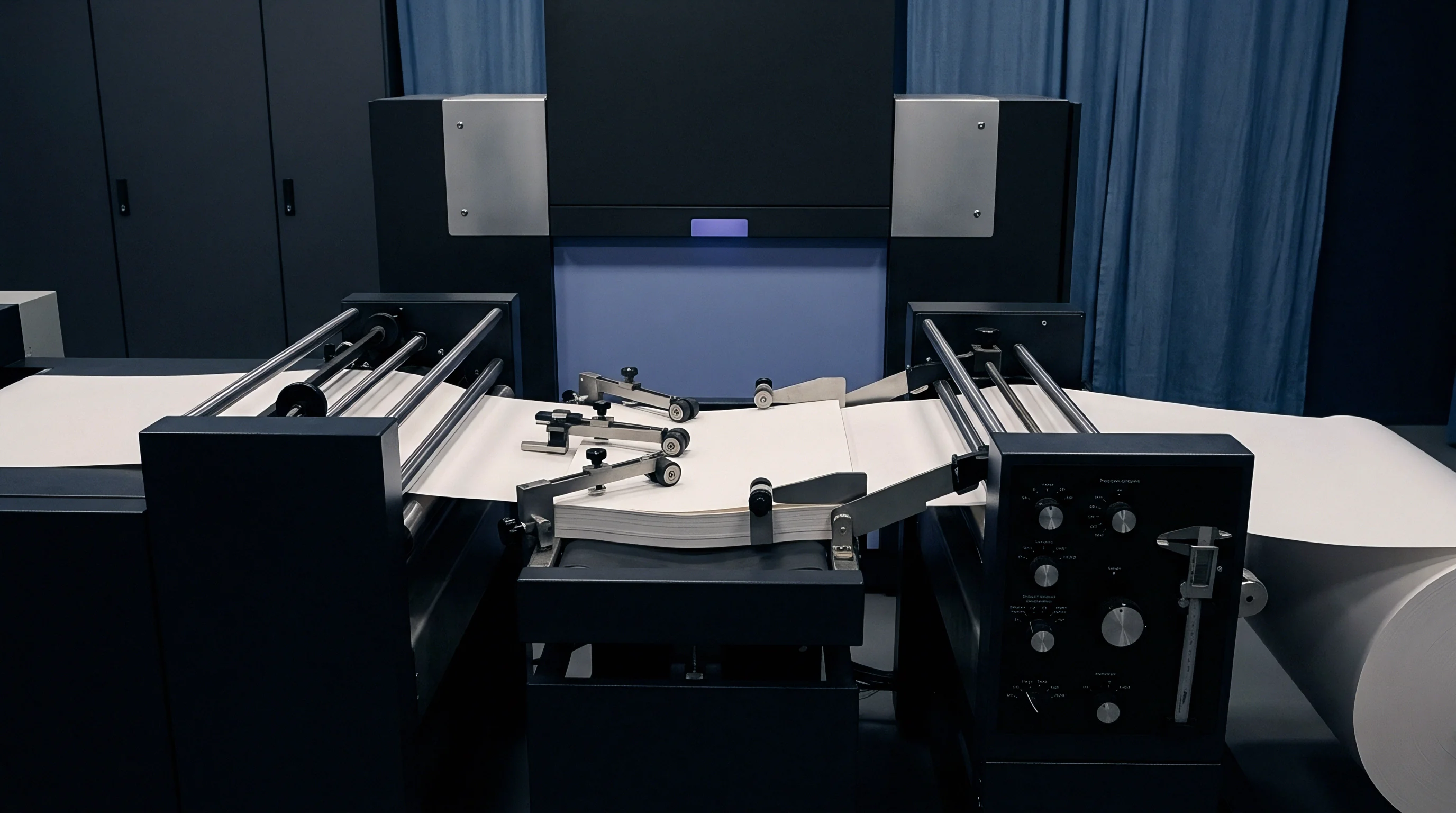
Pitch-catch emitter arrays positioned on slitter-rewinders maintain non-contact positioning through self-adjusting pneumatic float shoes. The acoustic array utilizes focused 100 kilohertz ultrasonic transducers inclined at precise Snell angles matching the antisymmetric wave phase velocity of the targeted board caliper. Transducer alignment fixtures maintain air gap distances to within plus or minus 0.5 millimeters under high web speeds exceeding 600 meters per minute.
Pneumatic mounts maintain gap height.
Calibration routines compensate for fluctuations in ambient air temperature, relative humidity, and web barometric pressure, all of which alter sonic propagation speeds in the air gap. Temperature sensors mounted adjacent to the transducers feed real-time atmospheric sound velocity adjustments (cair(T) = 331.3 sqrt1 + T/273.15) to signal processing boards. Phase delay filters lock onto fundamental wave arrivals, rejecting machine frame vibration and aerodynamic boundary layer noise generated by high-speed web movement.
- Position non-contact transmitter heads at precise Snell refraction angles relative to web normal using an optical alignment template.
- Execute baseline signal normalization across all receiver channels in open air to eliminate atmospheric humidity drift.
- Pass a reference paperboard calibration sheet of known bending stiffness through the acoustic beam path at target line velocity.
- Adjust digital signal bandpass filter parameters until measured phase velocity matches calculated flexural wave values within one percent.
- Record spatial encoder sync markers to tie acoustic dispersion anomalies to physical web positions along the roll length.
Standard Correlation with Laboratory Bending Protocols
Mechanical testing frames operating under ISO 2493 and TAPPI T556 conditions establish empirical baselines for verifying acoustic wave velocity readings. Standard laboratory testing utilizes static or low-speed 15-degree two-point bending fixtures to evaluate flexural resistance. Static tests miss transient strain.
Converting high-frequency ultrasonic phase velocity measurements into equivalent static Taber or L&W stiffness values requires applying empirical strain rate correction factors.
Paperboard exhibits viscoelastic behavior; its apparent elastic modulus increases with deformation rate. High-frequency ultrasonic measurements operate at effective strain rates exceeding 10,000 percent per second, whereas laboratory two-point bending tests execute at strain rates below one percent per second. The ratio between acoustic flexural modulus (Eacoustic) and static laboratory flexural modulus (Estatic) ranges from 1.25 to 1.45 depending on raw fiber furnish composition and degree of internal starch crosslinking.
Establishing mill-specific calibration curves maps non-contact acoustic dispersion metrics directly onto standard supplier quality certificates.
- Orthotropic Stiffness Certificate maps directional bending moduli across total web width using continuous acoustic phase velocity profiles.
- Web Profile Disparity Map identifies localized density variations and internal shear deficits that threaten high-speed erecting stability.
- Score Compliance Matrix details acceptable crease depth ranges relative to measured caliper and out-of-plane shear properties.
- Line Velocity Audit establishes maximum machine operational speeds based on board relaxation times and calculated erect force peaks.
| Measurement Parameter | Ultrasonic Test Condition | Standard Laboratory Method | Correlation Factor Range | Target Line Tolerance |
|---|---|---|---|---|
| MD Bending Stiffness (Sb) | Air-coupled A0 mode phase velocity at 80 kHz | ISO 5628 / TAPPI T543 (15-degree bending) | 1.28 to 1.38 (Eacust/Estatic) | ±4.5 percent |
| CD Bending Stiffness (Sb) | Air-coupled A0 mode phase velocity at 60 kHz | ISO 2493 (50 mm jaw distance) | 1.30 to 1.42 (Eacust/Estatic) | ±5.0 percent |
| Out-of-Plane Shear (G23) | High-frequency dispersion slope (150-300 kHz) | ASTM D5379 (Iosipescu shear method) | 0.88 to 0.95 (Gdynamic/Gstatic) | ±6.5 percent |
| Basis Weight Profile (barρ) | S0 mode time-of-flight transmission | ISO 536 (Grammage destruction sample) | 0.99 to 1.01 (Direct mass ratio) | ±1.5 percent |
Discrepancies between static laboratory bending tests and dynamic acoustic web measurements widen as converting line speeds surpass four hundred meters per minute.
Incorporating ISO 1924-3 tensile stiffness index thresholds into reel purchasing specifications forces mills to guarantee web phase velocity uniformity within five percent across total reel width.


Blank

Converting Waste Breakdown and Reel Grading
Scrap metrics on high-speed folder-gluer lines reflect spatial variation in paperboard physical properties across mill master rolls. When paperboard mills ship reels with unmonitored flexural stiffness gradients, converting plants experience variable jam rates during high-speed erecting runs. Scrap rates drive unit cost.
Inline ultrasonic profiling at the mill slitter-rewinder assigns a precise mechanical quality grade to each reel based on velocity dispersion uniformity across its width.
Consider a 30-tonne paperboard consignment of 320 gsm folding boxboard purchased at 1,450 Euros per tonne, yielding a total base material cost of 43,500 Euros. The converted blanks feed a high-speed erecting line running an order of 300,000 cartons. If the converting line runs unprofiled board exhibiting an unmonitored MD flexural stiffness drop from 16.5 to 11.2 millinewton-meters, erecting jam rates increase to 4.2 percent.
Material scrap claims 12,600 failed cartons, creating direct board waste equal to 1,827 Euros. Line stoppages force 4 hours of total unbudgeted downtime priced at 800 Euros per hour, adding 3,200 Euros in lost production capacity. The total failure cost reaches 5,027 Euros, adding 16.76 Euros per thousand finished cartons to the run ledger.
Applying real-time acoustic web dispersion profiles changes this commercial breakdown. When ultrasonic web scanning identifies low-stiffness zones across specific reel lanes, converting supervisors adjust die-cutting counterplates prior to the run. Matrix channel depths are modified from 0.45 millimeters to 0.50 millimeters for low-rigidity board lanes, reducing required crease folding moments.
Matrix selection fixes score geometry. Under optimized scoring parameters, erecting scrap rates drop to 0.5 percent, reducing board waste to 1,500 cartons (217.50 Euros) and cutting downtime to 0.5 hours (400 Euros). Total run failure costs decrease to 617.50 Euros, saving 4,409.50 Euros overall and lowering unit costs by 14.70 Euros per thousand cartons.
Modulated Packaging Fees and Tooling Adjustments
Die-cutting technicians alter matrix channel widths and crease blade heights on counterplates to match localized sheet rigidity shifts. Predictive web profiling identifies reels that require custom tooling parameters, separating high-rigidity board lanes from compliant ones. This separation permits converting plants to run high-speed erecting lines at maximum rated capacity without raising scrap allowances.
Modulated packaging fees under regional recyclability frameworks reward converting practices that reduce total paperboard scrap while maintaining box squareness without excessive plastic lamination. Uncoated paperboard grades profiled via ultrasonic dispersion methods maintain certified recyclability status under EN 13430 guidelines. By replacing heavy film laminates with precisely scored, acoustically qualified solid bleached or folding boxboard grades, brand owners avoid eco-contribution fee penalties while securing predictable high-speed mechanical erecting dynamic performance.
Adjusting die-scoring matrix channel depth based on ultrasonic web profiles prevents board cracking at the crease while maintaining box squareness during erection.