Predicting Long Term Thermal Degradation of Polymeric Dispersion Gas Phase Barriers in Humid Supply Chains
Thermal degradation of aqueous dispersion gas barriers stems from surfactant migration and hydrolytic chain scission accelerated by combined heat and substrate moisture.


Heat

Polymer Softening and Coalescence Reversion
Water-borne polymeric dispersions rely on a dense network of coalesced synthetic polymer particles to form continuous gas barriers on paperboard substrates. Polyvinylidene chloride, ethylene vinyl alcohol copolymers, styrene-butadiene emulsions, and bio-based polyhydroxyalkanoates are deposited as aqueous droplets, dried under intense thermal air knives, and fused into cohesive films. That cohesive structure remains thermosensitive throughout transit.
When container shipping temperatures cross the glass transition threshold of the barrier polymer, matrix chains regain segment mobility. Storage inside tropical freight holds reaching 45 degrees Celsius to 60 degrees Celsius under high deck-loading pressure induces polymer chain relaxation, driving localized density variations across the barrier layer.
Amorphous regions within the dispersion barrier expand during extended heat exposure. Surface surfactant residues, used to stabilize the aqueous emulsion during synthesis, migrate into the softening polymer matrix under elevated thermal energy. These hydrophobic and hydrophilic surfactant molecules form micro-phase-separated domains that create tortuous pathways for oxygen and water vapor transport.
Storage temperatures above 50 degrees Celsius accelerate surfactant agglomeration along particle-particle boundaries, converting an intended continuous gas-blocking web into a porous polymer lattice.
Morphological Shift under Dry Thermal Loading
Drying parameters on the coating line fix the initial morphology of the dispersion coating. An inline hot-air drying tunnel operating at a web temperature of 110 degrees Celsius leaves a specific distribution of residual stresses within the film. Subsequent storage in dry heat allows these internal stresses to relax, altering the free volume of the polymer network.
Free volume expansion directly elevates the solubility coefficient of oxygen within styrene-acrylic and alkyl acrylate dispersions, increasing overall gas flux without mechanical rupture.
Surfactant migration in styrene-butadiene dispersions stored at 50 degrees Celsius elevates oxygen permeability by 42 percent within fourteen days of ocean transit.
Thermal stress reduces film density by redistributing low-molecular-weight fractions toward the coating surface. This migration weakens the interface between the dispersion barrier and subsequent overprint varnishes or heat-seal layers. As thermal exposure continues, structural shrinkage in localized crystalline domains induces internal shear forces along the fiber-coating interface.
The underlying cellulose fiber network shifts, pulling the softened polymer film across micro-voids in the base paperboard surface and generating micro-pinholes that ruin barrier performance long before thermal degradation breaks the primary chemical bonds.
Coaters frequently blame raw material suppliers when barrier properties drop after summer shipping, claiming batch-to-batch polymer variations caused the gas leakage.
Hydrolysis
Combined Water Vapor and Thermal Cleavage
Moisture alters the thermal degradation profile of polymeric dispersion coatings by acting as both a physical plasticizer and a reactive nucleophile. In humid supply chains, ambient water vapor penetrates the coating surface and diffuses into the polymer bulk. Water molecules disrupt interchain hydrogen bonding within polyacrylamide, polyvinyl alcohol, and modified starch-latex hybrid barriers.
This plasticization drops the glass transition temperature of the polymer by as much as 25 degrees Celsius, bringing a film that is stable under dry room temperature into a mobile, liquid-like state under tropical transit conditions.
Chemical cleavage occurs when elevated heat pairs with high internal moisture content within the coating layer. Polyester-based polyurethanes and polyacrylic ester dispersions undergo ester hydrolysis, breaking main polymer chains into carboxyl and hydroxyl-terminated fragments. This chain scission reduces the average molecular weight of the barrier polymer, collapsing its mechanical film strength and creating molecular-scale voids through which non-condensable gases migrate rapidly.
Hydrolysis in aliphatic polyester dispersions accelerates exponentially once carboxyl end-groups accumulate, auto-catalyzing further breakdown across the matrix.
Substrate Moisture Dynamics and Dew Point Exposure
Paperboard substrates contain equilibrium moisture levels between 6 percent and 9 percent by weight under standard converting atmospheres. Sealed inside transport containers, ambient temperature swings cause rapid relative humidity changes, driving moisture out of the paperboard core and into the dispersion barrier interface. The moisture stream attacks the film from the reverse side while ambient humidity attacks the top face.
This dual-front hydration swells the polymer coating, generating osmotic pressure cells around un-dispersed mineral fillers like talc or kaolin clay.
| Dispersion Chemistry | Test Atmosphere | Glass Transition Shift (degrees C) | Oxygen Permeability Multiplier | Dominant Failure Mechanism |
|---|---|---|---|---|
| Styrene-Acrylic Latex | 40°C / 90% RH | -14 | 3.2x | Surfactant Clustering |
| Polyvinyl Alcohol (PVOH) | 38°C / 85% RH | -28 | 12.5x | Hydrogen Bond Disruption |
| Ethylene Acrylic Acid (EAA) | 50°C / 75% RH | -8 | 1.8x | Interfacial Delamination |
| Polyester Polyurethane | 45°C / 85% RH | -19 | 6.4x | Ester Chain Scission |
High moisture levels accelerate blistering along the substrate-coating boundary. Water molecules collect at pinhole sites, dissolving water-soluble binders within the base paper surface and detaching the continuous dispersion coating from cellulose fibers. The loss of mechanical anchoring permits the film to stretch and thin unevenly under structural transport vibration, leaving regions where gas barrier thickness drops below the critical minimum needed to block oxygen ingress.
Substrate fibers swell under prolonged humidity exposure, lifting surface fibers through the dispersion layer and tearing the polymer envelope. This mechanical fiber rise breaks the gas-tight barrier sheet completely, leading directly to rejection of the finished lot at the port of entry.

Kinetics
Arrhenius Extrapolation Limits in Multiphase Dispersions
Predicting long-term degradation relies on thermal acceleration models grounded in the Arrhenius equation. Standard accelerated aging runs barrier samples at elevated temperatures, such as 40 degrees Celsius, 50 degrees Celsius, and 60 degrees Celsius, to calculate the activation energy of oxygen permeability decay. In single-phase homogenous polymers, activation energy remains constant across thermal steps.
Dispersion barrier films, however, contain multiple phases including core-shell polymer particles, crystalline wax additives, mineral fillers, and water-soluble thickeners. Activation energy changes when thermal steps cross thermal transitions of any individual component.
Accelerated test protocols using conditioning above 55 degrees Celsius yield non-linear activation energies that overstate room-temperature oxygen barrier degradation by a factor of four.
Thermal activation energies for gas permeation through styrene-butadiene dispersions shift from 45 kilojoules per mole below the polymer glass transition to over 85 kilojoules per mole above it. Extrapolating high-temperature data down to real-world storage conditions using a single activation energy value generates massive predictive errors. The mathematical model assumes a single degradation reaction mechanism, whereas humid supply chain aging involves simultaneous physical swelling, surfactant migration, physical aging, and chemical hydrolysis running at independent rates.

Time-Temperature-Humidity Superposition Protocol
Construction of Master Curves for barrier performance requires shifting raw transmission data measured under varied temperature and relative humidity combinations. The shift factor must account for water vapor concentration within the polymer matrix. A modified Williams-Landel-Ferry equation incorporates moisture content as an equivalent thermal shift, creating a unified predictive surface across supply chain duration.
- Sample Pre-Conditioning ~ Seal die-cut barrier specimens inside environmental chambers held at target relative humidity levels between 50 percent and 90 percent until mass equilibrium confirms uniform moisture uptake.
- Isothermal Transmission Testing ~ Mount pre-conditioned sheets into gas transmission cells operating at five-degree increments across the target supply chain temperature spectrum without altering sample moisture content.
- Shift Factor Calculation ~ Determine horizontal shift values along the time axis by aligning logarithmic gas transmission rates from high-temperature runs with baseline room-temperature curves.
- Master Curve Construction ~ Plot the consolidated gas barrier retention curve against equivalent aging time, establishing a single decay function for product life estimation.
- Model Validation Run ~ Expose physical control samples to real-time ambient outdoor shipping cycles for 180 days to verify predicted transmission values against measured field performance.
Predictive kinetics models must account for transient humidity cycles during air and ocean freight transitions. Temperature fluctuations within containerized freight induce condensation cycles on package surfaces twice per twenty-four-hour period. Static isothermal testing misses the accelerated degradation driven by these moisture-drying stress cycles.
Micro-cavitations form at binder interfaces during rapid drying phases, permanently expanding gas passage pathways beyond predictions derived from static storage models.
| Model Variable | Baseline Value | High-Humidity Offset | Measurement Unit | Sensitivity Index |
|---|---|---|---|---|
| Apparent Activation Energy | 52.4 | +18.6 | kJ / mol | High |
| Pre-exponential Factor | 3.8 x 10^8 | 1.2 x 10^10 | cm3 / (m2 day atm) | Medium |
| Hydrolytic Rate Constant | 1.4 x 10^-4 | 8.9 x 10^-3 | 1 / hour | Critical |
| Moisture Shift Parameter | 0.045 | 0.092 | 1 / % RH | High |
How does the mathematical model compensate for the spatial variation in dispersion film thickness across a high-speed coat-weight profile?

Permeation
Mass Transfer Physics across Ageing Polymer Networks
Gas permeation through a polymeric dispersion film operates via a solution-diffusion mechanism described by Fick’s first law. The permeability coefficient equals the product of the gas solubility coefficient and the diffusion coefficient within the polymer matrix. Thermal degradation alters both terms simultaneously.
Thermal expansion of the polymer network increases the space available for gas molecule hops, elevating the diffusion coefficient. Concurrently, hydrolytic breakdown exposes polar functional groups, altering the solubility coefficient for specific gases like oxygen, carbon dioxide, and water vapor.
ASTM F1927 testing demonstrates that elevated moisture levels convert low-solubility styrene-acrylic coatings into high-solubility matrices, boosting oxygen diffusion rates six-fold.
The boundary layer between individual coalesced particles serves as the primary route for gas diffusion in aged dispersion coatings. Initial particle consolidation during drying leaves thin interstitial regions rich in hydrophilic emulsifiers and protective colloids. Heat and moisture attack these interstitial zones first, lowering the energy barrier for gas transport along particle boundaries long before the core of the synthetic polymer particle experiences chemical breakdown.
Oxygen molecules pass through these degraded inter-particle pathways, bypassing the higher density bulk polymer.

Pinhole Dynamics and Micro-Porosity Evolution
Pinholes formed during initial coating or expanded through supply chain stress transition gas transport from Knudsen diffusion to viscous Poiseuille flow. Under viscous flow regimes, gas transmission rates become inversely proportional to gas viscosity and directly proportional to the fourth power of the micro-pore radius. Thermal aging causes localized polymer shrinkage around mineral pigment particles, expanding microscopic voids at the filler-matrix interface into continuous capillary channels.
Oxygen Transmission Rate measurements performed strictly under ASTM D3985 dry conditions fail to capture the degradation state of humidified dispersion barriers. Testing must use ISO 15105-2 Annex C protocols specifying equal relative humidity on both sides of the test specimen. Standard commercial contracts mandate that barrier performance claims reference precise conditioning parameters: ISO 15105-2 testing conducted at 38 degrees Celsius and 90 percent relative humidity, with gas transmission limits verified after a mandatory 28-day thermal pre-conditioning sequence.
Crease
Mechanical Strain Concentration at the Packaging Fold
Forming flat paperboard into functional packages introduces localized mechanical strain that compromises the gas barrier film. Converting equipment forces the paperboard through scoring matrix rules, stretching the inner dispersion coating along crease lines by up to 15 percent elongation. Un-aged dispersion coatings containing high-molecular-weight polymers flex without cracking.
However, thermal aging inside humid supply chains reduces polymer elongation at break through chain scission and cross-linking side reactions, turning ductile films brittle.
Brittle dispersion coatings crack when folded into cartons or flexible pouches. Micro-cracks align along the score line, severing the continuous gas barrier and exposing raw cellulose fibers to the interior of the package. Gas molecules take the path of least resistance through these creased fissures, dropping the overall package barrier performance by two to three orders of magnitude compared to flat sheet test swatches cut from the same roll.
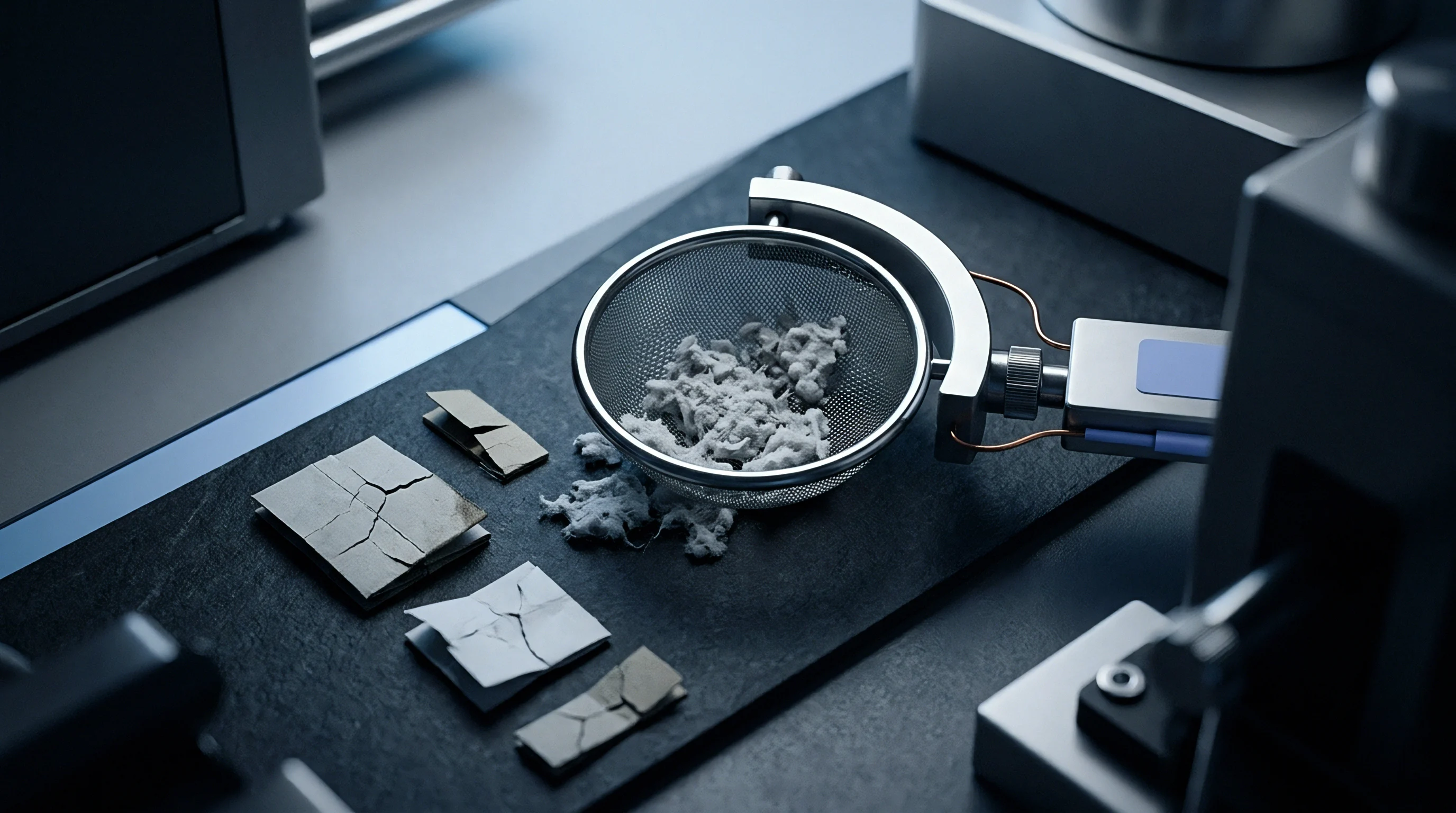
How Do Microcracks Evolve under Thermal Cycling?
Thermal cycling expands mechanical fissures formed during converting. As transport containers heat during the day and cool at night, paperboard substrates expand and contract moisture-wise, applying cyclic mechanical tension across the pre-cracked coating layer. Polymer chains at the crack tip experience stress concentration, driving crack propagation deeper into the coating thickness until the film splits to the bare fiber level.
- Mechanical Scoring ~ Die impression applies compressive and shear forces, pre-straining the dispersion film over a narrow scoring rule geometry.
- Carton Folder-Gluer Pass ~ High-speed folding belts bend the board 180 degrees, creating initial micro-fractures in low-ductility dispersion matrices.
- Supply Chain Thermal Expansion ~ Container heating expands substrate dimensions, stretching the crack mouth open under tension.
- Hydrolytic Edge Attack ~ Atmospheric moisture enters the open micro-crack, hydrolyzing the exposed polymer edges and preventing crack self-healing.
- Cyclic Structural Failure ~ Continuous shipping vibration drives the crack along the fold line, destroying the container’s gas containment ability.
Flexural fatigue testing using the Gelbo Flex method (ASTM F392) demonstrates that heat-aged aqueous dispersion coatings lose flex resistance dramatically faster than extruded polyolefin films. A dispersion barrier subjected to 270 degrees of thermal cycling over 14 days shows crack density increases from 2 cracks per square centimeter to over 45 cracks per square centimeter after just 20 flex cycles.
Creased barrier retention always tracks the physical ductility of the un-pigmented base resin rather than the total coat weight applied to the sheet.
Valuation
Waste Arithmetic and Make-Ready Loss Calculations
Specifying high-performance polymeric dispersion gas barriers requires balance between coat weight, lead time, and scrap costs. Water-borne dispersion coatings carry raw material prices ranging from 3.50 USD to 6.20 USD per dry kilogram, making them significantly more expensive than standard polyethylene extrusion resins. Applying an over-engineered coat weight of 15 grams per square meter to offset anticipated humid supply chain degradation increases job input costs while offering minimal real barrier protection if mechanical cracking occurs during folding.
Make-ready waste during dispersion application carries a distinct financial penalty. Achieving uniform pinhole-free film distribution requires precise doctor blade adjustment, drying tunnel air velocity tuning, and web tension control. Converting lines running dispersion barriers typical experience 4 percent higher setup waste than lines running solventless adhesives or wax coatings.
Every tonne of spoiled board represents both lost substrate value and unrecoverable barrier resin outlay spent during setup passes.
Extended Producer Responsibility and Recyclability Discounts
Packaging regulatory schemes impose fee surcharges on multi-layer barrier structures that contaminate paper recycling streams. Pure paperboard with aqueous dispersion coatings qualifying as repulpable under PTS-RH 021/97 or CEPI recyclability protocols earn reduced Extended Producer Responsibility fees compared to laminated aluminum foil or plastic film structures. However, if thermal degradation forces a converter to add a secondary film lamination pass to protect a failing dispersion barrier, the finished package shifts into a higher fee tier, increasing unit costs by 45 to 80 EUR per tonne of finished packaging.
To quantify the financial exposure of degradation risk, consider a 50-tonne packaging production run utilizing a 12 gram per square meter dispersion barrier coating on a 250 gram per square meter folding boxboard substrate.
- Base Substrate Cost ~ Paperboard input at 1,200 USD per tonne equals 60,000 USD for the substrate lot.
- Barrier Resin Input ~ 12 grams per square meter on 200,000 square meters of board requires 2.4 tonnes of dry dispersion polymer at 4,800 USD per tonne, totaling 11,520 USD.
- Converting Run Scrap ~ Baseline line waste at 5 percent adds 3,576 USD in destroyed material costs across setup and running passes.
- Thermal Degradation Claim Risk ~ Product spoilage claims arising from gas barrier decay in transit carry liabilities covering the full packaged goods value, often exceeding 150,000 USD per shipping container.
Managing the financial risk of thermal degradation requires precise specification of barrier requirements after simulated supply chain aging rather than on first-off dry sheets. Procurement teams must request barrier dossiers containing gas transmission figures verified after 28 days of combined thermal and humidity pre-conditioning. Aligning resin selection, coat weight, and scoring rule geometry with real transport stresses prevents costly field failures and protects conversion margins across international supply routes.