Predictive Modeling of Non-Linear Hygro-Thermal Expansion in Recycled Packaging Board under Fast Inter-Deck Curing
Calibrate inter-deck lamp irradiance to dynamic cross-direction desiccation curves, preventing register wander across recycled plies without slowing web speed.

Strain
Recycled packaging board experiences immediate dimensional distortion when exposed to high-intensity inter-deck curing lamps on sheetfed offset and flexographic printing presses. The incoming web or sheet carries an equilibrium moisture content between 6.5 percent and 8.0 percent under standard pressroom conditions governed by ISO 187 at 23 degrees Celsius and 50 percent relative humidity. Passing beneath inter-deck ultraviolet or near-infrared drying modules delivers energy densities ranging from 40 to 120 millijoules per square centimeter within exposure windows shorter than 120 milliseconds.
That thermal pulse triggers rapid sensible heating of the paperboard surface, elevating top-ply temperatures above 75 degrees Celsius while initiating flashed desorptive mass transfer. The resulting hygro-thermal deformation deviates sharply from classical linear elasticity due to the anisotropic, heterogeneous morphology of recycled secondary fibers.
Fibers recovered from post-consumer waste streams have undergone multiple drying cycles during previous paper machine runs. This repeated wetting and hornification collapses the intra-fiber lumen, hardens the secondary fiber wall, and reduces internal hydroxyl bonding potential. Virgin kraft pulp retains open, compliant cell wall structures capable of isotropic water uptake, whereas secondary recycled pulp displays suppressed transverse swelling paired with heightened hygro-expansion non-linearity.
Secondary fibers absorb water into disordered amorphous inter-fiber regions rather than porous lumen cavities. When thermal radiation strips moisture from these disordered domains between printing decks, localized shrinkage occurs at rates three to five times higher than those observed in virgin bleached kraft board under identical radiant flux.
Predictive modeling of this transient movement requires coupling two distinct mechanical driving forces: pure thermal expansion and desorptive shrinkage. Thermal expansion acts outward across machine direction and cross direction as sheet temperature climbs. Desorptive moisture loss acts inward, contracting the cellulose network as moisture leaves the fiber matrix.
Thermal conduction operates across milliseconds, while moisture desorption through the coated surface boundary layer is governed by phase change and capillary movement. In the first fifteen milliseconds of lamp exposure, sensible heat accumulation dominates, producing a brief positive strain. As surface water vaporizes, desorptive contraction overtakes thermal expansion, causing net shrinkage across the cross direction.
Thermal expansion briefly counteracts moisture shrinkage during the first twenty milliseconds of radiative exposure before vapor release dominates the strain response.
Cross-direction expansion exhibits severe hysteresis. Machine direction orientation during paperboard forming aligns the majority of long fibers parallel to sheet travel, giving the machine direction high tensile stiffness and low hygro-expansion coefficients. Cross-direction alignment contains predominantly transverse fiber orientations, where hygro-expansion coefficients are four to eight times larger than in the machine direction.
The hygro-expansion coefficient in recycled cartonboard ranges from 0.08 to 0.22 percent dimensional change per 1.0 percent change in moisture content along the cross direction. Along the machine direction, that coefficient falls between 0.015 and 0.045 percent per percentage point of moisture change.
Non-linear modeling captures this divergence by treating total strain as an additive tensor containing elastic, thermal, and hygro-expansion components. The constitutive formulation expresses total incremental strain dε as:
dε = dε_elastic + α_T(T, M) · dT + β_M(T, M) · dM
Here, α_T represents the temperature-dependent thermal expansion tensor, while β_M represents the moisture-dependent hygro-expansion coefficient tensor, which varies non-linearly with instantaneous moisture content M. In virgin furnishes, β_M remains relatively constant across operational moisture ranges from 4 to 9 percent. In recycled furnishes containing groundwood, deinked pulp, and mineral fillers, β_M increases exponentially as moisture drops below 5.5 percent. Drying the sheet below this threshold triggers rapid matrix compaction, generating unpredictable register discrepancies between print units.
- Hygro-thermal runaway develops when successive inter-deck lamps strip moisture below four percent, quadrupling transverse shrinkage per unit energy.
- Anisotropic strain mismatch forces uneven shrinkage between machine and cross directions, skewing multi-color dot register by up to 0.35 millimeters across a 1020-millimeter format.
- Filler displacement occurs within high-ash recycled middle plies, weakening internal bond strength when desorptive shear stress exceeds Scott bond thresholds.
- Thermal relaxation lag delays mechanical stabilization, causing sheets to alter dimensions between delivery pile stacking and secondary converting passes.
Register errors accumulate across printing decks. Printing presses operating six to eight stations with inter-deck drying subject the sheet to cyclical thermal shocks interspersed with partial moisture re-absorption from dampening solutions or water-based inks. When operators set inter-deck lamp irradiances without compensating for non-linear secondary fiber shrinkage, cross-direction print fit drifts outward on early decks and collapses inward on later stations.
Misalignment scrap compounds per added deck, generating off-register packaging blanks that jam high-speed folder-gluers and produce rejected carton lots during client automated filling.

Plies
Industrial packaging board produced from recycled fiber comprises multiple stratified layers engineered to balance bulk, stiffness, and cost. Coated white-lined chipboard typically incorporates three to five discrete plies. The top liner utilizes bleached recycled fibers or deinked pulp treated with calcium carbonate and clay pigment coatings bound by styrene-butadiene latex.
The under-liner contains semi-bleached recycled mechanical or chemical pulp. The thick middle plies rely on mixed unsorted wastepaper, old corrugated containers, and broke, carrying mineral filler fractions exceeding 15 percent by mass. The back liner utilizes sorted kraft waste or recycled newsprint.
Each ply maintains distinct mechanical stiffness, permeability, moisture diffusivity, and hygro-thermal expansion properties.
When high-velocity hot air, near-infrared emitters, or ultraviolet arrays strike the top liner, heat conducts downward through the caliper. Commercial white-lined chipboard running at 350 grams per square meter maintains a typical caliper of 450 micrometers. Thermal diffusivity through the porous, multi-ply cellulose structure ranges from 0.08 to 0.14 square millimeters per second.
Heat takes between 35 and 70 milliseconds to conduct from the irradiated top coating to the back liner. Inter-deck transit times on modern sheetfed presses running at 15,000 sheets per hour fall between 80 and 140 milliseconds. The top liner dries and heats substantially while the core and back plies remain cool and moist throughout the inter-deck span.
This transient thermal and moisture gradient generates severe through-thickness hygro-mechanical strain gradients. The top ply contracts under rapid moisture evaporation. The underlying filler plies, insulated by low thermal conductivity, retain their initial dimensions or expand slightly due to moisture driven inward by thermovaporous diffusion.
The constrained contraction of the surface ply produces intense in-plane tensile stress in the top liner and balancing compressive stress in the core and bottom plies. The internal bending moment induces out-of-plane distortion. Uncoated recycled plies curl toward heat.
In constrained sheetfed gripper systems or web tension spans, this internal bending moment manifests as cross-directional sheet cockle, flute formation, or diagonal edge curl.
Mathematical modeling of multi-ply recycled board requires laminated plate theory augmented with layer-wise hygro-thermal state variables. Each layer k is assigned an orthotropic stiffness matrix Q_k governed by machine-direction Young modulus E_MD, cross-direction Young modulus E_CD, in-plane shear modulus G_MD-CD, and major Poisson ratio ν_MD-CD. These mechanical properties depend directly on instantaneous temperature T and moisture content M. Moisture loss increases the elastic modulus through hydrogen bond stiffening, while elevated temperature softens the lignin and hemicellulose matrices.
In recycled plies with high lignin fractions, thermal softening competes directly with desorptive stiffening.
| Layer Position | Furnish Composition | Grammage (gsm) | Caliper (μm) | E_CD (MPa) | α_CD (10⁻⁶/K) | β_CD (%/%) | Diffusivity (mm²/s) |
|---|---|---|---|---|---|---|---|
| Top Liner | Deinked chemical pulp, coated | 65 | 60 | 2100 | 14.2 | 0.095 | 0.042 |
| Under-Liner | Semi-bleached mechanical waste | 45 | 55 | 1650 | 18.5 | 0.135 | 0.068 |
| Core Plies | Mixed waste, OCC, 18% ash | 185 | 265 | 1100 | 26.4 | 0.210 | 0.095 |
| Back Liner | Sorted unbleached kraft waste | 55 | 70 | 1450 | 19.8 | 0.145 | 0.075 |
Secondary fibers lose swelling capacity. The data demonstrates that the middle core ply, which comprises more than half the board caliper, possesses the highest cross-directional hygro-expansion coefficient β_CD at 0.210 percent strain per unit moisture change, alongside the lowest cross-directional stiffness at 1100 megapascals. The high concentration of degraded secondary fibers and mineral fillers creates a porous network prone to extreme desorptive movement whenever heat penetrates the core.
Surface sizing slows vapor escape. Moisture vaporized from the under-liner often cannot exit quickly through the dense latex top-coating, driving moisture downward into the dry recycled core plies. This process creates temporary swelling in the core while the top surface contracts, amplifying interlaminar shear stresses.
When interlaminar shear stresses exceed the internal bond strength of the recycled board, micro-delamination occurs within the sheet structure. Standard white-lined chipboard provides Scott bond values between 110 and 160 Joules per square meter, compared to virgin solid bleached sulfate boards that regularly exceed 240 Joules per square meter. Fast inter-deck heating cycles that induce steep through-thickness strain differentials break the weak secondary fiber bonds between the under-liner and the core.
The board sustains irreversible loss of bending stiffness before ever reaching downstream cutting and creasing stations.
The exact threshold where transient through-thickness vapor pressure gradients permanently fracture recycled inter-ply fiber bonds under microsecond radiation pulses remains an open question in paper physics.

Gauge
Quantifying non-linear hygro-thermal expansion for numerical models requires bench measurement protocols that decouple thermal expansion from desorptive contraction. Standard thermomechanical analysis instruments cannot capture the true behavior of packaging board because heating the specimen in a dry furnace chamber drives off moisture simultaneously. The resulting dimensional readout reflects a combined, convoluted curve where thermal expansion is masked by moisture shrinkage.
Isolating these independent coefficients demands controlled-atmosphere environmental thermomechanical analysis paired with dynamic vapor sorption.
Environmental thermomechanical analysis subjects a 15-millimeter by 5-millimeter board sample to precise tensile loads while varying chamber temperature at strictly controlled relative humidity levels. To measure pure thermal expansion α_T, the chamber must adjust ambient water vapor partial pressure simultaneously with temperature ramps, maintaining a constant chemical potential and holding specimen moisture content stable. Under these iso-moisture conditions, recycled cartonboard exhibits positive thermal expansion across all axes.
The thermal expansion coefficient α_CD ranges from 12 × 10⁻⁶ to 28 × 10⁻⁶ per Kelvin, depending heavily on filler loading and furnish composition. Higher ash fractions elevate thermal expansion because mineral carbonates expand more rapidly than bonded cellulose fibrils.
Dynamic vapor sorption balances measure the moisture expansion coefficient β_M by holding temperature isothermal at typical pressroom levels while stepping relative humidity between 10 percent and 80 percent. A continuous microbalance records mass gain while non-contact optical extensometers measure specimen length and width. Virgin board yields symmetric, reproducible sorption isotherms characterized by low hysteresis loops.
Recycled board generates broad, asymmetric hysteresis profiles. Secondary fibers display lower equilibrium moisture contents during adsorption than during desorption, reflecting structural hornification.
Compliance with ISO 12647-2 tolerance limits lapses when cross-deck hygro-thermal movement exceeds 0.08 millimeters between adjacent color stations.
The cross-directional hygro-expansion coefficient changes non-linearly across the moisture spectrum. Above 6.5 percent moisture, the matrix expands moderately as water molecules insert into accessible amorphous regions. Between 3.0 percent and 5.0 percent moisture, the removal of tightly bound monolayer water molecules collapses hydrogen-bonded fiber clusters, causing β_CD to escalate sharply.
In this low-moisture regime, a 0.5 percent loss in moisture generates three times the cross-direction contraction observed when drying the board from 8.0 percent down to 7.5 percent.
| Relative Humidity Step | FBB Moisture (%) | FBB β_CD (%/%) | WLC Moisture (%) | WLC β_CD (%/%) | Strain Ratio (WLC/FBB) |
|---|---|---|---|---|---|
| 80% to 65% | 8.6 to 7.2 | 0.082 | 7.8 to 6.6 | 0.112 | 1.36 |
| 65% to 50% | 7.2 to 5.9 | 0.091 | 6.6 to 5.4 | 0.138 | 1.51 |
| 50% to 35% | 5.9 to 4.5 | 0.105 | 5.4 to 4.1 | 0.184 | 1.75 |
| 35% to 20% | 4.5 to 3.2 | 0.124 | 4.1 to 2.8 | 0.245 | 1.97 |
| Data collected via dynamic vapor sorption with non-contact video extensometry; board samples pre-conditioned to equilibrium at 85% relative humidity before desorption testing. | |||||
Measuring dynamic behavior on the production press involves high-speed digital image correlation. Cameras mounted between press decks capture dot target displacements under flash illumination. Laboratory flash-heating benches simulate these inter-deck conditions by mounting miniature quartz near-infrared lamps above high-speed cameras running at 2000 frames per second.
Test specimens clamped under realistic web tensions of 150 to 300 Newtons per meter reveal that cross-directional shrinkage does not proceed uniformly across the board width. Sheet edges dry faster. Edge zones lose water vapor to ambient press air in three dimensions, while the sheet center can only desorb perpendicular to the top surface.
The resulting edge-to-center moisture divergence induces saddle-shaped strain distributions that distort printing registration across wide press formats.
Mill technical representatives often explain these dimensional variances by asserting that their recycled grades match virgin board tolerances when pressroom humidity complies with standard guidelines.
Span
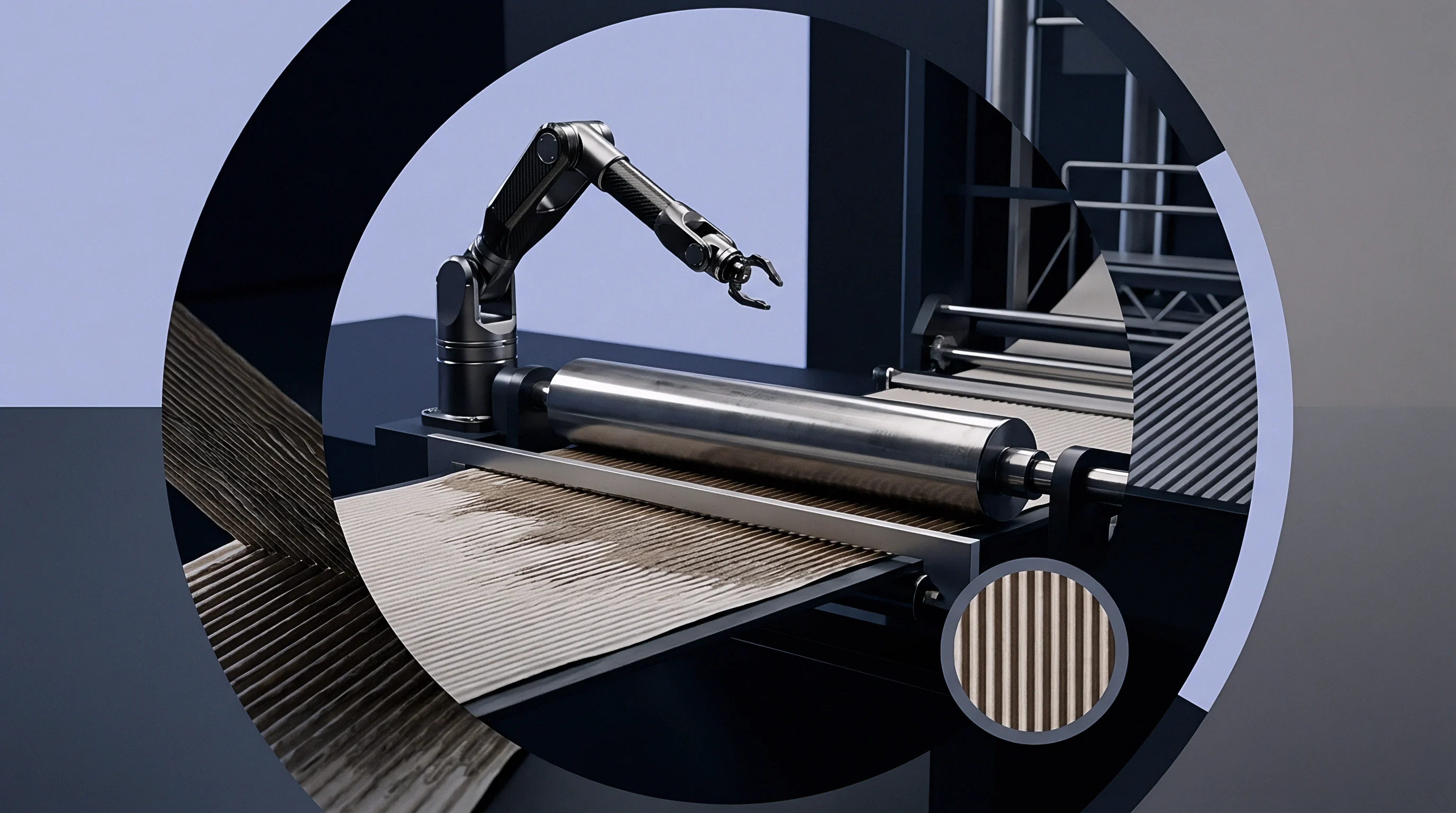
Moving a paperboard sheet through a multi-unit printing press represents a mechanically constrained transit where boundary conditions dictate whether internal hygro-thermal strain translates into register error or internal stress. On a 1020-millimeter sheetfed offset press, the sheet lead edge is gripped firmly by steel gripper fingers spaced along the impression cylinder shaft. The trailing edge remains completely free.
As the gripped sheet passes beneath an inter-deck curing lamp located between printing towers, the thermal and evaporative flux hits the sheet over a span of 200 to 400 millimeters.
Web spans in flexographic web presses introduce continuous tension boundaries. Machine-direction tension pulls the substrate flat, suppressing machine-direction hygro-thermal shrinkage. Poisson contraction compounds the problem.
Machine-direction tension produces a proportional transverse contraction governed by the in-plane Poisson ratio ν_MD-CD, which in recycled board ranges between 0.30 and 0.45. When inter-deck lamps desiccate the web simultaneously, thermal desorption shrinkage adds directly to this mechanical Poisson necking. The combined transverse contraction narrows the web substantially before it enters the next print nip.
Can Predictive Models Correct Dynamic Skew?
Modern press control architectures integrate numerical hygro-thermal algorithms into feed-forward print plate positioning systems. The predictive model computes the expected cross-directional contraction ΔW_CD across the span between printing units n and n+1 using the integrated state equation:
ΔW_CD = W_0 · ∫ dt
The first term accounts for thermal expansion during the heating phase. The second term tracks non-linear desorptive contraction driven by lamp energy density and ambient boundary air velocity. The third term incorporates transverse Poisson narrowing under mechanical tension σ_MD.
Because recycled board demonstrates variable β_CD values depending on fiber degradation, the model must receive continuous feedback from inline optical sensors measuring web temperature and moisture loss.
- Substrate characterization establishes baseline moisture isotherms, virgin-to-recycled furnish ratios, and caliper uniformity before loading stock into the press feeder.
- Energy flux calibration matches lamp power directly to ink film thickness and cure chemistry, eliminating excess radiant heat that drives core ply dehydration.
- Cylinder scale compensation applies differential lateral magnification to downstream printing plates, compensating for predictable transverse shrinkage.
- Active zone regulation throttles edge-lamp emitters independently to counterbalance accelerated boundary-layer moisture loss along web margins.
| Station Number | Pass Applied | Curing Source | Surface Temp (°C) | Moisture Loss (%) | Cumulative CD Drift (mm) |
|---|---|---|---|---|---|
| Unit 1 | Black Process Ink | Ambient Transit | 24.5 | 0.00 | 0.000 |
| Unit 2 | Cyan Process Ink | LED-UV 395nm (8 W/cm²) | 38.2 | 0.15 | -0.035 |
| Unit 3 | Magenta Process Ink | LED-UV 395nm (8 W/cm²) | 46.8 | 0.32 | -0.085 |
| Unit 4 | Yellow Process Ink | LED-UV 395nm (8 W/cm²) | 53.1 | 0.55 | -0.145 |
| Unit 5 | Cold Foil Adhesive | NIR Radiator (60 kW/m²) | 71.4 | 1.25 | -0.285 |
| Unit 6 | Spot Tactile Varnish | Medium Pressure UV (160 W/cm) | 84.2 | 2.10 | -0.420 |
Fibers dry faster than they absorb liquid ink solvents. Offset blankets pull damp fibers. The table highlights the steep acceleration in cumulative cross-direction drift once the sheet reaches near-infrared and medium-pressure mercury ultraviolet stations at Units 5 and 6.
The initial LED-UV stations operate at monochromatic 395-nanometer wavelengths, delivering targeted photon flux that polymerizes photoinitiators without emitting infrared heat. Moisture loss remains below 0.35 percent, holding drift within acceptable ISO 12647-2 limits of 0.08 millimeters. The introduction of broad-spectrum near-infrared heat at Unit 5 spikes surface temperatures to 71.4 degrees Celsius, flashing water vapor out of the secondary under-liner and driving cumulative contraction to negative 0.285 millimeters.
Feed-forward press compensation cannot correct this drift through uniform mechanical adjustments alone. Conventional presses attempt to correct for shrinkage by adjusting cylinder cocking or advancing plate sleeve timing. Cocking the plate cylinder rotates the print image relative to the leading edge.
Desorptive shrinkage does not produce pure rotation; it generates trapezoidal or parabolic distortion where the trailing corners shrink inward while the gripped lead edge remains mechanically held. Rectifying this non-linear distortion requires dynamic, sectional plate stretching or addressable LED curing arrays capable of dimming outer modules.
A sensible press operator decreases inter-deck dryer power whenever sheet tail flutter signals severe transverse edge desiccation.
Exposure
Packaging buyers specifying high-recycled-content board face substantial financial risk when combining fast inter-deck curing with downstream embellishment passes. Converting premium folding cartons frequently involves inline or offline cold-foiling, multi-level structural embossing, micro-flute lamination, and precision die-cutting. Each added pass introduces physical machinery that expects dimensional stability.
When inter-deck lamps strip moisture non-linearly from secondary fibers, the sheet shrinks unevenly, shifting the printed graphics away from tooling registration targets.
Cold-foiling operations illustrate this commercial vulnerability. Cold foil requires printing a curable adhesive at an early tower, passing beneath an inter-deck ultraviolet or LED lamp to build tack, and nipping a metallized polyester carrier film against the board surface. If the substrate shrinks by 0.25 millimeters across the format width during adhesive curing, the metallic foil film, which does not shrink under heat, wrinkles at the nip.
Trapped air bubbles, incomplete foil transfer, and pinholing destroy the solid metallic areas. Over-drying hardens the top liner. The board enters the foil nip with brittle surface fibers, encouraging micro-tearing along fine typographic lines and small intricate vector patterns.
Embossing and die-cutting tooling magnifies these alignment errors into immediate job rejection. A CNC-machined steel embossing die maintains rigid dimensions calculated at standard factory temperatures. If a 1020-millimeter sheet undergoes 0.35 millimeters of desorptive contraction during five print passes and an inter-deck varnish cure, the embossed relief misses the printed foil or ink borders.
Register drift exceeding 0.15 millimeters on high-contrast luxury packaging creates visual doubling that packaging quality auditors reject immediately.
Sheets entering downstream foil units carry less internal moisture than those stacked at the delivery pile.
Consider the economic mechanics of a packaging run of 50,000 sheets producing 300,000 cosmetic folding cartons on 350 gsm white-lined chipboard. The specification mandates four process colors, two spot brand colors, cold foil, and a final soft-touch matte dispersion coating, finished with offline relief embossing and flatbed die-cutting. The job budget assumes standard make-ready spoilage of 3.5 percent on the print line and 2.0 percent on the die-cutter.
If unexpected cross-directional shrinkage shifts the foil and embossing register outside visual specification bands, the operational ledger collapses rapidly.
Uncorrected hygro-thermal drift forces press crews into extended make-ready cycles. The make-ready team must repeatedly burn altered printing plates with manually scaled cross-direction dimensions, costing 180 euros per plate set across six stations, totaling 1,080 euros in direct plate waste. Running waste escalates from the budgeted 3.5 percent up to 9.2 percent as press operators adjust inter-deck drying lamps and hunt for acceptable register compromises.
On a 50,000-sheet board allocation costing 1,150 euros per metric ton (amounting to 20,125 euros in raw substrate), excess running waste of 5.7 percent destroys 1,147 euros in board stock alone.
Downstream consequences at the die-cutting platen carry even greater financial penalties. Flatbed cutting dies cost between 2,500 and 4,500 euros per production set. If the cured sheets enter the cutting station with unpredicted 0.40-millimeter cross-direction shrinkage, the steel creasing matrix will not match the printed carton creases.
Creasing scores placed off-center relative to printed borders induce carton cracking along the fold, invalidating food-contact barrier coatings and exposing raw unbleached secondary fibers. Altering steel rule dies on the factory floor is impossible; the converter must re-order re-scaled tooling, delaying delivery by three to five working days and incurring press downtime charges reaching 250 euros per machine hour.
Under standard commercial supply terms governed by the European Folding Carton Federation, raw material dimensional tolerances permit paperboard hygro-expansion variances up to plus or minus 0.2 percent under 10 percent ambient relative humidity shifts, leaving converters liable for register scrap unless contracts explicitly bind sheet stability to specified inter-deck lamp irradiance ceilings.