Quantifying Dynamic Contact Angle Hysteresis to Predict Solventless Polyurethane Adhesive Aging Degradation
Dynamic contact angle hysteresis quantifies interfacial polyurethane degradation weeks ahead of mechanical bond loss by measuring polar dipole pinning.

Hysteresis

Thermodynamic Contact Angle versus Dynamic Wetting
A fresh solventless polyurethane laminating adhesive film displays an advancing contact angle of 72 degrees and a receding angle of 54 degrees against deionized water. The difference between these two values defines the dynamic contact angle hysteresis. Static sessile drop measurements record an arbitrary equilibrium state dictated by mechanical friction at the liquid-solid contact line.
Dynamic measurement moves the triple-phase contact line across the cured polymer network. Advancing angles quantify the wetting resistance of low-energy segments oriented outward toward the air interface during curing. Receding angles capture the pinning of polar domains that remain bonded to polar liquids as the drop withdraws.
Polyurethane networks contain hard segments composed of diisocyanates like diphenylmethane diisocyanate and soft segments composed of polyether or polyester polyols. During phase separation, hydrophobic polyol segments migrate toward the low-energy boundary. Polar urethane and allophanate linkages retreat beneath the immediate surface plane.
Measuring the advancing angle forces the fluid front across this hydrophobic crust. Retracting the liquid exposes whether the buried polar segments rotate toward the interface under hydration. Contact angle hysteresis provides direct numerical access to this surface mobility.
Dynamic contact angle hysteresis reveals subsurface urethane dipole rotation long before bulk mechanical testing registers adhesive bond cleavage.
Thermal and hydrolytic stress alters this macromolecular rearrangement. Moisture diffusing through a laminated packaging structure attacks vulnerable ester bonds or unreacted isocyanate residues, breaking polymer chains and generating polar carboxyl and amine end groups. Dynamic wetting exposes these chemical changes at the outermost two nanometers of the adhesive film.
A widening hysteresis value tracks the accumulation of high-energy polar fragments that anchor the receding contact line while the advancing line continues to meet the unaged polymer matrix.
Predictive Surface Reconstruction
Surface reconstruction kinetics dictate the operational lifespan of adhesive bonds in flexible packaging barrier laminations. Standard laboratory tensile peel testing conducted according to ASTM D1876 or ISO 11339 registers macroscopic bond failure only after crosslink density drops below the cohesion limit of the bulk adhesive. Quantifying hysteresis via captive bubble or Wilhelmy balance methods detects interface degradation weeks ahead of physical delamination.
Converting operations that rely solely on mechanical peel testing miss the micro-hydrolysis stage where corrective recipe adjustments remain possible.
Measuring the contact line velocity during advancing and receding cycles isolates physical roughness effects from genuine chemical restructuring. Dynamic contact angle data gathered at velocities between 0.1 and 1.0 millimeters per minute isolate chemical dipole rotation without introducing hydrodynamic drag distortions. Surface degradation manifests as an asymmetry in the force-displacement loops recorded during tensiometric cycling.
Adhesive formulations that maintain a hysteresis band within 15 degrees over 500 thermal hours resist delamination across standard multi-layer retort or hot-fill packaging lifespans.
A supplier will state that any adhesive layer showing complete wet-out during the coating pass will retain its interfacial integrity across the shelf life of the pack.

Cleavage

Hydrolytic Chain Scission in Solventless Polyurethanes
Solventless two-component polyurethane adhesives cure through the reaction of polyfunctional isocyanates with hydroxyl-terminated polyols. Stoichiometric imbalance leaves residual isocyanate groups that react with atmospheric water, forming unstable carbamic acids that decompose into primary amines and carbon dioxide gas. The generated primary amines react with adjacent isocyanates to produce substituted urea groups.
Urea linkages provide initial cohesive stiffness. Under sustained humidity and thermal loading, these segments undergo hydrolytic cleavage, lowering molecular weight between crosslinks.
Polyester-based polyurethanes suffer autocatalytic ester hydrolysis in the presence of trapped moisture, producing terminal carboxylic acid moieties. Polyether-based adhesives resist ester hydrolysis but remain susceptible to photo-oxidative ether bond cleavage and chain radical scission under high-temperature converting steps. The accumulation of polar acid, amine, and hydroxyl end groups dramatically alters interfacial thermodynamics.
Each cleavage event increases the concentration of mobile hydrophilic species capable of hydrogen bonding with ambient moisture at the substrate-adhesive boundary.
Spectroscopic Signatures and Surface Energy Shifts
Attenuated total reflectance Fourier-transform infrared spectroscopy captures the loss of isocyanate absorption at 2270 inverse centimeters and the broadening of the carbonyl band between 1730 and 1690 inverse centimeters. These bulk spectroscopic measurements require degradation to penetrate several hundred nanometers into the adhesive bulk before yielding quantifiable shifts. Contact angle hysteresis registers the exact same bond cleavage at the monolayer level.
The receding angle drops abruptly as water molecules pin to the newly generated carboxylic and amine groups.
Tracking the Owens-Wendt-Rabel-Kaelble surface energy components confirms this chemical transition. The disperse component of the adhesive surface energy remains relatively stable near 34 millinewtons per meter throughout environmental exposure. The polar component climbs from an initial 4.2 millinewtons per meter in a fully cured network to over 18.5 millinewtons per meter in a severely degraded network.
Contact angle hysteresis increases linearly with this polar rise, serving as a direct non-destructive proxy for the chemical breakdown of the network.
| Exposure Time (Hours) | Advancing Angle (Degrees) | Receding Angle (Degrees) | Hysteresis (Degrees) | Polar Surface Energy (mN/m) | Disperse Surface Energy (mN/m) |
|---|---|---|---|---|---|
| 0 | 74.2 | 56.1 | 18.1 | 3.8 | 33.9 |
| 120 | 73.0 | 48.4 | 24.6 | 6.4 | 34.1 |
| 240 | 71.5 | 39.2 | 32.3 | 10.2 | 33.7 |
| 480 | 69.8 | 27.5 | 42.3 | 15.8 | 34.2 |
| 720 | 68.1 | 16.3 | 51.8 | 21.4 | 33.5 |
The rate of hysteresis growth tracks the generation of free hydrophilic chain ends. When water drops advance across the surface, hydrophobic segments minimize contact with the droplet, maintaining a relatively high advancing angle. As the liquid recedes, the water molecules drag the newly created hydrophilic polar ends into alignment, strongly pinning the contact line and causing a collapse in the receding angle.
Measuring this mechanical pinning effect provides a quantifiable early indicator of network unraveling.
Failure to monitor this chemical degradation window permits laminated barrier films to enter distribution chains where hydrolytic adhesive breakdown causes gas-barrier failure and product spoilage.

Tensiometry

Wilhelmy Plate Method on Cured Laminates
Wilhelmy balance tensiometry provides high-precision evaluation of dynamic contact angle hysteresis on thin flexible packaging films coated with solventless adhesives. A rectangular specimen of known perimeter hangs vertically from an analytical microbalance. The instrument raises a liquid reservoir of deionized water or diiodomethane at a controlled velocity of 0.2 millimeters per minute.
As the plate penetrates the liquid, the balance measures the downward meniscus force, generating the advancing contact angle profile. Lowering the reservoir extracts the plate, recording the receding contact angle profile.
The total force recorded by the electrobalance combines surface tension, buoyancy, and sample weight. Subtracting the linear buoyancy component isolates the wetting force along the immersion depth. Calculating the contact angle requires precise knowledge of the substrate thickness and liquid surface tension.
Standard packaging films such as 12-micron polyethylene terephthalate or 20-micron oriented polypropylene require rigid backing or tension clamps to prevent buckling during the immersion stroke. Any sample curvature introduces significant angle calculation errors.
Sessile Drop Tilt-Stage Measurements
Automated optical goniometers equipped with automated tilting cradles offer an alternative pathway for dynamic hysteresis quantification. A dispensing syringe deposits an accurate droplet of 4 to 6 microliters onto the horizontal adhesive surface. The motorized stage tilts the substrate at a constant rate of 0.5 degrees per second.
High-speed digital cameras record the droplet profile as gravity distorts the liquid volume. The advancing contact angle corresponds to the angle at the downhill edge immediately prior to the droplet rolling downhill. The receding angle is recorded at the uphill trailing edge.
Tilt-stage measurement protocols require precise environmental isolation. Convective air currents inside an open laboratory distort droplet geometry and accelerate solvent evaporation, altering local surface tension. Measuring contact angles inside an environmentally sealed chamber maintained at 23 degrees Celsius and 50 percent relative humidity according to ISO 187 eliminates these atmospheric artifacts.
Five discrete locations across the transverse direction of a laminated film web must be measured to establish statistical significance across production profiles.
- Capillary balance calibration with standard platinum plates establishes baseline instrument accuracy within 0.1 millinewtons per meter prior to adhesive sample loading.
- Specimen edge isolation prevents liquid wicking along cut foil or paperboard edges, using hydrophobic paraffin wax along exposed boundaries.
- Contact line velocity control between 0.1 and 0.5 millimeters per minute minimizes viscous drag forces that skew thermodynamic advancing angle readings.
- Droplet volume stabilization precisely balances gravitational deformation against capillary forces to yield repeatable sliding angle thresholds.
Discrepancies between automated goniometry and Wilhelmy tensiometry stem primarily from surface topography. Wilhelmy plates average contact angles over the entire wetted perimeter, smoothing out local roughness variations. Tilt-stage goniometry records localized triple-phase contact line dynamics.
If the cured adhesive layer displays micro-scale orange peel or ribbing from application rollers, optical readings vary based on droplet placement relative to the coating ridges. Wilhelmy balances integrate these variations into a stable, composite hysteresis measurement.
DIN 55660-6 establishes the standard calculation protocol for deriving advancing and receding angles from dynamic force tensiometric immersion profiles.
What parameters determine whether dynamic contact angle measurements predict bond failure reliably?
The answer resides in the mechanical decoupling of surface roughness from chemical polarity shifts, demanding rigorous surface profile scanning alongside dynamic contact angle verification.

Topography

Roughness Decoupling through Wenzel and Cassie-Baxter Regimes
Surface roughness alters apparent contact angles independently of surface chemistry. The Wenzel equation states that surface roughness amplifies the intrinsic wetting properties of a solid. A naturally hydrophobic surface with a contact angle above 90 degrees exhibits a higher apparent contact angle when roughened.
Conversely, a hydrophilic surface with a contact angle below 90 degrees displays a lower apparent angle upon roughening. Solventless polyurethane laminating adhesives exhibit smooth, glossy surfaces upon deposition, but curing shrinkage and roller patterns introduce micro-topography.
Wenzel roughness factors represent the ratio of actual surface area to projected geometric area. Optical profilometry or atomic force microscopy measures this surface area ratio, denoted as r. When air pockets remain trapped within the micro-crevices beneath a liquid droplet, the system transitions from the homogeneous Wenzel state into the heterogeneous Cassie-Baxter state.
In the Cassie-Baxter regime, the apparent advancing contact angle rises dramatically due to the liquid-air interface, artificially widening the measured contact angle hysteresis without any underlying chemical scission.
Distinguishing Physical Pinning from Chemical Degradation
Physical contact line pinning occurs when the moving triple line encounters sharp topographical steps, such as application cylinder gravure cells or roller chatter marks. This physical pinning elevates contact angle hysteresis without indicating polymer degradation. To verify that hysteresis increases stem from chemical bond cleavage, optical white-light interferometry must quantify surface roughness parameters before and after accelerated environmental conditioning.
An adhesive undergoing chemical degradation exhibits rising hysteresis while the root-mean-square roughness parameter, Sq, remains static below 50 nanometers.
When Sq values remain stable under 50 nanometers, topographic pinning contributes less than 3 degrees to total contact angle hysteresis. Any hysteresis expansion exceeding this threshold directly reflects chemical restructuring, polymer chain scission, or the outward migration of polar hydrolysis products. Measuring the sample topography before tensiometric evaluation protects packaging engineers from misinterpreting mechanical surface defects as chemical degradation.
| Sample Condition | Sq Roughness (nm) | Advancing Water Angle (Deg) | Receding Water Angle (Deg) | Measured Hysteresis (Deg) | Primary Pinning Mechanism |
|---|---|---|---|---|---|
| Fresh Smooth Cure | 14.2 | 75.4 | 58.2 | 17.2 | Polymer Segment Mobility |
| Fresh Roll-Patterned | 185.6 | 84.1 | 52.3 | 31.8 | Mechanical Asperity Pinning |
| Hydrolyzed Smooth | 16.8 | 68.2 | 21.4 | 46.8 | Polar Bond Cleavage Pinning |
| Hydrolyzed Roll-Patterned | 192.4 | 78.5 | 18.1 | 60.4 | Combined Chemical and Physical |
Separating physical from chemical pinning isolates the root cause of converting failures. If an unaged laminate demonstrates elevated hysteresis driven by high Sq roughness, the line foreman adjusts application cylinder temperatures or smoothing roll gap pressures to eliminate surface ribbing. When high hysteresis occurs on a smooth surface following aging exposure, the formulation chemist must address hydrolytic stability through polyol choice or isocyanate hard-segment crosslinking density.
An unresolved question remains whether nanometer-scale plasticizer migration to the surface produces identical pinning signatures to those of pure polyol chain scission.

Drift
Mix Ratio Deviation on Solventless Meter-Mix Units
Commercial solventless lamination relies on continuous two-component meter-mix gear pump dispensing units. These systems meter Part A isocyanate and Part B polyol at precise volumetric ratios, typically between 100:100 and 100:40 depending on chemical formulation. Viscosity changes induced by temperature swings in the day tank cause gear pump cavitation and slip.
A viscosity increase in the polyol component can restrict flow, causing the meter-mix dispenser to deliver an isocyanate-rich blend to the application roll coater.
An isocyanate-rich mixture produces an excessively brittle cured adhesive layer with dense allophanate and biuret networks. An excess of polyol leaves unreacted hydroxyl groups within the matrix, crippling cohesive strength and elevating moisture permeability. Both stoichiometry drift modes accelerate environmental aging degradation.
Excess polyol introduces mobile hydrophilic chains that migrate rapidly toward the adhesive surface, while excess isocyanate traps unreacted groups that convert into fragile urea structures prone to hydrolytic breakdown.

Application Roll Temperature Profiles
Solventless adhesives contain zero carrier solvent and rely entirely on thermal heating to lower viscosity for smooth mechanical distribution. Application roll temperatures operate strictly between 40 and 45 degrees Celsius. If the transfer roll cooling system malfunctions and temperature climbs to 55 degrees Celsius, premature polymerization occurs inside the coating nip.
The adhesive undergoes partial gelation before reaching the lamination nip where it joins the primary and secondary film webs.
Premature gelation prevents proper substrate wet-out and introduces microscopic interfacial voids. These microscopic air voids trap atmospheric oxygen and water vapor directly at the film-adhesive boundary. When exposed to heat and humidity, these trapped pockets accelerate local hydrolytic degradation.
Dynamic contact angle hysteresis scans across the web reveal this operational failure as periodic bands of elevated hysteresis matching the rotational circumference of the application roll.
- Viscosity verification via inline vibrational viscometers detects component ratio drift before the mixed adhesive enters the coating reservoir.
- Optical surface energy screening of incoming unlaminated webs confirms corona or plasma treatment levels remain above 38 millinewtons per meter.
- Infrared thermal mapping across the application and nip rollers identifies thermal gradients that create uneven curing kinetics.
- Retained isocyanate extraction testing conducted 24 hours post-lamination confirms complete network polymerization prior to slit and convert operations.
Production line drift directly impacts the unit economics of printed packaging. A 20,000-meter production run executed with a 5 percent stoichiometric imbalance passes immediate peel adhesion release testing at the rewinder. Three weeks later, inside a customer warehouse experiencing 30 degrees Celsius and 80 percent relative humidity, moisture penetrates the laminate.
The unreacted segments hydrolyze, contact angle hysteresis spikes past 45 degrees, and the multi-layer barrier structure delaminates under the seal stresses of vertical form-fill-seal machines.
Should the converting line alter web tension profiles when contact angle hysteresis drifts across the curing window?
Web tension adjustments cannot compensate for stoichiometric imbalance, leaving adhesive chemistry correction as the sole operational remedy.


Amortization

Priced Failure Mechanics in Flexible Converting
Evaluating adhesive degradation through dynamic contact angle hysteresis transforms quality control from a retrospective failure analysis into a prospective financial risk management discipline. Consider a typical converting operation producing barrier laminations for dry food packaging, running a 12-micron metallized polyethylene terephthalate web bonded to a 50-micron linear low-density polyethylene sealant web using a standard two-component solventless polyurethane adhesive. The adhesive application weight targets 1.8 grams per square meter, operating at a line speed of 400 meters per minute on a 1300-millimeter web width.
The raw material cost structure for this structure averages 0.12 dollars per square meter for the metallized film, 0.18 dollars per square meter for the polyethylene sealant web, and 0.02 dollars per square meter for the solventless adhesive applied at standard weight. Total substrate and adhesive value equals 0.32 dollars per square meter before converting passes. Machine hour rates for the solventless laminator run at 280 dollars per hour, including direct labor, energy, and plant overhead.
Running at 400 meters per minute, the line processes 31,200 square meters per hour, generating an added converting cost of approximately 0.009 dollars per square meter.
The Spoilage Ledger across Scale Production
A single eight-hour production shift yields 249,600 square meters of laminated web, representing an accumulated manufacturing investment of 82,118 dollars. If a stoichiometric shift in the adhesive dispensing unit occurs halfway through the shift, creating a latent hydrolytic aging defect, standard mechanical peel testing performed immediately off the machine records acceptable green bond strength of 1.5 Newtons per 15 millimeters. The rolls are cleared for curing in the hot room and forwarded to secondary slitting and pouch making.
Assume an accelerated shelf-life trial using dynamic contact angle hysteresis testing identifies hydrolytic failure risk at hour 48 of environmental exposure, where hysteresis widens from 18 to 44 degrees. If identified before slitting, the material loss is contained to the raw laminate inventory value. If undetected until delivery to the brand owner, food packaging filling lines encounter web delamination during retort processing.
Delamination at the customer facility triggers commercial chargebacks, product recall liability, disposal fees, and packaging replacement costs that regularly multiply the original material value tenfold.
A stable dynamic contact angle hysteresis reading confirms interfacial cure integrity weeks before mechanical testing detects boundary failure.
Investing in automated dynamic tensiometry equipment requires an upfront capital outlay between 35,000 and 65,000 dollars. Amortizing a 50,000-dollar analytical tensiometer across a three-year depreciation schedule equals roughly 1,388 dollars per month. Preventing a single rejected lamination run of 100,000 square meters saves over 32,000 dollars in direct scrap material and machine time, amortizing the entire instrument cost within two production cycles.
Standard packaging procurement agreements stipulate that the converter absorbs all transport, conversion, and disposal costs for laminated barrier rollstock that suffers interfacial failure within six months of delivery.

Weathering
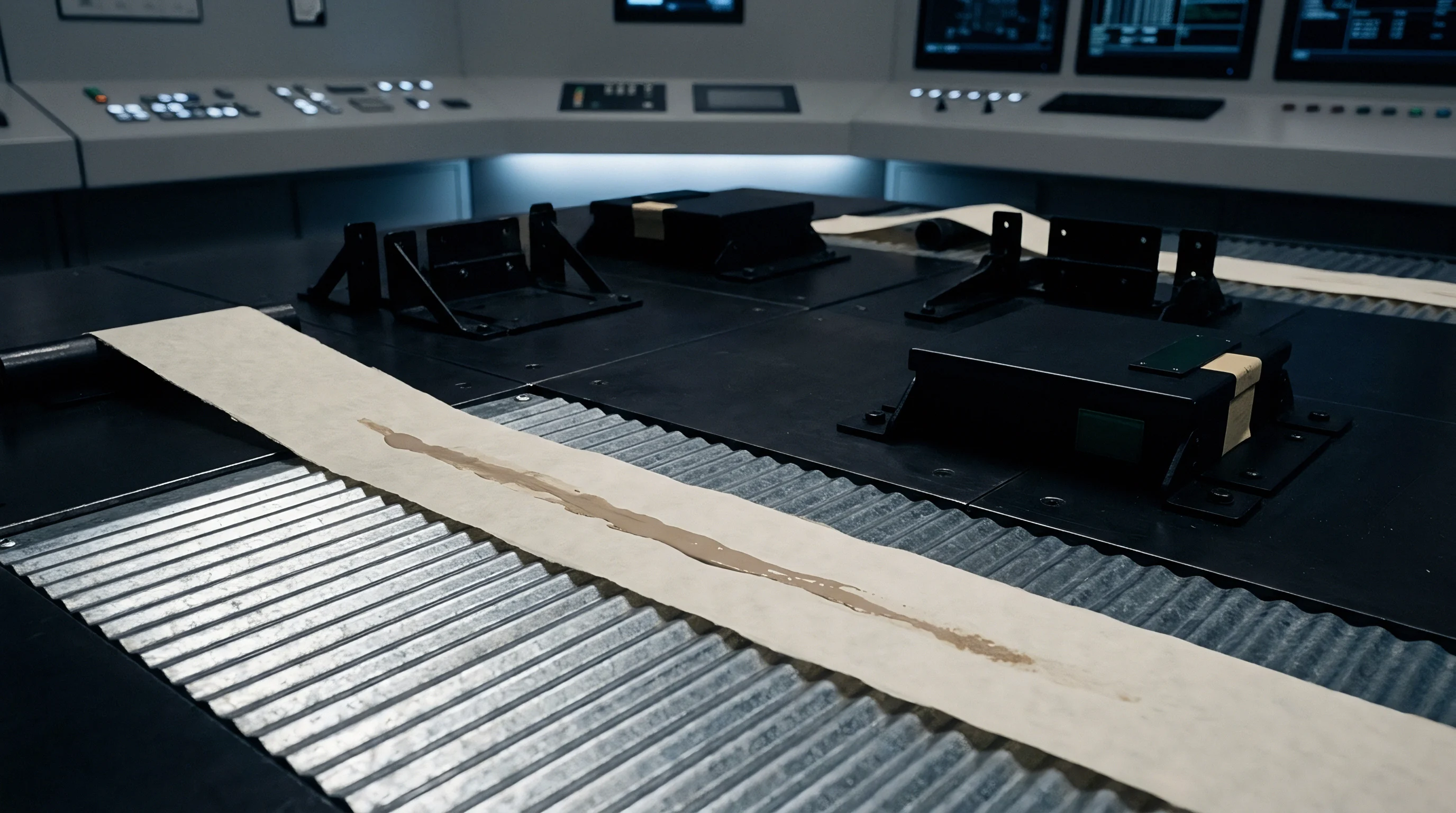
Thermal and Hydrolytic Aging Chambers
Validating the predictive correlation between dynamic contact angle hysteresis and long-term delamination requires structured accelerated aging trials. Test specimens undergo conditioning inside controlled environmental chambers per ASTM D4332 protocols. Standard operational evaluation protocols cycle laminated specimens through three discrete environmental profiles: steady-state tropical testing at 40 degrees Celsius and 75 percent relative humidity, accelerated thermal aging at 60 degrees Celsius and ambient dry humidity, and cyclic damp heat cycling between 25 and 55 degrees Celsius with 90 percent relative humidity transitions.
Specimens are extracted at predetermined intervals of 24, 72, 168, 336, 504, and 720 hours. For each extraction point, technicians prepare specimens for dual-path validation: mechanical T-peel adhesion testing according to ASTM D1876 and dynamic contact angle tensiometry using both Wilhelmy plate and tilt-stage goniometry. Contact angle measurements require specimens to re-equilibrate inside a standard testing atmosphere of 23 degrees Celsius and 50 percent relative humidity for four hours prior to wetting analysis.
This equilibration step ensures that transient surface moisture desorbs, allowing instruments to record intrinsic polymer network degradation.

Predictive Lifetime Modeling Algorithms
Mathematical modeling of adhesive service life relies on the Arrhenius relationship, which links the chemical reaction rate of hydrolytic bond scission to temperature. In traditional protocols, calculating activation energy requires running mechanical peel tests to total failure across multiple high-temperature chambers, a process consuming months of testing time. Dynamic contact angle hysteresis accelerates this calculation.
The rate of change in contact angle hysteresis over time, d(Delta Theta)/dt, directly mirrors the chemical reaction rate constant, k, of urethane and ester cleavage.
Plotting the natural logarithm of the hysteresis divergence rate against the inverse of absolute temperature yields a linear Arrhenius plot. The slope of this line defines the activation energy for interfacial degradation. Solventless polyurethane adhesives exhibiting activation energies below 60 kilojoules per mole demonstrate high vulnerability to tropical delamination.
Formulations engineered with sterically hindered polyols or hydrophobic silane adhesion promoters display activation energies exceeding 85 kilojoules per mole. Calculating activation energy from contact angle hysteresis curves reduces required accelerated chamber testing duration from 12 weeks to under 14 days.
| Formulation Type | Test Temp (Deg C) | Hysteresis Divergence Rate (Deg/Day) | Calculated Activation Energy (kJ/mol) | Predicted Bond Failure (Days) | Observed T-Peel Failure (Days) |
|---|---|---|---|---|---|
| Standard Polyester-PU | 40 | 1.85 | 58.4 | 28 | 31 |
| Standard Polyester-PU | 60 | 5.40 | 58.2 | 9 | 10 |
| Polyether-PU | 40 | 0.72 | 74.1 | 65 | 72 |
| Polyether-PU | 60 | 2.80 | 73.8 | 18 | 21 |
| Hindered Polyester-PU | 40 | 0.35 | 88.6 | 140 | 155 |
| Hindered Polyester-PU | 60 | 1.60 | 88.1 | 34 | 38 |
The predictive alignment between the dynamic contact angle hysteresis divergence rate and observed physical delamination confirms the viability of interfacial tensiometry as a rapid qualification tool. Converting plants establish critical thresholds where a hysteresis widening beyond 30 degrees triggers formulation rejection, long before laminated rolls reach slitting operations or customer filling lines.
As packaging materials transition toward mono-material polyethylene and polypropylene barrier laminates to meet recyclable packaging mandates, polyolefin surface dynamics require identical contact angle hysteresis tracking to prevent adhesive aging failures.