Single Sided Lamination Curl against the Flatness Filling Lines Need
Single-sided lamination curl is controlled by balancing nip heat, reverse dampening, decurling bar tension, and conditioning board to filling line humidity.

Feeder
High-speed cartoning machinery running past three hundred folding cartons per minute requires board to lie completely flat across every millimeter. When single-sided film lamination pulls unevenly across paperboard, the resulting curl in either the machine or cross direction disrupts downstream line mechanics. Pick-and-place suction cups depend on a flat surface to achieve a tight pneumatic seal.
If edge lift distorts a blank by even three millimeters, ambient air leaks into the vacuum cup, triggering missed picks, false stoppages, and poor alignment at the pre-break station.
Feed hoppers depend on predictable stack behavior. When blanks lie flat, gravity and pusher fingers slide them smoothly down the hopper against consistent friction. Once single-sided lamination bows the board into a concave or convex profile, blanks no longer rest flat against the side rails and instead dig in along their cut edges.
Friction spikes at these contact points, causing the bottom blank to bind under the stack’s weight, resist the feed blade, or pull double sheets into downstream transfer turrets.
High-speed packaging lines operate within narrow tolerance windows for carton erection, product insertion, and flap tucking, where distorted blanks trigger specific mechanical failures across automated cartoning units.
| Mechanism | Feeder Operating Parameter | Tolerance Threshold | Operational Consequence |
|---|---|---|---|
| Suction Pick Station | Vacuum Pressure Bar | Minus 0.8 Bar Minimum | Missed carton pick causes empty line pockets and sensor tripping. |
| Magazine Hopper | Edge Friction Clearance | Plus 1.5 Millimeters Max | Carton blank binding causes erratic feeding and line stops. |
| Pre-Break Finger | Break Force Alignment | 50 to 70 Grams Force | Misaligned breaker arms score film layer and rupture carton corners. |
| Tuck Flap Inserter | Flap Deflection Margin | 0.5 Millimeters Planar | Flap collision deforms dust flaps and jams high-speed platen closure. |
When running 350 gram per square meter folding boxboard on high-speed cartoners, carton blank distortion compounds rapidly inside the feed magazine. Static electricity generated by the polymer film layer worsens this instability, drawing adjacent curled blanks into tight contact.

Carton Blank Transport Mechanisms and Vacuum Pick Failures
Pneumatic transfer systems rely on consistent air displacement across the board face. A curled blank alters the gap between the vacuum cup lip and the substrate before touch-down, and if the board’s structural bending stiffness exceeds the vacuum’s pull force, the cup cannot pull the sheet flat. Because vacuum generators monitor pressure drop rates, an incomplete seal immediately trips an emergency stop to prevent un-inserted product from traveling down the conveyor.
Single-sided lamination curl cuts packaging line efficiency by creating air gaps that block full vacuum draw at high-speed pick stations.
Carton erection requires precise force during transfer. As the vacuum head pulls a blank from the hopper, stationary or rotary pre-break swords strike the side panels to pre-fold creases between ninety and one hundred thirty degrees. If the blank presents a curved profile to the sword, contact shifts off the crease axis, causing the sword to strike the flat face of the board ~ crushing the paperboard or scratching the protective film layer.
Downstream tuck-in mechanisms require flat flaps to function reliably. Side dust flaps curling inward collide with incoming product guides, while main closure flaps curling outward miss the tucking shoes entirely. Resolving these jams requires manual operator intervention, which drops overall equipment effectiveness and increases unit conversion costs across the run.
High Speed Infeed Tolerances for Single Sided Laminated Board
Standard dimensional tolerances for unprinted board accommodate minor moisture movement, but single-sided film lamination leaves far less room for error. Automated filling lines running between four hundred and six hundred packs per minute require flat blanks with less than one point five millimeters of height deviation across a three hundred millimeter span. Exceeding that limit causes mechanical interference inside timing chains and transfer pockets.
Several physical failure modes occur when single-sided laminated blanks pass through high-speed automation equipment.
- Blank Arc Drift causes lateral misalignment on high-speed transport belts, pushing blanks out of register with downstream folding rails.
- Suction Cup Vacuum Leakage happens when concave board profiles keep perimeter rubber seals from seating flat against the film face.
- Magazine Side Rail Binding occurs when curled board corners dig into vertical channel guides under the stack’s weight.
- Pre-Break Arm Jamming happens when curved score lines hit mechanical breaking fingers at the wrong angle during transfer.
Converters frequently attribute line stoppages to filling line settings rather than structural moisture imbalances within the delivered board stock.
Physics
Thermodynamics and hygroscopic expansion dictate how single-sided laminates behave from the moment the web hits the laminating nip. Paperboard is an anisotropic fiber network that continuously absorbs or releases moisture as ambient humidity shifts. In contrast, synthetic films like oriented polypropylene, polyethylene terephthalate, or cellulose acetate combine low moisture permeability with high elastic recovery.
When heat and pressure join these materials, subsequent shifts in humidity or internal strain force the sheet to bow toward whichever layer exerts greater tension.
Paperboard expands far less in the machine direction than in the cross direction because wood fibers swell primarily in diameter as they absorb water vapor, driving cross-direction expansion five to eight times higher than machine-direction movement. When thermal or solventless lamination bonds a stretched polymer web to one side, that film acts as a rigid barrier against natural dimensional movement across the fiber face.
Thermal lamination accelerates this instability by stripping moisture directly from the substrate. Running board over a heated chrome roll between ninety and one hundred twenty degrees Celsius drives off water, shrinking the paperboard. Simultaneously, the polymer film expands under nip heat and web tension.
Once the web exits the nip and cools, the film contracts while the paperboard reabsorbs atmospheric moisture, creating a strain differential that pulls the sheet into a curl toward the film side.
| Film Polymer Type | Substrate Moisture Loss | Nip Temperature Range | Thermal Strain Coefficient | Dominant Curl Tendency |
|---|---|---|---|---|
| Oriented Polypropylene (OPP) | 1.2% to 1.8% by weight | 95°C to 105°C | 1.2 x 10^-4 / K | Concave toward film side |
| Polyethylene Terephthalate (PET) | 0.8% to 1.4% by weight | 110°C to 125°C | 0.7 x 10^-4 / K | High linear machine-direction pull |
| Cellulose Acetate | 1.5% to 2.2% by weight | 85°C to 95°C | 1.6 x 10^-4 / K | Humidity sensitive cross-curl |
| Polylactic Acid (PLA) Bio-Film | 1.0% to 1.6% by weight | 80°C to 90°C | 1.4 x 10^-4 / K | Delayed post-cure distortion |
Adhesive selection is equally critical to structural stability. Water-based acrylic adhesives introduce moisture directly to the top fibers as the bond forms, causing temporary swelling in the nip. As that water diffuses into the core and evaporates off the bare reverse side, the top fibers dry and contract beneath the locked film, generating severe upward curl.
Conditioning paperboard to five point five percent equilibrium moisture content prior to thermal lamination minimizes post-process hygroexpansion curl.
Hygroexpansion Coefficient Differences between Polymer and Fiber
Dimensional shifts in paperboard stem from water interacting with hydrogen bonds inside cellulose cell walls. Synthetic films lack this structure and remain dimensionally stable across relative humidity changes. When ambient humidity rises from thirty to seventy percent, an unlaminated 300 micrometer folding boxboard sheet expands up to zero point four percent in the cross direction.
Because the film layer remains inert, the expanding board forces the structure into a convex curve against the rigid film face, behaving much like a bimetallic strip.
A drop in humidity produces the opposite reaction: dry air extracts moisture from the board, shrinking the fibers while the film holds its dimensions, bending the sheet concave toward the film side. Because moisture equilibrium shifts throughout transport and storage, storing stock in unconditioned warehouses subjects pallets to humidity swings that can flip the curl direction repeatedly before the board ever reaches a packaging line.
Fiber orientation determines where dimensional movement concentrates. Machine-direction orientation imparts high flexural rigidity that resists curl along the roll length, whereas cross-direction stiffness is substantially lower, leaving the web vulnerable to roll-width curl and edge lifting along slitted margins.

Thermal Nip Induced Moisture Stripping and Plastic Strain
Heat applied during dry-bond thermal lamination acts as a strong dehydrator. Nip pressures above twenty bar compress the web while high temperatures drive free water out of the substrate. This thermal shock alters the mechanical modulus of the surface fibers, locking them into a compressed state as the film sets.
Permanent plastic deformation occurs whenever nip pressure and thermal stress exceed the yield strength of the dry cellulose matrix.
Four separate stress components act simultaneously across a single-sided film laminate:
- Differential Moisture Shrinkage acts along the bare fiber face as water evaporates from the back of the board.
- Thermoplastic Web Tension Strain stretches the film during lamination, leaving residual elastic tension that recovers after sheeting.
- Asymmetric Caliper Modulus creates uneven flexural resistance between the dense outer film and the bulkier paperboard core.
- Post-Cure Adhesive Shrinkage builds as solventless polyurethane or waterborne acrylic crosslinks over twenty-four to forty-eight hours.
Whether inline dampening units and tension management systems can fully offset thermodynamic moisture loss during thermal nip processing depends on precise closed-loop control.
Hydration
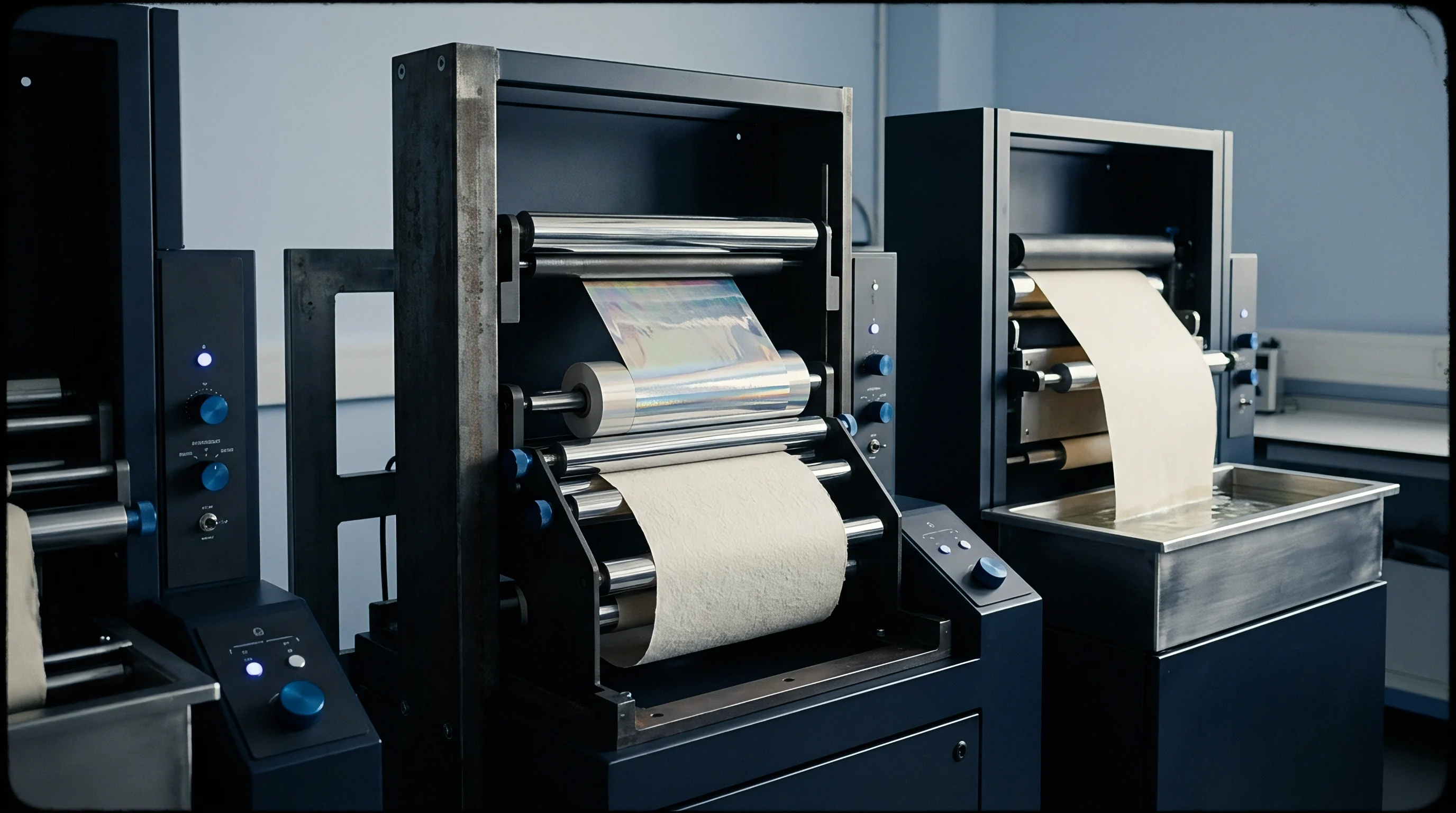
Restoring physical balance to a single-sided laminated web requires active mechanical and chemical intervention before sheeting or rewinding. Modern laminating lines rely on decurling break bars, reverse wetting units, and automated tension monitoring to counteract stresses imparted by the nip. The objective is to balance internal forces ~ either by mechanically stretching the polymer film or by reintroducing controlled moisture into dehydrated paperboard fibers.
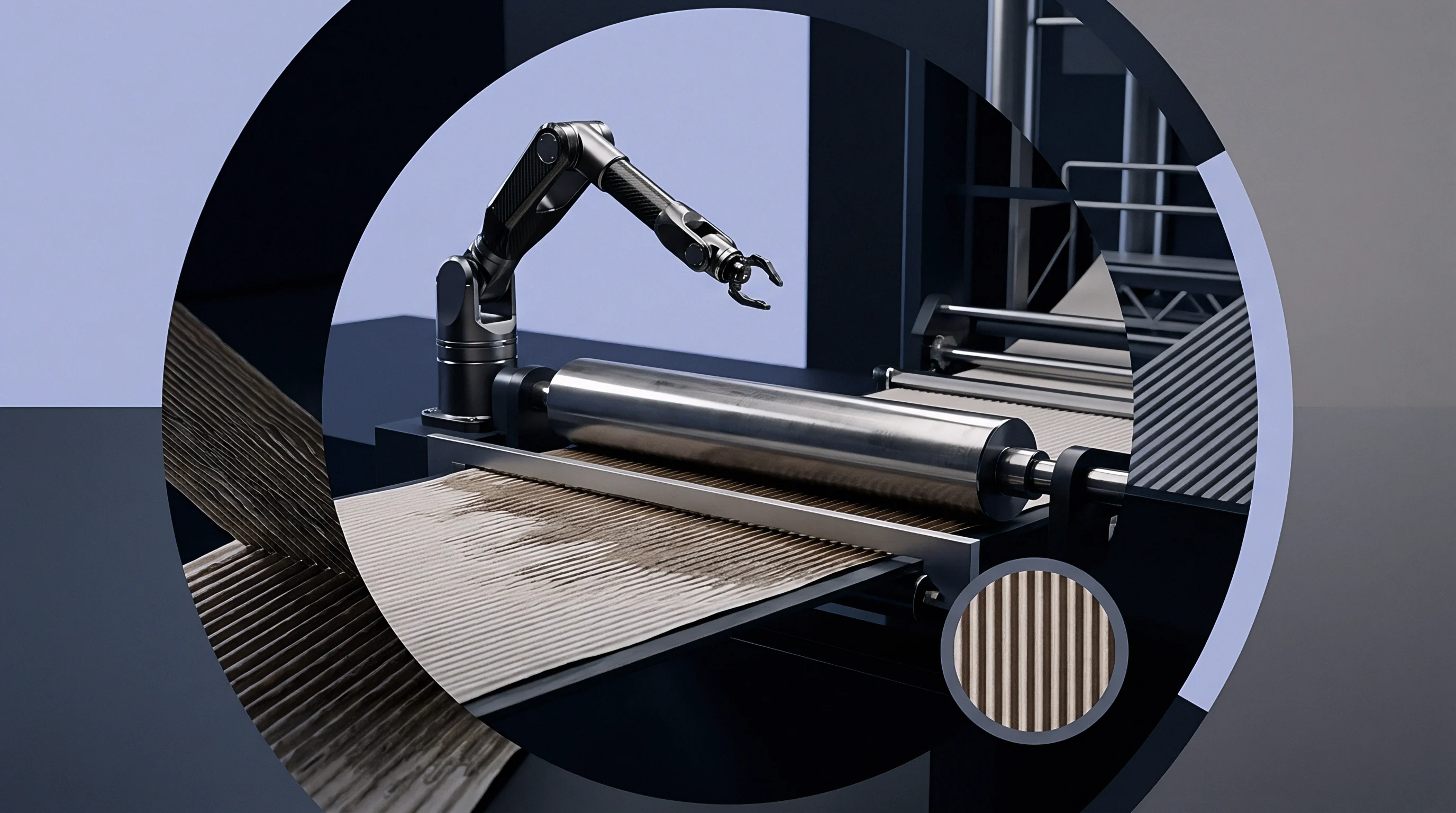
Mechanical decurling uses small-diameter breaker bars or rollers to flex the web over a tight radius against its natural curl direction. Under controlled tension, the web passes over a hardened steel bar eight to fifteen millimeters in diameter. This sharp bend forces the polymer film past its yield point, permanently elongating the synthetic layer so its length matches the paperboard substrate and neutralizes the tension driving concave curl.
Over-stretching compromises surface appearance and bond integrity. Excessive break angles or web tension micro-fracture clear and metallized films, producing haze, stress lines, or localized delamination. Operators must adjust breaker bar penetration dynamically to account for line speed, board caliper, and observed curl.
| Intervention Mechanism | Primary Operating Parameter | Target Moisture Restored | Surface Energy Impact | Line Speed Limits |
|---|---|---|---|---|
| Mechanical Breaker Bar | Penetration Angle (10° to 45°) | 0.0% (Mechanical stretch only) | Zero effect on surface dynes | No speed reduction required |
| Water Dampening Roll | Anox Roller Speed Ratio (5% to 15%) | 0.8% to 1.4% water by weight | Temporary surface wetting | Capped at 250 m/min |
| Steam Injection Hood | Steam Pressure (1.5 to 3.0 Bar) | 1.0% to 1.8% water by weight | No alteration of substrate face | Runs to 400 m/min |
| Corona Back-Treatment | Power Output (1.5 to 3.5 kW) | 0.0% (Surface oxidation only) | Increases dynes to >48 mN/m | No speed reduction required |
Water re-introduction addresses thermal curl directly by restoring moisture lost from the uncoated reverse side. Reverse dampening systems use gravure rolls or electrostatically assisted sprays to apply an ultra-thin film of deionized water onto the back of the web immediately after the chill rolls. The dry fibers absorb this water, swelling back toward their original dimensions and counteracting top-side film tension.
On a high-speed line running 18 micron biaxially oriented polypropylene, adjusting reverse dampening roll speed to match measured moisture loss stabilizes lay-flat performance after sheeting.
How Does Reverse Dampening Rebalance Board Tension?
Applying water to the bare fiber face induces localized swelling in the bottom plies of the board. As moisture migrates into the Z-direction core, expanding fibers counteract the tension exerted by the polymer film. The volume of applied water must closely match what was lost during heating: insufficient moisture leaves residual concave curl, while excessive water induces convex curl toward the unlaminated side and risks mold development inside wrapped pallets.
Automated moisture control systems deploy inline near-infrared sensors to measure web moisture prior to lamination and immediately after cooling. These sensors feed real-time data to closed-loop controllers that modulate gravure dampening roll speeds or steam hood output. Maintaining substrate moisture within a tight window of five point zero to five point eight percent prevents post-conversion dimensional movement.
Stresses locked into board during original manufacture resurface as moisture levels shift. Re-hydration restores balance only when applied uniformly across the entire web width; moisture gradients between the edges and center induce wavy margins or tight centers that stall automated line feeders.
Mechanical Decurling Bar Geometry and Breaker Roll Dwell
Decurling efficiency depends on contact angle, roll diameter, and web tension. Drawing a heavy paperboard composite over a small radius forces the outer film to travel a longer path than the underlying board, inducing plastic elongation in the polymer layer. Machine parameters are tuned directly to match board caliper.
Setting up inline decurling mechanisms during lamination make-ready follows a standard sequence:
- Measure ambient relative humidity and substrate equilibrium moisture before setting up the laminator.
- Adjust lamination nip temperature and chill roll water flow to maintain surface equilibrium.
- Set decurling bar penetration depth against web tension to introduce mechanical counter-strain.
- Apply controlled water vapor via atomizing spray to the raw fibrous back side.
- Stack finished converted sheets on sealed pallets wrapped in stretch film to slow humidity absorption.
Unconditioned storage at a customer facility can undo inline decurling efforts within hours if converted stock remains exposed to ambient air.
Mechanical film stretching must be balanced against fiber moisture rehydration to ensure long-term carton flatness.
Drawing the web over small-radius breaker bars increases web tension, elevating the risk of web breaks or edge tears at high line speeds. Operators balance these mechanisms by using breaker bars primarily to overcome short-term elastic film strain, relying on reverse-side re-hydration to stabilize long-term moisture movement.

Audit
Verifying sheet flatness prior to dispatch requires standardized testing environments and strict measurement protocols. Standard laboratory conditions under ISO 187 specify twenty-three degrees Celsius plus or minus one degree and fifty percent relative humidity plus or minus two percent. Evaluating single-sided samples outside these parameters yields misleading data, as exposed paperboard fibers react to ambient air within minutes.
Flatness checks require specimens cut to standard dimensions ~ typically two hundred by two hundred millimeters or full sheet size ~ drawn directly from fresh production pallets. Samples condition for twenty-four hours to achieve moisture equilibrium. Technicians measure curl height by placing the sheet on a certified granite surface plate and gauging the gap at raised corners using a digital height gauge or laser displacement sensor.
Average corner lift and curl orientation determine lot acceptance or rejection.
Laser surface profiling provides non-contact, high-resolution mapping of sheet topography. Scanners map the full three-dimensional contour, calculating the radius of curvature across both machine and cross directions to eliminate operator variability and detect complex compound shapes like twist curl from web misalignment or cross-grain tension. Laboratory conditioning at 23 degrees Celsius and 50 percent relative humidity that reveals an average curl height of 14 millimeters indicates severe structural imbalance requiring lot rejection.
| Evaluation Method | Standard Reference | Sample Conditioning | Pass/Fail Threshold | Measurement Accuracy |
|---|---|---|---|---|
| Granite Plate Corner Lift | ISO 8791 / Internal | 23°C / 50% RH for 24 hours | Max 3.0 mm corner height | ± 0.1 Millimeter |
| 3D Laser Surface Profiling | TAPPI T564 / DIN 55437 | 23°C / 50% RH for 12 hours | Radius of curvature > 1.5 m | ± 0.02 Millimeter |
| Cobb Water Absorbency | ISO 535 | 60 seconds exposure water | Water uptake 25 to 35 g/m² | ± 0.5 Grams/m² |
| Delamination Peel Strength | FINAT FTM1 / ASTM D903 | 180-degree peel at 300 mm/min | Adhesion force > 3.5 N/25mm | ± 0.1 Newton |
Static testing alone cannot guarantee runnability on high-speed packaging machinery. Dynamic testing uses mock feed tracks to evaluate conditioned sheets under vacuum suction and rapid mechanical separation. Simulating operational forces highlights subtle stiffness deficits or localized movement before board reaches the packaging line.
Laboratory Conditioning Controls and Flatness Measurement Standards
Sample preparation heavily influences test outcomes. Cutting specimens with dull die blades compresses board edges and forces margins upward, mimicking film-induced curl. Using rotary shears or razor cutters avoids edge distortion, while samples drawn directly from hot, newly converted rolls require time for internal thermal and moisture gradients to equalize fully.
Substrate moisture testing complements physical dimensional checks. Handheld dielectric meters or microwave instruments measure internal water content non-destructively. Board moisture below four point five percent signals severe thermal dehydration during lamination, pointing to a high risk of concave curl as the sheet equilibrates to ambient conditions.
Quality control teams auditing single-sided laminated board follow four primary verification criteria:
- Equilibrium Moisture Bounds must fall between five point zero and six point zero percent water weight across all pallet lots.
- Maximum Curl Radius Threshold mandates a minimum radius of curvature exceeding one point eight meters under standard room conditions.
- Crease Stiffness Retention Ratio requires post-lamination score resistance to stay within ten percent of raw board baselines.
- Pallet Acclimation Hold Times require pallets to remain sealed in protective film for forty-eight hours after sheeting before final audit.
Audits must account for Z-directional moisture distribution through the board’s cross-section. Moisture gradients between top and bottom plies create internal shear stress, driving delayed distortion after die-cutting.
Predictive Packaging Line Acceptance Criteria
Clear compliance metrics in supply agreements prevent disputes between converters and packaging operators. Flatness specifications should define acceptable corner lift relative to blank length rather than as a single absolute millimeter value. A three-millimeter corner lift on a small cosmetic carton represents severe distortion, whereas that same three-millimeter lift on a large display sheet falls well within mechanical handling limits.
Supply specifications defining maximum allowable sheet curl must state the exact relative humidity and exposure duration used for compliance testing.
Acceptance protocols require moisture tolerance bands calibrated to climate conditions in the customer’s filling plant. Delivering board at five percent moisture into a facility running at seventy percent relative humidity triggers rapid edge swelling and wavy margins. Matching board moisture to destination ambient conditions remains the most effective preventive measure.
Checking sheet flatness right off the layboy before post-cure moisture equilibration occurs can lead to lot rejections and repulping, as latent distortion emerges only after storage.
Contract
Commercial agreements for single-sided laminated board require explicit risk allocation clauses covering dimensional stability and line runnability. Standard trade definitions often classify minor sheet bow as an inherent characteristic of paperboard, leaving buyers exposed to downtime and scrapped runs. Procurement contracts eliminate this ambiguity by tying quality guarantees to measured flatness thresholds, defined humidity conditioning windows, and verifiable line performance metrics.
Converter warranties must establish precise performance parameters for single-sided stock. When specifications call for single-sided OPP, PET, or acetate film lamination for barrier or visual properties, the vendor assumes responsibility for inline decurling and moisture control. Contracts must define make-ready scrap allowances and establish clear liability limits for line stoppages caused by non-compliant board.
Downstream downtime costs far outweigh the material value of defective board. High-speed food and pharmaceutical packaging lines incur downtime losses ranging from two thousand to ten thousand dollars per hour. Supply contracts should outline structured chargeback procedures for verified material failures while requiring converting mills to maintain safety stock of pre-conditioned board to expedite replacement runs.
Extended Producer Responsibility regulations across Europe and North America impose direct financial penalties on non-recyclable packaging. Single-sided plastic laminates face substantial eco-modulated fee surcharges under current waste management frameworks, making finishing choices a key driver of conversion economics and compliance costs.
| Finishing Pass Structure | Added Pass Cost / 1k B1 Sheets | Converter Scrap Factor | CEPI Recyclability Grade | EPR Fee Surcharge Index |
|---|---|---|---|---|
| 12 Micron OPP Thermal Lamination | $28.50 to $34.00 | 4.0% to 6.0% | Grade C (Deduction for plastic film) | 150% Base Tariff |
| 15 Micron PET Thermal Lamination | $36.00 to $42.50 | 5.0% to 7.5% | Grade D (Difficult to repulp) | 200% Base Tariff |
| Inline Waterborne Acrylic Dispersion | $14.00 to $18.50 | 1.5% to 2.5% | Grade A (Fully repulpable) | 100% Base Tariff (No Penalty) |
| 12 Micron PLA Bio-Film Lamination | $48.00 to $56.00 | 6.0% to 8.5% | Grade B (Compostable stream target) | 125% Base Tariff |
Finishing specifications establish moisture tolerance limits before lamination rolls are cut. Commercial transparency forces both converter and buyer to evaluate total landed cost, balancing shelf appeal against line efficiency and disposal tariffs.
Commercial Scrap Liability and Downtime Allocation Models
Resolving commercial disputes over non-compliant production lots requires objective, pre-agreed root-cause procedures. Contracts should specify that when a filling line experiences repeated jams from board curl, joint quality teams inspect the material under controlled lab conditions within forty-eight hours. If corner lift exceeds specified limits, the converter covers replacement stock, freight, and direct downtime claims based on documented hourly rates.
Converter liability clauses often require packaging buyers to test first-off production samples before initiating full runs. Signing off on initial delivery pallets waives certain downtime claims if the customer fails to maintain required storage conditions. Storing unsealed pallets in non-climate-controlled environments invalidates flatness warranties, shifting financial responsibility back to the buyer.
Material substitution rights represent another critical contract term. Converters must not alter paperboard furnish, caliper, or laminating film grade without formal re-qualification testing. Substituting a lighter core or switching from cast OPP to biaxially oriented PET film alters web tension and hygroexpansion dynamics, turning an approved lay-flat specification into unrunnable stock.
EPR Modulated Packaging Tariffs and Recyclability Grading
Regulations increasingly penalize composite structures that combine paperboard with non-separable plastic film. Single-sided laminates create operational hurdles at repulping plants, where coarse plastic flakes clog screens and increase waste volumes. Under European CEPI recyclability guidelines, packaging where plastic film exceeds five percent of total dry weight receives lower recyclability scores, triggering higher EPR fees per ton placed on the market.
Switching to repulpable waterborne barrier coatings or ultrathin dispersion finishes avoids EPR fee multipliers while eliminating single-sided lamination curl entirely. Waterborne dispersion coatings do not form a continuous plastic membrane, allowing water to penetrate the fiber matrix instantly during hydrapulping. Removing the synthetic film layer eliminates the mechanical strain driving curl, ensuring flat sheets on high-speed cartoning lines without requiring decurling systems.
Standard supply contract terms establish clear legal boundaries for material flatness and downstream runnability:
The vendor warrants that all single-sided film-laminated board delivered under this specification shall exhibit a maximum corner lift of less than two point five millimeters across a three hundred millimeter span when tested under ISO 187 atmospheric conditions, and assumes direct financial responsibility for verified filling line downtime costs resulting from non-compliant material deformation.