Single Sided Thermal Lamination Curl Mechanics and Substrate Stability
Single-sided thermal lamination curl stems from cooling thermal contraction mismatch and asymmetric hygral expansion, neutralized via inline reverse strain decurling.

Mismatch
Thermal lamination fixes a pre-stretched polymer film to a paper substrate at elevated nip temperatures, creating an inherently unbalanced composite structure upon cooling. During processing, heated steel rolls drive temperatures between 95°C and 115°C into the nip to melt the extruded ethylene-vinyl acetate adhesive layer. At these elevated temperatures, the thermal expansion coefficient of oriented polypropylene film reaches approximately 120 × 10⁻⁶ K⁻¹, whereas the cellulose fiber network of a solid bleached sulfate board expands at roughly 8 × 10⁻⁶ K⁻¹ in the machine direction.
As the combined web leaves the nip and cools to ambient room temperature, the polymer layer contracts at more than ten times the rate of the underlying paperboard. This thermal shrinkage delta creates an un-equilibrated bending moment across the sheet thickness, forcing the composite to curl toward the plastic side.
The viscoelastic properties of thin film substrates exacerbate this differential contraction. Web tension required to keep the film flat during unwind pulls the film elastically prior to nip contact. When the adhesive solidifies, it locks this mechanical stretch into the interfacial boundary.
Upon tension release at the rewinder or sheet cutter, the film attempts elastic recovery, adding mechanical contraction force to the thermal shrinkage. Solid bleached board resists compressive deformation along its surface fibers, causing the overall structure to arch upwards toward the film face. Thinner papers suffer higher curvature because their bending stiffness scales with the cube of substrate caliper.
| Film Polymer Type | Thickness (µm) | Thermal Expansion Coefficient (10⁻⁶ K⁻¹) | Water Vapor Transmission Rate (g/m²/24h) | Cooling Shrink Force (N/15mm) |
|---|---|---|---|---|
| Biaxially Oriented Polypropylene | 24 | 120 | 4.5 | 3.8 |
| Oriented Polyethylene Terephthalate | 12 | 65 | 22.0 | 5.2 |
| Polyamide (Nylon 6) | 15 | 80 | 180.0 | 6.1 |
| Polylactic Acid | 20 | 95 | 150.0 | 4.1 |
Cooling a 24-micron oriented polypropylene film from a 105-degree heated nip to 22-degree room ambient generates a thermal contraction strain differential of 1.1 percent against solid bleached sulfate board.
Adhesive selection plays a secondary role in strain transfer across the interface. Standard low-density thermal adhesives yield a soft bond line that absorbs a fraction of the lateral shear stress. Reactive polyurethane adhesives form cross-linked chemical networks that transfer nearly 100 percent of the film’s thermal contraction stress directly into the top fibers of the board.
High-speed laminators running above 60 meters per minute exacerbate temperature gradients across the sheet thickness. The unlaminated bottom side of the board cools faster than the core, establishing internal density variations that alter post-press dimensional equilibrium. Operational line speed controls the depth of heat penetration into the paper matrix.
Inaccurate calculation of thermal contraction strain leads directly to uncontrolled panel distortion, causing feeding failures in down-stream automated folding equipment and unresolvable registration offsets during subsequent hot foil stamping passes.
Sorption
Substrate moisture balance changes continuously from the moment paper enters a heated lamination nip through storage in non-conditioned environments. Solid bleached board typically enters the finishing line carrying between 5.5 and 6.5 percent moisture content by weight. The intense thermal energy inside a 110°C lamination nip flashes off bound water from the paper web, dropping substrate moisture down to 3.0 or 3.5 percent at the exit point.
This rapid desiccation causes micro-contraction of the cellulosic fiber network. While the paper matrix dries out under heat, the freshly applied polymer film acts as an absolute moisture barrier on the top face of the sheet.
Post-lamination humidity equilibration triggers severe secondary curl mechanics. Standard ambient processing environments maintained under ISO 187 standard atmosphere (23°C and 50 percent relative humidity) force the exposed, unlaminated back side of the board to absorb ambient water vapor to regain equilibrium. As the unlaminated fibers rehydrate back to 6.0 percent moisture, they undergo hygral expansion.
Because the laminated top face remains sealed by the low water vapor transmission rate of polypropylene film, only the bottom layer expands. This asymmetric dimensional growth forces the unlaminated side to push outward, creating severe convex curl directed toward the film layer. The curl intensity escalates over the first 48 hours following production as moisture gradients equalize through the board caliper.
Substrate delivery under ISO 187 conditioning mandates target moisture retention between 5.5 and 6.5 percent before thermal application.
Atmospheric moisture exchange generates distinct physical failure patterns across finished sheets:
- Cross-Direction Roll Curl develops when the unlaminated reverse side expands perpendicular to the machine run direction, forcing flat sheets into arched tubes along pallet edges.
- Edge Fluting in Stacked Pallets appears when pallet sides absorb ambient humidity faster than the dense stack center, creating wavy sheet margins across trimmed stock.
- Blistering Under UV High-Gloss Varnish occurs when trapped water vapor escapes through micro-voids in the coating line during high-temperature curing passes.
- Delamination Along Scoring Lines arises when hygral swelling forces break fragile adhesive bonds adjacent to high-stress carton folds.
Substrate suppliers routinely defend post-lamination distortion by stating that paper is a natural hygroexpansive material and that any humidity variance outside a strict 45 to 55 percent plant envelope voids all merchant sheet flatness guarantees.
Break
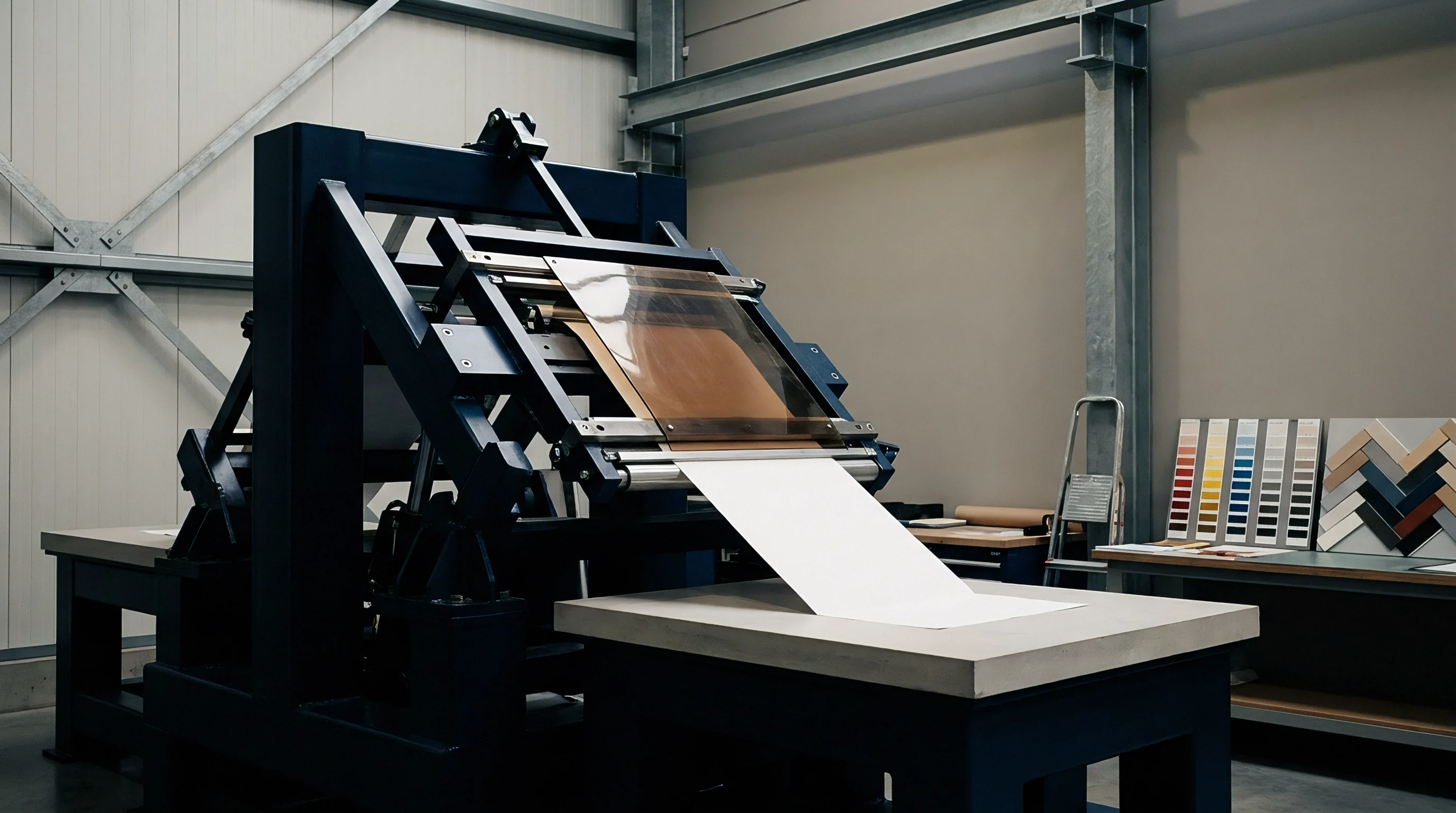
Correcting single-sided thermal lamination curl requires inline mechanical intervention immediately after the heated nip while the adhesive layer and polymer film remain warm and pliable. Modern laminating lines employ adjustable decurling bars, often called breaker rolls or decurler rods, to introduce counter-strain into the substrate composite. Passing the web over a small-radius steel bar under controlled wrap angles forces the unlaminated paper fibers into outer-radius tension.
This plastic deformation stretches the back side of the board, matching the strain length of the cooling polymer film and effectively cancelling the curl bending moment.

How Does Breaker Bar Radius Dictate Substrate Yield?
The geometry of the decurling interface governs the balance between curl correction and structural damage to the paperboard matrix. A small bar radius concentrates bending stress into a narrow contact zone, creating high localized tensile strain on the unlaminated face. If the radius is too sharp relative to board caliper, the process fractures the outer fiber layer or ruptures the reverse-side clay coating.
Conversely, a large bar radius fails to exceed the yield point of heavy paperboard, resulting in elastic recovery where the sheet snaps back into a curled state within hours of slitting.
| Board Caliper (µm) | Decurler Bar Radius (mm) | Web Wrap Angle (Degrees) | Web Tension (N/m) | Post-Finish Flatness Status |
|---|---|---|---|---|
| 200 | 4.0 | 25 | 180 | Flat within 2mm arch limit |
| 300 | 6.0 | 35 | 240 | Flat within 2mm arch limit |
| 400 | 8.0 | 45 | 310 | Flat within 3mm arch limit |
| 500 | 12.0 | 60 | 380 | Slight reverse curl at tail end |
Executing an inline decurling adjustment sequence follows a precise mechanical progression to avoid web breaks while establishing dimensional stability across the run:
- Increase web unwind tension until all lateral film wrinkles dissipate before entering the thermal nip zone.
- Engage the primary decurler bar by rotating the entry guide roll to establish an initial ten-degree web wrap angle over the rod.
- Observe sheet exit behavior at the automatic shear cutter, checking for immediate upward or downward panel curvature.
- Increase wrap angle incrementally in five-degree steps until the sheet lands dead flat on the delivery table.
- Verify reverse-side coating integrity using a 10x optical loupe to confirm zero micro-fracturing along the tensioned fiber surface.
Increasing web tension over a sharp breaker bar compensates for high film shrink force but risks permanent micro-fracturing of the unlaminated coating layer.
Line operators rely on mechanical intuition when matching rod diameter to substrate stiffness. Smaller rod radii demand reduced wrap angles to protect surface fibers on lightweight stocks.
Grain
Anisotropy in machine-made paper and paperboard governs how lamination stresses manifest across different sheet axes. Fiber orientation produced during wet-end forming aligns the majority of cellulose structures parallel to the machine direction. Consequently, elastic modulus in the machine direction is typically two to three and a half times greater than in the cross direction.
Moisture-induced expansion behaves inversely: individual wood fibers swell predominantly in diameter rather than length, making cross-direction hygral expansion four to eight times higher than machine-direction expansion. Single-sided thermal lamination accentuates this structural asymmetry, producing severe cross-direction tub curl if press sheet imposition ignores fiber layout.
Matching sheet layout to carton converting requirements demands structural discipline during pre-press imposition planning. When single-side laminated folding cartons are die-cut with their primary crease lines running parallel to the machine direction, the low cross-direction bending stiffness allows film contraction to bow the main display panels easily. Aligning main panel fold lines perpendicular to the machine direction utilizes the high elastic modulus of the fibers to resist film pull.
Substrate selection must balance flexural rigidity against score cracking limits.
- Machine Direction Alignment places long panel dimensions parallel to fiber run, maximizing resistance to thermal film contraction along major panel spans.
- Score Line Clearance Allowances widen female channel dies by 10 to 15 percent on single-laminated stock to prevent film tearing during high-speed folding passes.
- Substrate Stiffness Ratio Selection specifies paperboard lots with machine-to-cross stiffness ratios below 2.2 for applications requiring multi-directional panel stability.
Cross-direction hygral expansion accounts for nearly four-fifths of all post-press dimensional distortion in single-side film laminates.
Delivery contracts governing technical paperboard purchases incorporate standard inspection requirements under ISO 187 protocols. These clauses establish that dimensional stability claims require substrate testing under controlled conditioning, shifting financial liability for moisture-induced curl onto the converter if plant atmospheric logs show relative humidity deviations exceeding five percent during processing passes.
Exposure
Post-processing storage conditions determine whether a balanced, single-side laminated sheet maintains flatness through end-use converting. Palletized stacks of single-side laminated board exhibit localized micro-climates. The center of a dense pallet remains isolated from atmospheric changes, retaining the low moisture levels established inside the thermal nip.
Sheet margins exposed to room air absorb or lose water vapor rapidly based on storage facility climate. This differential rehydration creates dish-shaped distortion across top sheets and edge-fluting throughout the outer perimeter of the stack. Stretch-wrapping pallets with vapor-impermeable polyethylene film immediately after sheet slitting halts perimeter moisture absorption, locking in dimensional equilibrium until die-cutting operations commence.
Recyclability schemes under modern Extended Producer Responsibility systems penalize single-sided film laminates due to fiber recovery friction. Mechanical pulping systems struggle to separate thin polypropylene films from cellulose fiber networks during standard hydro-pulping cycles. Under European Standard EN 13430, single-sided film applications must prove fiber yield recovery exceeding 85 percent to avoid elevated waste treatment surcharges.
Water-dispersible thermal adhesives ease film separation, but increase sensitivity to ambient humidity changes during storage, worsening long-term curl potential.
Financial risk modeling demonstrates the true landed cost of single-sided thermal lamination failures. Consider a converting job comprising 50,000 sheet units of 350 gsm solid bleached board, laminated single-sided with 24-micron gloss polypropylene film at a base material cost of 0.85 USD per sheet. Standard inline processing waste runs at roughly 2.0 percent.
If uncorrected single-sided curl causes auto-feeder trips and register jams at the high-speed die-cutter, scrap rates routinely spike to 8.5 percent. This increase adds 3,250 spoiled sheets to the job docket, representing 2,762.50 USD in direct lost material costs, excluding lost press time billed at 220.00 USD per hour.
What structural modifications inside the fiber matrix can substrate mills engineer to permanently equalize single-sided polymer contraction without relying on energy-intensive mechanical decurling passes on line?