Viscoelastic Shear Slip at Polymer Film Interfaces in Laminated Cellulosic Matrix Packaging
Viscoelastic shear slip along film-board interfaces is minimized by balancing web tension, maintaining adhesive storage modulus, and matching crease geometry.
Creep

Interfacial Stress Accumulation in Cellulosic Polymeric Composite Sheets
Laminated folding cartons combine anisotropic cellulosic networks with synthetic polymer films to establish liquid barriers, oil resistance, and specific optical finishes. High-speed converting lines join biaxially oriented polypropylene, polyethylene terephthalate, or bio-based polylactic acid to solid bleached sulphate or folding boxboard using solventless polyurethane, waterborne acrylic, or extruded polyolefin tie layers. The mechanical integrity of this composite relies on stress transfer across the interface between the hygroscopic, viscoelastic paperboard matrix and the hydrophobic polymer film.
Cellulosic fibers expand and contract in response to relative humidity fluctuations, exhibiting dimensional instability perpendicular to the machine direction. Synthetic films respond predominantly to thermal excursions, expanding under ambient heating while maintaining high dimensional stability against moisture. When environmental relative humidity increases from 50 percent to 80 percent at 23 degrees Celsius, solid bleached sulphate board expands by 0.15 to 0.30 percent across the grain direction, while an adjacent 12-micrometer polyethylene terephthalate film exhibits virtually zero moisture expansion.
This dimensional divergence generates localized shear stress at the adhesive boundary layer.
The interface splits.
Time-dependent deformation governs how this shear stress relaxes or causes progressive interfacial displacement. Polymeric tie layers and wet-laminating adhesives operate within their viscoelastic transition zone under normal storage temperatures. Sustained shear stress originating from web tension, reel tight-winding, or hydro-thermal expansion induces steady-state shear slip along the polymer-fiber boundary.
Over extended storage cycles, viscoelastic yield in the adhesive matrix converts elastic strain into permanent relative displacement between the film and the underlying fibers.
| Film Type | Tie Layer Chemistry | Glass Transition Temp (deg C) | Initial Shear Modulus (MPa) | 100-Hour Creep Compliance (1/MPa) |
|---|---|---|---|---|
| Biaxially Oriented Polypropylene (15 μm) | Solventless Polyurethane | -10 to -5 | 120 | 0.085 |
| Polyethylene Terephthalate (12 μm) | Waterborne Acrylic | 70 to 75 | 450 | 0.012 |
| Polylactic Acid (20 μm) | Extruded Polyethylene | 55 to 60 | 280 | 0.042 |
| Low-Density Polyethylene (25 μm) | Direct Extrusion Tie | -120 to -110 | 45 | 0.210 |
Molecular Mechanisms of Time-Dependent Boundary Displacement
Adhesion between synthetic polymers and paperboard relies on a combination of mechanical interlocking within the porous fiber matrix, Van der Waals forces, and hydrogen bonding with surface hydroxyl groups. Corona or flame treatment increases the polar component of film surface energy to at least 42 mN/m, enabling wet adhesive wet-out prior to mechanical nip compression. Once cured, the adhesive layer forms a discrete domain with distinct glass transition behavior and creep dynamics.
Cellulose expands rapidly.
An interfacial shear stress threshold of 0.35 MPa initiates irreversible polymer chain micro-sliding in solventless polyurethane tie layers conditioned at 23 degrees Celsius and 50 percent relative humidity.
Temperature fluctuations alter the free volume within the amorphous regions of the adhesive polymer. Storage conditions above the adhesive glass transition temperature accelerate molecular chain mobility, reducing the shear modulus and accelerating interfacial creep rates. Under constant shear stress induced by paperboard expansion, polymer chains slide past one another, causing macroscopic film register movement, edge lifting, and localized tunnel formation near die-cut boundaries.
Is interfacial shear slip primarily controlled by adhesive crosslink density or by paperboard surface roughness?

Viscosity
Converting Line Dynamics and Fluid Rheology
Application of thin laminating adhesives requires precise control over shear rate, coat weight, and drying kinetics to prevent premature viscoelastic failure. Rotogravure and smooth roll coater units deliver liquid adhesives at shear rates exceeding 10,000 reciprocal seconds within the metering gap. At these extreme rates, non-Newtonian adhesive formulations undergo shear thinning, dropping in viscosity to ensure uniform coating distribution across the paperboard substrate without pinholes or streak patterns.
Adhesive compliance dictates yield.
Following nip application, the adhesive layer must rapidly regain sufficient structural viscosity to resist web tension differentials before entering the drying tunnel or rewind reel. If the recovery of the storage modulus is delayed, web tension variations cause initial shear slipping at the uncured interface. Excess solvent or residual moisture trapped within the composite further plasticizes the adhesive polymer matrix, lowering the effective glass transition temperature and extending the period during which the interface remains vulnerable to slip.
Web Tension Balancing and Nip Mechanics
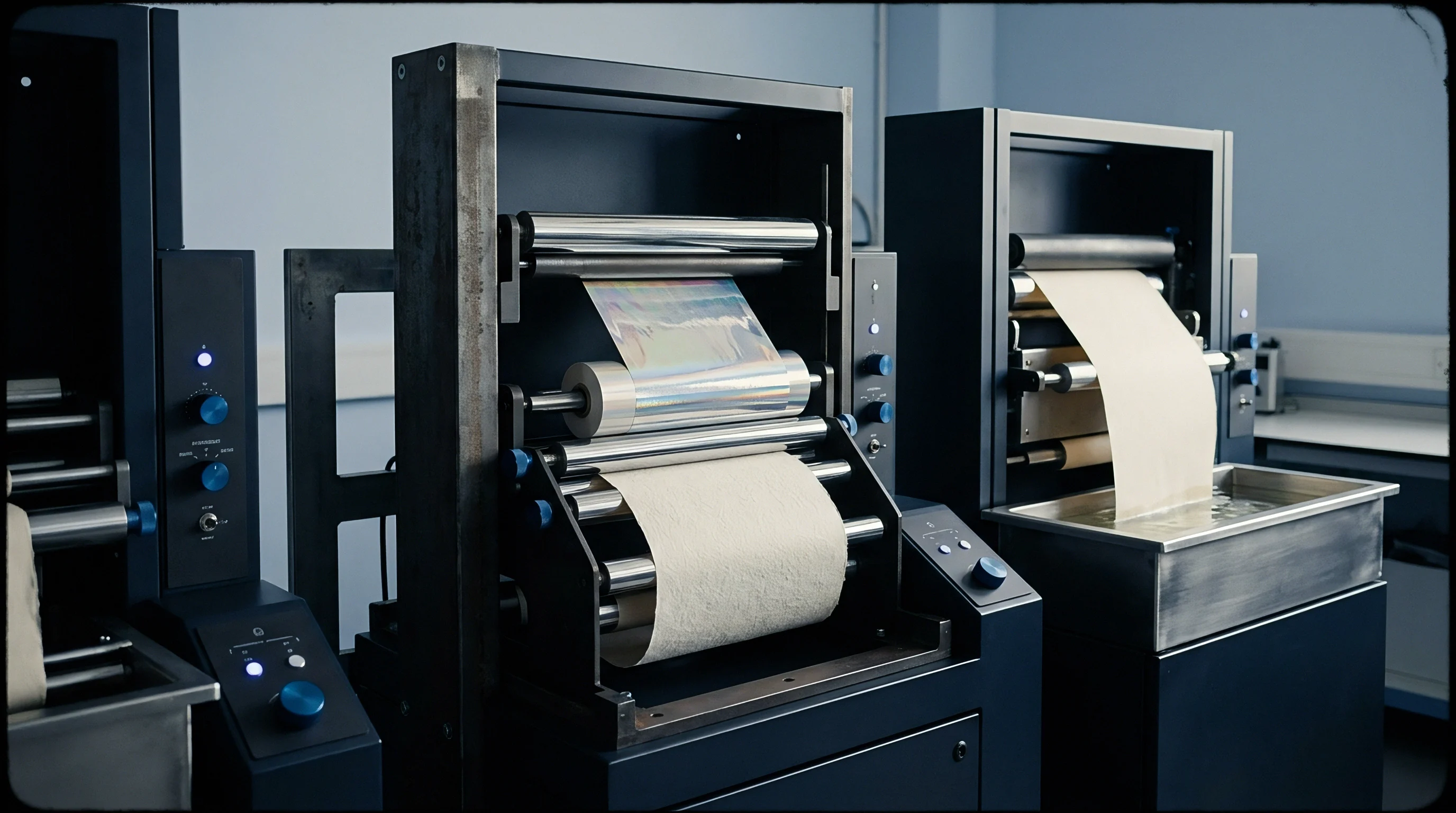
Process optimization requires establishing a tight tolerance band for web tension, nip pressure, and moisture levels across the converting sequence. The following adjustments stabilize the interface during continuous roll-to-roll production:
- Set unwind tension on the primary paperboard web to maintain total strain below 0.08 percent based on measured tensile modulus.
- Adjust film unwind brake force to match the instantaneous elastomeric elongation of the board web at the primary nip point.
- Calibrate pneumatic nip pressure between 3.5 bar and 5.0 bar across a 70-durometer rubber impression roll to maximize physical contact area without crushing paperboard caliper.
- Regulate thermal drying zones to ensure residual solvent content in the dry adhesive film remains strictly below 3 milligrams per square meter before reel rewind.
Heat restores equilibrium.
When rewind tension exceeds the instantaneous yield strength of the semi-cured adhesive, internal shear stress becomes locked into the wound roll. As the reel cools over 24 to 48 hours, thermal contraction of the film opposes moisture equilibration of the cellulosic matrix, driving interfacial creep while the material rests on the floor.
Excessive web tension during lamination creates internal locked-in stress that manifests as delayed film creep during post-converting storage.
Converting suppliers routinely explain interfacial separation by asserting that paperboard moisture excursions exceeded contract specifications during customer storage.
Shear
Standardized Qualification of Interfacial Mechanics
Evaluating interfacial shear slip resistance requires standardized test methods that isolate long-term static shear loading from rapid dynamic peel forces. Standard tape testing and 180-degree dynamic peel trials measure surface tack and short-term adhesion, failing to capture time-dependent viscoelastic creep under sustained low-magnitude loads. Laboratory protocols utilize modified lap-shear configurations combined with controlled environmental conditioning to monitor relative interfacial displacement over time.
Specimens are prepared by laminating a 25-millimeter wide film strip to a rigid paperboard carrier using the specified adhesive coating weight. A static load ranging from 5 N to 20 N applies constant shear stress parallel to the bond interface while optical micrometers track film movement over a 100-hour duration. Testing performed inside environmental chambers governed by ISO 187 isolates the compounding effects of relative humidity and thermal exposure.
| Test Condition ID | Temperature (deg C) | Relative Humidity (%) | Applied Shear Load (MPa) | Mean 100-Hr Displacement (mm) | Failure Mode |
|---|---|---|---|---|---|
| Standard Ambient | 23 | 50 | 0.20 | 0.04 | No Failure |
| Elevated Humidity | 23 | 85 | 0.20 | 0.38 | Fiber Tear Creep |
| Elevated Thermal | 40 | 50 | 0.20 | 0.82 | Adhesive Cohesive Slip |
| Tropical Transport | 40 | 85 | 0.20 | 2.15 | Interfacial Delamination |
Modes of Interfacial Degradation
Analysis of failed composite samples reveals distinct mechanical breakdown pathways depending on surface preparation, adhesive choice, and environmental exposure levels.
Films retain memory.
- Adhesive Cohesive Slip occurs when internal polymer chain cohesion degrades, resulting in smooth relative sliding with adhesive residue left symmetrically on both substrate surfaces.
- Interfacial Adhesive Failure manifests as clean separation between the cured adhesive layer and the polymer film surface, indicating insufficient initial surface treatment or severe corona treatment decay over time.
- Substrate Delamination Slip takes place within the top fiber layer of the paperboard matrix, where shear stress exceeds the internal z-directional strength of the cellulosic network.
- Hydrolytic Tie-Layer Breakdown emerges under high humidity conditions when water molecules permeate the film, breaking ester bonds within polyurethane adhesives and dropping shear modulus.
Standard quality documentation specifies that any laminated composite exhibiting interfacial displacement exceeding 0.5 millimeters under a 0.20 MPa static shear load after 48 hours at 40 degrees Celsius and 85 percent relative humidity results in immediate lot rejection at the buyer receiving dock.

Crease

Deformation Mechanics along Score Lines
Carton converting subjects laminated paperboard to severe localized bending deformation. During die-cutting and creasing, male scoring rules force the composite sheet into female channel dies, inducing intense compression on the inner board surface and extreme tension on the outer polymer film surface. The scoring operation requires the paperboard matrix to delaminate internally along pre-engineered shear planes, forming a controlled internal hinge.
When the scoring rule strikes the sheet, stress distribution shifts from pure tension to severe interfacial shear along the bend radius. If the adhesive tie layer lacks sufficient elastic recovery or exhibits high shear compliance, the film slips relative to the top liner of the board during crease formation. This localized displacement causes film gathering, surface wrinkling, or micro-flaking along the score line fold.
Where Do Interfacial Displacements Concentrate along Package Creases?
Displacements concentrate at the outer shoulders of the creased score line, where the differential radius between the stretched film and the compressed paperboard reaches its peak. Tension distorts score lines.
Bending induces local strain.
Selection of score rule geometry, channel width, and creasing depth dictates the magnitude of shear stress imposed on the adhesive interface. Excessive crease depth crushes the board matrix, forcing adhesive out of the bond zone and initiating edge delamination. Insufficient channel width forces the polymer film to absorb excessive elongation, driving viscoelastic slip to relieve localized tension along the package edge.
Cellulosic moisture absorption during storage alters the internal shear strength of folding boxboard, increasing the probability of score line film delamination during high-speed carton erecting.
An improper match between creasing rule dimensions and composite sheet thickness causes permanent film necking, score line bursting, and unlaminated ridges that destroy barrier integrity along carton edges.
Margin
Economic Consequences and Recyclability Modulations
The selection of laminating chemistry and film structures directly dictates both converting efficiency and regulatory packaging fees. Extended producer responsibility schemes across international jurisdictions apply financial penalties to paperboard packaging containing non-separable synthetic polymer films. Standard solid bleached board decorated with a 15-micrometer biaxially oriented polypropylene film faces higher end-of-life processing fees unless the film cleanly separates during industrial hydropulping cycles.
When viscoelastic shear slip occurs prematurely, high-speed automated filling lines experience machine downtime due to cartoning jams, misfeeds, and optical sensor read errors caused by wrinkled film surfaces. A single line stoppage on a high-speed pharmaceutical cartoning line running at 400 packs per minute generates substantial financial waste within minutes, far exceeding the initial material cost of high-performance adhesive systems.
| Specification Architecture | Added Laminating Pass Cost (per 1,000 m2) | Typical Converting Spoilage Allowance (%) | Modulated EPR Fee Penalty (per Tonne) | Hydropulping Fiber Recovery Efficiency (%) |
|---|---|---|---|---|
| BOPP Film + Solventless Polyurethane | 45.00 USD | 2.5 | +180.00 EUR | 72 |
| PET Film + Waterborne Acrylic | 58.00 USD | 3.0 | +240.00 EUR | 65 |
| Dispersion Barrier Coating (Direct) | 38.00 USD | 1.5 | 0.00 EUR | 96 |
| PLA Bio-Film + Compostable Tie Layer | 85.00 USD | 4.5 | +90.00 EUR | 88 |

Verification Audits and Dossier Compliance
Converters and brand owners maintain rigorous technical documentation to substantiate both functional performance and recyclability claims. Auditing regulatory compliance requires verifying the precise chemical composition of adhesive layers alongside physical stress qualifications.
Coated boards resist wet.
Procurement dossiers for laminated packaging materials must include the following structural data points:
- Certified Chemical Inventories specifying that all adhesive tie layers comply with relevant food-contact regulations under EU Regulation 10/2011 and FDA 21 CFR 175.105.
- Standardized Recyclability Certificates documenting fiber yield above 85 percent following pulp breakdown under standard laboratory disintegration methods.
- Shear Creep Qualification Data proving interfacial displacement remains below 0.3 millimeters under environmental stress conditioning.
- Corona Treatment Residual Logs confirming surface energy levels on incoming film reels met minimum threshold requirements at the moment of lamination.
Waste fees escalate quickly.
High crosslink density in tie-layer adhesives increases shear resistance while reducing recyclability scores at the mill.