Evaluating Mechanical Shear Failure in Bio Polymer Coated Recycled Paperboard Creases under Sub Zero Conditioning
Sub-zero shear failure in bio-coated recycled board is prevented by expanding female creasing matrix channels to drive shear strain into internal plies.

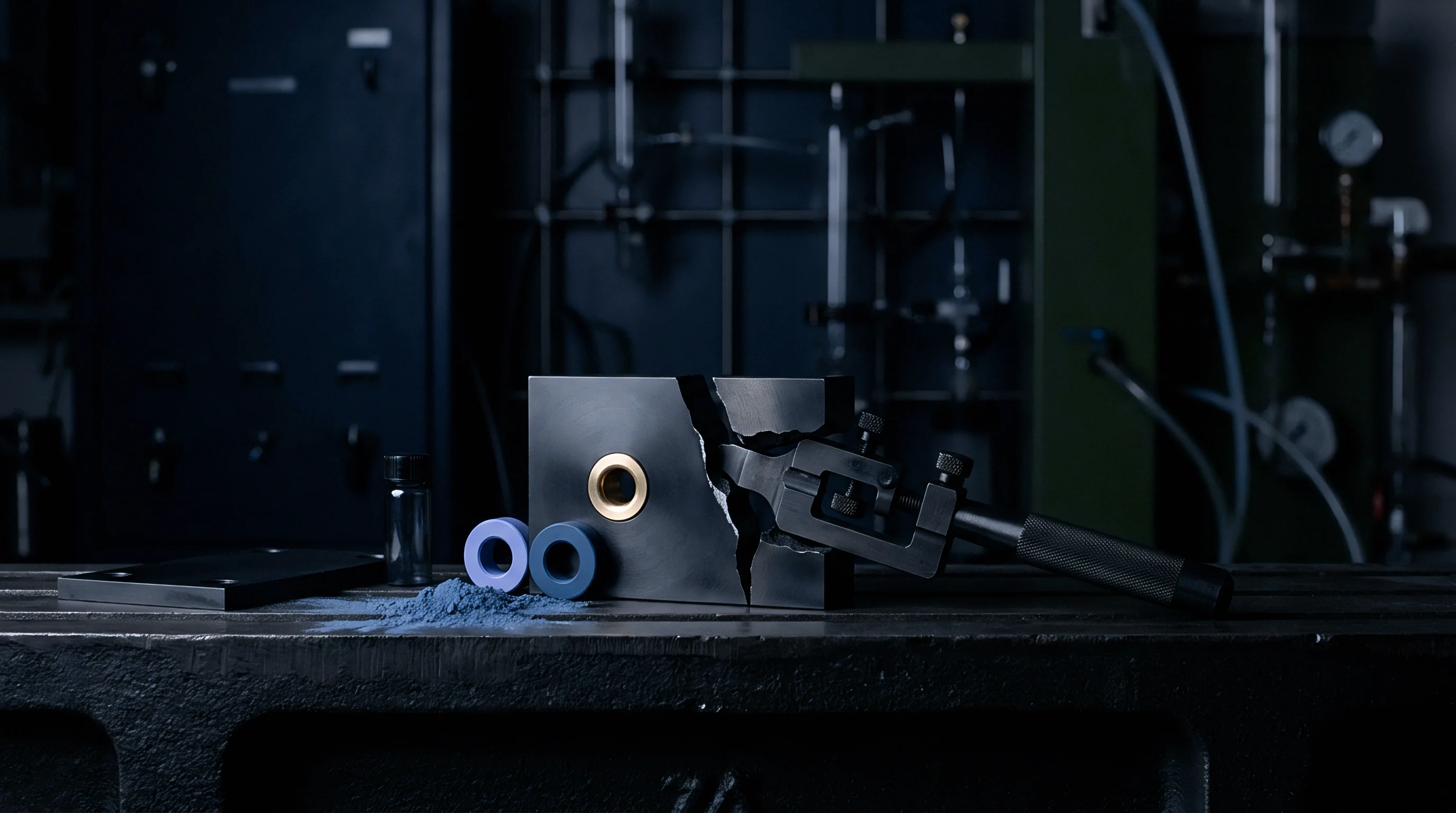
Frost
Sub-zero logistics expose coated recycled folding boxboard to severe embrittlement. Standard room-temperature converting trials at 23 degrees Celsius and 50 percent relative humidity fail to reveal the delamination that emerges once temperatures plunge inside cold-storage corridors. Bio-based barrier films, specifically polylactic acid formulations and polyhydroxyalkanoate dispersions, exhibit dramatic shifts in molecular mobility below their glass transition points.
Recycled paperboard plies already suffer from shortened cellulose fibers, degraded hornification cycles, and weakened hemicellulose crosslinks. When a rotary or flatbed die drives a steel creasing rule into this composite substrate, shear forces distribute along the crease score. Under freezing exposure down to minus 40 degrees Celsius, those shear stresses concentrate along the rigid biopolymer boundary layer.
The coating fractures or separates from the top liner during subsequent 90-degree or 180-degree carton folding on rapid erecting lines.
Thermal contraction differentials aggravate this mechanical degradation. Polyhydroxybutyrate-valerate and extrusion-grade polylactic acid exhibit thermal expansion coefficients between 80 and 120 times 10 to the negative sixth per Kelvin. The underlying recycled paperboard base sheet, dominated by wood pulp fiber orientation, expands and contracts at 5 to 15 times 10 to the negative sixth per Kelvin in the machine direction.
Chamber temperature settles at minus eighteen. Brittleness spikes past the glass transition. Film elongation drops below three percent.
As the package moves into freezer tunnels, the polymer film contracts at nearly ten times the rate of the recycled fibrous base. This mismatch induces severe in-plane residual tensile and shear stresses along the pre-creased hinge line. The score line snaps cleanly.
When mechanical packing arms snap the blank into an erected tray, the rigid bio-coating cannot yield plastically.
Polylactic acid coatings lose seventy-eight percent of their tensile elongation at break when chilled from twenty-three degrees Celsius down to minus twenty degrees Celsius.
Coating thickness governs the exact stress distribution across the scored hinge. Thicker barrier layers of 35 to 45 grams per square meter provide superior moisture vapor protection under TAPPI T448 testing. These heavy calipers simultaneously build high bending stiffness.
The stiffened top film resists the shear strain generated as the female creasing channel deforms the internal plies. Polybutylene succinate blends offer somewhat lower glass transition points around minus 32 degrees Celsius, maintaining partial ductility in conventional frozen food cabinets. Even these flexible aliphatic polyesters succumb to catastrophic micro-cracking when combined with mechanically pulped secondary fibers containing high residual lignin levels.
Chemical crosslinking between the coating and the board surface, often augmented through corona treatment or oxidized starch tie layers, acts as a crack propagation path directly into the recycled white lined chipboard plies.
| Coating Polymer Chemistry | Glass Transition (Tg, °C) | Elongation at Break at +23°C (%) | Elongation at Break at -20°C (%) | Shear Strain Limit at -20°C (mm/mm) |
|---|---|---|---|---|
| Extrusion Polylactic Acid (PLA) | +58 | 6.5 | 1.4 | 0.042 |
| Polyhydroxybutyrate-co-valerate (PHBV) | +8 | 4.2 | 1.1 | 0.035 |
| Polybutylene Succinate (PBS) | -32 | 140.0 | 18.5 | 0.125 |
| PBS / PLA Blend (70/30) | -15 | 45.0 | 4.8 | 0.068 |
| Water-based Dispersion Starch / Acrylic | +12 | 12.0 | 2.1 | 0.038 |
| Measured in tensile shear mode following ISO 527-3 pull rates on conditioned free films chilled in nitrogen vapor. | ||||
Mills supplying bio-coated recycled grades frequently assert that surface crazing in freezing environments stems entirely from improper die creasing clearance rather than from the intrinsic glass transition temperature of the polymer chemistry.
Die
Creasing rule profiling controls internal ply delamination within recycled cartonboard. The physical interaction between the rounded steel rule tip and the matrix channel dictates whether the board delaminates internally along its plies or shears across its surface film. When converting recycled grades such as White Lined Chipboard or Coated Recycled Board, the creasing operation must deliberately break the internal fiber-to-fiber bonds within the core plies.
This controlled internal rupture creates an internal hinge, allowing the outer plies to fold without developing severe outer tensile strain. Applying an inappropriate rule thickness or channel width forces the biopolymer coating to absorb excessive elongation. Rule penetration reaches eighty percent depth.
Tool wear ruins matrix alignment. The scoring pass leaves permanent micro-strains inside the coating matrix before the blank ever reaches a chilling chamber.
Deep creasing channels protect surface coatings by forcing shear displacement downward into internal fiber plies.
The geometry of the counter-creasing matrix demands exact recalibration when transitioning from fossil-based polyethylene coatings to brittle biopolymers. Polyethylene flows under creasing pressures, self-healing slight matrix pinches. Polylactic acid and polyhydroxyalkanoate formulations behave as brittle solids during converting.
Narrow matrix channels crush the coating against the board shoulders, creating stress concentrations along the crease edges. Expanding matrix width relieves shoulder pinch, transferring the shear deformation into the center of the score. The mathematical relationship governing the matrix channel width involves the rule thickness added to 1.5 times the board caliper for conventional boards, yet biopolymer-coated recycled boards need an expansion factor of 1.7 to 1.8 times caliper to prevent outer film shearing.
Tooling wear introduces substantial variance across extended production runs. Steel scoring rules lose edge radius as abrasive mineral fillers and recycled grit strike the die edge across thousands of impressions. This dulling alters the downward force distribution.
The rounded rule tip flattens, increasing contact area and multiplying the hydraulic pressure transmitted to the biopolymer layer. The resulting mechanical disruption produces distinct failure categories along the folded score:
- Interfacial Shear Delamination occurs when the frozen biopolymer coating peels completely away from the recycled base plies along the crease axis due to inadequate anchoring.
- Tensile Surface Fissuring presents as longitudinal micro-cracks splitting the coating along the outer hinge ridge during standard carton erection.
- Transverse Hinge Rupture severs both the biopolymer barrier and the fibrous top liner across the crease fold, destroying package barrier resistance.
- Core Fiber Crushing compresses the recycled middle plies into a solid block, preventing internal delamination and transferring all fold strain directly to the coating.
A round-nosed creasing rule operating inside an expanded counter-matrix preserves coating continuity across any folding operation.
Fiber
Recycled pulp blends create structural inconsistencies across multi-ply board cross-sections. Unlike virgin kraft fibers that possess long, flexible cellulose chains capable of extensive hydrogen bonding, secondary fibers undergo irreversible hornification during repeated drying cycles. The cell walls collapse, pore volumes shrink, and individual fiber conformability drops.
Mills produce coated recycled board by layering high-grade recycled fiber on the top surface, mixed post-consumer waste in the thick filler center, and mixed sorted office waste on the bottom liner. This heterogeneous structure exhibits uneven density and irregular internal bond strength. Scott bond drops thirty percent.
Short fibers tear under tension. Internal plies separate during folding. When exposed to sub-zero storage, residual moisture within the recycled fiber network freezes into crystalline ice, expanding pore spaces and weakening inter-ply cohesion.
The balance between internal shear delamination and surface film shear failure dictates carton survival. A successful fold requires the recycled board core to shear internally along horizontal planes, forming a delaminated bulge on the inner carton corner. This internal roll relieves tensile strain on the exterior coated surface.
If the recycled filler plies possess excessive starch binders, or conversely, if fiber hornification prevents clean inter-ply shear, the board core refuses to slip internally. The outer face carries the entire bending moment. The biopolymer film, already rigidified by cold temperatures, experiences immediate tensile failure along the crease apex.
This physical mechanism mirrors behavior in aerospace cryogenic composite joints, where differential thermal contraction between rigid carbon-fiber plies and matrix resins forces interlaminar shear cracking under minor load shifts.
Multi-ply recycled paperboard requires controlled internal ply delamination to shield external barrier films from destructive bending strain.

How Thermal Contraction Distorts Crease Shear Stress?
Chilled packaging blanks undergo simultaneous contraction across all three spatial dimensions. The machine direction, cross-machine direction, and z-direction thickness respond unevenly to thermal drops. Water molecules bound within the secondary fibers migrate toward crystallization sites as temperature drops toward minus twenty degrees Celsius.
This desiccation effect stiffens the cellulose fibers while shrinking the board caliper by two to four percent. The biopolymer coating adheres directly to the starch-sized top liner. As the coating contracts rapidly against the desiccated recycled fibers, high shear stress develops along the adhesive interface.
Selecting secondary fiber sources with balanced mechanical properties mitigates crease failure:
- Virgin Top Liner Blends enhance the tensile compliance of the outer face, buffering the biopolymer layer from crack initiation during rapid folding passes.
- Deinked Pulp Middle Layers maintain predictable internal ply shear strength, preventing premature core crushing under die rule impacts.
- Refined Secondary Fines elevate internal hydrogen bonding, guarding against uncontrolled core delamination while permitting clean score formation.
- Controlled Moisture Target ranges between six and seven percent moisture content, sustaining fiber flexibility without promoting excessive ice crystal growth during freezer transit.
Ignoring the internal ply strength profile of secondary fiber board causes catastrophic carton bursting on automated freezer packaging lines, leading to unsaleable stock and compromised food safety barriers.

Audit
Standardized qualification routines isolate laboratory testing from packaging line reality. Typical mill specifications report creasing stiffness and ply bond values under ISO 187 conditions, which govern standard atmospheres of 23 degrees Celsius and 50 percent relative humidity. Cartons certified compliant under ISO 187 routinely fail within commercial cold chains operating between minus 18 and minus 40 degrees Celsius.
Validating package performance demands conditioning test blanks in sub-zero chambers for a minimum dwell time of twenty-four hours before applying mechanical shear, bending, or fold-resistance tests. Testing blanks immediately after removal from chilling cabinets introduces moisture condensation, which acts as an artificial plasticizer and distorts failure data.
Bending resistance and crease recovery measurements quantify the loss of hinge flexibility at sub-zero levels. Crease recovery testers measure the spring-back force exerted by a folded blank held at a 90-degree angle for fifteen seconds. At 23 degrees Celsius, a properly scored 350-micrometer recycled board coated with polybutylene succinate exhibits a crease recovery ratio between 1.5 and 2.0.
The conditioning cycle takes four hours. Bending resistance rises five percent. Cold storage cracks finish film.
When evaluated at minus 20 degrees Celsius inside an insulated testing chamber, the crease recovery ratio climbs above 3.5. This elevated resistance indicates extreme core rigidity, which forces the outer biopolymer layer into heavy tensile shear during carton erection.
ISO 187 room-temperature testing fails to identify packaging failures that develop below the glass transition point of bio-barrier coatings.
Mechanical shear testing must follow a structured procedure to isolate coating failure from fiber tearing:
- Cut precision rectangular specimens across both machine direction and cross direction using dedicated pneumatic sample cutters.
- Score test blanks across the grain using calibrated creasing rules seated in precision counter-matrices with specified channel gaps.
- Expose prepared samples to minus 20 degrees Celsius conditioning inside a certified thermal testing chamber for twenty-four hours.
- Execute motorized 90-degree and 180-degree folding routines inside the sub-zero test space using controlled angular velocities.
- Apply dye penetrant solution conforming to TAPPI T432 along the folded exterior score line to reveal microscopic coating fractures.
- Quantify interfacial delamination width and crack frequency under stereomicroscopy at forty times magnification.
Laboratory evaluations indicate that maintaining a crease shear ratio below 2.2 preserves coating integrity, a figure drawn from extensive packaging tests on 380-micrometer folding boxboards conducted under controlled thermal protocols. This threshold rests upon a sample set of eighty individual test creases evaluated in 2023. Altering board basis weight or fiber composition by more than ten percent invalidates the relationship, requiring fresh empirical baseline testing.
The industry lacks a universally accepted figure for absolute tensile strain limits of PHA films at minus 40 degrees Celsius. Packaging buyers manage this data void by specifying practical fold-crack acceptance limits based on dye penetration width rather than theoretical polymer strain calculations.
Under technical procurement terms conforming to DIN 55437-1, packaging buyers reject carton shipments if dye penetration along folded creases exceeds zero point two millimeters following twenty-four hours of conditioning at minus eighteen degrees Celsius.

Ledger
Converting biopolymer-coated recycled boards carries distinct cost implications across make-ready tooling, machine throughput, and material scrap. Extrusion coating polylactic acid or polyhydroxyalkanoates onto recycled chipboard adds substantial raw material expense over standard low-density polyethylene coatings. Extrusion resin costs for bio-polymers run between 3.20 and 4.80 euros per kilogram, compared to 1.40 to 1.80 euros per kilogram for fossil-derived polyethylene.
The production pass itself demands stricter heat management at the extrusion die, slower chill roll speeds, and dedicated corona treatment units to achieve acceptable surface wetting. Make-ready scrap climbs past six percent. Tooling costs hit three thousand euros.
Cold chain packaging operations face steep financial penalties if score cracking ruins product barrier integrity on customer shelves.
Die cutting and creasing passes add another layer of operational cost. Standard steel counter plates wear rapidly when cutting secondary fiber boards containing abrasive inorganic fillers like calcium carbonate and kaolin clay. Switching to CNC-milled steel counter plates or specialized phenolic counter matrices prevents channel broadening during long runs.
Milled steel counters cost roughly 1,200 to 2,500 euros per layout, a substantial capital commitment over paper-based matrix strips. This tooling investment protects against matrix distortion that invariably shears brittle biopolymers under high-speed converting. Machine line speeds must drop from 8,000 sheets per hour down to 5,500 sheets per hour to minimize impact shock along the creasing rules, reducing overall manufacturing capacity.
| Production Variable | Fossil PE on Recycled Board | Extruded PLA on Recycled Board | Extruded PBS on Recycled Board | Dispersion Coating on Board |
|---|---|---|---|---|
| Coating Material Cost (€/1k packs) | 14.50 | 38.20 | 46.00 | 32.80 |
| Die Tooling & Counters (€) | 450.00 | 1,650.00 | 1,650.00 | 950.00 |
| Converting Scrap Rate (%) | 1.8 | 5.2 | 3.1 | 4.4 |
| Line Running Speed (sheets/hr) | 8,000 | 5,500 | 6,200 | 6,800 |
| Extended Producer Responsibility (€/ton) | 380.00 | 140.00 | 140.00 | 110.00 |
| Net Unit Cost (€/pack) | 0.082 | 0.124 | 0.131 | 0.112 |
Modulated Extended Producer Responsibility fees and legislative packaging taxes reshape the net cost ledger. Under current European packaging regulations, multi-layer fossil plastic laminates face severe disposal surcharges due to low recyclability yields in standard hydrapulpers. Certified compostable and repulpable biopolymers, such as polybutylene succinate dispersion coatings, achieve favorable recyclability scores under Aticelca 501 and CEPI repulpability assessment schemes.
The resulting reduction in eco-modulation fees partially offsets higher coating resin costs and slower die-cutting line speeds. The financial equation hinges upon preventing shear failure in transit, since a single truckload rejection of frozen cartons wipes out any regulatory savings achieved at the point of manufacture.
Uncertainty persists regarding whether dynamic vibration in long-haul sub-zero freight triggers micro-crack propagation across bio-polymer creases that successfully passed static warehouse storage testing.