Dynamic Mechanical Recovery Thresholds and Z Axis Shear Failure Mechanics in Recycled Fibre Board Stock
Dynamic mechanical recovery thresholds set the limit where cyclic shear causes permanent ply delamination, dropping box stacking strength in transit.
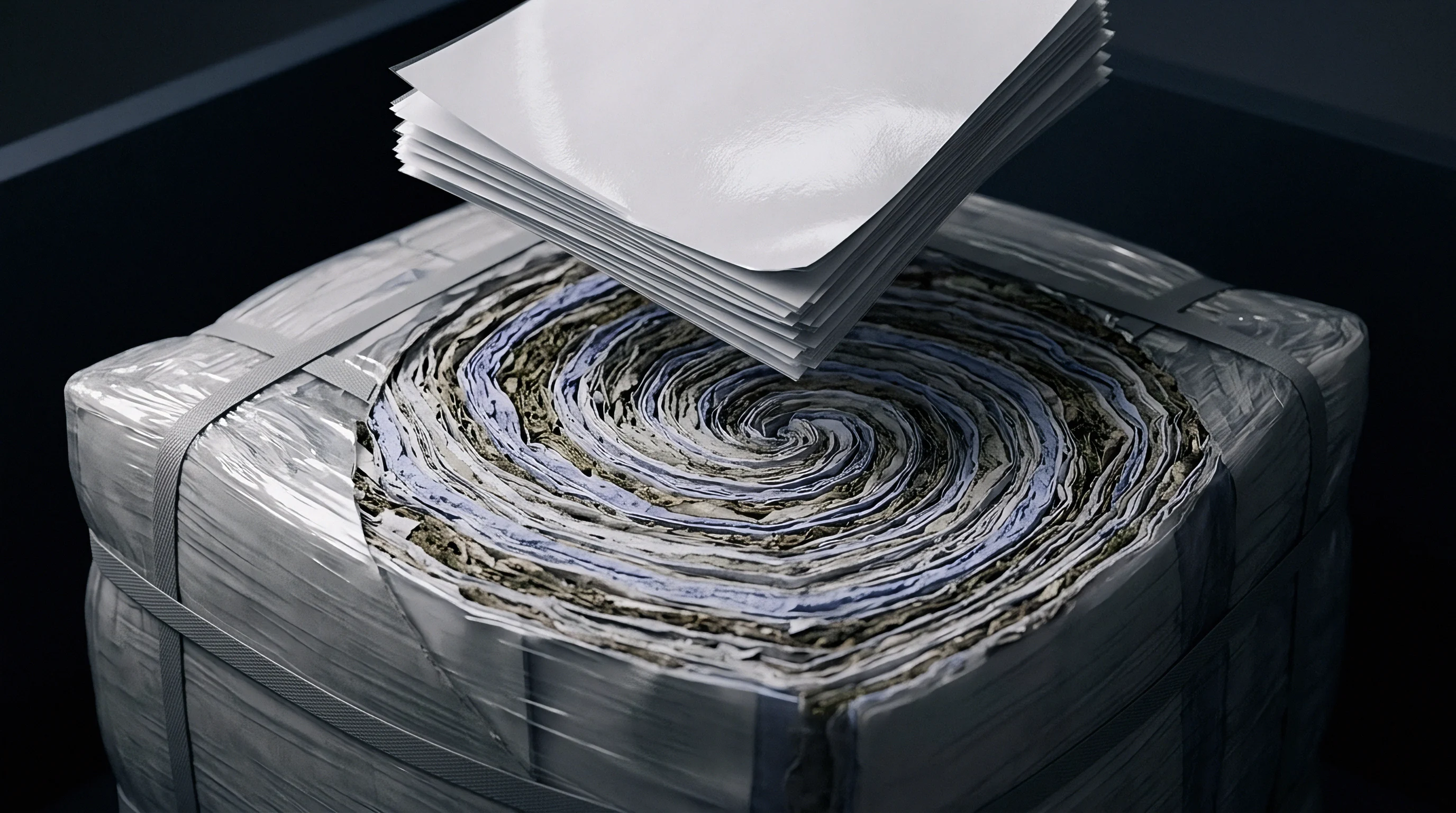
Tenacity
An engineer inspecting a corrugated transport container after long-haul transit often discovers delamination along the score lines or interior creasing planes, even when static crush metrics passed initial testing. Recycled fibre board stock endures repeated cyclic compression and out-of-plane micro-displacements during road, rail, and marine distribution. Static laboratory indicators, such as flat crush resistance under ISO 3035 or short-span compression strength via ISO 9895, measure immediate yield capacity under monotonic loading rates of 12.5 millimetres per minute.
These baseline tests fail to characterize rate-dependent energy dissipation or out-of-plane shear fatigue. Dynamic mechanical analysis under cyclic loading reveals an operational endurance boundary. When cyclic transverse shear stress exceeds approximately 38 percent of static z-directional ultimate tensile strength under standard conditioning of 23 degrees Celsius and 50 percent relative humidity, secondary cell-wall micro-fibrils exhibit progressive inter-laminar disengagement.
This fatigue accumulation induces irrecoverable plastic deformation across internal plies.
Cellulose fibres recovered through multiple recycling loops display hornification, marked by irreversible pore closure within internal fibre walls. Recycled furnishes feature shortened mean fibre lengths, diminished swelling indices, and fractured external surfaces. These degraded physical properties directly reduce relative bonded area across the z-axis.
The Scott internal bond strength, governed by TAPPI T 569, declines markedly as recycled content increases from zero to one hundred percent in multi-ply containerboard liners. Virgin kraft liners typically sustain internal bond values exceeding 280 Joules per square metre. Highly recycled testliner counterparts regularly fall between 120 and 170 Joules per square metre under identical atmospheric equilibrium.
This lower baseline makes the furnish susceptible to cyclic fatigue. The mechanical network experiences progressive stress-softening when exposed to alternating out-of-plane forces, accelerating internal failure.
An internal energy dissipation threshold separates transient viscoelastic flexure from permanent inter-fibre delamination in multi-ply recycled substrates.
Dynamic mechanical recovery defines the proportion of stored strain energy a fibrous network returns upon cyclic stress relaxation. The mathematical threshold for elastic restitution correlates with the internal storage modulus measured during continuous waveform excitation. Recycled paperboard exhibits pronounced viscoelastic non-linearity.
Subjecting a 150-gram-per-square-metre testliner to dynamic sinusoidal out-of-plane shear reveals a critical boundary condition. The storage modulus maintains stability across cyclic shear strains under 0.15 percent. Strains past 0.40 percent trigger an abrupt rise in the loss factor, signaling substantial thermal and frictional dissipation from inter-fibre bond rupture.
Subsequent cycles exhibit reduced mechanical recovery, leaving the web vulnerable to catastrophic ply separation.
Industrial converting processes aggravate these micromechanical limitations. Modern rotary die-cutters, high-speed folder-gluers, and automated packing equipment operate at line speeds exceeding 350 metres per minute. Rapid creasing imposes severe transverse shear strain on the sheet.
If score depths and female counter-channel clearances do not match recycled furnish properties, the plies fracture internally before cartons enter distribution. Converting operations require precise clearance ratios to accommodate the reduced z-axis extensibility of recycled furnish. Production margins narrow, as processing mistakes degrade field survivability across multi-tier retail transit environments.
The operational life of secondary packaging depends entirely on matching cyclic transport acceleration profiles to the dynamic recovery threshold of the board grade. When transport vibrational inputs exceed the damping capacity of recycled furnish, micro-cracks form within lignin-poor amorphous regions between adjacent plies. Progressive cracking initiates irreversible structural collapse long before static pallet loads reach rated capacities.

Ply
Multi-ply paperboard machines assemble separate fibre slurries to engineer target bending stiffness and calipers at reduced production costs. Machine builders apply high-grade virgin pulp or cleaner secondary fibre to top plies for print quality, while loading middle plies with low-cost mixed waste, deinked pulp, and mechanical screenings. This layered design creates distinct shear stress gradients across adjacent interfaces.
Finite element analysis of corrugated board under combined bending and edge compression reveals peak transverse shear stresses concentrated at the core-to-liner adhesive boundary and internal ply transitions of the liner itself.

Out-of-Plane Stress Fields and Transverse Displacement
Z-axis mechanical properties diverge significantly from in-plane machine and cross-direction metrics. Paper is mechanically orthotropic, displaying distinct material properties across principal axes. The ratio of in-plane elastic modulus to out-of-plane shear modulus often exceeds fifty to one in highly recycled linerboard.
When a composite board panel flexes under stacking loads, the middle ply experiences pure transverse shear. In virgin solid bleached sulphate, strong inter-fibre entanglements and high hemicellulose content maintain uniform stress distribution across the sheet thickness. Recycled multi-ply board concentrates transverse strain along the middle plies, where shorter fibres, residual ink particles, and mineral fillers congregate.
Internal bond development during wet pressing relies heavily on starch application between forming wires. Cylinder formers and multi-fourdrinier machines apply native or chemically modified starches at wet-end transfer zones to reinforce inter-ply cohesion. Spraying cooked cationic potato starch at rates between 2.5 and 4.0 grams per square metre bridges low-bonding mechanical pulp fractions.
Thermal drying profile variations across cylinder dryers create micro-voids if starch gelatinization fails to complete before evaporation strips residual water. Micro-voids act as structural stress concentrators under cyclic transit strain, seeding z-axis delamination.
| Substrate Classification | Basis Weight (g/m²) | Equilibrium Density (kg/m³) | Static Scott Bond (J/m²) | Storage Modulus G prime (MPa) | Loss Factor Tan Delta | Dynamic Recovery Ratio (%) |
|---|---|---|---|---|---|---|
| Unbleached Kraftliner (Virgin Softwood) | 175 | 740 | 310 | 82 | 0.045 | 91.2 |
| Testliner Grade 2 (Mixed Recycled Fibre) | 175 | 680 | 165 | 48 | 0.082 | 74.6 |
| Testliner Grade 3 (Deinked Recovered) | 160 | 635 | 135 | 39 | 0.108 | 66.8 |
| Recycled Fluting Medium (Semi-Chemical Simulant) | 140 | 590 | 115 | 31 | 0.124 | 61.4 |
| Solid Bleached Board (Virgin Hardwood/Softwood) | 220 | 810 | 345 | 96 | 0.038 | 94.1 |
The dynamic recovery ratio in the data above drops by nearly thirty percentage points between virgin kraftliner and recycled fluting medium. This mechanical deficit traces directly to inter-ply cohesion and fibre wall stiffness. When dynamic shear loading pushes past the elastic limit, the storage modulus decays through irreversible bond rupture.
The board shifts from an elastic load-bearing material into a dissipative, unbonded structure unable to resist vertical stacking loads.
ISO 16260 internal bond testing under dynamic impact speeds isolates weak plies before converting lines begin high-speed operations.
Cross-sectional inspection of ruptured testliner plies shows clean separation planes directly through starch-starved layers rather than across individual fibre matrices. Converting lines running recycled substrates at high web tensions encounter web breaks when dynamic unwinding tension exceeds degraded internal bond limits. These failures trace to uneven filler distribution within central plies, compounding transverse shear susceptibility.
Rupture
Micro-mechanical breakdown within recycled fibre networks follows a distinct fracture path. Transverse shear failure initiates at microscopic stress concentrations within the cell-wall matrix and propagates along structural plies. The primary fracture path navigates three distinct material zones: cross-ply fibre-fibre contact points, intra-fibre cell wall lamellae, and starch-filler interfaces.
Scanning electron microscopy shows that virgin fibre failure typically ruptures the primary and outer secondary cell walls via complete fibre tear-out. Recycled fibre networks fail predominantly through clean adhesive bond peeling, leaving intact, uncollapsed fibres on fractured planes.

Progressive Delamination Mechanisms and Hornification
Hornification alters the surface energy and contact compliance of papermaking fibres. Virgin fibres are supple, collapsing into ribbon geometries during pressing to maximize molecular contact areas. Recycled fibres resist pressing deformation, retaining tubular, uncollapsed morphologies.
This geometric stiffness reduces relative contact area at crossover points. The fundamental shear strength of an individual contact point, governed by hydrogen bonding and macromolecular inter-diffusion, drops significantly after several recycling cycles.
Out-of-plane shear stress introduces Mode II sliding fracture mechanics into the internal sheet geometry. Under pure Mode II conditions, crack propagation velocity increases exponentially when local shear strain energy exceeds the critical energy release rate. In recycled multi-ply board, the critical Mode II energy release rate falls within a range of 80 to 140 Joules per square metre, compared to 220 to 320 Joules per square metre for unbleached virgin pine kraft sheets.
The crack proceeds through inter-ply boundaries with minimal mechanical impedance once initial micro-voids coalesce.
- Elastic Network Shearing accommodates initial cyclic shear displacement via reversible flexure of amorphous cellulose domains within the secondary wall without bond disruption.
- Localized Bond Micro-Rupture begins when shear displacement surpasses elastic limits, breaking outer-boundary hydrogen bonds at low-density fibre intersections.
- Inter-Lamellar Cleavage spreads across starch-deficient ply interfaces as broken bonds concentrate shear strains into adjacent zones.
- Macroscopic Structural Delamination develops when interconnected micro-cracks form a continuous fracture surface, destroying sheet bending stiffness.
Mineral filler accumulation in recycled furnish worsens this fracture progression. Papermaking loops recycle substantial quantities of ground calcium carbonate, precipitated calcium carbonate, and kaolin clay from coated magazine and packaging stock. Ash content in secondary testliner can exceed eighteen percent by weight.
While mineral fillers improve sheet opacity and ink absorption, they impede inter-fibre bonding. Mineral particles occupy space along cellulose surfaces, preventing hydroxyl groups from establishing hydrogen bonds. Calcium carbonate particles create brittle fracture focal points under transverse shear, lowering the energy needed to drive inter-ply cracks.
Pore water dynamics during dynamic loading also impact rupture mechanics. Residual moisture within fibre networks acts as a plasticizer. At moisture contents above nine percent, water molecules weaken hydrogen bonds across amorphous cellulose chains, lowering both yield strength and transverse shear recovery thresholds.
If cyclic shear occurs under elevated humidity, microscopic plastic flow accelerates across fibre interfaces, hastening sudden z-axis failure.


Hygro
Atmospheric humidity alters mechanical recovery and shear endurance in recycled paperboard. Cellulose is intrinsically hygroscopic, absorbing and desorbing moisture according to environmental relative humidity. Moisture uptake plasticizes the cellulose and hemicellulose matrices, depressing the glass transition temperature of localized amorphous fractions toward ambient conditions.
As environmental humidity shifts, moisture gradients develop through the board caliper, inducing differential hygro-expansion strains that degrade mechanical cohesion.

Cyclic Humidity Loading and Mechanosorptive Creep
Subjecting recycled corrugated packaging to fluctuating humidity under constant or cyclic mechanical load triggers mechanosorptive creep. Mechanosorptive deformation substantially exceeds the sum of pure mechanical creep and free hygro-expansion strain. During moisture sorption cycles, transient swelling and shrinking of internal fibre walls disrupt hydrogen bonds under stress.
Hydrogen bonds break and reform in relaxed, mechanically weakened orientations, generating accelerated permanent shear deformation.
The out-of-plane shear modulus experiences severe degradation during cyclic humidity swings. A testliner sample cycled between 50 percent and 85 percent relative humidity at 23 degrees Celsius can lose more than 45 percent of its static z-axis shear strength within three moisture cycles. The dynamic mechanical recovery threshold falls concurrently.
Under steady-state conditions of 50 percent relative humidity, a recycled furnish might tolerate dynamic shear stress amplitudes of 25 kilopascals before plastic strain accumulates. Under transient moisture sorption, that operational threshold drops below 11 kilopascals. Transport packaging exposed to daily temperature and humidity shifts suffers premature delamination at fractions of its rated mechanical capacity.
| Climatic Conditioning Regime | Equilibrium Moisture (%) | Z-Direction Tensile Strength (kPa) | Mode II Shear Modulus Gzx (MPa) | Loss Tangent Tan Delta | Recovery Threshold Ratio (%) |
|---|---|---|---|---|---|
| 23°C / 50% RH (Static Standard) | 7.4 | 240 | 38.5 | 0.078 | 42.0 |
| 23°C / 85% RH (High Humidity Static) | 11.8 | 145 | 21.2 | 0.134 | 24.5 |
| 23°C / 30% RH (Low Humidity Static) | 5.2 | 295 | 44.1 | 0.061 | 48.5 |
| Cycles 50% to 90% RH (Dynamic Sorption) | 7.2 to 12.6 | 105 | 14.6 | 0.198 | 14.2 |
| 38°C / 90% RH (Tropical Environment) | 13.4 | 88 | 11.8 | 0.225 | 11.5 |
Moisture sorption also degrades internal sizing chemicals, particularly alkyl ketene dimer and alkenyl succinic anhydride. These sizing formulations reduce liquid penetration rates, but do not prevent vapor diffusion through sheet pore structures. In recycled furnish, incomplete chemical distribution and sizing migration during drying leave micro-channels through which moisture enters.
Localized swelling generates internal shear stress along ply interfaces, accelerating dynamic fatigue.
The packaging converter cannot correct for moisture-induced degradation using surface coatings alone without compromising line runnability. Water-based barrier dispersions limit vapor diffusion rates, but introduce process complications during scoring and gluing. Water-barrier films also hinder sheet re-pulping in standard recycling facilities.
Sourcing specifications for humid transit chains require heavier basis weights or virgin blend requirements to compensate for hygro-mechanical losses.
Importers purchasing secondary board stocks regularly identify substantial basis-weight variances across delivered lots. When incoming stock carries unverified recycled fractions, high ambient humidity on the press floor induces edge-wave distortion and internal ply bubbling before cutting dies engage the sheet.
Gauge
Verifying dynamic mechanical recovery thresholds and out-of-plane shear properties requires specialized laboratory instruments capable of isolating z-axis mechanics. Standard quality control routines rely on static tests: the ring crush test via ISO 12192, the short-span compression test via ISO 9895, and the burst test via ISO 2759. These tests evaluate in-plane compressive or tensile resistance, offering limited insight into inter-ply shear fatigue under dynamic transport vibration.
Dynamic Z-Axis Shear Testing Protocols
To quantify dynamic recovery, laboratories mount precision-cut board samples between rigid parallel steel platens using high-modulus cyanoacrylate or structural polyurethane adhesives. The testing apparatus applies an in-line normal compressive pre-load to prevent peel stresses while imposing controlled sinusoidal shear displacements across the plies. An electromagnetic dynamic mechanical analyzer or specialized servo-hydraulic test frame applies frequencies from 0.1 to 50 Hertz, matching frequency bands measured in distribution logistics.
Accurate calibration requires rigorous instrument preparation. Uneven adhesive application or platen misalignment introduces peel moments, transforming pure Mode II shear into mixed-mode Mode I and Mode II failures. The measurement apparatus monitors continuous force, displacement, and phase lag to derive the storage modulus, loss modulus, and dynamic recovery boundary.
When testing recycled stock, five consecutive test runs per reel position capture cross-machine property drift.
- Platen Parallelism Verification aligns upper and lower sample plates to within 0.005 millimetres across testing spans to prevent localized stress concentrations during shear cycles.
- Adhesive Penetration Monitoring controls adhesive penetration depth below 15 percent of outer ply thickness, avoiding artificial reinforcement of interior plies.
- Sinusoidal Frequency Sweeping subjects conditioned samples to dynamic testing cycles from 1 to 30 Hertz to simulate highway vibration frequencies.
- Equilibrium Atmospheric Conditioning stabilizes test specimens according to ISO 187 at 23 degrees Celsius and 50 percent relative humidity for a minimum of 24 hours.
Ultrasonic stiffness testing offers a non-destructive alternative for production environments. Automated ultrasonic velocity gauges direct high-frequency acoustic waves across thickness dimensions to evaluate the z-axis elastic matrix component, C33. The acoustic wave transmission speed correlates with relative bonded area and out-of-plane elastic modulus.
If ultrasonic velocities drop below established control floors, technicians pull suspect reels before converting operations begin.
Single-point burst testing methods yield zero actionable data regarding dynamic inter-laminar shear fatigue thresholds under cyclic distribution strains.
Disputes between board mills and converters often center on testing discrepancies. Mill laboratories cite Scott bond results generated under high-velocity pendulum impacts, whereas converting plants document delamination failures under low-frequency, high-amplitude transport vibrations. Pendulum tests compress timescales and introduce viscoelastic embrittlement, masking structural shear fatigue vulnerabilities found under prolonged low-frequency excitation.
When qualification protocols omit dynamic z-axis evaluation, converting plants absorb the financial fallout. Carton creasing operations develop unpredictable hinge spring-back variations, auto-packer carton feeds jam from delaminated flaps, and compressed cartons collapse during multi-tier container shipments.
Yield
Substrate specification choices balance mechanical integrity against converted unit cost. Converting plants purchase board stock by the metric tonne, but deliver finished packaging as unitized individual cartons. Downgauging basis weight reduces base raw material spend, but lowers caliper, z-axis shear resistance, and structural stability.
Recycled furnish provides lower material cost per tonne, but requires increased basis weight to match the bending stiffness of virgin kraftliner, eroding unit yield advantages.

Worked Financial Comparison: Virgin Kraftliner against Recycled Testliner
A corrugated packaging producer converts 10,000,000 standard shipping cartons requiring a minimum panel bending stiffness to support pallet stacking loads. The production run evaluates two substrate configurations: a virgin kraftliner outer and inner facing system, and a recycled testliner alternative. Virgin kraftliner delivers higher z-axis shear strength, permitting a lower basis weight to achieve required carton integrity under dynamic transport stresses.
The manufacturing scenario assumes a virgin kraftliner specification at 140 grams per square metre costing 880 United States Dollars per metric tonne delivered. The alternative recycled testliner specification requires 175 grams per square metre to compensate for lower internal bond strength and higher dynamic shear fatigue. The testliner costs 640 United States Dollars per metric tonne.
Die-cutting blanks measure 0.85 square metres per carton, with overall converting run waste established through press trials at 3.5 percent for virgin stock and 6.8 percent for recycled stock, driven by score cracking and edge delamination during folding.
- Virgin Kraftliner Surface Area Requirement consumes 1.70 square metres of linerboard per finished box blank across the two exterior facings.
- Virgin Stock Total Tonnage demands 2,463 metric tonnes to deliver 10,000,000 finished cartons, accounting for 3.5 percent production waste.
- Virgin Board Material Spend totals 2,167,440 United States Dollars, establishing an unprinted substrate cost of 216.74 United States Dollars per thousand boxes.
- Recycled Testliner Surface Area Requirement consumes 1.70 square metres of linerboard per box blank across internal and external facings.
- Recycled Stock Total Tonnage requires 3,189 metric tonnes to deliver the run, factoring in 6.8 percent converting scrap.
- Recycled Board Material Spend totals 2,040,960 United States Dollars, generating an unprinted substrate cost of 204.10 United States Dollars per thousand boxes.
Recycled testliner delivers an initial gross material savings of 12.64 United States Dollars per thousand cartons, or 126,480 United States Dollars across the full contract. However, shipping 3,189 tonnes instead of 2,463 tonnes adds 726 tonnes of physical freight into the logistics chain. Assuming domestic outbound logistics fees of 65 United States Dollars per transported tonne, freight absorbs 47,190 United States Dollars of the apparent savings.
Operational downtime on automated high-speed case erectors linked to score delamination consumes an estimated 38,000 United States Dollars in lost production efficiency. The net economic advantage of the recycled stock compresses to 41,290 United States Dollars across ten million units.
When finished pallets encounter high-humidity distribution channels, the recycled design faces dynamic recovery failure. If transit vibration induces delamination in 0.8 percent of shipping cases, product damage claims and customer return penalties quickly eliminate the remaining savings. Packaging buyers evaluating recycled substitutions must analyze unit yield, freight weight, and dynamic survivability alongside base tonnage prices.
A standard purchasing agreement that relies solely on basis weight and static burst metrics leaves the buyer liable for converting scrap and transit failures. Contracts that specify verified dynamic mechanical recovery thresholds and minimum z-axis shear limits transfer performance accountability directly to the substrate supplier.