Auditing Multi-Ply Folding Boxboard Crease Quality on High-Speed Die-Cutters
Auditing multi-ply boxboard crease quality relies on matching matrix channel dimensions to caliper while maintaining controlled internal ply delamination on press.

Layer
Multi-ply folding boxboard relies on a engineered ply construction to sustain severe deformation during press conversion without structural failure. Solid bleached board and folding boxboard grades consist of distinct outer and inner fibre layers. Outer plies feature long, bleached chemical softwood kraft fibres that provide tensile strength and print surface smoothness.
Inner plies incorporate mechanical thermo-mechanical pulp or stone groundwood pulp to create bulk and bending stiffness at lower basis weights. When a creasing rule impacts the sheet against a female counter channel on a high-speed die-cutter running at 9,000 sheets per hour, the internal structure experiences intense localized shear and compressive stresses.
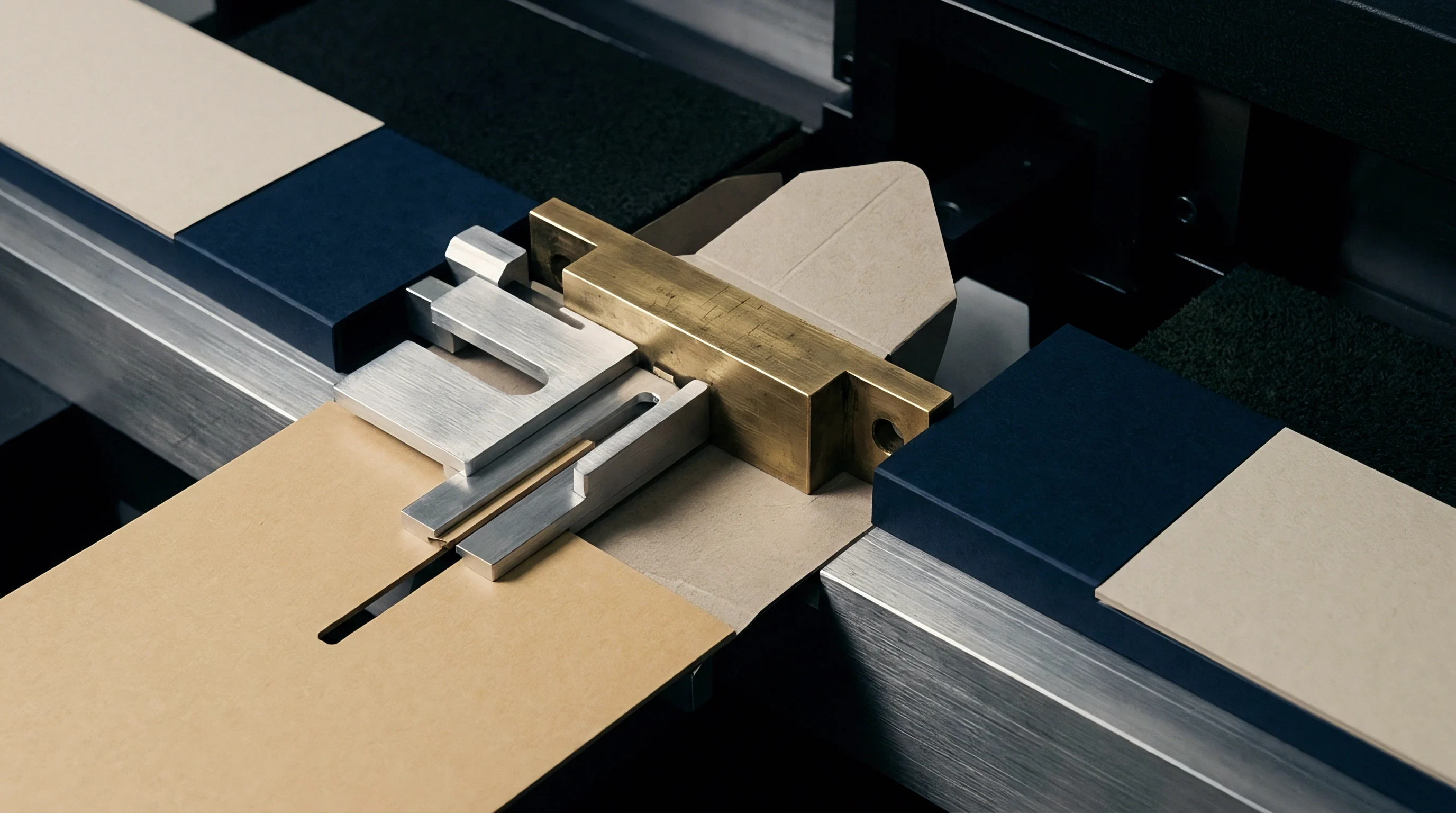
Mechanical pulp forms the core. Structural integrity during folding depends entirely on controlled internal micro-delamination within these core plies. As the creasing steel penetrates the sheet thickness, the bonded fibre network inside the mechanical pulp layer breaks apart along predefined planes.
This localized internal separation forms an internal hinge. The outer liner plies stretch over the male rule radius while the inner liner bulges cleanly into the counter cavity. Board density determines shear response.
If core delamination fails to initiate due to excessive starch binder loading or overly dense furnish, tensile failure transfers immediately to the outer clay coating and bleached kraft surface plies.
| Board Caliper Range (mm) | Male Rule Width (mm) | Matrix Channel Width (mm) | Matrix Channel Depth (mm) | Calculated Crease Ratio |
|---|---|---|---|---|
| 0.30 to 0.35 | 0.71 | 1.20 | 0.40 | 1.45 |
| 0.36 to 0.45 | 0.71 | 1.40 | 0.50 | 1.52 |
| 0.46 to 0.55 | 1.05 | 1.80 | 0.60 | 1.55 |
| 0.56 to 0.65 | 1.05 | 2.10 | 0.75 | 1.62 |
| 0.66 to 0.80 | 1.42 | 2.50 | 0.90 | 1.68 |
Sheet stiffness governs carton squaring. Converting multi-ply board demands strict alignment between board caliper and die tooling geometry. Standard calculation for matrix channel width uses the formula where channel width equals rule thickness plus 1.5 times the board thickness for cross-direction creases, or 1.4 times board thickness for machine-direction creases.
Deviation from these dimensional proportions disrupts ply shearing.
Crease depth retention drops below 65 percent when press room relative humidity falls under 40 percent at 23 degrees Celsius.
Selecting narrow counter channels to force sharp corner radii on heavy-caliper board squeezes core fibres beyond their ultimate shear threshold. Core fibres crush permanently instead of micro-delaminating smoothly. The resulting fold displays severe surface cracking, uncoordinated liner bulging, and asymmetric corner formation on automated packaging lines, triggering frequent machine stoppages and carton rejected lots.

Channel
Female matrix channels mounted on press platens direct the flow of board fibres during the millisecond creasing strike. Die-cutting stations operating flatbed tooling utilize phenolic paper matrix strips, vulcanized rubber grooves, or milled steel counterplates. High-volume runs exceeding 100,000 impressions demand solid steel counterplates milled with high-precision computer numerical control cutters.
Steel channels eliminate the positional drift and shoulder wear inherent in adhesive-backed phenolic matrix strips.
Matrix depth drives crease height. Impression depth settings dictate the vertical displacement of the male creasing rule into the counter channel. Press operators adjust platen tonnage to achieve optimal crease bead height without crushing adjacent unprinted board areas.
Wear alters channel geometry constantly. Continuous high-speed impact degrades phenolic channel edges, widening the channel shoulder radius over extended operational shifts.
Tooling degradation on high-speed flatbed presses manifests through distinct physical mechanisms across extended production runs:
- Channel Shoulder Erosion rounding of matrix channel entry edges caused by continuous abrasive friction against clay-coated board surfaces.
- Adhesive Delamination Shift lateral movement of self-adhesive matrix base strips under repetitive high-tonnage shear forces across the platen.
- Rule Tip Flattening deformation of male creasing rule bevels from repeated contact against hard steel counterplate surfaces.
- Ejection Rubber Hardening loss of elastic recovery in synthetic ejection rubbers surrounding creasing rules leading to board marking.
Steel plates eliminate matrix movement. Precise alignment between male creasing rules and female counter channels prevents asymmetric ply delamination. A lateral offset of 0.05 mm shifts the shear strain unevenly across the crease axis.
The outer liner breaks on the narrow side of the offset crease while the wider side forms a loose, poorly defined bead.
Phenolic counter channels lose shoulder edge definition after 75000 impressions on unbleached kraft board.
Tooling vendors frequently defend erratic score folding performance by alleging batch-to-batch basis weight drift across mill deliveries. This claim overlooks channel shoulder erosion and improper ejection rubber durometer selection on press die-boards.
Groove
Evaluating physical crease quality demands objective laboratory measurements of moment reduction rather than visual surface inspection. Standard ISO 5628 protocols define two-point bending stiffness determination for paperboard substrates. DIN 55437 specifies test procedure parameters for assessing score quality by measuring the moment needed to bend an uncreased board sample to 90 degrees compared against the moment needed to bend a creased sample from the same production lot.
Bending resistance drops after creasing. The ratio of creased bending moment to uncreased bending moment forms the crease factor index. Uncreased board exhibits high resistance as continuous outer liners take tensile load while core plies take compression.
A correctly formed crease reduces bending moment by 40 to 60 percent compared to uncreased stock. This reduction permits smooth carton erection on automatic cartoning machinery without panel bowing.
| Substrate Grade Type | Nominal Caliper (mm) | Uncreased Moment (mNm) | Creased Moment (mNm) | Stiffness Drop Factor (%) | Target Moment Ratio |
|---|---|---|---|---|---|
| GC1 Bleached Kraft Core | 0.40 | 18.5 | 8.2 | 55.7 | 0.44 |
| GC2 Mechanical Core | 0.40 | 22.1 | 9.1 | 58.8 | 0.41 |
| SUB Solid Unbleached | 0.45 | 31.0 | 13.8 | 55.5 | 0.45 |
| WLC Recycled Core | 0.45 | 16.2 | 9.8 | 39.5 | 0.60 |
Consider a practical comparative evaluation between two 400-micrometer paperboard grades processed under identical die-cutting press setups. Grade A represents a virgin fibre GC1 folding boxboard with twin bleached kraft liners. Grade B represents a white lined chipboard containing 80 percent recycled furnish with short, heavily refined core fibres.
Under ISO 187 standard conditioning at 23 degrees Celsius and 50 percent relative humidity, Grade A yields an uncreased bending moment of 18.5 millinewton-meters in the cross direction and a creased moment of 8.2 millinewton-meters, yielding a stiffness drop factor of 55.7 percent. Grade B exhibits an uncreased moment of 16.2 millinewton-meters but yields a creased moment of 9.8 millinewton-meters, resulting in a stiffness drop factor of only 39.5 percent. The recycled core fibres inside Grade B lack the long-fibre ply shear network needed to create clean internal delamination.
The score line retains excessive resistance, causing high spring-back force during high-speed erection.
- Cut test strip samples to exact dimensions of 38 mm width by 70 mm length using a precision twin-blade cutter.
- Condition test specimens in an ISO 187 compliant atmosphere at 23 degrees Celsius and 50 percent relative humidity for 24 hours.
- Mount uncreased specimens in a motorized laboratory bending tester to record peak bending force at a 15-degree deflection angle.
- Insert creased specimens featuring the test score centered exactly over the pivot point of the bending fixture clamp.
- Drive the test arm at a constant rotational speed of 3.0 degrees per second up to the full 90-degree folding angle.
- Log peak moment force values and calculate the percentage stiffness reduction ratio between creased and uncreased states.
DIN 55437 acceptance standards require a minimum crease stiffness reduction factor of 50 percent for carton blank auto-erection.
Purchasing contracts specifying DIN 55437 compliance grant packaging buyers explicit rights to reject delivered board lots that exhibit crease stiffness reduction values under 45 percent when tested under standard laboratory atmospheric conditioning.
Defect
High-speed die-cutters running at production speeds above 8,000 sheets per hour exaggerate board defect vulnerability. Rapid mechanical impact leaves micro-seconds for fibre displacement within the matrix channel. Flaws in multi-ply construction or improper moisture content manifest immediately as visible converting failures on the delivery pile.
Unconditioned board invites outer failure. Atmospheric moisture shifts pulp network flexibility dramatically. Board stored in cold, unconditioned transit warehouses loses internal moisture rapidly when brought into warm converting plant environments.
Low sheet moisture below 5.5 percent makes cellulose fibres brittle, hindering internal delamination and triggering surface coating fractures along the score line.
Quality control personnel categorize creasing failure modes into distinct physical categories during press setup audits:
- Liner Coating Cracking visible fine ruptures along the outer clay coating layer exposing raw white fibres beneath after ninety-degree folding.
- Internal Core Crushing total structural collapse of mechanical core plies without clean delamination, creating a flat, soft score line.
- Score Line Shear Displacement lateral wandering of the crease bead away from the intended die centerline due to uneven matrix channel wall friction.
- Micro Fluting Distortion wave-like buckling along carton panels adjacent to creasing scores caused by excessive platen impression tonnage.
High press speeds aggravate cracking. Dynamic impact velocity on high-speed flatbed presses reduces the effective elongation capability of surface kraft fibres. Dies operating cleanly on slow hand-fed proofing presses frequently produce severe liner cracking when running on automated platens at full rated production velocity.
Score line deviation ruins packing. High-speed cartoning machines pushing 400 cartons per minute reject blanks that exhibit irregular folding resistance across parallel crease lines. Unresolved variations in cross-direction ply thickness across the paperboard web leave technical auditors questioning whether press platen impression depth adjustment or mill paperboard profile control should take operational priority during trouble-shooting sessions.

Pallet
Goods-in verification procedures establish incoming board quality before committing press time and tooling setup costs. Receiving inspectors pull sample sheets across top, middle, and bottom sections of delivered pallet loads according to statistical sampling schemes. ISO 2859-1 sampling plans govern inspection lot sizes, applying an Acceptance Quality Limit of 1.0 for severe surface cracking defects and 2.5 for minor crease displacement errors.
Mill certificates establish batch traceability. Mill test report certificates accompanying delivered pallets detail grammage, caliper, moisture content, and cross-direction bending stiffness values measured at the paper machine reel. Goods-in auditors verify reel test data against incoming laboratory bench checks to ensure sheet properties fall within contracted tolerance bands before releasing stock to the die-cutting floor.
| Inspection Parameter | Test Standard | Sample Size per Lot | Acceptance Threshold | Rejection Threshold |
|---|---|---|---|---|
| Liner Surface Cracking | Visual 10x Magnification | 125 sheets | = 2 defective sheets | |
| Crease Moment Drop Factor | DIN 55437 Method B | 20 test strips | = 50 percent drop | |
| Caliper Uniformity Drift | ISO 534 Gauge | 50 locations | +/- 3 percent nominal | +/- 5 percent nominal |
| Moisture Content Deviation | ISO 287 Oven Method | 10 specimens | 6.5 percent +/- 1.0 | 8.5 percent |
Audit records preserve mill accountability. Purchasing dossier records for incoming board shipments must contain complete traceability documentation to back commercial claims against suppliers:
- Mill Test Certificate signed document stating reel production date, machine identification, grammage, caliper, and breaking length values.
- Pallet Inspection Log recorded goods-in audit sheet detailing ambient storage temperature, relative humidity, and measured sheet moisture.
- Laboratory Bending Audit certified test record detailing uncreased and creased moment values measured per DIN 55437 standard conditions.
- Press Trial Sign Off operator check sheet logging die-cutter tonnage, matrix serial code, press speed, and score alignment verification.
A contractually enforced AQL of 1.0 for score line cracking shifts all sorting costs for rejected carton lots directly back to the substrate supplier.
Calculating landed unit costs requires accounting for make-ready waste, die-cutting scrap, and cartoning line efficiency losses. Substituting lower-grade recycled board to trim raw material tonnage price by 8 percent frequently backfires on high-speed packaging lines. Poor crease delamination increases carton mis-feeds, raising waste rates by 4 percent while forcing die-cutters to run at reduced speeds, entirely erasing initial substrate savings on delivered finished cartons.