Containerboard Moisture Equilibrium in Refrigerated Storage Units
Refrigerated containerboard performance depends on controlling relative humidity sorption kinetics, virgin fiber selection, and barrier coating verification.

Equilibrium
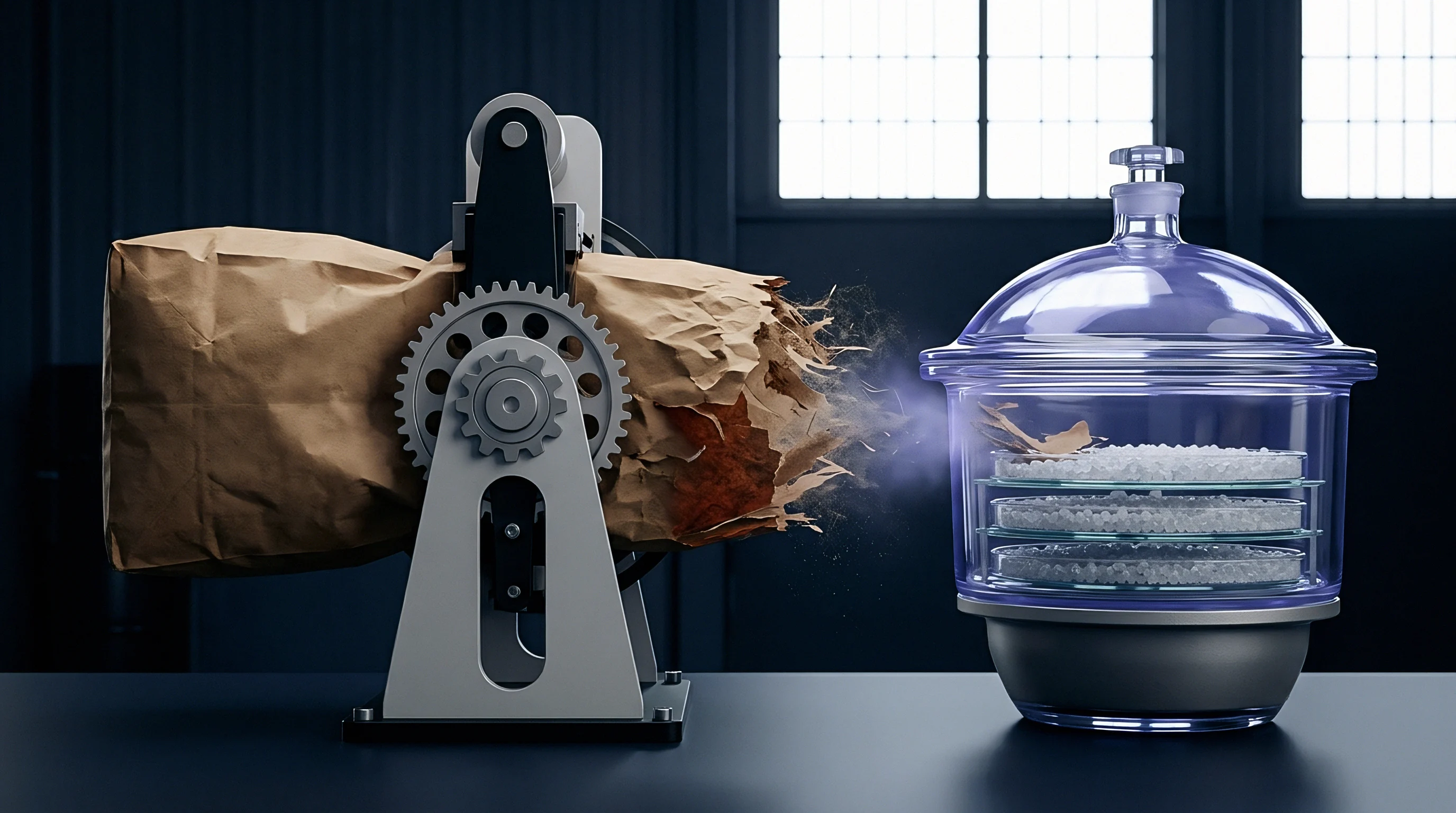
Thermodynamic interactions between cellulosic fibers and ambient air dictate the structural behavior of paperboard packaging inside cold storage facilities. Refrigerated spaces maintained between zero and four degrees Celsius commonly operate at relative humidity levels reaching eighty-five to ninety-five percent to prevent food dehydration. Under these thermal and atmospheric conditions, containerboard absorbs water vapor from the surrounding air until the vapor pressure within the porous fiber matrix matches the ambient partial vapor pressure.
This steady state defines the equilibrium moisture content of the board.
Cellulosic fibers are naturally hydrophilic due to free hydroxyl groups along the cellulose and hemicellulose polymer chains. As relative humidity rises, atmospheric water molecules adsorb onto accessible sorption sites within the fiber cell wall through hydrogen bonding. Low temperatures in cold stores lower the saturation vapor pressure of air while increasing the thermodynamic affinity of cellulose for water molecules.
Consequently, containerboard placed in refrigerated storage reaches a significantly higher equilibrium moisture content than the exact same board stored at standard laboratory conditions of twenty-three degrees Celsius and fifty percent relative humidity.
| Containerboard Grade | Fiber Furnish Type | 50% RH Moisture (% dry basis) | 75% RH Moisture (% dry basis) | 90% RH Moisture (% dry basis) |
|---|---|---|---|---|
| Unbleached Kraftliner | 100% Virgin Softwood Kraft | 7.2 | 11.8 | 18.5 |
| Testliner Grade 2 | 100% Recycled OCC | 8.1 | 13.2 | 21.4 |
| Semi-Chemical Fluting | 75% Virgin Hardwood / 25% OCC | 7.6 | 12.4 | 19.8 |
| Recycled Fluting (Medium) | 100% Recycled Mixed Paper | 8.5 | 14.0 | 22.9 |
| Data determined under ISO 187 conditioning protocols adapted for cold atmospheric chambers at four degrees Celsius. | ||||
The rate at which containerboard moves toward equilibrium depends on board thickness, density, surface sizing, and air circulation velocity across the stack. Unprotected corrugated board sheets exposed to turbulent airflow in a cold room can gain up to eighty percent of their total potential moisture intake within twenty-four hours. Equilibrium is reached asymptotically over several days, causing dimensional swelling, loss of stiffness, and reduced structural integrity across every component of the corrugated matrix.
Relative humidity inside cold storage drives fiber moisture gain far faster than low temperature slows adsorption kinetics down.
Different paperboard grades demonstrate distinct equilibrium curves based on their chemical composition and papermaking history. Virgin unbleached softwood kraft fibers contain high proportions of intact cellulose microfibrils and native lignin, creating a tightly ordered crystalline structure that resists water penetration compared to recycled fibers. Recycled containerboard grades, produced from old corrugated containers, contain hornified fibers that have undergone repeated wetting and drying cycles.
Hornification collapses internal pore structures, yet the high presence of residual fine particles, degraded hemicellulose, and open surface capillaries in recycled furnish leads to elevated total water uptake at relative humidity levels above eighty percent.
When a box enters a cold room, the air inside the flute void spaces cools rapidly, increasing localized relative humidity right at the paper surface. If the temperature drops below the dew point, liquid condensation forms directly on the linerboard face, causing immediate surface wetting that bypasses gas-phase sorption kinetics and accelerates moisture absorption into the core fluting structure.
High ambient humidity always dominates temperature effects when determining final fiber moisture levels in cold environments.

Sorption
Moisture exchange dynamics within cellulosic structures follow sigmoidal sorption isotherms classified as Type II under physical chemistry conventions. The relationship between relative humidity and fiber moisture content is not linear, exhibiting a distinct hysteresis loop where the path taken during moisture uptake diverges from the path taken during moisture release. Containerboard that reaches a specific relative humidity through moisture intake holds less water than board reaching that same relative humidity through drying from a saturated state.
In cold storage management, hysteresis presents a persistent challenge. A corrugated shipping container produced at seven percent moisture content and placed into a ninety percent relative humidity cold room follows the adsorption curve, steadily acquiring water weight until equilibrium is established near nineteen percent moisture content. If that same container moves to a drier staging dock at sixty-five percent relative humidity, it follows the desorption branch of the isotherm.
The board retains a higher moisture level than fresh board conditioned up to sixty-five percent relative humidity, permanently altering its physical properties and mechanical performance.
Kraft linerboard held at 4°C and 90% relative humidity reaches a balance point near 18.5% water content under ISO 187 standard conditioning limits.
The chemical composition of the furnish governs the total capacity of sorption sites within the paper matrix. Hemicelluloses possess the highest hygroscopicity among wood components due to their amorphous arrangement and abundant accessible hydroxyl groups. Lignin displays a moderately hydrophobic nature at room temperature, but its presence inside virgin unbleached kraft pulp acts as a physical barrier that restricts water molecules from accessing internal cellulose microfibrils.
Recycled testliner contains degraded fibers stripped of natural waxes, elevated levels of short fines, and hydrophilic mineral fillers like calcium carbonate, which collectively enhance moisture uptake at high ambient humidity.
- Linerboard delamination occurs when unequal moisture pickup across inner and outer plies induces differential hygroexpansion shear forces that exceed starch bond strength.
- Flute roll deformation manifests as local buckling when high humidity softens the semi-chemical corrugating medium below its critical yield stress threshold.
- Adhesive bond crystallization weakens starch lines subjected to persistent high equilibrium water content at sub-zero boundary layers within multi-ply structures.
Pore architecture plays an equally dominant role in water vapor retention. Papermaking operations introduce macro-pores between fibers and micro-pores within fiber walls. At low relative humidity levels below thirty percent, water adsorption occurs as a monomolecular layer across accessible cell wall surfaces.
Between thirty and seventy percent relative humidity, water molecules form multi-molecular layers. Above seventy-five percent relative humidity, capillary condensation takes place inside the microscopic pores of the fiber wall, filling capillary voids with liquid water and causing significant macroscopic swelling of the paperboard.
Specialized wet-strength resins and internal rosin sizing are often assumed to prevent moisture pickup in cold storage, but surface sizing treatments and internal sizing additives only retard the rate of liquid water penetration; they do not alter the thermodynamic equilibrium moisture content established through water vapor sorption over extended storage periods.
Buckling
Mechanical strength loss in containerboard subjected to cold, humid conditions represents a primary cause of secondary packaging failure during transport and warehousing. Water acts as a plasticizer within the amorphous regions of cellulose and hemicellulose, disrupting inter-fiber hydrogen bonds and lowering the glass transition temperature of the polymer matrix. As moisture content increases from standard laboratory levels of seven percent to refrigerated equilibrium levels above eighteen percent, compression strength drops sharply.
The compressive strength of corrugated board is traditionally evaluated using the Edge Crush Test measured according to ISO 3037 or TAPPI T 811. Edge crush resistance correlates directly with the compression capacity of the finished shipping container. At elevated moisture levels, individual paper fibers undergo plastic deformation under compressive loads rather than elastic bending, causing premature micro-buckling of the linerboard and flute structures under a fraction of their dry design rating.
Can Recycled Containerboard Match Virgin Linerboard Cold Compression Performance?
Virgin unbleached kraftliner maintains a higher proportion of its structural load capacity under wet cold storage conditions than recycled testliner grades. Kraft fibers retain longer microfibrils and superior internal bonding integrity, allowing the sheet to sustain compressive loads even when water plasticizes the fiber wall. Recycled testliner, constructed from short, repeatedly processed fibers with higher ash content, exhibits steep performance degradation under high ambient humidity, losing up to sixty percent of its dry compression resistance when moisture content exceeds sixteen percent.
| Grade Specification | Dry ECT at 7% Moisture (kN/m) | ECT at 12% Moisture (kN/m) | ECT at 18% Moisture (kN/m) | Strength Retention (%) |
|---|---|---|---|---|
| 175 g/m² Virgin Kraftliner | 8.4 | 6.8 | 4.2 | 50.0 |
| 175 g/m² Recycled Testliner T2 | 6.9 | 5.1 | 2.6 | 37.7 |
| 120 g/m² Semi-Chem Fluting | 3.8 | 3.1 | 2.1 | 55.3 |
| 120 g/m² Recycled Fluting | 3.1 | 2.2 | 1.1 | 35.5 |
Structural engineers use empirical formulas such as the McKee equation to estimate Box Compression Test values from Edge Crush Test figures, bending stiffness, and box perimeter. Standard McKee models developed under room-temperature conditions fail in cold storage calculations because the relationship between flat crush resistance, flexural stiffness, and edge compression changes non-linearly as moisture plasticizes the board matrix.
Corrugated boxes stacked on pallets inside refrigerated facilities undergo time-dependent mechanical deformation known as compressive creep. Under dry ambient conditions, creep deformation progresses slowly over several months. In cold, high-humidity environments, cyclic fluctuations in storage room humidity trigger accelerated creep, a phenomenon known as mechano-sorptive creep.
As relative humidity fluctuates due to refrigeration defrost cycles or door openings, the continuous sorption and desorption of moisture under static pallet loads accelerates micro-fracturing across fiber interfaces, inducing catastrophic box collapse at load levels far below static compression capacity thresholds.
Ignoring the synergistic impact of high moisture content and static pallet duration results in crushed lower-tier packaging, collapsed unit loads, and extensive product destruction across cold distribution chains.
Barriers
Retarding moisture vapor absorption and liquid water penetration into containerboard requires functional surface modifications applied during papermaking or converting. Functional coatings act as physical shields that slow moisture diffusion kinetics, preserving structural stiffness during the initial critical hours of cold storage exposure. Selecting the appropriate barrier system involves balancing moisture protection, converting line gluability, repulpability, and overall cost per thousand printed boxes.
Surface sizing with hydrophobic agents like alkyl ketene dimer or alkenyl succinic anhydride reduces initial liquid water absorption rates, evaluated via the Cobb test per ISO 535. However, internal sizing treatments do not create a continuous surface film. Water vapor molecules easily penetrate between coated fibers over extended storage periods.
True vapor resistance demands continuous barrier layers created through functional polymer dispersions, extrusion coatings, or bio-based barrier formulations applied directly to the linerboard surface.
Specifying TAPPI T 441 Cobb values without declaring cold storage test temperatures leaves packaging buyers unprotected against premature box failure.
Polyethylene extrusion coating provides an impermeable moisture barrier, preventing water vapor sorption even under extreme relative humidity conditions. Despite its performance, polyethylene-coated containerboard disrupts recycling streams, requiring specialized repulping equipment to separate plastic films from cellulosic fibers. Modern packaging specifications favor water-based dispersion coatings utilizing styrene-butadiene or acrylic polymers.
These dispersions form thin, flexible films across linerboard micro-topography, reducing water vapor transmission rates while remaining repulpable in standard mill recycling circuits.
- Cobb value target specifies surface water absorption beneath 30 grams per square meter over a sixty-second exposure under ISO 535 testing.
- Repulpability verification confirms that functional polymer dispersions break down without generating sticky contaminants in standard recycling operations.
- Chilled glue-line compatibility mandates that cold-set adhesives bond reliably through hydrophobic surface treatments without tailing or joint failure.
Paraffin wax treatments historically served as the industry standard for hydro-cooling and direct-ice wet-pack corrugated boxes. Environmental regulations and corporate sustainability targets have largely phased out curtain-coated and wax-impregnated boards due to their non-recyclable nature. Modern bio-based wax alternatives, derived from hydrogenated vegetable oils or microcrystalline cellulose networks, offer effective water repellency but require careful tuning of cold-set glues on high-speed box converting equipment.
Micro-flute structures like E-flute and F-flute present unique barrier challenges in chilled packaging. These thin profiles possess reduced internal void volumes, resulting in rapid moisture penetration through outer linerboards directly into the fluting medium. Applying functional barrier coatings to both the inner and outer linerboards of micro-flute containers becomes necessary to maintain structural integrity when packaging chilled liquids, fresh produce, or proteins that generate localized high humidity inside the sealed package.
An ongoing technical challenge lies in determining whether bio-based dispersion coatings can match the long-term water vapor transmission rates of petroleum-derived polymers without compromising high-speed folder-gluer adhesive bonding performance on cold packaging lines.
Metrology
Accurate measurement of moisture content and structural performance in chilled containerboard demands strict control over conditioning atmospheres and analytical protocols. Standard laboratory testing governed by ISO 187 or TAPPI T 402 requires conditioning paper specimens at twenty-three degrees Celsius and fifty percent relative humidity. Bringing cold, highly humid containerboard directly from a refrigerated store into a warm standard test laboratory induces rapid water evaporation, leading to inaccurate moisture content values and overstated mechanical strength metrics.
Measuring true moisture levels of board stored in cold facilities requires specialized sampling procedures designed to freeze the thermodynamic state of the material before atmospheric exposure alters the specimen. Handheld capacitive or microwave moisture meters calibrated exclusively for ambient room conditions generate erroneous readings when applied to cold board, as dielectric properties of water and cellulose vary significantly with temperature.
- Enclose the cold storage containerboard sample immediately in a vapor-tight foil laminate bag before removal from the refrigerated environment.
- Transport the sealed package into the testing facility and allow thermal equilibration to twenty-three degrees Celsius for a minimum of four hours.
- Weigh the specimen before opening the enclosure to ensure no atmospheric condensation altered the total package weight during thermal transition.
- Place the specimen inside the controlled atmospheric chamber maintained strictly at twenty-three degrees Celsius and fifty percent relative humidity per ISO 187.
- Measure oven-dry mass following ISO 287 procedures at one hundred five degrees Celsius until consecutive readings vary by less than one milligram.
Standard Cobb surface absorption tests conducted under standard room temperatures misrepresent coating performance inside cold facilities. Cold water exhibits higher viscosity and altered surface tension compared to room-temperature water, slowing penetration rates through functional surface sizing. Laboratory evaluations must cool the test water and specimen to four degrees Celsius to simulate true refrigerated exposure, yielding realistic Cobb values that reflect field performance.
| Test Parameter | Standard ISO Method | Field Sampling Error Mechanism | Measured Deviation |
|---|---|---|---|
| Moisture Content | ISO 287 / TAPPI T 412 | Flash evaporation during transfer to warm lab | 1.8% to 3.5% low |
| Edge Crush Test | ISO 3037 / TAPPI T 811 | Rapid drying lowers moisture during test setup | 12% to 22% high |
| Cobb Water Absorption | ISO 535 / TAPPI T 441 | Temperature mismatch alters fluid viscosity | 15% to 30% low |
| Bursting Strength | ISO 2759 / TAPPI T 810 | Fibers regain stiffness as specimen warms | 8% to 14% high |
Dynamic Vapor Sorption analysis provides precise gravimetric measurement of water sorption kinetics across controlled temperature and humidity profiles. Using microgram-scale samples, dynamic vapor sorption instruments plot real-time adsorption and desorption isotherms at exact refrigerated storage temperatures, exposing subtle differences in furnish hygroscopicity, binder performance, and coating integrity that standard static conditioning chambers fail to detect.
Moisture meters calibrated solely for standard laboratory conditions yield inaccurate readings when applied directly to cold boards at goods-in docks.
Incorporating explicit environmental conditioning clauses within material purchase contracts, such as specifying minimum Edge Crush Test ratings at eighty-five percent relative humidity and four degrees Celsius per ISO 187 Annex specifications, shifts technical compliance from laboratory ideals to operational distribution reality.
Settlement
Commercial claims and specifications for containerboard delivered into cold storage applications require precise contractual frameworks that account for weight shifts and mechanical degradation caused by atmospheric moisture uptake. Containerboard is bought by weight and converted by area. When moisture content increases from a manufacturing target of seven percent to an ambient equilibrium level of eighteen percent in cold warehousing, total shipment weight increases by eleven percent entirely due to absorbed water vapor.
Wet weight inflates landed tonnage cost. Sourcing agreements must define standard billing basis weights calculated strictly at normalized moisture levels per ISO 536. If a buyer receives a shipment of high-moisture reels or pre-conditioned corrugated sheets without normalized moisture adjustments, they pay premium tonnage rates for entrained water that actively impairs subsequent converting and packaging performance.
Purchasing dossiers for cold-chain packaging must establish technical tolerance bands covering moisture content at delivery, minimum Edge Crush Test retention percentages under high humidity, and acceptable Cobb limits. Contracts specifying containerboard solely under standard room-temperature metrics leave buyers with no legal recourse when boxes collapse inside refrigerated distribution centers despite meeting nominal ambient quality certificates.
Grade substitution represents a major source of cold storage packaging failure. Paper mills occasionally substitute high-grammage recycled testliner for lower-grammage virgin kraftliner to meet nominal dry Edge Crush Test specifications at lower furnish costs. While dry performance parameters may appear equivalent on mill inspection reports, the recycled sheet exhibits dramatically higher strength decay in cold, humid environments.
Sourcing specifications must mandate strict furnish declarations, capping recycled fiber content percentages for board assigned to refrigerated supply chains unless functional barrier coatings or wet-strength additives are explicitly specified and validated through cold-chamber compression testing.
Resolving commercial disputes over collapsed cold-store packaging hinges on establishing clear chain-of-custody documentation regarding environmental conditions throughout transit and storage. Integrating calibrated relative humidity and temperature data loggers inside palletized shipments isolates whether structural failure resulted from out-of-specification paperboard furnish, defective corrugating adhesive bonds, or extreme atmospheric excursions beyond contractually agreed refrigeration parameters.