Moisture Equilibrium Isotherms in Recycled Packaging Stock
Recycled stock reaches moisture equilibrium below virgin levels due to hornification, altering yield arithmetic, adhesive speed, and humid compressive retention.
Fibre
A digital caliper measures a 350-micrometre sheet of coated recycled board at 23 degrees Celsius and 50 percent relative humidity, but raising ambient moisture to 80 percent alters cell wall geometry through localized free enthalpy changes. Packaging stock made from secondary furnish behaves quite differently under humid conditions than virgin kraft substrates. Water vapor sorption is driven thermodynamically by the chemical potential gradient between moisture in the air and hydroxyl binding sites in the cell wall matrix.
Hygroscopic Mechanics in Recycled Cell Walls
At low relative humidity, water molecules bind to amorphous regions of cellulose and hemicellulose through hydrogen bonding. As water activity rises, multilayer adsorption gives way to capillary condensation inside the sheet’s pore network. In secondary furnishes, repeated repulping, refining, and thermal drying alter this structure by contracting intra-crystalline spaces between microfibrils and permanently collapsing cell wall pores.
This shift restricts internal volume for capillary water accumulation at high relative humidity, dropping the moisture equilibrium isotherm across the entire water activity spectrum.
At 23 degrees Celsius and 85 percent relative humidity, secondary unbleached kraft linerboard reaches equilibrium at 10.8 percent moisture content, whereas virgin softwood kraft under identical conditioning stabilizes at 13.2 percent.

Hornification and Hydroxyl Site Accessibility
Thermal drying forces adjacent cell wall polymers into irreversible close contact. This process, hornification, removes available hydrogen-bonding sites that would otherwise bind water vapor, lowering the equilibrium moisture content of secondary stock by 15 to 25 percent compared to unbleached virgin softwood kraft under identical ambient conditions. High-lignin recycled mechanical pulps are less sensitive to moisture at low relative humidity than recycled chemical pulps, but their mechanical strength degrades rapidly once capillary water fills macropores between damaged fibres.
Fewer accessible hydroxyl sites directly alter mass balance calculations on high-speed packaging lines. Moving recycled board from a dry conversion floor into a humid transit container changes its water uptake rate relative to virgin stock. Because hornified stock has smaller pore radii, it generates higher capillary pressures; surface sorption happens rapidly while diffusion into the inner core slows down.
This imbalance creates localized swelling stress between the surface plies and inner core of multi-ply combination boards.


Hysteresis
The moisture content of recycled paper at any given relative humidity depends on whether it reached equilibrium by gaining water or losing it. Physical sorption hysteresis produces two distinct equilibrium curves across the 0 to 100 percent relative humidity range, with the desorption branch consistently holding more moisture than the adsorption branch at identical temperatures and relative humidities. Because hysteresis dictates delivered sheet mass, accounting for this gap is essential when verifying stock weight at goods-in inspection.
Thermodynamic Divergence in Adsorption and Desorption
Cellulose networks relax structurally as they wet from a dry state. During desorption, hydrogen bonds between water and cellulose stay intact until lower relative humidity breaks them, holding water inside shrinking capillaries. During adsorption, collapsed cell walls resist opening until swelling pressure overcomes internal steric hindrance.
Secondary furnishes show a narrower hysteresis loop than virgin stock, as losing flexible amorphous hemicellulose during washing and de-inking cuts the structural elasticity needed for hysteresis divergence.
Conditioning Paths under International Standards
Measuring sheet mass in the lab requires strict control over environmental history. Standard testing under ISO 187 and TAPPI T402 requires pre-conditioning paper stock in a low-humidity atmosphere between 10 and 35 percent relative humidity at no more than 40 degrees Celsius before final equilibration at 23 degrees Celsius and 50 percent relative humidity. This step sets a consistent baseline by forcing the sheet to reach equilibrium along the adsorption path, removing up to 1.8 percentage points of moisture variation tied to desorption history.
- Dry the sample lot in a circulating pre-conditioning oven held between 25 and 30 percent relative humidity at 35 degrees Celsius for a minimum of 4 hours.
- Transfer the sample immediately into a climate chamber controlled to 23 degrees Celsius plus or minus 1 degree, and 50 percent relative humidity plus or minus 2 percent.
- Expose all sheet surfaces to circulating air maintaining a minimum velocity of 0.5 metres per second across the stock face.
- Weigh the sample on a calibrated analytical balance at 1-hour intervals until two consecutive mass readings differ by less than 0.2 percent of total sheet mass.
- Record the final mass as the true equilibrium moisture content along the adsorption isotherm branch.
Moisture compliance disputes often center on transit conditions, where ambient humidity causes natural re-equilibration along the desorption path, inflating delivered weight without altering base dry fibre mass.
Formulation
Mathematical models of moisture sorption isotherms allow packaging engineers to predict board weight variations across global supply chains. Standard physical chemistry equations map water activity against dry-basis moisture content. Two-parameter models like the Brunauer-Emmett-Teller equation break down above 0.45 to 0.50 water activity due to micro-pore condensation, but three-parameter models maintain precision across standard storage and handling environments.

Guggenheim Anderson De Boer Isotherm Parameterization
The three-parameter Guggenheim-Anderson-de Boer model fits moisture sorption from low relative humidity up to 0.90 water activity. The equation balances monolayer moisture capacity, first-layer binding enthalpy, and multilayer water interaction properties. Recycled stocks shift these specific constants through ash loading, added starch, and short-fibre geometry.
The monolayer capacity parameter tracks the count of available sorption sites, falling steadily as recycled content increases.
| Substrate Grade Type | Recycled Content (%) | Monolayer Capacity (mm, g/g) | Guggenheim Constant (CG) | Multilayer Factor (K) | Standard Error (R2) |
|---|---|---|---|---|---|
| Virgin Kraftliner | 0 | 0.062 | 14.8 | 0.78 | 0.994 |
| Testliner 2 (Secondary Kraft) | 100 | 0.048 | 11.2 | 0.82 | 0.991 |
| Coated Recycled Board (CRB) | 85 | 0.041 | 9.6 | 0.85 | 0.988 |
| Uncoated Folding Boxboard | 15 | 0.057 | 13.5 | 0.79 | 0.995 |
Standard mill delivery contracts specifying a total moisture band without defining pre-conditioning direction permit up to two percent variation in true dry fibre mass per delivered tonne.
What Alters Water Monolayer Capacity in Recycled Board?
Papermaking additives and secondary refining loops systematically alter the volume of primary sorption sites. Mineral fillers like ground calcium carbonate and talc are far less hygroscopic than cellulose, so a secondary sheet with 12 percent calcium carbonate by weight shows a proportional drop in monolayer capacity. Conversely, surface sizing with oxidized starch increases water affinity at low humidity, raising monolayer capacity while clogging pores and suppressing high-humidity capillary volume.
Alkyl ketene dimer and alkenyl succinic anhydride sizing agents change fibre surface energy without fully blocking internal hydrogen bonds. Sized recycled containerboard adsorbs water more slowly, shifting the dynamic isotherm during brief humidity spikes without changing the final equilibrium reached after long exposure. This lag can throw off quick moisture readings taken right after unwrapping a pallet.
The interplay between mineral filler concentration, residual starch, and hornified short fibres makes it difficult to define the exact thermodynamic point where capillary condensation starts to override surface sorption in multi-ply recycled containerboard.
Deformation
Dimensional changes across a paper web cause major converting problems when humidity fluctuates during printing and die-cutting. Single fibres swell radially by 15 to 20 percent when taking on moisture, compared to just 1 to 2 percent lengthwise. Because paper machines align fibres mostly in the machine direction, expansion concentrates in the cross-machine direction, driving severe sheet distortion.

Cross Direction Hygroexpansion and Fluting Curl
Individual sheet components expand unevenly across orthogonal axes. The hygroexpansion coefficient measures percentage dimensional change per one percent change in moisture. While recycled stocks have lower overall hygroexpansion coefficients than unrefined virgin pulps because of hornification, they build up higher localized stresses.
When a virgin top liner is combined with recycled inner plies in multi-ply board, differential hygroexpansion causes curl, with cross-direction movement driving overall board warp.
Fluting medium made from 100 percent recycled waste paper experiences localized moisture strain in corrugating nip rolls under steam showers. If the medium’s equilibrium isotherm differs significantly from the linerboard faces, uneven moisture loss during cooling leaves washboarding defects and flutes distorted across the corrugated sheet.
Differential moisture uptake across adjacent plies turns flat containerboard into warped stock during converting long before structural compression limits are reached.
Score Line Rupture under Relative Humidity Extremes
Folding boxboard relies on plastic deformation along internal delamination planes during creasing. When relative humidity drops below 40 percent, recycled fibres lose bound water and become brittle. This lower equilibrium moisture content reduces shear tolerance between plies, causing the outer liner to split along score lines during 180-degree folds on high-speed folder-gluers.
- Out-of-Plane Warp occurs when differential moisture absorption rates between top and bottom linerboards generate unbalanced bending moments across the board profile.
- Washboarding Deformation emerges when thin linerboards absorb excess moisture from adhesive lines, collapsing into the valleys between corrugated flutes.
- Score Line Flaking develops when dry recycled linerboard lacks sufficient moisture-induced ductility to stretch around outer crease radii without surface fibre rupture.
- Register Mismatch manifests during multi-pass offset printing when cross-direction web expansion alters sheet dimensions between color units.
Specifying low-grade recycled board without matching its hygroexpansion profile to storage conditions causes jams on automated packaging lines and filling equipment, often resulting in rejected lots.


Converting
High-speed converting equipment requires consistent surface hydration to ensure uniform adhesive bonds and reliable web transport. Equilibrium moisture content sets the thermodynamic state of the sheet, while water absorptiveness (measured by Cobb value under ISO 535) controls how fast liquid water penetrates. Together, both parameters determine runnability on converting lines.
Adhesive Setting Dynamics and Water Activity
Starch and aqueous emulsion glues rely on rapid liquid absorption into the substrate to establish initial tack. When recycled stock arrives at a high equilibrium moisture state above 75 percent relative humidity equivalent, capillary water fills part of the internal pore volume. This blocks water penetration from water-based adhesives, extending open time and weakening green bond strength.
Conversely, dry stock equilibrated to low relative humidity pulls glue vehicles in too quickly, starving the bond line and leaving brittle joints.
| Grade Description | Baseline EMC at 50% RH (%) | Equilibrated EMC at 90% RH (%) | Cobb 60 Absorption (g/m²) | BCT Retained at 85% RH (%) |
|---|---|---|---|---|
| Virgin Kraftliner 175 g/m² | 7.2 | 14.1 | 28 | 68 |
| Testliner 1 160 g/m² | 6.8 | 12.6 | 34 | 54 |
| Recycled Fluting 120 g/m² | 6.5 | 11.8 | 42 | 46 |
| Coated Recycled Board 350 g/m² | 6.1 | 11.2 | 22 | 58 |
Compressive Strength Loss under Humid Cycling
Corrugated boxes lose significant structural strength when exposed to fluctuating relative humidity in cold-chain logistics. Under constant high humidity, edge crush strength drops linearly as moisture increases. Under cyclic conditions ~ such as swinging between 50 and 90 percent relative humidity ~ compressive strength falls faster than under steady-state exposure at the peak humidity level.
This accelerated creep happens because transient moisture gradients trigger continuous molecular rearrangement within the load-bearing cellulose matrix.
- Verify Roll Core Integrity to ensure internal core crushing has not occurred due to moisture-induced expansion of tightly wound inner paper plies.
- Audit Pallet Wraps for continuous film coverage down to the wooden pallet deck to prevent moisture ingress from humid floor air.
- Check Surface Cobb Values alongside equilibrium moisture data to confirm chemical sizing levels have not degraded during storage.
- Calibrate Handheld Moisture Meters using oven-dry baseline testing under ISO 287 specifically tuned for recycled furnish calibration curves.
Adhesive setting performance stabilizes when board moisture stays balanced within the absorption window of the selected glue formulation.

Specification
Procurement contracts for packaging board often overlook the cost penalties built into moisture variations. Paper mills sell board by gross weight, whereas packaging converters process stock by surface area. Buying wet board means paying paper prices for water weight, while buying overly dry stock increases cracking risks during converting.
Commercial Moisture Tolerances and Freight Arithmetic
Consider a purchase order for 100 tonnes of recycled testliner specified at 6.5 percent target moisture content with an allowable delivery tolerance of plus or minus 1.5 percentage points. If the mill delivers stock at the upper limit of 8.0 percent moisture, the buyer receives 1.5 tonnes of excess water instead of functional fibre, inflating landed costs. At a contract price of 650 Euros per tonne, this moisture drift shifts 975 Euros directly into net yield loss on a single truckload, while reducing total finished box yield by 1.5 percent.
Water purchased at containerboard prices represents an unrecoverable freight fee and an immediate loss of converting yield.
Barrier Packaging Specifications for Transit Storage
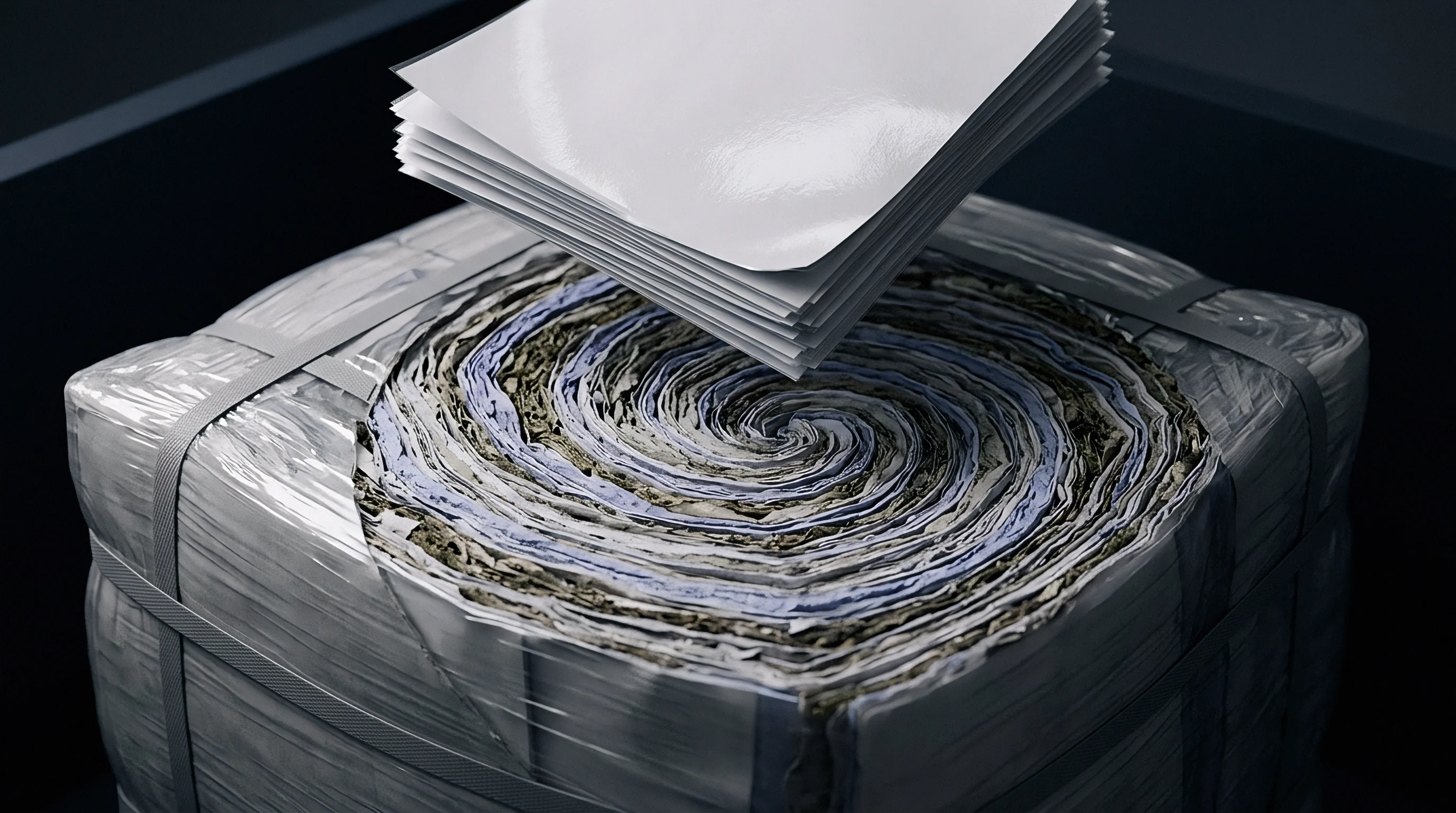
Protective wrapping on delivered pallets serves as the main defense against moisture uptake during transport. Because unwrapped pallets readily pick up moisture, reels and sheet pallets destined for cross-border shipping through tropical zones require moisture-impermeable barrier wrapping. Polyethylene stretch film specifications should require at least six overlapping spiral wraps with a water vapor transmission rate under 5 grams per square metre per 24 hours measured under tropical conditions of 38 degrees Celsius and 90 percent relative humidity.
Contract specifications must include explicit clauses defining baseline moisture acceptance limits tied to standard measurement protocols. The following language establishes clear commercial liability for out-of-spec moisture states upon delivery:
All delivered reels must demonstrate an average moisture content of 7.0 percent plus or minus 0.5 percent as measured in accordance with ISO 287 upon initial pallet unwrapping at the buyer facility. If measured moisture exceeds 7.5 percent along the adsorption path, the invoice total shall be adjusted downward by an amount equivalent to the excess water mass calculated against the net delivered weight. Lots demonstrating moisture content below 6.0 percent will be subject to immediate rejection due to elevated risk of score line rupture during automated carton assembly.