Subzero Moisture Equilibrium Rates in Recycled Containerboard Grades
Subzero equilibrium in recycled containerboard takes up to 35 days at -18C, shifting equilibrium moisture by 2.4% higher than virgin kraft grades.
Frost
Recycled containerboard grades reaching sub-zero packaging environments experience immediate reductions in water vapor diffusion rates. Ambient temperatures falling below zero degrees Celsius alter the thermodynamics of moisture absorption within the paper matrix. While virgin softwood kraftliner maintains relatively uniform pore distributions, recycled testliner and fluting medium contain shortened fibers, broken fibrils, and residual mineral fillers.
These structural variations modify how water vapor moves through the sheet and at what point internal equilibrium stabilizes.
Subzero Adsorption Kinetics in Secondary Fibre Matrices
Pulping cycles shorten cellulose chains while generating fine particles that fill pore spaces. The reduced pore volume increases capillary pressure, altering how vapor condenses on pore walls at sub-freezing temperatures. At twenty-three degrees Celsius, recycled linerboard reaches moisture equilibrium in approximately forty-eight hours under standard atmospheric conditions.
Lowering the ambient environment to negative eighteen degrees Celsius extends this stabilization window dramatically. Sorption kinetics slow because ambient water vapor pressure drops precipitously at sub-zero temperatures, reducing the driving potential for vapor diffusion into the fiber network.
Cellulose fibers within recycled furnish possess higher degrees of hornification than virgin fibers. Repeated drying and rewetting cycles collapse internal fiber lumens and create tight micro-capillaries. When moisture enters these micro-capillaries at negative temperatures, the Kelvin equation dictates a lower saturation vapor pressure over the concave liquid meniscus.
Cold air holds less vapor. Consequently, moisture condenses inside small recycled pores at relative humidity levels that would not cause condensation in larger virgin pores.
Ice blocks internal migration paths. Water molecules entering the outer surface of recycled testliner freeze inside macro-pores before diffusing into the core of the board stock. This localized ice formation seals off interior fiber networks, creating steep moisture gradients across the caliper of the sheet.
Secondary fibres absorb water rapidly.
- Fiber Wall Collapse Excessive moisture cycles at low temperatures crush lumen structures during ice formation.
- Capillary Vapor Freezing Frozen pore networks prevent moisture evacuation during defrost storage phases.
- Pore Surface Saturation Fine particles absorb water rapidly, accelerating physical swelling of recycled liners.
- Adhesion Matrix Degradation Frozen moisture weakens internal hydrogen bonds between recycled cellulose fibers.
Bound Water Phase Transitions at Sub-Zero Temperatures
Unfrozen moisture within cell walls remains liquid down to negative twenty degrees Celsius. Paper physics distinguishes between free water in capillary spaces and bound water held within cell wall pores by hydrogen bonds. Free water freezes at zero degrees Celsius, expanding by nine percent in volume and exerting mechanical stress on surrounding fibers.
Non-freezing bound water stays mobile down to negative forty degrees Celsius because physical confinement prevents water molecules from arranging into an ice crystal lattice.
Internal pore ice blocks capillary diffusion paths within recycled containerboard fibres long before external frost becomes visible on the surface.
Differential scanning calorimetry reveals that recycled containerboard contains a higher ratio of non-freezing bound water than virgin kraftliner at identical moisture contents. High fine counts and exposed hydroxyl groups hold water molecules tightly. As temperatures decrease from zero to negative twenty-five degrees Celsius, free water converts to ice while bound water remains in a supercooled liquid state.
This persistent liquid fraction allows ongoing, albeit sluggish, moisture migration through the cell walls even when macro-pores contain ice.
Ignoring subzero moisture uptake rates leads to catastrophic stacking collapses when corrugated boxes enter sub-zero cold stores without modified safety margins.
Hysteresis
Desorption and adsorption paths diverge sharply when board stock moves through sub-freezing ambient shifts. The equilibrium moisture content achieved when a sheet absorbs water in a cold store differs from the equilibrium level achieved when a moist sheet freezes. This sorption hysteresis gap expands at sub-zero temperatures due to the mechanical rigidity of frozen fibers.
Frozen cellulose chains cannot reorient easily, trapping water molecules within the pore architecture during desorption.
Sorption Isotherms across Freezing Temperature Gradients
Equilibrium moisture content drops non-linearly when testing environment conditions descend from zero to negative thirty degrees Celsius. At ambient conditions, a typical recycled testliner of 140 grams per square meter holds seven percent moisture at fifty percent relative humidity. Subjected to negative eighteen degrees Celsius at the same eighty-five percent relative humidity typical of cold storage, the equilibrium moisture content rises above fourteen percent on a dry basis.
| Substrate Grade | Recycled Content (%) | Grammage (g/m²) | Equilibrium Moisture at -18°C / 85% RH (%) | Time to 90% Equilibrium (Hours) |
|---|---|---|---|---|
| 100% Recycled Testliner 2 | 100 | 140 | 14.8 | 620 |
| 100% Recycled Fluting Medium | 100 | 120 | 15.2 | 580 |
| Semi-Chemical Fluting | 35 | 130 | 13.1 | 310 |
| Unbleached Kraftliner | 0 | 175 | 12.4 | 240 |
| Data determined via modified ISO 187 gravimetric sorption methodology at sub-freezing temperatures under steady air velocity of 0.2 m/s. | ||||
Subzero equilibrium requires extended conditioning. Testing reveals that recycled fluting mediums achieve higher final moisture levels than virgin kraft liners exposed to the same sub-zero conditions. The high hemicellulose content and degraded crystalline structure of recycled pulps create abundant sorption sites.
Water molecules bind to these accessible hydroxyl groups, establishing a higher moisture baseline that diminishes the structural rigidity of the containerboard.
Sorption rates drop at low temperatures. Lower thermal kinetic energy reduces the velocity of water vapor movement through air gaps. Consequently, containerboard pallets stored in sub-zero distribution hubs may require weeks to reach true moisture equilibrium, causing continuous dimensional shifts throughout transit.

Fibre Hornification and Micro-Capillary Vapor Transport
Irreversible pore collapse during previous drying cycles alters internal capillary condensation capacity. Hornified recycled fibers possess rigid cell walls that resist swelling when exposed to moisture vapor. When exposed to liquid water, however, capillary suction forces draw liquid into inter-fiber voids rapidly.
- Initial Temperature Drop Cold storage entry causes immediate atmospheric condensation on outer liner surfaces.
- Vapor Pressure Equalization Internal board moisture migrates toward freezing outer surfaces along thermal gradients.
- Unfrozen Core Desorption Cell wall moisture diffuses slowly toward ice-blocked capillary pore networks.
- Equilibrium Plateau Stabilization Sorption rates decelerate completely as accessible cellulose pore spaces fill with ice.
At negative eighteen degrees Celsius and eighty-five percent relative humidity, 100 percent recycled testliner reaches moisture equilibrium at 14.8 percent dry basis over 620 hours under ISO 187 modified testing conditions.
Vapor diffusion through the sheet proceeds via two distinct mechanisms: Knudsen diffusion within micro-pores and Fickian surface diffusion along fiber surfaces. At sub-zero temperatures, Knudsen diffusion dominates because gas molecule mean free paths exceed the collapsed pore diameters of recycled fiber. This restriction retards moisture movement, creating prolonged periods of moisture imbalance between outer package surfaces and inner fluting layers.
The precise chemical mechanism causing sub-zero pore water entrapment to stabilize at negative thirty-five degrees Celsius remains unexplained by current capillary condensation models.


Chamber
Laboratory evaluation of sub-zero moisture equilibrium demands climate enclosures operating down to negative forty degrees Celsius. Standard TAPPI T402 room conditioning at twenty-three degrees Celsius and fifty percent relative humidity fails to predict substrate performance in frozen food supply chains. Standard conditioning chambers cannot maintain controlled relative humidity below freezing without ice accumulation on sensor elements and refrigeration coils.
Specialty gravimetric apparatuses equipped with dual-stage cooling systems and optical dew-point mirrors provide accurate environmental control under freezing regimes.
Gravimetric Rate Measurement Protocols under Sub-Freezing Conditions
Automated dynamic vapor sorption balances track mass changes down to one tenth of a microgram. Measuring sub-zero sorption kinetics requires precise control of environmental parameters around the test specimen. Standard gravimetric methods involve suspended paper specimens weighed continuously inside sealed, temperature-controlled enclosures.
- Condition board samples at twenty-three degrees Celsius and fifty percent relative humidity for twenty-four hours to establish a baseline mass under ISO 187.
- Transfer the conditioned specimens directly into a climate enclosure maintained at negative eighteen degrees Celsius and eighty-five percent relative humidity.
- Measure the mass accumulation using an automated microbalance every fifteen minutes until three consecutive readings show weight changes below zero point zero one percent.
- Record the ultimate mass gain to calculate the sub-zero equilibrium moisture content on a dry-weight basis.
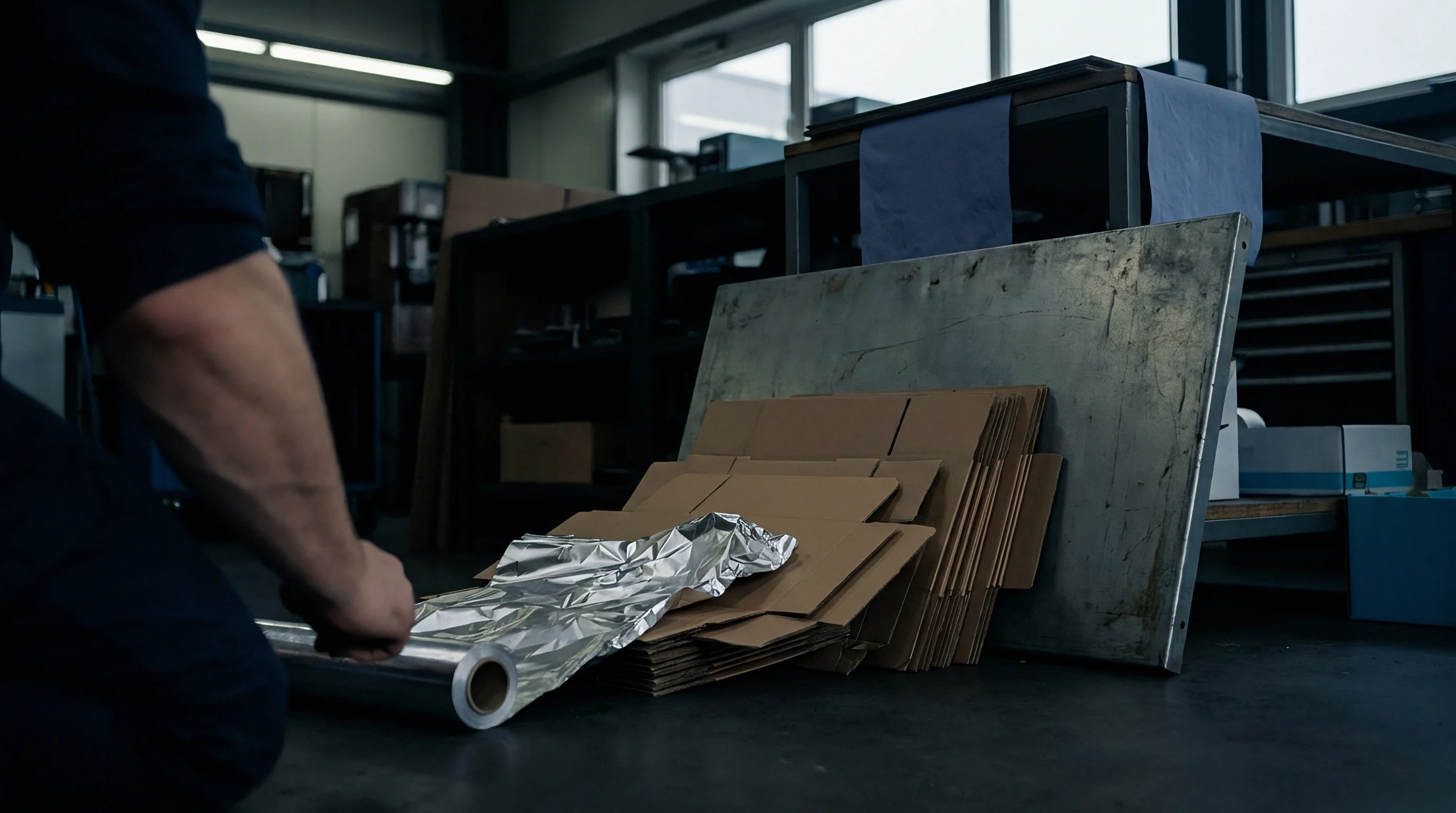
Sample preparation dictates measurement accuracy. Edge sealing with impermeable foil prevents artificial end-grain vapor penetration, forcing moisture transport through the surface of the sheet as occurs in combined corrugated board. Unsealed edges yield artificially high adsorption rates, overestimating board performance in practical applications.
Why Do Subzero Desorption Rates Stagnate below Freezing?
Ice crystal formation within macro-pores creates physical blockages that impede vapor migration. When a moist containerboard sheet freezes, water inside large capillary channels crystallizes into solid ice. This transformation locks water molecules in place, effectively halting liquid movement and severely restricting vapor migration out of the sheet.
Moisture shifts alter panel stiffness.
Sub-zero desorption testing demonstrates that removal of water from frozen board stock requires thermal energy input sufficient to sublime ice directly into vapor. Below the triple point of water, liquid phase drainage ceases entirely. Water sublimation proceeds at fraction of the speed of liquid evaporation.
Consequently, recycled board exposed to freezing environments remains at an elevated moisture state for extended periods, even when transferred into dry sub-zero storage rooms.
| Temperature (°C) | Relative Humidity (%) | Diffusion Coefficient (cm²/s × 10⁻⁸) | Equilibrium Moisture Content (%) | Adsorption Rate Constant (k / hour) |
|---|---|---|---|---|
| 0 | 85 | 4.12 | 13.1 | 0.0185 |
| -10 | 85 | 2.05 | 13.9 | 0.0092 |
| -18 | 85 | 0.88 | 14.8 | 0.0039 |
| -25 | 85 | 0.31 | 15.3 | 0.0014 |
Testing an actual converting setup highlights these principles. Consider a twenty-tonne shipment of 100 percent recycled testliner delivered at a nominal moisture content of seven point five percent. When stored at negative eighteen degrees Celsius and eighty-five percent relative humidity for thirty days, the board adsorbs moisture until reaching an equilibrium level of fourteen point eight percent.
The dry fiber mass equals eighteen point five tonnes. At fourteen point eight percent moisture on a dry basis, the total wet mass expands to twenty-one point two three tonnes, adding one point two three tonnes of water weight. This moisture gain increases sheet caliper by eight point two percent while reducing short-span compressive strength under ISO 9895 from two point four five kilonewtons per meter down to one point seven two kilonewtons per meter, delivering a twenty-nine point eight percent loss in load-bearing capacity.
ISO 536 basis weight calculations performed without cold-chain moisture correction result in automatic three percent invoicing adjustments under European corrugated trade guidelines.
Moisture equilibrium takes thirty days. Linerboard stiffness drops under frost. Cold logistics exacerbate box collapse.
Box compression capacity decreases in direct proportion to moisture accumulation within the load-bearing fluting medium.
Clause 6.2 of EN 12048 mandates sub-zero conditioning verification before cold-chain stack testing, preventing uncalibrated weight drift claims during transit arbitration.

Flute
Corrugated combined board exhibits localized structural failures when the internal medium transfers moisture unevenly to the linerboard. Corrugating adhesives based on native corn starch undergo retrogradation under sub-zero conditions. Starch gel networks lose elasticity as temperature drops, turning brittle and prone to micro-fracturing when subjected to shock loads during handling.

Delamination Risk under Cold Chain Mechanical Stress
Starch adhesive lines become brittle under freezing conditions while absorbing redistributed moisture. As water vapor condenses along the glue line, the local moisture content near the flute tips rises toward saturation. Starch brittleness triggers delamination failure.
High local moisture softens the paper surface fibers at the interface, causing the adhesive to pull paper fibers directly out of the linerboard under flexural stress.
| Combined Board Grade | Liner/Medium Combination | Combined Moisture Content (%) | Edge Crush Test (kN/m) | Pin Adhesion Strength (N/m) |
|---|---|---|---|---|
| Double-Wall BC Flute | Recycled Testliner / Recycled Fluting | 15.1 | 7.2 | 280 |
| Double-Wall BC Flute | Kraftliner / Semi-Chemical Fluting | 12.8 | 9.8 | 410 |
| Single-Wall C Flute | Recycled Testliner / Recycled Fluting | 14.9 | 4.6 | 290 |
| Single-Wall C Flute | Kraftliner / Recycled Fluting | 13.4 | 5.8 | 350 |
Fibre shortening reduces structural strength. Recycled fluting medium absorbs moisture faster than virgin semi-chemical medium because recycling treatments strip away hydrophobic natural resins. When recycled fluting softens in sub-zero environments, the arch structure flattens under vertical loads.
Flattened flutes reduce the overall caliper of the combined board, diminishing structural moment of inertia and accelerating box sidewall buckling.
Dynamic Moisture Redistribution in Corrugated Structures
Temperature gradients across double-wall containerboard create internal vapor pressure differentials. When warm, freshly packed goods sit inside corrugated boxes entering cold storage rooms, heat flows outward from the package core to the exterior atmosphere. Water vapor inside the board structure migrates along this thermal gradient toward the colder outer liner.
Moisture accumulates at the outer liner surface, creating localized zones of extreme softening.
- Starch Gelatinization Audits Inspect glue line penetration depths on converted corrugated board to confirm water-resistant adhesive carrier bonds.
- Cold Cobb Penetration Testing Measure water absorption capacity on outer and inner liners at four degrees Celsius over two-minute exposure intervals.
- Delamination Shear Verification Test pin adhesion strength under sub-zero conditions to catch brittle glue line failures before box formation.
- Flute Compression Monitoring Evaluate flat crush resistance on reconditioned board samples stored at negative eighteen degrees Celsius for fourteen days.
Recycled linerboard stored below freezing gains equilibrium moisture far slower than virgin kraftliner under identical relative humidity conditions.
Water expands during phase transitions. Cold stores accelerate panel bulging. Internal stress generated by ice expansion forces inner liner surfaces to bow outward, distorting the rectangular footprint of stacked boxes.
Distorted boxes shift structural loads onto unsupported panel centers, bypassing reinforced vertical corners.
Board mills frequently assert that standard room-temperature sizing specifications remain valid under freezing conditions because wet-end chemical additives do not decompose at low temperatures.
Tariff
Substrate procurement contracts account for moisture-adjusted basis weight offsets in frozen distribution channels. Buying containerboard on a tonnage basis without accounting for sub-zero equilibrium moisture behavior introduces financial variance into packaging supply chains. Mills invoice board tonnage based on manufactured weight, which typically includes seven to eight percent moisture.
When converting recycled stock designated for cold chain usage, the true fiber mass delivered per euro spent drops if the initial moisture content deviates from agreed specification baselines.

Commercial Penalties of Frozen Basis Weight Drift
Inaccurate moisture allowances at mill dispatch lead to financial disputes when pallets freeze during transit. Containerboard shipped across thermal zones picks up environmental moisture, increasing total shipment weight while lowering the yield of usable square meters per tonne. A ten-tonne reel shipment delivered at nine percent moisture yields fewer converted boxes than the same tonnage delivered at six point five percent moisture.
Dry calculations generate financial error. Converter purchasing agreements include moisture band specifications with price deduction scales for excess water weight. Standard commercial contracts invoke penalty clauses when delivered moisture exceeds nine percent.
Below zero degrees Celsius, however, standard moisture meters utilizing surface electrical capacitance generate inaccurate readings due to the high dielectric constant of ice compared to liquid water. Uncalibrated moisture meters underreport frozen water mass, allowing out-of-spec shipments to pass goods-in inspection without financial adjustments.
Extended Storage Yield Losses in Cold Logistics
Longer residence times in sub-zero cold stores reduce compressive board strength over ninety-day holding windows. Corrugated boxes designed with inadequate safety factors fail under sustained stacking loads, leading to product damage claims, retail penalties, and unsalable inventory. Packaging engineers compensate for sub-zero strength loss by specifying higher grammage recycled grades or substituting virgin kraftliners.
Grade substitution alters yield economics directly. Replacing a 140 gram per square meter recycled testliner with a 125 gram per square meter virgin kraftliner maintains required cold-chain edge crush strength while reducing total fiber weight per box. The higher purchase price per tonne of virgin kraftliner offsets against reduced freight weights and lower total tonnage requirements, balancing total landed packaging costs.
Purchasing containerboard based on dry-weight mill baseline calculations guarantees unrecoverable financial losses when converting stock for refrigerated supply chains.