Correlation Models between Wet-End Starch Addition Rates and High-Speed Creasing Delamination Defects
Controlled wet-end starch dosing between 6 and 9 kg/t maintains Scott bond at 180 to 240 J/m², preventing score cracking and delamination at high press speeds.


Dose
Wet-end cationic potato starch application rates govern internal bond development across multiply paperboard structures. Addition rates ranging between 4 and 12 kilograms per metric ton of dry furnish modify the z-directional tensile strength by bridging unrefined cellulose surfaces. Beyond an application rate of 14 kilograms per metric ton, retention aids fail to capture free amylopectin molecules, leaving unadsorbed polysaccharides in the white water system.
These free polymers blind forming fabrics, reduce drainage rates, and cause uneven basis weight distribution across the cross machine direction. Variations in local sheet density induce localized shear zones that fail under commercial creasing tooling.
Dry fiber bonds fail first.

Internal Bond Mechanics under Wet End Additions
Quaternary amine substitution levels between 0.035 and 0.045 degree of substitution determine how effectively amylopectin chains anchor to cellulose fibers. Cationic starches carry positive quaternary ammonium groups. These positive functional groups neutralize the negative zeta potential of recycled brown stock or bleached kraft fibers.
When the cationic starch dosage stays within 6 to 8 kilograms per ton, polymer chains spread across the fiber wall, creating extensive hydrogen bonding networks during hot cylinder drying. This mechanism elevates internal ply cohesion without causing matrix embrittlement. The paperboard maintains viscoelastic compliance when subjected to transverse mechanical scoring.
Scott bond values below 160 J/m² under TAPPI T 569 at 23 °C and 50 percent relative humidity generate immediate internal ply delamination along female matrix shoulders.
Overdosing shifts the failure boundary entirely. When mills push dosing past 15 kilograms per ton to compensate for degraded secondary fibers, excess starch forms glassy, brittle polymer clusters within the middle plies. The sheet gains static stiffness but loses out-of-plane shear ductility.
The male rule penetrates rapidly. As the scoring rule strikes the sheet, the rigidified starch matrix shatters rather than yielding plastically, creating uncontrolled internal fissures that burst through the linerboard.

Thresholds for Z-Direction Tensile Development
Standard TAPPI T 569 Scott internal bond testing records values ranging from 140 J/m² on untreated furnish up to 290 J/m² under optimal polymer additions. Multi-ply folding boxboard and white-lined chipboard grades demand Scott bond values between 180 and 230 J/m² to survive high-speed creasing operations at speeds exceeding 7,000 sheets per hour. Board lots showing values below 170 J/m² delaminate uncontrollably along the score line shoulders, generating irregular blisters and cracked print coatings.
Board lots showing values above 300 J/m² present a different converting challenge: the plies bond too tightly, preventing the controlled, narrow delamination roll necessary to form a neat hinge.
Stiff fibers resist localized folding. The score cannot roll cleanly into the female channel, forcing excessive tensile strain onto the outer surface plies. Commercial purchase contracts stipulating DIN EN ISO 1924-2 tensile standards alongside DIN 54518 z-directional tensile minimums of 220 kPa force the converting plant to accept responsibility whenever creasing failures occur under compliant substrate test values.
Fracture
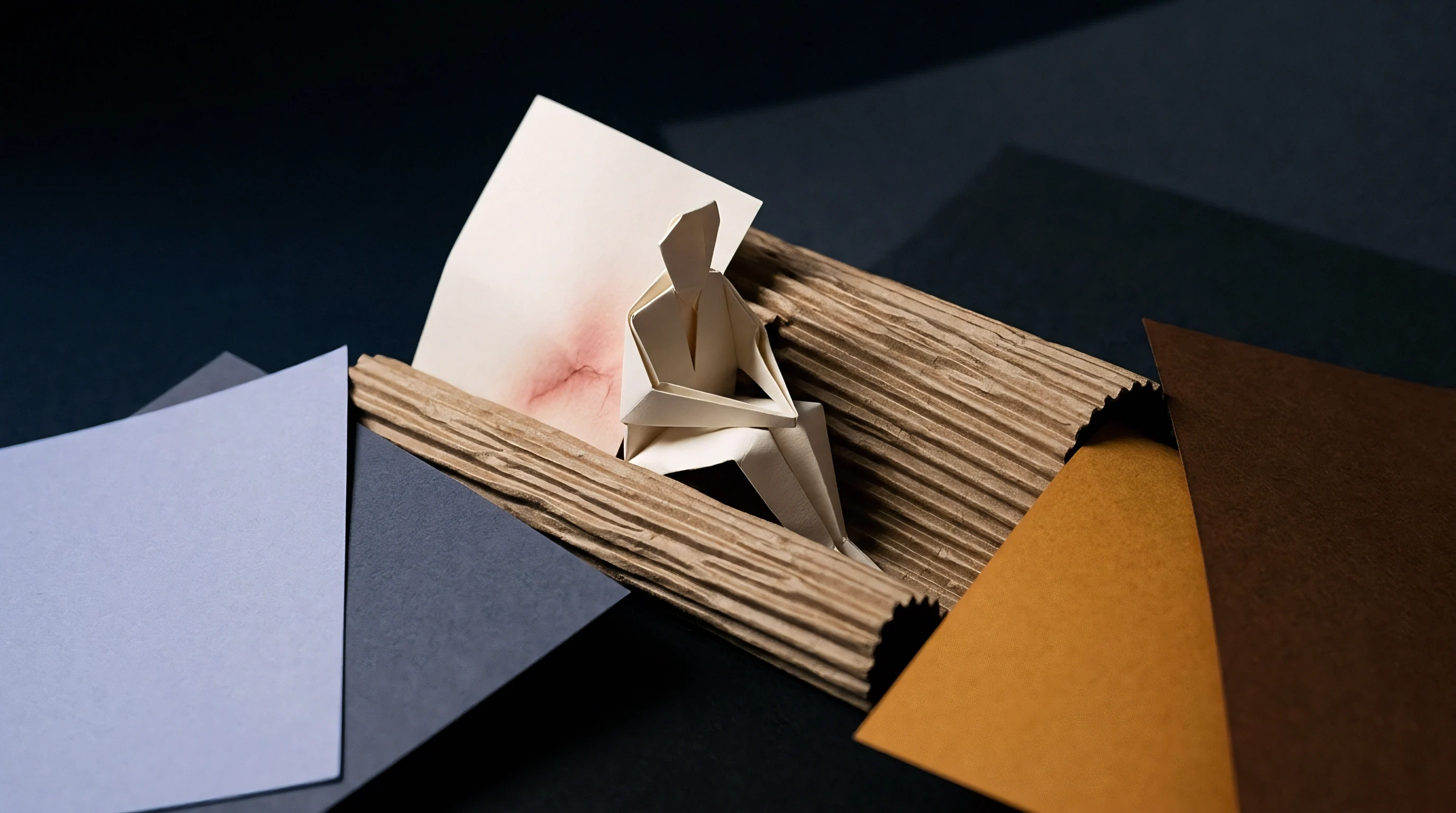
Scoring cartonboard on high-speed flatbed or rotary die-cutters subjects individual plies to violent out-of-plane shear loads. The operation forces the substrate into a female matrix groove, establishing a permanent hinge without rupturing the exterior liner plies. A sound crease produces an internal delamination bubble, permitting the board layers to separate cleanly and slip against each other as the carton blank folds 90 or 180 degrees.
If internal bond strength exceeds material limits, or if wet-end starch distribution remains non-uniform, shear stresses crack the outer plies or cause wide, ragged delamination splits.
The crease line fractures immediately.
Mechanics of High-Speed Creasing Tooling
Male scoring rules plunge into female matrix channels within two to four milliseconds on commercial Bobst flatbed presses. Scoring rule profiles follow standard industry thicknesses: a two-point rule measures 0.71 millimeters, while a three-point rule measures 1.05 millimeters. Female channel width calculation follows the formula where channel width equals rule thickness plus 1.5 to 1.7 times board caliper.
When board caliper measures 450 micrometers and rule thickness sits at 0.71 millimeters, the female matrix channel width targets 1.40 to 1.50 millimeters.
| Board Caliper (µm) | Rule Thickness (pt / mm) | Matrix Channel Width (mm) | Shear Strain Rate (s⁻¹) | Critical Scott Bond Band (J/m²) | Failure Mode Under High Speed |
|---|---|---|---|---|---|
| 350 | 2 pt / 0.71 mm | 1.25 mm | 1,450 | 160 to 210 | Tension splitting on liner |
| 450 | 2 pt / 0.71 mm | 1.45 mm | 1,200 | 185 to 240 | Clean internal shear roll |
| 550 | 3 pt / 1.05 mm | 1.90 mm | 980 | 210 to 265 | Ragged inter-ply delamination |
| 650 | 3 pt / 1.05 mm | 2.10 mm | 820 | 230 to 290 | Shoulder blister bursting |
Tool clearance controls crease definition. The male rule depth penetration must compress the central plies by 30 to 45 percent of nominal board caliper to initiate core separation. If the papermaking mill has applied excessive starch, the dense middle plies exhibit high shear moduli that resist compression.
The rule exerts extreme transverse pressure, transmitting shear forces directly toward the top linerboard. The top liner tears open along the score edges, exposing raw white or gray recycled fibers through printed ink layers.
Standard delivery terms invoking ISO 187 conditioning penalize buyers who process board stocks outside fourty-five to fifty-five percent relative humidity ranges.

Delamination Crack Propagation Patterns
Cross-sectional microscopic evaluation under ISO 5626 folding tests exposes cohesive failure lines following the interface between top liner and middle furnish plies. Balanced starch addition promotes cohesive delamination strictly inside the mechanical core plies. The fracture develops as a controlled shear crack traveling parallel to the web surface, arrested before reaching the back liner.
High-speed video diagnostics reveal that crack propagation speeds exceed 250 meters per second through the furnish matrix during the tool dwell phase.
Internal shear stresses peak instantly. When the starch addition rate drops below 5 kilograms per ton, the weak ply interface permits crack bifurcation. Instead of a single, continuous shear bubble, multiple micro-cracks run erratically across several plies.
The score loses bending stiffness and collapses into an irregular roll during automated carton erecting. Incorrect female channel sizing paired with excessive out-of-plane shear stresses splits carton hinges lengthwise across automatic cartoner feeding magazines, stopping packaging lines and wasting entire litho-laminated production batches.
Kinetics
Mathematical modeling connects wet-end chemical application directly to converting reject frequencies through multivariable regressions. Converting lines operating at speeds between 6,000 and 10,000 impressions per hour compress the mechanical deformation window below 3 milliseconds. Board viscoelasticity diminishes as tool contact velocities increase.
Dynamic modulus of elasticity and z-directional shear compliance shift according to polymer dosage, sheet moisture, and core furnish density.
Starch molecules migrate during hot pressing.
Can Cationic Starch Saturation Reverse Internal Bond?
Electrokinetic charge titration curves verify an inversion point where excess polysaccharide additions overload the anionic demand of virgin and recycled furnish. The anionic demand of a typical secondary fiber suspension sits between 80 and 140 microequivalents per liter. Virgin chemical pulp operates lower, around 20 to 50 microequivalents per liter.
Once cationic starch addition neutralizes this charge, surplus polymer remains unadsorbed. Free starch agglomerates into colloidal gels that foul felts and weaken sheet formation uniformity.
Starch saturated fibers lose rotational flexibility under rapid tool impacts.
Unbound polymer weakens cross-directional cohesion. High concentrations of free starch create slippery, poorly bonded boundary layers between individual plies formed on multi-wire machines. Laboratory evaluations using TAPPI T 833 testing show that plies formed under excess starch conditions display reduced z-directional fracture energy.
The board appears rigid under static bending tests like ISO 2493, yet it shears apart catastrophically under dynamic impact loading.
| Starch Dose (kg/t dry pulp) | Z-Direction Tensile (kPa, DIN 54518) | Scott Bond Energy (J/m², TAPPI T 569) | Taber Stiffness 15° (mN·m, ISO 2493) | Observed Crease Delamination Rate (%) | Score Line Visual Quality Class |
|---|---|---|---|---|---|
| 2.0 | 145 ± 12 | 125 ± 15 | 18.5 ± 0.8 | 14.8 | Extensive ragged delamination |
| 4.5 | 185 ± 10 | 165 ± 12 | 21.2 ± 0.6 | 6.2 | Occasional shoulder cracking |
| 7.0 | 230 ± 8 | 210 ± 10 | 24.5 ± 0.5 | 0.4 | Clean, symmetrical score bead |
| 9.5 | 255 ± 11 | 240 ± 14 | 26.1 ± 0.7 | 0.9 | Uniform score bead |
| 12.0 | 280 ± 14 | 275 ± 18 | 27.8 ± 0.9 | 4.1 | Core micro-shattering, stiff bead |
| 15.0 | 295 ± 18 | 315 ± 22 | 29.2 ± 1.1 | 11.3 | Liner split, excessive stiffness |
Predictive Regression Formulas for Crack Formation
Statistical algorithms link Scott energy, board thickness, crease depth, and line velocity into an empirical cracking probability index. The delamination crack probability, designated P_crack, derives from an exponential logistic regression model grounded on press floor sampling:
P_crack = 1 / (1 + exp(-(-4.85 + 0.028 V_press – 0.035 S_bond + 0.142 D_ratio + 0.210 C_starch)))
Inside this model formulation, V_press represents press velocity in sheets per hour divided by 1,000, running within a valid calibration window of 4.5 to 9.5. S_bond denotes Scott bond strength in J/m² according to TAPPI T 569, bounded between 130 and 320 J/m². D_ratio designates the rule penetration depth ratio expressed as indentation depth divided by uncompressed sheet caliper, operating between 0.25 and 0.55.
C_starch represents the wet-end starch addition rate in kilograms per metric ton, valid from 2.0 to 16.0.
Consider an operational production lot of 450-micrometer recycled folding boxboard running at 8,000 sheets per hour with a rule depth penetration ratio of 0.42. If the papermaking mill overdoses wet-end starch at 14.5 kilograms per ton, the Scott bond tests at 305 J/m². The calculated logit term evaluates to -4.85 + 0.028 (8.0) – 0.035 (305) + 0.142 (0.42 100) + 0.210 (14.5), yielding a logit value of -4.85 + 0.224 – 10.675 + 5.964 + 3.045 = -6.292.
This negative balance suppresses delamination cracking from low bond strength, yet it drives the board into brittle fracture.
Excess starch raises board brittleness. When the starch term drives the board matrix past its viscoelastic deformation limit, outer liner tensile strain reaches the rupture boundary under ISO 1924-2 testing. Whether mill laboratory Scott bond measurements under static twenty-three degree Celsius conditioning can ever reliably predict dynamic multi-axial crack bifurcation at five hundred strokes per minute remains an unsettled question among converting scientists.

Furnish
Secondary pulp fibers display hornified cell walls that shorten drainage windows and restrict polymer retention during sheet forming. Recycled furnishes derived from old corrugated containers or mixed sorted graphic paper contain short fibers, residual mineral ash, and fragmented fines. Virgin chemical pulps possess flexible, long softwood fibers that form compliant sheets under standard mechanical refining.
Blending strategies between plies determine how chemical additives distribute through the cross section.
Recycled furnish drains slowly.

Could Dynamic Creasing Speeds Suppress Matrix Plasticity?
Strain rate sensitivity experiments demonstrate board embrittlement when scoring tools strike at velocities above six meters per second. High converting velocities reduce relaxation times. Under rapid loading, paperboard ceases to dissipate energy via fiber slip, shifting deformation energy directly into inter-fiber adhesive bonds.
If those bonds consist of rigid, highly retrograded starch networks, brittle matrix cleavage occurs before the ply interface can slide.
The die strikes the sheet. Polymeric bond networks must yield along predictable cleavage planes. Papermakers handling recycled furnishes frequently introduce amphoteric or modified starches alongside micro-polymer retention aids to optimize drainage without excessive charging.
Process engineers implement rigorous production sequences on board machines to verify chemical retention:
- Continuous inline charge monitoring samples white water streaming potential every ninety seconds to track anionic trash spikes.
- Cationic starch dosing adjusts via automated metering pumps to stabilize headbox zeta potential between negative five and zero millivolts.
- Bentonite or silica micro-particle additions introduce controlled flocculation downstream from pressure screens to secure uniform retention.
- Cylinder dryer thermal profiles ramp progressively, holding wet-end sheet temperature below sixty degrees Celsius through early dryer sections to avoid premature starch gelatinization.
- Calender stack nips apply precise linear pressure under infrared moisture profiling to maintain eight percent sheet equilibrium moisture across the parent roll.
Failure sequences diverge when furnish composition varies across ply layers. Box plants encounter multiple distinct mechanical defects when converting board lots running unstable chemical additions:
- Inter-ply blistering generates hollow structural pillows along female matrix lines caused by deficient core bonding below 150 J/m² Scott bond.
- Liner surface splitting tears bleached top coatings lengthwise when middle plies exhibit excessive rigidity exceeding 290 J/m² Scott bond.
- Cross-directional crow-foot cracking shatters carton corners during ninety-degree folding due to retrograded starch clusters embedded in dry recycled furnish.
- Asymmetrical score bead displacement forces carton panels out of square because uneven wire-side starch retention distorts local shear compliance.
Retention Chemistry and White Water Charge
Colloidal titrations using streaming current detectors show that unabsorbed amylose molecules build up across closed mill loops. As white water circuits close to meet environmental discharge regulations, dissolved conductive salts and residual surfactants accumulate. This ionic contamination compresses the electrical double layer around cellulose fibrils.
Polyelectrolyte complexes precipitate in white water.
The cationic starch fails to bind cleanly to cellulose fibers, requiring dosage increases that exacerbate system instability. Mills counter this problem by applying dual-polymer schemes: a low molecular weight, high-charge polyamine or poly-DADMAC coagulant added early neutralizes anionic trash, freeing higher molecular weight cationic potato starch to bond directly to structural fibers. Mill technical sales managers typically insist that seasonal fluctuations in incoming OCC starch content explain wet-end charge shifts, deflecting complaints about ply bond failures back to board storage temperatures.

Yield
Converting efficiency calculations balance raw material additions against box plant scrap frequencies to define true packaging costs. Packaging buyers who focus solely on mill base paper prices overlook make-ready waste and downtime losses caused by scoring failures on high-speed folder-gluers. A board grade containing optimized wet-end polymer chemistry commands a price premium of 30 to 45 euros per metric ton over generic, low-grade recycled board.
That initial expense disappears when converted carton scrap drops below one percent.
The outer liner splits open.
Unit Economics of Chemical Overdosing
Adding four kilograms of potato starch per metric ton increases dry furnish input expenditure by roughly 5.80 euros. If an aggressive papermaker over-applies starch up to sixteen kilograms per ton to mask severely shortened fibers, chemical costs swell by 23.20 euros per ton without delivering proportional structural performance. The resulting board stiffens, loses folding endurance under ISO 5626 testing, and causes frequent line jams on high-speed consumer packaging lines.
Tough fibers create pliable hinges while brittle binders shatter scoring channels.
Consider an enterprise packaging run processing 150 metric tons of 400-micrometer multi-ply board into 1,200,000 litho-laminated food cartons. Assume a press operating speed of 7,500 sheets per hour with baseline operational costs fixed at 420 euros per press hour. A generic board lot showing erratic Scott bond values of 150 to 310 J/m² incurs a four percent creasing defect rate.
The press operator stops the line three times per eight-hour shift to scrape blistered carton scrap out of the female matrix channels, adding four hours of downtime. The yield balance reveals immediate commercial divergence:
| Cost Component Parameter | Under-Dosed / Inconsistent Furnish | Optimized Starch Addition Furnish | Variance Impact per 150-Ton Order |
|---|---|---|---|
| Base Substrate Landed Cost (€/t) | 840.00 | 875.00 | +5,250.00 € substrate expenditure |
| Die-Cutting Crease Reject Rate (%) | 4.2 % | 0.6 % | -43,200 rejected carton blanks |
| Carton Blank Material Loss (€) | 5,292.00 | 756.00 | -4,536.00 € scrap savings |
| Unplanned Press Stoppage Downtime (h) | 6.5 h | 0.5 h | -6.0 h machine downtime |
| Die-Cutter Hourly Downtime Cost (€) | 2,730.00 | 210.00 | -2,520.00 € conversion savings |
| High-Speed Gluer Feeder Jam Rate (%) | 2.8 % | 0.2 % | -31,200 unglued packaging blanks |
| Net Landed Cost per 1,000 Finished Packs (€) | 118.45 | 113.80 | -4.65 € per thousand delivered cartons |
The raw sheet savings of thirty-five euros per ton on the generic board convert into a net loss of over 4,600 euros across the finished packaging batch. Scrap cartons carry the full value of offset printing ink, cold foil, barrier dispersion varnishes, and laminating adhesives. Discarding laminated cartons due to split hinge lines destroys converting profitability.

Audit Checkpoints for Substrate Procurement
Technical delivery specifications state rigorous testing boundaries that incoming board pallets fulfill before warehouse receiving clerks approve payment. Sourcing teams writing substrate supply contracts mandate strict laboratory compliance boundaries to insulate finishing plants from furnish defects:
- Z-directional tensile thresholds enforce DIN 54518 values between 200 and 260 kPa across all reel positions from drive side to tender side.
- Scott bond distribution limits reject board lots demonstrating TAPPI T 569 test results outside a strict 180 to 240 J/m² processing window.
- Equilibrium moisture bands require conditioning within 7.5 to 8.5 percent moisture under ISO 287 to prevent post-conversion score brittleness.
- Cross-machine stiffness ratios restrict ISO 2493 Taber 15-degree machine-to-cross stiffness ratios below 2.4 to maintain uniform carton opening force.
Board that bends without splitting yields cartons that pack without stopping.