Schopper Riegler Refining Control for Eucalyptus Board Tensile Strength
Maintain eucalyptus refining between 28 and 32 Schopper Riegler at low edge loads below 0.8 J/m to maximize board tensile index while preserving bulk and wire drainage.

Freeness
Bleached eucalyptus kraft pulp delivered to a packaging board line responds aggressively to mechanical beating within a narrow processing envelope. An unrefined South American pulp consignment typically tests at 18 to 20 Schopper-Riegler, exhibiting an initial tensile index below 28 Newton metres per gram when prepared under ISO 5269-1 sheet-forming conditions. Board converters require high tensile strength in the outer and liner plies to prevent web snap under high-tension flexographic printing and laminating operations.
Increasing the dewatering resistance to 30 or 32 Schopper-Riegler raises that tensile index toward 70 Newton metres per gram. Moving beyond that threshold damages the economic utility of the furnish. Hardwood vessel elements break apart, creating microscopic fines that blind the forming fabric.
The sheet rapidly loses caliper, which degrades section modulus and ruins box stacking strength.

Tensile Development across Schopper Riegler Intervals
Laboratory evaluations using ISO 5267-1 demonstrate that tensile gain correlates positively with drainage resistance up to a definitive crest. Below 25 Schopper-Riegler, the fibre network contains insufficient external fibrils to establish high contact area during wet pressing. Hydrogen bonding remains sparse.
Tensile values plateau near thirty-four degrees. Between 26 and 32 Schopper-Riegler, delamination of the primary cell wall permits internal swelling, allowing short eucalyptus fibres to flatten and conform. Specific tensile strength climbs steeply throughout this interval.
Laboratory beatings show that pushing beating beyond 35 Schopper-Riegler yields less than a three percent increase in ultimate tensile resistance while shifting drainage time upward by twenty-five percent. Fiber cutting replaces surface activation. The stock stiffens under nip pressure.
Bleached eucalyptus kraft pulp conditioned at 23 degrees Celsius and 50 percent relative humidity achieves a tensile index of 72.4 Newton metres per gram at 31 Schopper Riegler under ISO 1924-2 testing.
Fibre length measurements conducted via automated optical analyzers confirm that pristine eucalyptus fibres average between 0.75 and 0.85 millimetres. Once the furnish passes 33 Schopper-Riegler, the mean arithmetic fibre length contracts toward 0.62 millimetres. The population of fines passing a 200-mesh Bauer-McNett screen escalates from an initial four percent to more than twelve percent.
These detached cell fragments fail to bridge gaps between load-bearing fibres. Instead, they occupy the void volume, raising web density and restricting water evacuation. Refining shifts water retention.
A board mill running three fourdrinier plies faces immediate production penalties when the top liner drainage resistance climbs past thirty degrees.

Drainage Resistance and Caliper Retention Limits
Structural packaging grades depend on bulk to achieve target flexural rigidity under ISO 5628 protocols. Eucalyptus fibres provide an exceptional stiffness-to-weight ratio because their natural morphology yields an open, porous structure at low beating levels. Pushing refining degree upward to satisfy an aggressive machine-direction tensile target collapses this bulk.
Sheet density increases across the press. A multi-ply folding boxboard loses four to seven percent of its total caliper when the hardwood liner component is beaten from 26 to 34 Schopper-Riegler under identical wet-press loading.
| Refining Stage (°SR) | Tensile Index (N·m/g) | Apparent Density (g/cm³) | Bending Stiffness Index (mN·m⁶/kg³) | Drainage Time (s) |
|---|---|---|---|---|
| 18 | 26.4 | 0.58 | 1.82 | 4.2 |
| 24 | 48.1 | 0.66 | 1.64 | 5.8 |
| 28 | 64.8 | 0.72 | 1.45 | 8.1 |
| 32 | 73.2 | 0.78 | 1.26 | 12.4 |
| 36 | 76.0 | 0.83 | 1.08 | 19.6 |
| 40 | 77.1 | 0.87 | 0.94 | 29.5 |
| Values reflect ten-sheet laboratory averages prepared under ISO 5269-1 with pulp refined in a laboratory PFI mill according to ISO 5264-2. | ||||
The standard figure of 73.2 Newton metres per gram at 32 Schopper-Riegler rests on standard laboratory PFI mill evaluations utilizing fresh market pulp slurried in demineralized water at ten percent consistency. Mill operations utilizing recycled mill white water with elevated electrical conductivity and dissolved calcium ions observe a rightward shift of this curve: achieving that same tensile target routinely demands 34 or 35 Schopper-Riegler because dissolved electrolytes suppress osmotic swelling. The mill delivery representative routinely claims that elevated beating degrees are harmless because modern retention chemicals compensate for sluggish wire drainage.

Bar
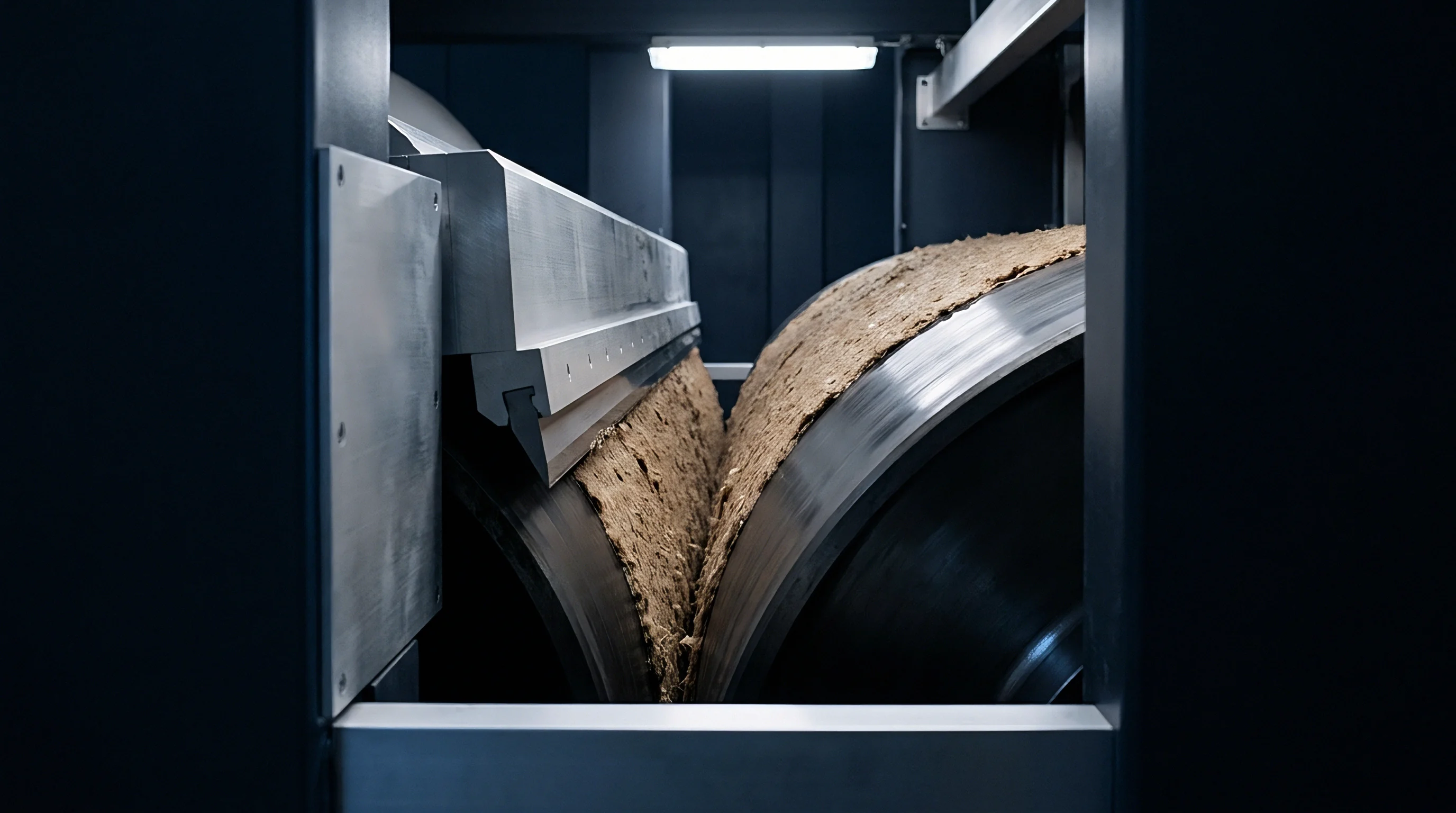
Tackle selection on industrial disc refiners dictates whether hardwood furnish experiences gentle surface peeling or destructive fibre cleavage. Eucalyptus cell walls measure approximately 2.8 to 3.4 micrometres in thickness, enclosing a narrow central lumen. Subjecting these delicate structures to sharp, intense impacts shears the fibre transversally.
Papermakers quantify this mechanical impact through Specific Edge Load, expressed in Joules per metre. Effective eucalyptus processing mandates an edge load between 0.4 and 0.8 Joules per metre. Selecting tackle with wide bars and wide grooves introduces high-intensity impacts that destroy fibre integrity before adequate swelling occurs.
Can Specific Edge Load Preserve Fibre Length?
Low intensity beating maintains structural length by maximizing the frequency of bar crossings while minimizing the energy discharged per impact. Operating at 0.5 Joules per metre ensures that mechanical work transfers through a hydraulic cushion of fibre bundles rather than direct metal-on-metal compression. Fibers shear under excessive bar impact.
When refiner plates feature narrow bars between 1.0 and 1.5 millimetres with matching sub-two-millimetre grooves, the cutting edge length per revolution expands dramatically. Low intensity treatment minimizes fiber breakage. This geometry distributes the net drive motor output across billions of cellular contact points, stripping away the outer primary wall and unwrapping the S1 layer without snapping the fibre axis.
Refining intensity governs fibre length preservation while net specific energy dictates swelling and surface fibrillation.
Operating outside these bar limits destabilizes the tensile-to-drainage relationship. Applying a 1.2 Joule per metre intensity to a pure bleached eucalyptus furnish drives the drainage resistance to 32 Schopper-Riegler through the generation of fines rather than external fibrillation. Tensile strength reaches only 55 Newton metres per gram because shortened fibre fragments lack the length necessary to form a load-distributing matrix.
Z-directional strength deteriorates simultaneously. Scott bond reflects internal ply adhesion. The sheet develops internal weakness that fails during gravure printing or rotary die-cutting.
Plate Pattern Geometry and Cutting Actions
Disc patterns configured with aggressive cutting angles slice eucalyptus cells into useless dust. Cast stainless steel plates with a five-to-ten-degree bar angle create scissor actions that snip hardwood tubes into fragments. Operators minimize cutting by installing cast segments with thirty-degree intersecting bar angles, establishing a pushing, rubbing action within the refining zone.
Groove depth controls throughput. As bar edges wear round from mineral fillers or grit, the effective bar clearing changes, altering the shear field. Pulp buyers evaluate supplier bar maintenance schedules because dull edges crush wet fibres, generating micro-cracks along the cell axis that reduce cross-direction tensile performance.
- Edge load intensity below 0.6 Joules per metre prevents premature cell wall rupture while initiating sufficient external swelling to support network tensile load.
- Intersecting bar angles exceeding twenty-five degrees suppress shear cutting actions, directing electrical work into fibre wall delamination and lumen collapse.
- Groove velocity control maintains consistent residence time across the disc face, avoiding regional overheating and hydraulic starvation that degrades pulp quality.
- Plate life tracking detects bar rounding before metal distortion accelerates fines generation and alters wet-end water removal rates.
Maintaining a delicate balance between bar edge geometry and volumetric flow keeps the furnish inside the fibrillating zone. When plate wear reduces groove depth below 1.5 millimetres, hydraulic capacity collapses and forces operators to widen plate clearance to maintain production rates, completely destroying refining efficiency. Sharp bars beat fast, blunt bars burn energy, narrow bars preserve bulk.
Wire
Drainage dynamics on the wet end establish the upper operational ceiling for eucalyptus refining. Water removal rates along the gravity table and vacuum boxes drop precipitously when stock arrives above 30 Schopper-Riegler. Eucalyptus fines lodge inside the inter-fibre capillaries of the forming sheet, transforming the porous mat into an impermeable filter cake.
Vacuum levels across low-vacuum flatboxes climb to their mechanical limit, pulling the wet web into the forming fabric and increasing drive motor load. Dewatering resistance climbs past thirty degrees. Machine speeds must adjust downward to allow adequate water evacuation prior to the couch roll.
Where Does Dewatering Impedance Threaten Machine Speed?
Couch roll solids content serves as the prime indicator of drainage health on multi-ply board machines. When refining controls function correctly, the eucalyptus furnish enters the press section at eighteen to twenty percent dry solids. Over-refined pulp arrives at the couch at only fourteen percent solids because gravity foils fail to evacuate water through the dense fiber network.
Fines plug the forming fabric openings. The couch vacuum increases, but air cannot penetrate the sealed wet web to pull interstitial moisture out. Every additional percentage point of water entering the wet presses increases web crushing risks and amplifies sheet two-sidedness.
Over-refined hardwood furnishes reduce paper machine drainage rates long before sheet tensile properties reach their structural limit.
A machine operating at 600 metres per minute cannot tolerate drainage delays. If beating drifts from 28 to 34 Schopper-Riegler, couch vacuum spikes by fifteen kilopascals while couch moisture rises by three percentage points. Wet web tensile strength drops because excess water lubricates inter-fibre movement under tension.
Press section moisture profiles deteriorate. Wet web breaks multiply at the open draw between the second press and the first dryer cylinder. Mill managers watch couch vacuum.
Lost production time from web breaks rapidly outstrips the commercial value of any slight tensile gains achieved through excess beating.
Web Consolidation across Multi-Ply Formers
Board machines producing folding boxboard or solid bleached sulphate combine multiple plies to balance stiffness, surface smoothness, and strength. Eucalyptus pulp occupies either the surface layers for printability or the entire cross-section in solid bleached boards. In three-ply structures, core layers often incorporate thermomechanical pulp or unrefined brock to maximize bulk, while outer plies utilize beaten eucalyptus for tensile integrity.
Divergent drainage characteristics between plies create internal hydraulic shear during pressing. If the outer eucalyptus layer drains too slowly relative to a free-draining mechanical core, water becomes trapped at the ply interface, producing blister defects and severe delamination during drying.
- Stock freeness verification at the headbox loop detects refining drift before furnish reaches the forming wire and disrupts water evacuation.
- Forming wire vacuum optimization adjusts vacuum box step-gradients, preventing rapid compaction of the bottom surface while maintaining continuous drainage.
- Press nip dewatering monitoring tracks water extraction across each press nip to confirm that wet web solids achieve safe levels prior to open draws.
- Inter-ply bond verification confirms that moisture differentials between wet plies remain within safe limits to avoid structural blistering in dryer sections.
Uncontrolled beating on the hardwood line forces machine speed reductions, increases vacuum blower power consumption, and elevates wet-end sheet break frequency, translating directly into higher conversion overheads and lower gross tonnage output across every machine run.
Power
Refiner energy allocation dictates both mill operating margin and pulp strength optimization. Processing eucalyptus requires tracking two distinct electrical parameters: no-load power and net specific energy. No-load power represents the electrical energy expended to rotate the refiner plates in water without performing mechanical work on fibres.
Net specific energy reflects the actual mechanical work imparted directly to the pulp slurry, expressed in kilowatt-hours per bone-dry metric tonne. Eucalyptus pulps develop structural strength rapidly, demanding between 40 and 80 kilowatt-hours per tonne of net specific energy. Supplying energy beyond 90 kilowatt-hours per tonne generates negligible tensile improvement while consuming costly line power.
Specific Energy Consumption per Tensile Unit
Mathematical modeling of refiner lines establishes the conversion efficiency between electrical energy input and mechanical strength output. Market bleached eucalyptus kraft pulp enters the refiner with an inherent tensile index near 25 Newton metres per gram. Applying 50 kilowatt-hours per tonne of net specific energy typically lifts the tensile index to 60 Newton metres per gram.
An additional 25 kilowatt-hours per tonne advances tensile to 72 Newton metres per gram. Supplying another 25 kilowatt-hours per tonne pushes tensile only to 74 Newton metres per gram. Energy consumption rises past seventy kilowatt-hours.
The incremental energy cost per unit of tensile strength increases exponentially past 70 kilowatt-hours per tonne.
| Net Energy (kWh/t) | Freeness (°SR) | Tensile Index (N·m/g) | Scott Bond (J/m²) | Energy Cost (€/t) |
|---|---|---|---|---|
| 0 | 19 | 26.5 | 85 | 0.00 |
| 30 | 23 | 45.0 | 140 | 3.60 |
| 50 | 27 | 61.5 | 210 | 6.00 |
| 70 | 31 | 71.0 | 265 | 8.40 |
| 90 | 35 | 74.5 | 280 | 10.80 |
| 110 | 40 | 75.5 | 285 | 13.20 |
The desk cannot fully defend the specific industry assumption that electrical energy converts to tensile strength uniformly regardless of seasonal water temperature swings: winter processing temperatures drop water viscosity and alter disc cavitation thresholds, demanding that buyers verify refined pulp properties dynamically rather than relying on fixed kilowatt-hour targets. Global supply chains experience localized power grid price volatility that transforms unmonitored refining into an acute cost drain. When power costs hit 120 Euros per megawatt-hour, expending 90 kilowatt-hours instead of 65 kilowatt-hours per tonne adds three Euros per tonne of unrecoverable furnish cost.
Bending stiffness declines at higher density. The board also loses caliper, requiring higher basis weights to satisfy client package stiffness criteria, compounding material costs per thousand finished cartons.
Furnish Blending and Hardwood Substitution Curves
Modern board formulations blend beaten eucalyptus with unrefined or lightly brushed softwood kraft pulp to optimize the strength-bulk envelope. Long softwood fibres from pinus radiata or pinus taeda provide tear resistance and tensile network matrix support at low density. Bleached eucalyptus fills voids, providing sheet smoothness and compressive strength.
Beating eucalyptus to 30 Schopper-Riegler allows board producers to increase hardwood substitution rates from fifty percent to sixty-five percent without dropping below web tensile specifications. Eucalyptus pulps are priced at a commercial discount relative to northern bleached softwood kraft. Hardwood substitution reduces raw material outlay.
Consider a cartonboard manufacturer operating an annual production run of 100,000 metric tonnes of solid bleached board. The formulation baseline incorporates forty percent northern bleached softwood kraft at 850 Euros per tonne and sixty percent bleached eucalyptus kraft at 680 Euros per tonne. Raising the eucalyptus refining degree from 24 to 30 Schopper-Riegler lifts the hardwood tensile contribution sufficiently to shift the furnish blend to seventy percent eucalyptus and thirty percent softwood.
The raw material savings total seventeen Euros per tonne of finished board. Subtracting the incremental refining energy cost of 2.40 Euros per tonne leaves a net operational margin expansion of 14.60 Euros per tonne, generating 1,460,000 Euros in net annual savings across the machine line. Delamination risks rise in dryer cans.
What remains technically unproven across modern high-speed formers is the exact micro-rheological mechanism by which hydrodynamic shear forces inside dilute headbox suspensions dissociate refined eucalyptus fibre flocs without damaging wet web consolidation.

Tolerance
Commercial acceptance of delivered packaging board relies on precise physical property ranges verified through standardized test protocols. Converter facilities face catastrophic downtime when incoming board exhibits out-of-specification tensile properties or brittle score lines. Tensile testing conducted under ISO 1924-2 measures the force required to rupture a fifteen-millimetre paperboard strip at constant elongation rate.
Converting engineers establish machine-direction and cross-direction tensile criteria to ensure webs pull evenly through flexographic printing presses, extrusion coaters, and folder-gluers without edge tears or register drift. High couch moisture increases steam usage.
Goods-In Testing Protocols for Converting Performance
Quality assurance departments evaluate incoming board shipments against rigorous laboratory baselines. Pallets must rest in conditioned environments matching ISO 187 parameters for twenty-four hours before testing. A sheet removed directly from an unconditioned shipping container exhibits false tensile readings because environmental moisture plasticizes hemicellulose chains within the fibre wall, masking poor refining execution.
Score lines crack on dense stock. When testing confirms low tensile strength coupled with abnormally high sheet density, the converter identifies an over-refined furnish where excessive beating failed to overcome poor native fibre bonding.
Standard delivery specifications citing ISO 2493-1 reject board shipments whose cross-direction bending resistance falls below contracted taber equivalents regardless of tensile test compliance.
Internal bond strength serves as a vital cross-check on refining quality. Scott bond testing according to TAPPI T 569 evaluates the energy absorbed when an internal pendulum delaminates a paperboard specimen. Over-refined eucalyptus plies frequently exhibit excessive Scott bond values exceeding 300 Joules per square metre at the expense of bending stiffness.
Plies split under flexure. When such board passes through scoring dies, the brittle liner refuses to stretch around the scoring rule, resulting in cracked box creases that rupture upon glue folding. Rejection follows poor bonding.
Commercial Exposure on Score Line Cracking
Carton failures in automated packaging lines trace back to improper refining balances established months earlier at the paper mill. When an over-beaten eucalyptus top liner is applied over a dense recycled or mechanical core, score lines lose their hinge capability. High-speed cartoning machines run at speeds exceeding 400 cartons per minute.
When a score line cracks, the box skew jams the feeder pocket, stopping the entire packaging line. The packaging buyer issues commercial non-conformance claims against the converter, who passes the financial liability back to the board mill.
Master supply agreements incorporate precise technical annexes detailing acceptable property envelopes for all virgin hardwood paperboard grades. Standard procurement contracts enforce strict rejection parameters via explicit clauses: Mill technical specification sheet annex four states that any board lot displaying cross-direction elongation at break below 1.8 percent under ISO 1924-2, or Taber stiffness index variations exceeding eight percent of nominal values defined by ISO 2493-1, permits the buyer to issue immediate debit notes covering full landed tonnage cost and line downtime charges.