Viscoplastic Cohesive Zone Parameters for High Speed Scoring and Creasing
Viscoplastic cohesive zone parameters prevent liner cracking during high-speed creasing by accurately modeling rate-dependent shear delamination.

Impulse
As a scoring creaser penetrates paperboard substrate at high speed, the entire creasing operation takes place in just one to five milliseconds. Under these rapid dynamic conditions, static models routinely overestimate delamination because multi-ply board fails to behave like an elastoplastic solid with fixed fracture properties. Out-of-plane shear and normal compression applied so quickly generate localized strain rates between 100 and 1000 per second within internal plies.
The underlying cellulose network ~ bound by hydrogen ties and physical entanglements ~ exhibits strong rate-dependent viscoelastic and viscoplastic responses. When tooling strikes the sheet above three hundred metres per minute, interfacial stiffness rises abruptly, shifting how plies delaminate to form a functional crease.
Cohesive zone modeling is the main numerical approach for simulating interlayer shear and tensile failure in scoring. Traditional rate-independent formulations rely on fixed critical energy release rates and constant peak traction values; using these static parameters in high-speed converting models produces sharp discrepancies between predicted and actual score geometries. The brief stress pulse during high-speed scoring leaves insufficient time for viscous stress relaxation across the inter-ply starch and fiber matrix.
As a result, apparent Mode I tensile and Mode II shear fracture energies rise with loading velocity, requiring viscoplastic regularization directly inside the cohesive traction-separation law.
Dynamic Strain Rates during Creasing Penetration
Local strain rates in the scoring zone reach 100 to 1000 per second during rapid tool engagement. At lower converting speeds, paperboard plies yield gradually in shear, allowing short hardwood fibers in the core to realign microstructurally. High-velocity penetration suppresses this accommodation, raising peak traction thresholds before ply separation ever begins.
Dynamic material testing confirms that peak shear tractions increase by 35 to 60 percent when moving from quasi-static conditions to strain rates typical of high-speed die-cutters.
Viscoplastic cohesive formulations address this increase by making peak interface strength a function of the effective separation rate. Overstress models, such as Perzyna or Duvaut-Lions extensions, keep cohesive elements supporting stresses above the quasi-static damage yield surface during high-velocity impacts. The extent of overstress depends on a viscosity parameter and a rate-sensitivity exponent.
Omitting these terms causes explicit finite element simulations of scoring blades to predict premature delamination that conflicts with physical cross-sections of scored blanks.

Stress Relaxation Kinetics across Paperboard Plies
Viscous dissipation alters the peak stress reached during millisecond impact durations. As the creasing rule contacts the board, energy dissipates through fiber friction and permanent plastic deformation at the ply interface. Because interfacial shear strength rises with speed, a creasing dwell time shorter than the matrix’s characteristic relaxation time leaves the interface with elevated resistance to delamination.
This shift alters the penetration depth needed to achieve a target crease bending moment.
As high-speed scoring tools withdraw, residual stresses in the crease zone govern the permanent foldability of the blank. Static cohesive parameters cannot capture the rate-dependent spring-back and plastic strain retained in the score line. Viscoplastic parameters model the time-dependent relaxation happening right after impact, giving packaging engineers a reliable way to predict whether a blank will hold its shape on automated cartoning lines.
| Substrate Grade | Caliper (µm) | Static Shear Strength (MPa) | Dynamic Shear Strength at 500 m/min (MPa) | Dynamic Viscous Penalty (MPa·s/mm) |
|---|---|---|---|---|
| Solid Bleached Board (SBB) | 350 | 4.2 | 6.8 | 0.085 |
| Folding Boxboard (FBB) | 400 | 2.8 | 4.5 | 0.120 |
| Coated Recycled Board (CRB) | 420 | 2.1 | 3.1 | 0.165 |
Score splits on high-speed creasing lines are frequently attributed to tooling misalignment rather than strain hardening within recycled fiber furnish.

Delamination
Cohesive zone models treat inter-ply interfaces as zero-thickness elements governed by a traction-separation relationship. Controlled internal separation lets paperboard fold cleanly without cracking outer printed coatings. In high-speed operations, shear delamination dominates matrix penetration: the creasing rule drives the top liner into a female matrix groove, subjecting middle plies to severe out-of-plane shear and localized transverse compression.
A successful crease hinges on achieving extensive, localized delamination in these middle plies while keeping the outer liners intact.
Simulating this process accurately at production speeds requires incorporating rate sensitivity into both initiation criteria and damage evolution laws. Bilinear and exponential traction-separation laws with viscoplastic regularization introduce a time-dependent viscous penalty term. This penalty scales interfacial traction during rapid loading while suppressing numerical instabilities ~ like mesh sensitivity and pathological strain localization ~ that plague explicit dynamic finite element analysis.
Traction Separation Formulations for Rate Dependent Interfaces
Constitutive equations for cohesive elements govern how loading transitions from elastic response to damage evolution. Within a rate-dependent framework, total separation splits into elastic and viscoplastic components. Elastic stiffness holds the interface until combined normal tensile and shear tractions meet a quadratic or maximum stress threshold, while viscous penalties stabilize the explicit solver during fast transitions.
High deformation velocities suppress ductile micro-voiding, driving the damage initiation threshold upward as separation rates rise. Mathematical formulations express peak normal and shear tractions as functions of instantaneous separation velocity scaled by a viscosity coefficient. This rate adjustment stops models from predicting total interface cleavage during the initial sub-millisecond strike of the creasing rule.
At 23 °C and 50 percent relative humidity, high-speed scoring at 5 m/s elevates effective mode II shear fracture energy by 42 percent compared to quasi-static test conditions.

Viscoplastic Softening and Energy Dissipation Mechanics
Damage evolution along high-speed score lines depends on both strain softening rates and viscous damping coefficients. Once interfacial traction reaches its rate-adjusted peak, damage accumulates and drives scalar stiffness from unity to zero. In viscoplastic cohesive formulations, total energy dissipation splits between the surface energy needed to create crack surfaces and the viscous work absorbed as inter-ply starches and fiber fractions flow.
Total work of separation under high-speed scoring runs higher than static fracture energies measured in low-speed lab tests. If numerical models rely solely on static Mode I and Mode II critical energy release rates, they predict excessive shear delamination that spreads far beyond the matrix channel. That artificially wide delamination zone depresses calculated crease stiffness and misleads tool designers on optimal matrix groove widths.
Implementing rate-dependent cohesive zones numerically requires tight parameter verification to prevent artifacts from distorting explicit dynamic runs:
- Mesh dependency locking occurs when element size exceeds cohesive zone characteristic length, causing artificial stress concentrations and premature delamination through adjacent multi-ply elements.
- Spurious energy oscillations arise when viscous penalty parameters are set too high, triggering high-frequency numerical ring-down that distorts predicted scoring force profiles.
- State variable divergence develops during rapid unloading as the creasing blade retracts if the integration algorithm lacks sub-stepping capabilities.
- Mode mixity inversion takes place when high out-of-plane compression alters effective interfacial shear resistance, skewing the ratio between Mode I and Mode II dissipation.
Whether rate dependence in Mode II shear separation stems primarily from microstructural fiber reorientation or viscoelastic matrix flow between plies remains unresolved.

Compliance
Furnish composition dictates how stress propagates through board plies during rapid folding. Bleached chemical softwood kraft fibers offer high tear resistance and tensile energy absorption, whereas mechanical pulps such as chemi-thermomechanical pulp (CTMP) provide bulk and out-of-plane stiffness at the cost of lower inter-ply bond strength. Coated Recycled Board (CRB) relies on short, repeatedly recycled fibers with low hydrogen bonding capacity and higher filler content, making its internal interfaces vulnerable to brittle shear cleavage at elevated deformation speeds.
Moisture content shifts failure thresholds significantly. While standard laboratory conditioning per ISO 187 specifies 23 °C and 50 percent relative humidity, converting plants routinely operate anywhere between 30 percent and 65 percent relative humidity. Water acts as a plasticizer in amorphous cellulose and hemicellulose.
As moisture increases, viscoplastic relaxation times within internal plies drop, lowering peak dynamic tractions but raising overall viscous dissipation during creasing.

Furnish Architecture and Ply Stiffening Effects
Virgin bleached kraft liners absorb far more tensile energy than mechanical pulp cores. In multi-ply Folding Boxboard (FBB), the bulky CTMP core must yield internally under out-of-plane shear while chemical pulp outer liners bend without rupturing. Because recycled fibers exhibit shorter relaxation times, evaluating viscoplastic cohesive parameters requires distinct property sets for each ply interface based on its specific furnish blend.
The table below details calibrated viscoplastic cohesive parameter ranges across primary paperboard packaging grades at scoring speeds of 5 metres per second.
| Board Type | Furnish Composition | Mode I Energy G_IC (J/m²) | Mode II Energy G_IIC (J/m²) | Viscosity Parameter (N·s/mm³) | Critical Strain Rate Threshold (s⁻¹) |
|---|---|---|---|---|---|
| Solid Bleached Board (SBB) | 100% Chemical Kraft Pulp | 180 – 240 | 450 – 620 | 0.05 – 0.09 | 250 |
| Folding Boxboard (FBB) | Chemical Liners / CTMP Core | 120 – 160 | 280 – 380 | 0.10 – 0.15 | 180 |
| Coated Recycled Board (CRB) | 100% Recycled Fiber / Filler | 80 – 110 | 190 – 260 | 0.14 – 0.22 | 120 |
Environmental Conditioning and Moisture Sensitivity
Shifting relative humidity between 50 percent and 65 percent alters internal shear yield stress considerably. Dry environments stiffen the fiber matrix and push cohesive behavior toward brittle fracture. In low-humidity plant conditions, dynamic peak shear strength can jump by up to 25 percent while critical displacement at failure falls, shortening the cohesive zone length and predisposing simulations to unstable crack growth.
Testing paperboard tensile absorption under TAPPI T494 without rate-dependent calibration leads to invalid folding stiffness predictions on automated packaging lines.
Qualifying substrates for high-speed cartoning requires a systematic testing sequence to verify that cohesive parameters match delivered mill reels:
- Extract core samples across drive-side, center, and operator-side web positions of delivered reels to map basis weight variation.
- Condition specimens under ISO 187 conditions for twenty-four hours to achieve moisture equilibrium prior to testing.
- Measure out-of-plane z-direction tensile strength via TAPPI T541 to establish baseline static Mode I peak traction values.
- Perform high-speed shear delamination tests using drop-tower or pneumatic actuators to capture rate-dependent traction enhancement ratios.
- Fit experimental force-displacement profiles into a non-linear optimization solver to extract viscosity parameters and softening exponents.
Higher mechanical pulp content in core plies requires wider creasing channels to keep outer liners from rupturing during rapid folding.

Calibration
Extracting cohesive parameters requires pairing high-rate physical test benches with inverse finite element optimization. Measuring parameters directly during sub-millisecond creasing is hindered by stress wave propagation, localized contact loads, and complex multiaxial deformation inside the matrix channel. Physical testing therefore relies on isolated deformation modes run at production-equivalent speeds, followed by numerical parameter fitting.
Characterizing Mode I fracture energy requires high-speed Double Cantilever Beam (DCB) setups on dynamic actuators, while Mode II energy extraction uses End-Notched Flexure (ENF) or double-notch shear fixtures on high-velocity servo-hydraulic test frames. Digital Image Correlation (DIC) paired with video recorded above 100,000 frames per second tracks localized displacements and crack tip kinetics.

Laboratory Extraction Methods for Fracture Energies
High-speed double cantilever beam setups quantify Mode I critical energy release rates across loading speeds from 0.1 to 10 metres per second. High-speed video tracks the crack tip as a piezoelectric load cell records instantaneous resistance. Applying J-integral analysis to the resulting force-displacement curves yields the rate-dependent R-curve for inter-ply delamination.
Calibrating Mode II shear is more challenging because shear cracks in paperboard readily kink into adjacent plies. Asymmetric end-notched flexure fixtures used under dynamic impact suppress this kinking, yielding stable inter-ply shear separation and isolating interfacial rate sensitivity from bulk flexural deformation.
Thicker board calipers require lower initial cohesive penalty stiffness to prevent artificial stress oscillations in explicit finite element scoring simulations.

Inverse Finite Element Parameter Optimization Protocols
Digital image correlation captures full-field surface displacements during high-speed scoring impacts. Calibration proceeds by replicating the test setup inside an explicit finite element solver, where an optimization algorithm iteratively adjusts penalty stiffness, peak tractions, viscosity coefficients, and fracture energies until simulated load curves and crack velocities align with experimental DIC data.
Weighting the error objective function properly balances low-rate compliance fitting against high-rate peak force capture. Over-constraining initial elastic penalty stiffness creates ill-conditioned system matrices that force solvers into excessively small time steps. The calibration routine should bound penalty stiffness using physical out-of-plane modulus measurements (ISO 534) to maintain solver efficiency alongside physical accuracy.
Packaging specifications defining board compliance for high-speed folding must incorporate precise test metrics:
- Out of plane tensile bond strength measured per TAPPI T541 establishes the baseline lower bound for static Mode I cohesive traction.
- Z direction shear strength determined via short-span double-notch compression tests provides initial Mode II peak strength estimates.
- Dynamic tensile energy absorption evaluated per ISO 1924-3 at strain rates above 100% per second defines maximum plastic work parameters.
- Bending resistance and crease stiffness quantified via ISO 2493-1 tests calibrate residual rotational spring constants in score models.
Purchasing specifications under ISO 1924-3 require reporting dynamic tensile energy absorption at elevated strain rates to prevent batch rejections during high-speed converting.
Envelope
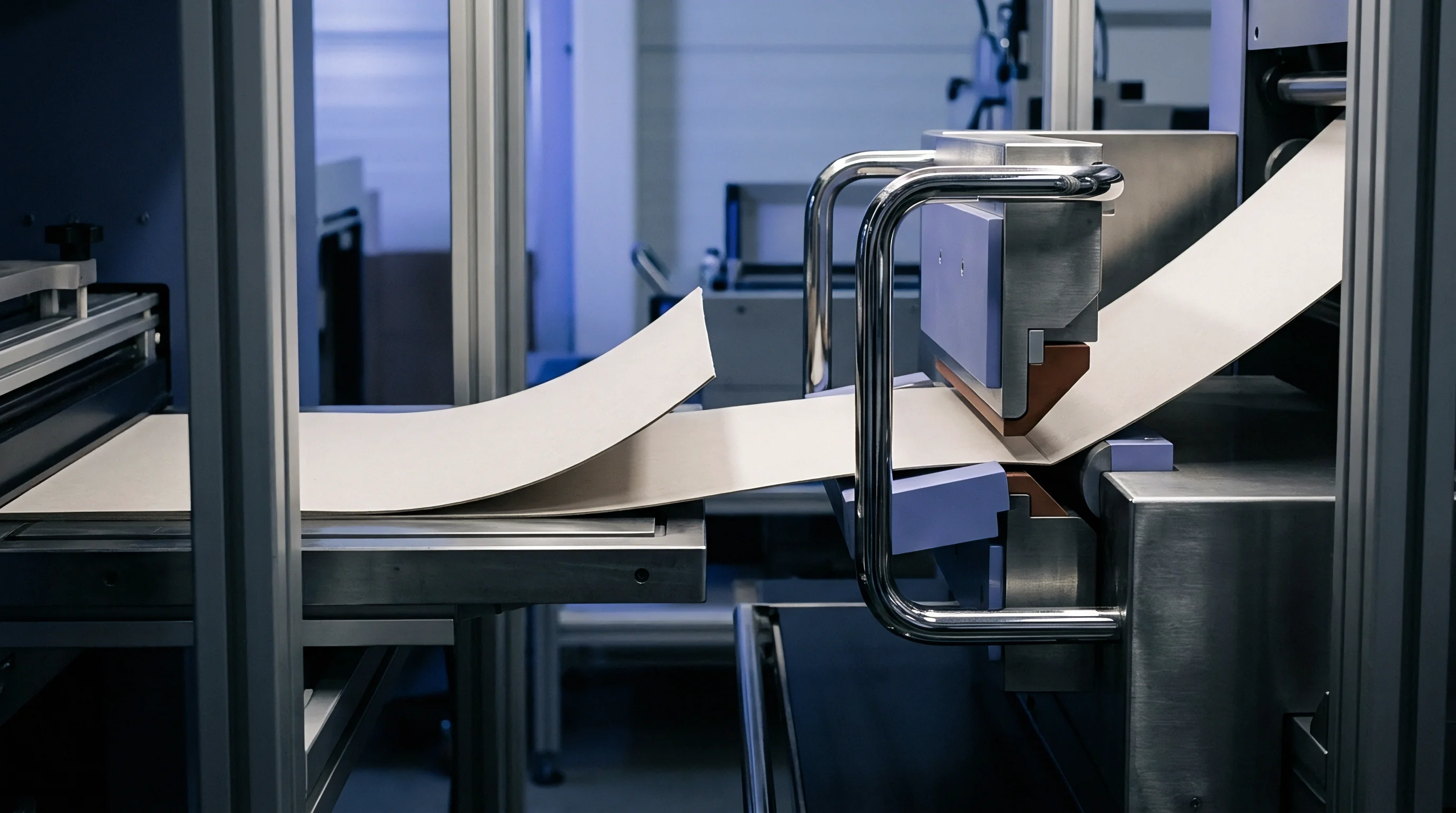
Converting lines running between three hundred and five hundred metres per minute operate within narrow margins. If score depth is insufficient, internal plies fail to delaminate, driving up crease bending moments and causing carton sidewalls to bow on automatic packing lines. Conversely, excessive scoring penetration or mis-matched matrix channel geometry cracks outer liners, tearing printed surfaces and exposing raw fiber.
Because matrix width controls bending radius and static parameters mispredict spoilage at speed, viscoplastic cohesive zone models allow converters to map precise operational windows ~ defining scoring depths, die-cutting rule radii, and channel widths across variable machine speeds. This approach eliminates trial-and-error setups on production die-cutters and cuts make-ready waste during high-volume runs.
Matrix Creasing Geometry and Score Quality Metrics
Rule thickness, channel width, and creasing depth must match board caliper to prevent liner failure. The primary variables ~ creasing rule width, male rule tip radius, female channel clearance, and matrix counter-groove depth ~ must adjust as production accelerates, where higher ply shear strength demands slightly wider female channel clearances.
A score quality index measures crease bending resistance against un-scored board bending resistance. For high-speed folding cartons, target score quality indexes range between 1.5 and 2.5. Hitting this window without cracking liners requires internal shear delamination across at least 60 percent of the crease zone width ~ a balance governed directly by the viscoplastic cohesive properties of core plies.
Uncalibrated static cohesive parameters consistently underestimate the scoring punch force needed at operational machine speeds above three hundred meters per minute.
Yield Arithmetic and Conversion Spoilage Analysis
Line downtime and blank rejection rates dictate the landed cost per thousand cartons. On a high-volume run of 500,000 folding cartons made from 400 µm Folding Boxboard (FBB) at 400 metres per minute, scoring parameters derived solely from static cohesive models result in an unexpected 2.4 percent liner cracking rate at full speed due to unmodeled strain hardening.
Recalibrating tooling geometry with rate-dependent viscoplastic parameters opens up the operational window. Widening the female matrix channel by 80 µm and reducing creasing rule penetration depth by 35 µm compensates for dynamic shear elevation, dropping defect rates from 2.4 percent to 0.1 percent. This reduction saves 11,500 defective blanks per run ~ yielding roughly 2,800 EUR in direct board savings while preventing four hours of downstream cartoning stoppages.
| Machine Speed (m/min) | Crease Dwell Time (ms) | Score Depth Ratio (%) | Liner Crack Incidence (%) | Waste Cost per 100,000 Blanks (EUR) |
|---|---|---|---|---|
| 100 | 5.2 | 65 | 0.05 | 45 |
| 250 | 2.1 | 65 | 0.42 | 378 |
| 400 | 1.3 | 65 | 2.40 | 2160 |
| 400 (Optimized CZM) | 1.3 | 58 | 0.08 | 72 |
Inaccurate cohesive parameters cause severe blank jam rates, damaged print runs, and excessive waste costs during high-speed assembly.