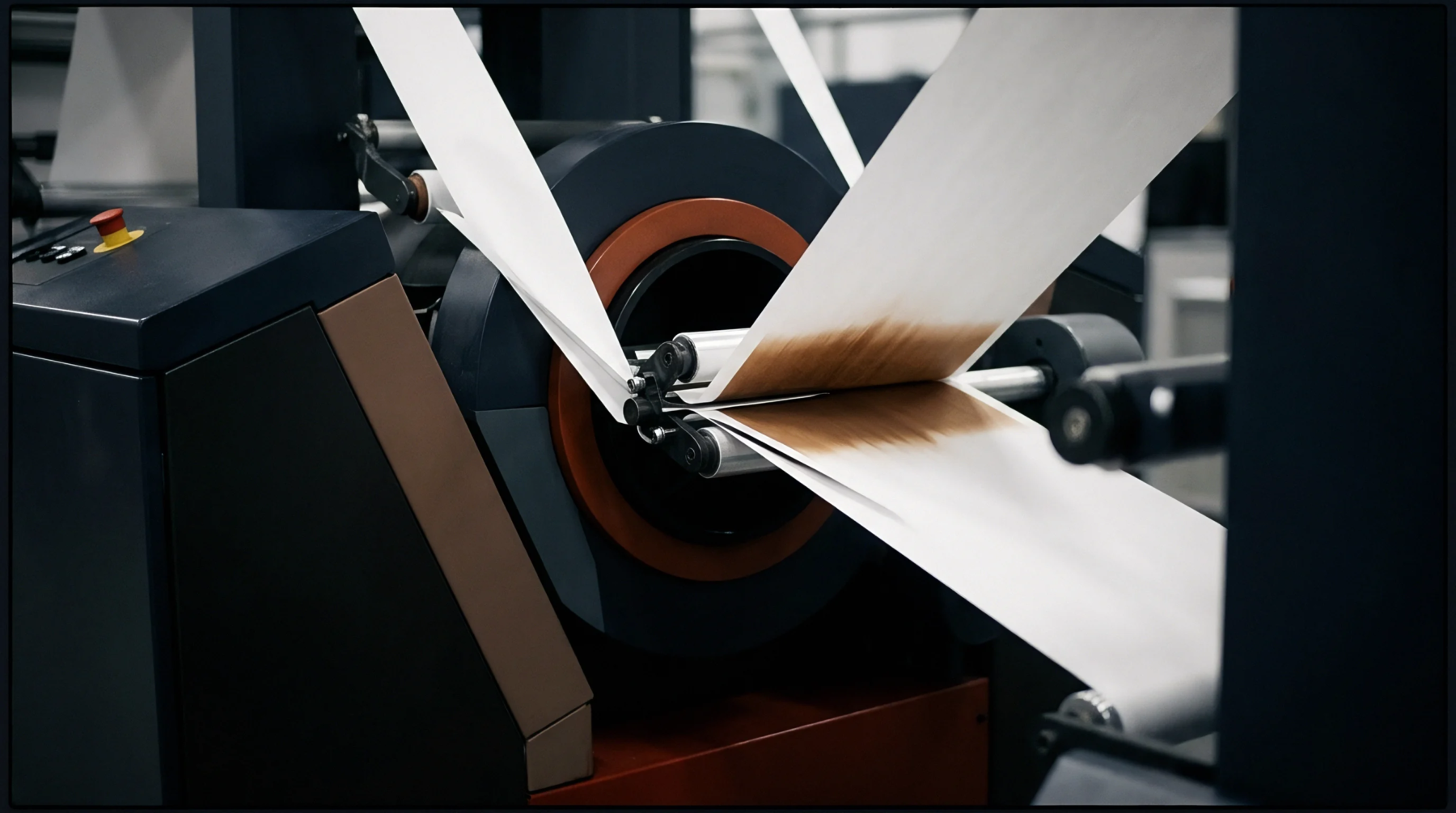
Internal Separation Defect
Localized planar rupture between adjacent plies or within the internal fibre core of paperboard forms an expanded dome-like bubble under elevated thermal and vapor stress. A delamination blister appears when internal steam generation exceeds the transverse z-directional tensile strength of the fibrous substrate during rapid heating processes such as blister packaging, heat sealing, or heatset web offset printing. High residual moisture in the base board rapidly vaporizes when pinched between heated sealing plates or passed through drying ovens.
Trapped moisture cannot vent laterally through the dense, coated surface plies, generating immense internal thermodynamic pressure that shears fibre bonds apart. The defect terminates once the internal gas bubble ruptures the outer liner or cools, leaving a permanently weakened, raised structural void.
Vaporization Kinetics
Rapid heat transfer through outer board plies instantly flashes capillary moisture into high-pressure vapor while the surface remains sealed against heated metal dies. A delamination blister initiates when local steam pressure surpasses the Scott bond strength or z-directional tensile threshold of the weakest internal ply. Dense pigment coatings with low air permeability compound the entrapment, preventing harmless vapor migration through microscopic sheet pores.
Starch bond failure between the top liner and under-plies provides the default path of least mechanical resistance, permitting the expanding steam pocket to peel adjacent fibre networks apart. Machine factors such as excessive wet pressing, inadequate refining of middle-ply mechanical pulp, and erratic moisture profiles across the sheet width drastically lower the critical blister threshold.
Packaging Line Integrity
Production line failure during blister pack sealing manifests as crushed or ruptured board surfaces that fail mechanical push-through integrity testing. Packaging lines running high-speed thermoformed plastic-to-board seals demand board grades with uniform internal bond metrics and calibrated surface porosities to avert blister formation. If a delamination blister develops within the carton wall, package compression strength drops sharply, risking warehouse stack collapse under standard pallet loads.
Converters prevent blistering by specifying base boards with moisture contents below seven percent and tightly controlled z-direction tensile values above two hundred kilopascals.