Interlaminar Delamination Mechanics during Creasing of High Bulk Boxboard Plies
Controlled interlaminar delamination during high bulk boxboard creasing requires widened matrix channels to fracture low-density cores without breaking liners.
Flaw
Delamination failure during rotary or flatbed creasing originates when through-thickness shear stresses exceed the internal cohesive strength of middle plies before controlled interlaminar shear cracking develops. High bulk boxboard grades, spanning folding boxboard with mechanical pulp cores and multi-ply solid bleached sulfate, rely on high specific volume to achieve bending stiffness at minimal basis weight. The mechanical pulp core in folding boxboard contains stiff, uncollapsed fibres of thermo-mechanical pulp or chemithermo-mechanical pulp yielding bulk values from 1.4 to 2.2 cm³/g.
These stiff fibres establish fewer hydrogen bonds per unit volume than chemical pulp plies. The creasing rule indents the board against a female channel, generating localized transverse shear and out-of-plane compression. A sound crease produces a permanent hinge via micro-delamination along several controlled shear planes.
A defective crease triggers uncontrolled core destruction or tensile cracking across external plies.
When shear failure runs uncontrolled, the board displays bead splitting, liner rupture, or erratic folding torque. Folding torque instability causes carton misfeeds on automated packaging lines running above 400 cartons per minute. The primary variable governing this mechanical response is the Scott bond energy, measured under TAPPI T 569 at 23 °C and 50 percent relative humidity.
Typical values for high bulk middle plies fall between 110 and 160 J/m², compared to 250 to 380 J/m² for virgin chemical pulp liners. If the internal bond falls below 100 J/m², shear bands fail to distribute across the core thickness. The indentation of the rule concentrates shear strain into a single plane, peeling the liner away from the core.
If the internal bond exceeds 220 J/m² in a mechanical core, the plies resist shearing, forcing the tension side of the board beyond its elongation limit, which breaks the outer coated liner.
The creasing envelope collapses when internal shear strength prevents multi-layer cleavage under standard rule indentation.
Moisture content at the converting nip modulates this failure interface. Equilibrium moisture shifts across ambient storage directly affect fibre plasticization and hydrogen bond stability. High bulk mechanical fibres lose dry-state shear modulus rapidly when core moisture rises from 6.5 percent to 8.5 percent under ISO 287 testing.
Excessive moisture softens the middle ply excessively, causing lateral plastic spread under the rule tip without creating distinct delamination cracks. Low core moisture below 5.5 percent makes the furnish brittle, shifting failure from progressive shear cleavage to catastrophic tensile fracture of the print surface. Converting lines set up for standard density boards crack the surface of high bulk substrates when machine settings fail to account for the reduced transverse shear resistance of the bulked core.
Tooling
Tooling geometry dictates the strain distribution across the stratified plies. The creasing rule possesses a defined tip radius, standardly 0.35 mm to 0.70 mm on a two-point (0.71 mm) or three-point (1.05 mm) rule. The counter-die channel presents two sharp steel edges spaced at a specified channel width.
Penetration depth represents the vertical distance the rule travels past the surface of the matrix channel. For solid bleached board, channel width calculations standardly follow the empirical formula where width equals 1.5 times the board thickness plus the rule thickness. High bulk folding boxboard requires a modified geometry due to its low density and high compressibility.
The channel width multiplier expands to 1.7 to 1.9 times board caliper plus rule thickness to accommodate the higher lateral displacement of bulky mechanical fibres.
| Caliper (µm) | Basis Weight (g/m²) | Rule Thickness (pt / mm) | Channel Width (mm) | Channel Depth (mm) | Penetration Target (mm) |
|---|---|---|---|---|---|
| 350 | 215 | 2 pt / 0.71 | 1.30 | 0.35 | 0.30 |
| 450 | 280 | 2 pt / 0.71 | 1.50 | 0.45 | 0.40 |
| 550 | 345 | 3 pt / 1.05 | 2.00 | 0.55 | 0.50 |
| 650 | 405 | 3 pt / 1.05 | 2.25 | 0.65 | 0.58 |
Penetration depth controls the magnitude of the z-directional shear force. During indentation, the board experiences three distinct phases: surface indentation, transverse shear formation, and bottom-dead-center compaction. In the second phase, shear stresses concentrate along the neutral axis.
The rule tip creates high transverse compression immediately beneath its profile while the edges of the channel induce bending and out-of-plane shear. In high bulk boards, an insufficient penetration depth fails to initiate shear bands in the middle plies. The resulting carton retains a rigid core that buckles during folding.
Conversely, an excessive penetration depth crushes the mechanical core into a high-density, brittle band and fractures the bottom liner via excessive membrane tension.
Channel width calculations follow the strict relation of one point seven times caliper plus rule gauge for mechanical cores.
Rotary creasing introduces dynamic nip mechanics that diverge from flatbed platens. The rotary nip involves continuous engagement where the leading edge of the crease enters the tooling under angular shear. The contact duration in a high-speed rotary die running at 300 m/min drops below 5 milliseconds.
This strain rate stiffens the viscoelastic lignin components within mechanical pulps. Higher strain rates elevate the apparent shear strength of the core, requiring higher vertical forces to initiate delamination. Tool wear on long rotary runs erodes the rule shoulder radius, increasing local contact pressures and causing premature top-ply shear cuts rather than internal ply cleavage.
Hinge
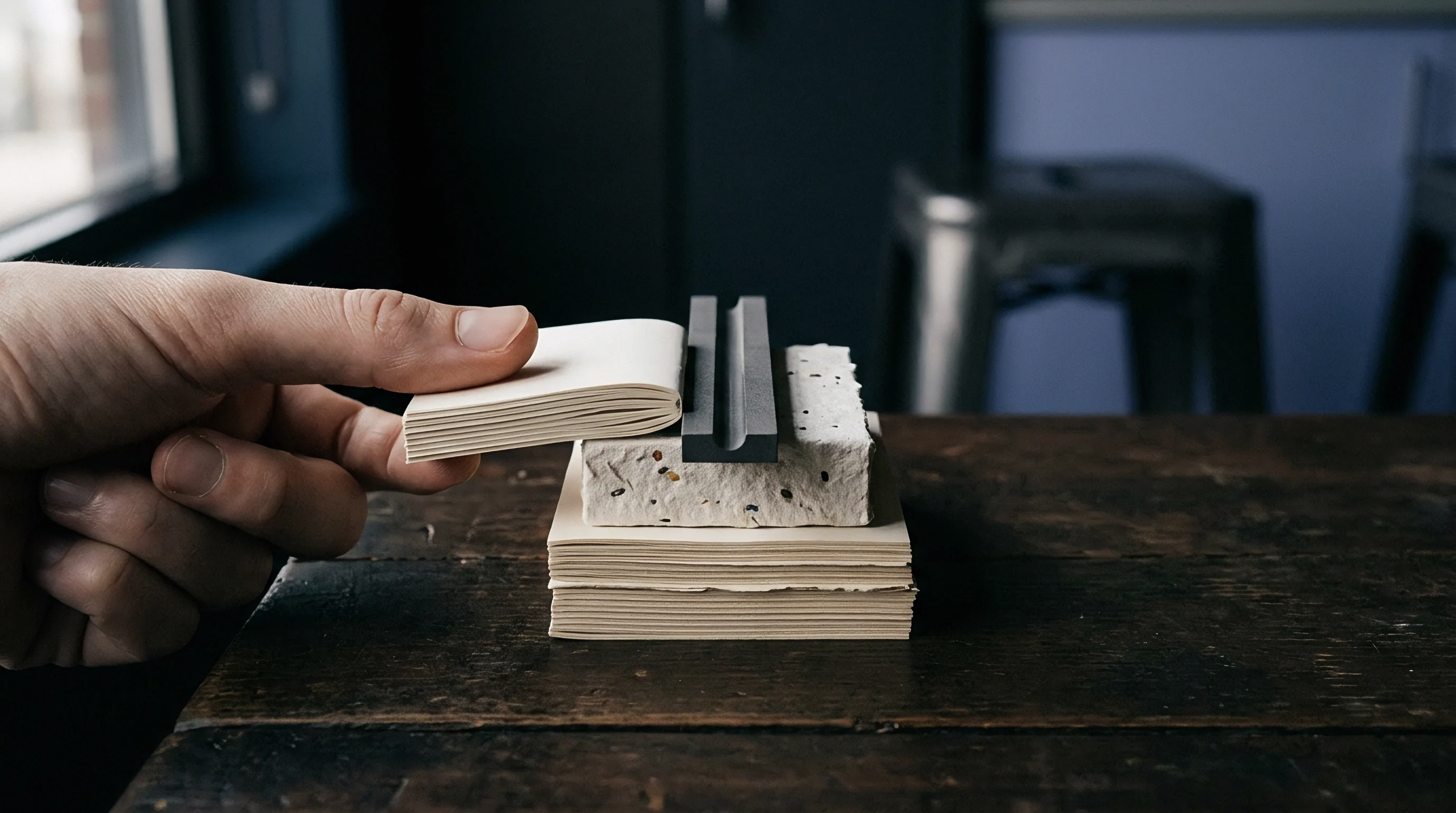
A well-formed crease behaves as an internal mechanical hinge. When folded through 90 or 180 degrees, the delaminated plies slide over one another without tensile fracture of the outer plies. The outer liner acts as a tensile skin, while the delaminated inner plies collapse inward into the fold interior, forming an organized bulge termed the crease bead.
High bulk mechanical plies absorb this displacement through intra-core compaction. The mechanical pulp core possesses open space between coarse fibres, allowing individual fibre bundles to displace into internal micro-voids without generating high transverse outward force against the printed liner.
Crease Recovery and Bending Resistance
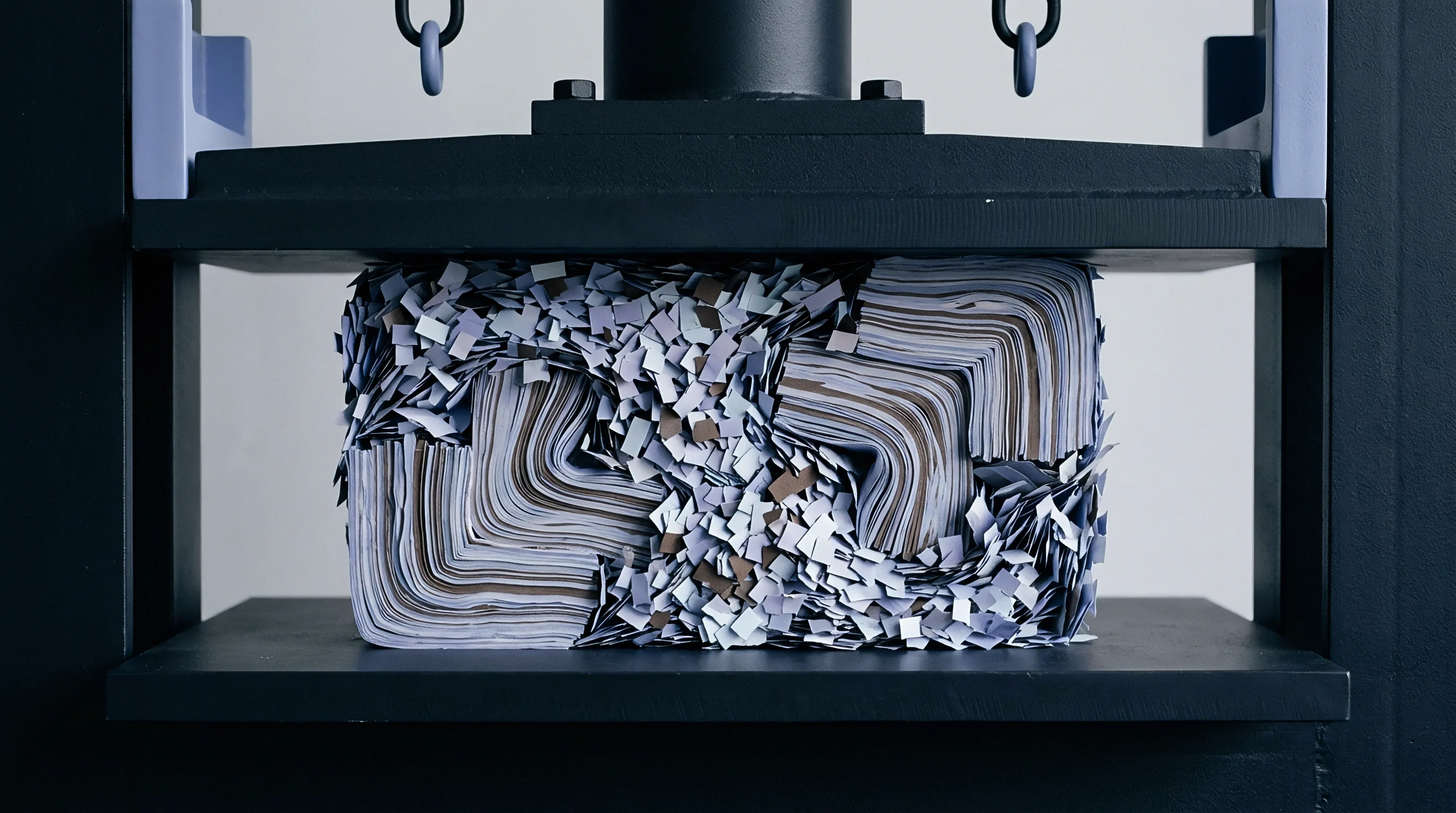
Folding behavior is quantified by measuring bending moment using instruments such as the Lorentzen & Wettre Crease Tester. Testing conforms to ISO 2493 for bending resistance and DIN 55437 for crease resistance. The primary metric is the crease recovery ratio, expressed as the ratio of folded crease resistance to the uncut board bending resistance, multiplied by one hundred.
Standard density virgin board delivers ratios between 40 percent and 55 percent. High bulk boxboard requires ratios between 35 percent and 48 percent to prevent carton bulging during gluing and cartoning.
- Initial Elastic Deflection spans the first zero to five degrees of fold angle where external plies sustain linear tensile and compressive strain before internal slip occurs.
- Interlaminar Slip Phase occurs from five to forty-five degrees as pre-delaminated core plies shear along the established fracture planes, flattening the required bending moment.
- Core Compaction Phase engages from forty-five to ninety degrees where internal mechanical pulp fragments compress into the fold radius without tensile failure of the outer ply.
- Terminal Bead Lock marks the terminal zone beyond ninety degrees where inner surfaces meet in direct contact, setting the residual folding resistance of the carton edge.
Cross-direction creases present higher cracking sensitivity than machine-direction creases. In the machine direction, fibres align predominantly parallel to the creasing rule, allowing easy lateral displacement. In the cross direction, the rule must indent across the axial length of the fibres.
Mechanical pulp fibres in the cross direction exhibit high resistance to transverse shear, demanding higher penetration depths. If the die-cutter operator applies the same penetration depth to both orientations, the cross-direction creases fail to delaminate cleanly. The converter adjusts make-ready tape beneath the die to vary penetration depth between orthogonal rule segments.
Residual hinge torque directly impacts cartoner efficiency. High-speed packaging machinery utilizes mechanical fingers and vacuum suction cups to erect cartons from flat blanks. If the crease recovery ratio remains elevated due to poor interlaminar cleavage, the blank resists square erection, springing back toward a rhomboid cross-section.
This springback causes line jams, cartoner feeder trips, and crooked glue lines on downstream sealing machines.
Uncontrolled core splitting manifests on the cartoner when blanks experience secondary lateral deflection. The outer bleached liner separates from the mechanical core along the panel perimeter, exposing unbleached fibres along the scored edges. What parameter ensures high bulk folding boxboard maintains delamination without panel rupture?
Furnish
Stratification of fibres across distinct plies determines delamination morphology. Multi-ply folding boxboard (FBB) typically integrates three to four functional layers produced on multi-wire forming sections. The top liner uses bleached chemical kraft pulp, refined to 22 to 28 °SR (Schopper-Riegler) under ISO 5267-1, delivering high tensile strength and a smooth printing surface.
The middle plies incorporate groundwood, thermo-mechanical pulp (TMP), or chemithermo-mechanical pulp (CTMP). The back liner consists of bleached or unbleached chemical kraft pulp. This construction separates high-tensile outer skins with a high-bulk, low-density spacing core, maximizing the second moment of area.
| Stratified Ply Layer | Typical Furnish Composition | Refining Level (°SR) | Fibre Length (mm) | Scott Bond (J/m²) |
|---|---|---|---|---|
| Top Liner (Print Surface) | 100% Bleached Hardwood / Softwood Kraft | 24 to 28 | 1.2 to 2.4 | 280 to 360 |
| Under Liner (Barrier Layer) | 100% Bleached Chemical Kraft | 22 to 26 | 1.5 to 2.5 | 240 to 310 |
| Core Plies (Bulk Layer) | 80-100% CTMP / TMP, 0-20% Broke | 14 to 18 | 1.6 to 3.2 | 110 to 160 |
| Back Liner (Base Layer) | 100% Bleached Softwood / Hardwood Kraft | 20 to 24 | 1.8 to 2.6 | 250 to 320 |
The fibre morphology of chemithermo-mechanical pulp directly influences how cracks initiate and propagate. Chemically treated wood chips undergo mild sulfonation prior to mechanical refining, preserving high yield around 85 to 90 percent while softening middle lamella lignin. CTMP fibres retain a coarse, tubular, uncollapsed geometry compared to flexible chemical kraft fibres.
During creasing, these rigid fibres fail to slip past one another smoothly. Instead, shear stresses cause localized rupture of inter-fibre hydrogen bonds along the boundaries between the chemical kraft liner and the mechanical core. The boundary layer represents a zone of mechanical impedance mismatch.
Under ISO 1924-2 testing, chemical liner elongation ranges between 3.5 and 4.5 percent, whereas mechanical cores reach fracture at less than 1.8 percent strain.
Starch application at the ply interface governs crack containment. Board machines apply native or cationic spraying starch between wet plies on the forming section, typically at application rates of 1.0 to 3.5 g/m² dry basis. The starch slurry bonds the wet plies together during wet pressing and drying cylinder operations.
Insufficient starch dosage creates weak boundary bonding, leading to wide-area sheet blistering during creasing. Excessive interfacial starch increases local bond strength to match the chemical liners, preventing the creation of multiple sub-critical micro-delaminations. When this occurs, the crease forces shear cracks to divert upward through the outer print liner, causing visible coating fracture.
Mineral fillers present in coating and top plies alter structural mechanics under rule pressure. Calcium carbonate and clay coatings provide ink holdout and brightness under ISO 2470 testing. Mineral layers lack the tensile elongation of the underlying bleached kraft fibres.
When the creasing rule descends, the coating layer experiences sharp local compression followed by intense bending strain. If the core below does not shear cleanly to absorb this displacement, the brittle mineral coating shatters along the shoulder of the crease, exposing the underlying fibrous structure to moisture ingress and cosmetic degradation.
Starch spray variations across the deckle width lead converters to observe that side-run rolls delaminate differently than center rolls cut from the same parent tambour.
Yield
Grammage reductions achieved through high bulk cores dictate the economic trade-offs in carton manufacturing. Multi-ply folding boxboard with a bulk of 1.6 cm³/g replaces solid bleached sulfate (SBS) boards running at 1.25 cm³/g while preserving identical geometric caliper and equivalent Taber bending stiffness under ISO 2493. Caliper preservation maintains carton column strength and stackability under warehouse load.
A standard commercial packaging requirement demanding 400 µm caliper board demonstrates this yield variance across converting operations.
Consider an order of 1,000,000 cartons utilizing a blank size yielding exactly 4.0 cartons per sheet on a parent format of 720 mm × 1020 mm (0.7344 m² per sheet). The production run requires 250,000 net good sheets, equivalent to 183,600 m² of converted board. An SBS grade at 400 µm thickness requires a basis weight of 320 g/m² (bulk of 1.25 cm³/g).
The total raw material required equals 58.75 tonnes net. A high bulk folding boxboard grade at 400 µm thickness functions at a basis weight of 250 g/m² (bulk of 1.60 cm³/g). Net material required for the same order equals 45.90 tonnes.
The basis weight differential represents a 21.8 percent reduction in total tonnage consumed.
- Raw Material Consumption drops from 58.75 tonnes on SBS to 45.90 tonnes on high bulk FBB, saving 12.85 tonnes of substrate on the baseline production volume.
- Make-Ready Waste Rates increase from 1.5 percent on chemical boards to 3.5 percent on high bulk substrates due to narrow die-cutting tolerances and dynamic pressure tuning.
- Landed Substrate Costs shift based on a delivered metric ton price of 1,350 currency units for SBS versus 1,480 currency units for engineered high bulk FBB.
- Downstream Shipping Efficiencies save tare weight across outbound pallets, reducing freight allocations by 12.85 tonnes across finished product transport.
The economic balance alters when die-cutting make-ready times and run speeds enter operational accounting. High bulk boxboards display narrower creasing windows than dense chemical sheets. Press make-ready for high bulk board demands micrometric adjustment of die-cutting platen pressure.
A pressure variance of 0.05 mm over-penetration can trigger liner cracking, while 0.05 mm under-penetration leaves creases unformed, causing cartoner jam failures. On long converter runs, flatbed die-cutting speed drops from 8,000 sheets per hour on SBS to 6,800 sheets per hour on high bulk FBB to manage dynamic shock loads on mechanical pulp cores.
The tonnage cost calculation rests on sheet yield offsets against converting operational friction. In this worked production run, net raw material cost for SBS runs at 79,313 currency units (58.75 tonnes at 1,350 units/tonne). The high bulk FBB run consumes 45.90 tonnes at 1,480 units/tonne, totaling 67,932 currency units.
The direct substrate savings equal 11,381 currency units. Additional die-cutter make-ready downtime and a 15 percent machine speed reduction subtract 2,800 currency units in press hour charges. Extra setup waste of 2.0 percent adds 1,358 currency units in lost board.
The net landed savings settle at 7,223 currency units per million cartons, or 7.22 units per thousand finished cartons.
Converting agreements specify that waste claims arising from ply delamination require batch-matched retain sheets conditioned to standard laboratory atmospheres within forty-eight hours of delivery.