Optimizing Matrix Creasing Channels for Multi Ply Recycled Packaging Boards
Optimizing matrix creasing channels for multi-ply recycled board requires widening the channel to 1.75 to 1.90 times caliper to absorb brittle shear stress.
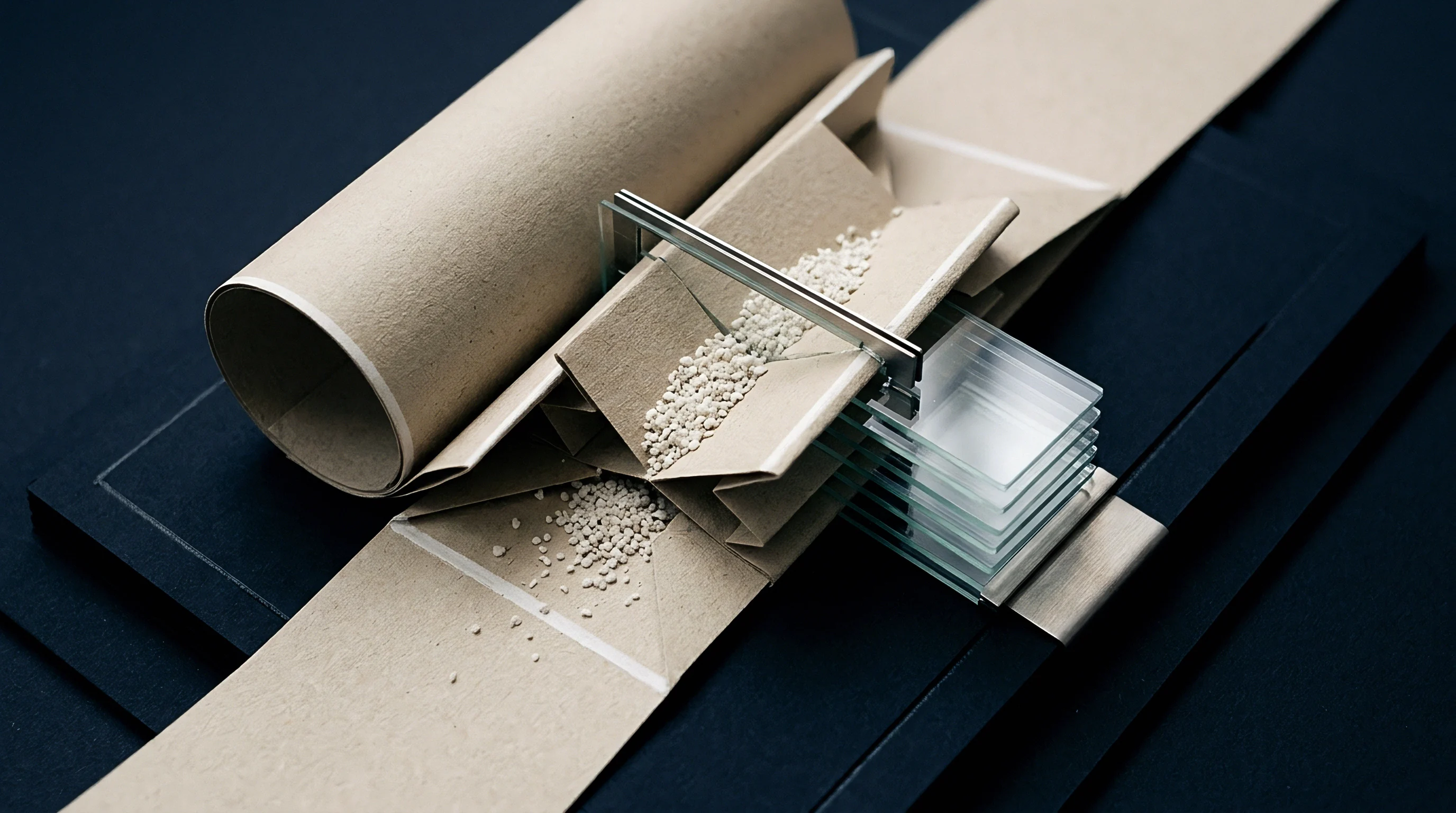

Profile
The micrometer barrel closes against a sheet of 450 micrometre coated white lined chipboard at 23 degrees Celsius and 50 percent relative humidity under ISO 187 conditioning. A 2 pt creasing rule, measuring exactly 0.71 millimetres in thickness, descends toward an anvil channel cut into a phenolic counter. If the channel is sized using standard virgin folding boxboard geometry, the recycled sheet tears at the outer coating during three-point bending.
Secondary fibres fracture readily. The mechanical pulp and mixed deinked furnish inside the filler plies lack the unbroken fibrillar entanglement found in chemical virgin kraft pulps. Setting creasing channel geometry for recycled multi-ply packaging boards demands a wider female pocket to accommodate displaced bulk without exceeding the ultimate elongation of short recycled cellulose.
Channel width calculation on multi-ply recycled chipboard, designated as GD2 or GD3 under DIN 19303, departs from the classic virgin cartonboard multiplier. Virgin solid bleached sulphate tolerates a channel width equal to the rule thickness plus 1.5 times the board thickness. Multi-ply recycled board contains between four and eight distinct plies bonded with native or cationic starches.
The inner plies contain short mechanical fibres, recovered newsprint, and calcium carbonate mineral fillers that lower internal ply cohesion. Applying a 1.5 multiplier forces the dense middle plies into an abrupt shear angle, breaking the top coated liner along the crease bead shoulder. Production lines running coated duplex boards achieve clean folding hinges by expanding the width factor to between 1.75 and 1.90 times the measured caliper for cross-direction scores, and between 1.65 and 1.80 times the caliper for machine-direction scores.
| Board Caliper (µm) | Rule Thickness (pt / mm) | Orientation Relative to Grain | Channel Depth (mm) | Channel Width (mm) |
|---|---|---|---|---|
| 350 | 2 pt (0.71 mm) | Machine Direction | 0.35 | 1.30 |
| 350 | 2 pt (0.71 mm) | Cross Direction | 0.35 | 1.35 |
| 450 | 2 pt (0.71 mm) | Machine Direction | 0.45 | 1.50 |
| 450 | 2 pt (0.71 mm) | Cross Direction | 0.45 | 1.55 |
| 550 | 3 pt (1.05 mm) | Machine Direction | 0.55 | 2.00 |
| 550 | 3 pt (1.05 mm) | Cross Direction | 0.55 | 2.10 |
| 650 | 3 pt (1.05 mm) | Cross Direction | 0.65 | 2.30 |
Channel depth selection controls the vertical displacement of the female bead into the counter matrix. Standard packaging lines set the channel depth equal to the nominal board thickness, recorded in millimetres. Multi-ply recycled board compresses under high-speed platen impact due to void volume between dried fibre networks.
Setting the channel depth exactly equal to the uncompressed caliper risks insufficient bead height, leaving the board with excessive bending resistance. Setting the channel depth 0.05 millimetres shallower than the board caliper increases bead formation and promotes controlled internal ply separation. The score line shears prematurely.
Excessive shallowing drives the creasing rule into the counterplate steel, shearing the lower liner before fold initiation occurs.
Coated duplex board conditioned at 23 degrees Celsius and 50 percent relative humidity loses 18 percent of its creasability index when plant moisture falls below 40 percent.
Recycled packaging boards exhibit pronounced directional variance that dictates different matrix selections across the same die-cutting layout. Fibres aligned in the machine direction yield high tensile stiffness but low stretch along the web axis. Cross-direction creases undergo tension perpendicular to the predominant fibre alignment, where elongation limits are naturally higher but bending resistance is reduced.
The matrix channel for machine-direction creases accommodates higher local stiffness by using a narrower channel width to force crisp hinge formation. Cross-direction creases demand broader channel geometry to prevent the stiff, transverse fibre bundles from rupturing the white clay-coated top liner. Ignoring these directional constraints produces cartons with asymmetric opening forces that twist during carton erection.
Improper channel calculations generate immediate physical defects on the converting floor, producing torn white top liners along exterior carton edges, delaminated carton flaps that snag in cartoner feeds, and cracked score lines that expose grey recycled base stock to end consumers.


Platen
Flatbed die-cutting platens exert compressive forces between 200 and 400 tonnes across modern cutting chases. The creasing rule, seated within laser-cut birch plywood or steel die plates, strikes the multi-ply board directly above the counter channel. Rule height must match the cutting knife height minus the channel matrix base thickness and the compressed sheet caliper.
Standard cutting knives stand at 23.80 millimetres. When using a matrix system with a 0.40 millimetre structural backing, a 2 pt creasing rule for a 450 micrometre board stands at 23.35 millimetres. Platen tonnage increases linearly.
Mismatches of 0.05 millimetres across platen sectors crush the recycled furnish, destroying the bulk necessary to maintain carton corner rigidity.

Is Channel Depth Governed by Board Caliper?
Die-cutting operators frequently treat channel depth as a static mirror of the board specification sheet. The actual depth requirement depends on the compression modulus of the multi-ply structure. A virgin board with high bulk compresses elastic-plastically and rebounds.
A multi-ply recycled chipboard with 15 percent ash content compresses with minimal elastic spring-back. Starch increases stiffness while lowering ductility. Setting the channel depth equal to 90 percent of the measured caliper on dense recycled grades provides the displacement required to form an internal blister without cutting the backliner.
High-density recovered boards, such as coated chipboards produced from recovered office waste, require a channel depth equal to 85 percent of caliper to prevent the creasing rule from fracturing the brittle clay coating layer.
Rule edge profile choices influence how localized strain develops within the multi-ply plies during platen dwell:
- Full round creasing rules distribute downward pressure uniformly across the channel shoulders, preventing stress concentrations on delicate coated bleached kraft liners.
- Flat edge rules compress the central zone of the crease excessively, which induces horizontal shear cracks in low-tensile grey backliners during subsequent ninety-degree folding.
- Side bevel rules shift the internal ply fracture toward the carton interior, giving complex tuck flaps clearance while protecting structural fold integrity.
Make-ready sheets beneath the cutting plate establish the level impression across the platen surface. Recycled boards display caliper variations across a single mill roll, often drifting by plus or minus 5 percent from target thickness. On a 500 micrometre order, this drift represents a 50 micrometre variance beneath the knife and creasing rule.
Make-ready tissue measuring 0.03 millimetres thick compensates for low spots across the chase. Failure to map platen pressure variations across the entire die layout results in uneven creasing, where cartons cut from the operator side fold with minimal resistance while cartons cut from the drive side tear at the carton corners.
Every scoring matrix channel requires absolute alignment with the die rule centerline to prevent asymmetrical ply rupture across the carton flap.
The tooling vendor stated that caliper variation across recycled board shipments accounts for all creasing splits and exonerates the standard rule configurations specified on the die layout.
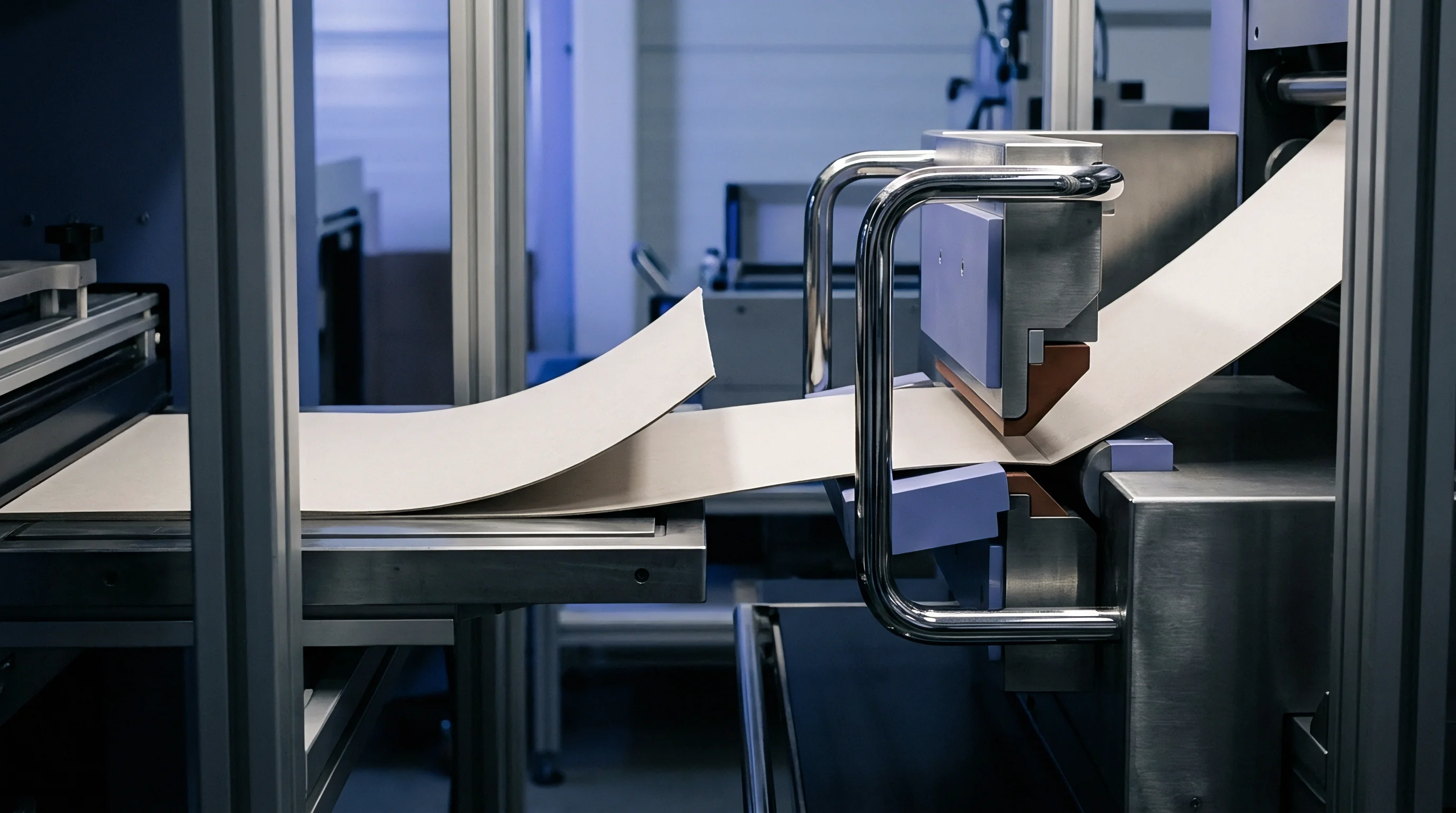
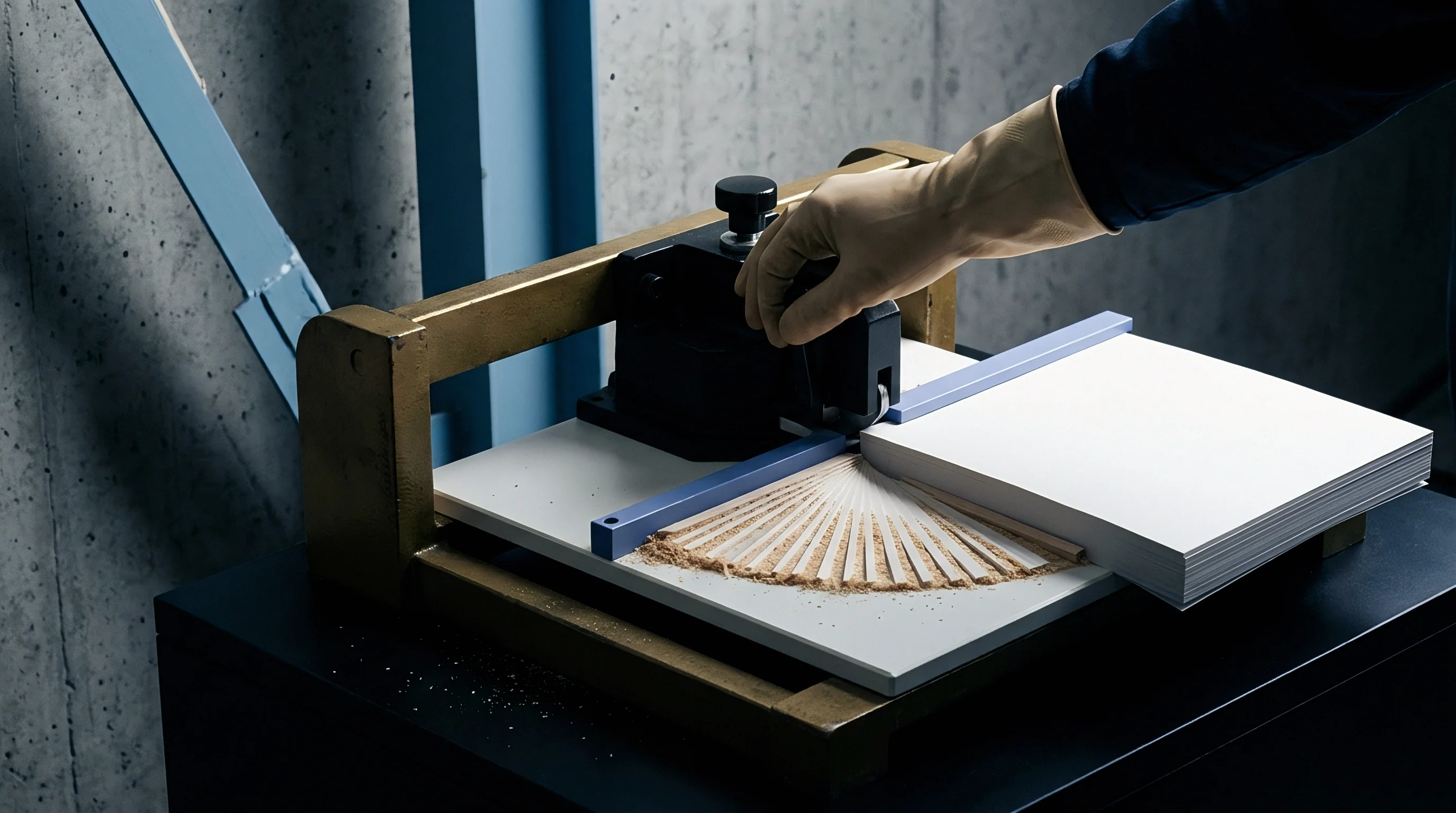
Shear
Internal delamination within multi-ply board during the creasing stroke governs carton functionality. When the creasing rule forces the board into the matrix channel, the board experiences high shear stress between its laminated layers. A sound crease does not compress the sheet into a permanent groove.
A sound crease fractures the internal fibre bonds in a controlled shear zone, creating a hollow delamination bubble called a hinge blister. The outer liner bends outward in a smooth arc. The inner liner pushes inward into the open channel, creating a tension-free hinge.
If internal shear strength is excessively high, the board behaves like a solid plate, transferring all tensile stress to the outer coated liner until the surface ruptures.

Will Symmetrical Creasing Rules Prevent Liner Cracking?
Symmetrical rules apply identical lateral forces to both shoulders of the matrix channel. This geometry functions reliably when carton panels on both sides of the score line share identical surface areas and unrestrained movement. On glue flaps and narrow tuck flaps, the resistance of the narrow panel is lower than that of the adjacent main panel.
The narrow flap slips horizontally across the matrix face during stroke descent, pulling the sheet off-center. An asymmetric rule profile, incorporating a steeper bevel on the flap side, holds the panel stationary. This equalizes strain across the crease core, stopping the outer bleached coating from splitting along the glue tab hinge.
| Grade Designation | Furnish Construction | Scott Bond Value (J/m²) | MD/CD Stiffness Ratio | Tensile Strain to Failure (%) |
|---|---|---|---|---|
| Solid Bleached Board (SBB) | 100% Virgin Chemical Pulp | 240 | 1.8 | 5.5 |
| Folding Boxboard (FBB) | Virgin Chemical Plies / Mechanical Core | 180 | 2.1 | 3.8 |
| White Lined Chipboard (GD2) | Recycled News / Deinked Pulp / Grey Back | 130 | 2.4 | 2.2 |
| Coated Recycled Board (GD3) | Unsorted Mixed Waste / High Ash Core | 105 | 2.6 | 1.8 |
| Test methods: Scott Bond internal bond strength measured under TAPPI T 569; stiffness measured via Taber method ISO 2493; strain measured via ISO 1924-3. | ||||
The Scott Bond value, measured in Joules per square metre under TAPPI T 569, serves as the primary predictor of creasability in multi-ply substrates. High ash content reduces ply cohesion. Recycled chipboards often register Scott Bond values between 100 and 140 J/m², compared to 200 to 280 J/m² for virgin chemical cartonboards.
When the Scott Bond drops below 95 J/m², the board delaminates too easily under the initial touch of the rule, creating an oversized, floppy internal bubble that lacks folding snap. Conversely, when starch sizing increases Scott Bond above 160 J/m² in a short-fibre recycled furnish, internal delamination fails to occur. Liner tension exceeds tensile limits.
The outer face splits open under minimal bend angles.
Moisture content within the furnish sets the shear limit of the recycled matrix. A sheet of GD2 board held at 7.5 percent moisture contains flexible fibre networks capable of micro-slippage without tensile rupture. Moisture loss accelerates surface cracking.
When dry seasonal air or heated pressroom storage reduces sheet moisture to 5.0 percent, the hydrogen bonds between recycled fibres become brittle. The tensile elongation at break drops from 2.2 percent to 1.4 percent. The board loses its capacity to accommodate matrix deformation, producing catastrophic liner flaking on 180-degree pre-breaking units on automated folder-gluers.
Environmental control in raw material storage determines converting stability across variable seasons:
- Equilibrium relative humidity on the production floor must remain between 45 and 55 percent to prevent dimensional shrinkage of die-cut blanks.
- Pallet wrap integrity protects conditioned board stocks from ambient moisture loss during transit between the printing press and cutting platen.
- Infrared drying heat on offset presses must be moderated to avoid baking residual moisture out of the top ply prior to creasing.
How the progressive shortening of recycled fibres across future European closed-loop recycling schemes will alter the baseline shear envelope of coated chipboard remains an unresolved challenge for packaging converters.
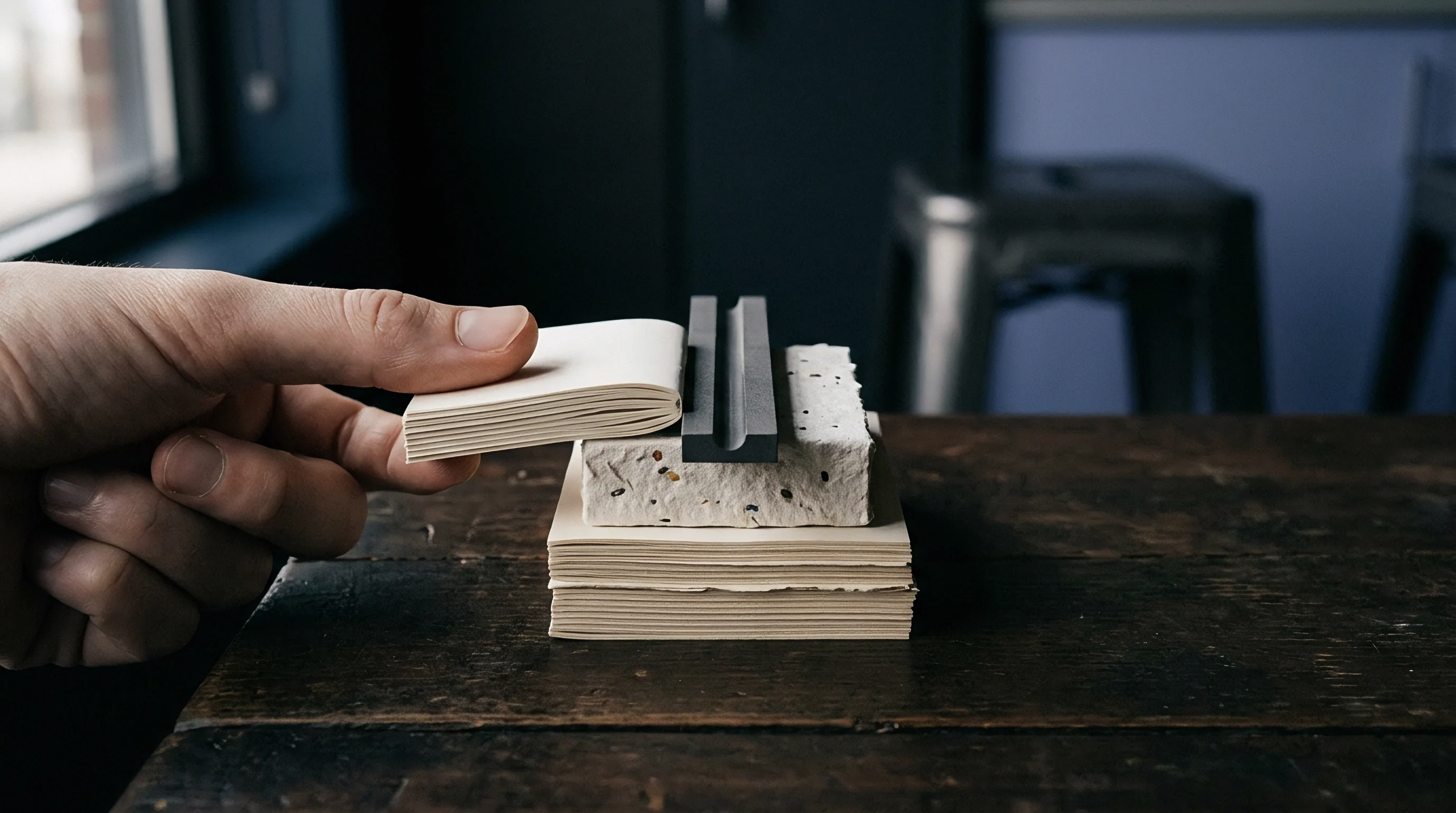
Tooling
The interface between the steel creasing rule and the counter matrix defines the mechanical boundary of the channel. Packaging converters select between presliced individual composite matrix strips and solid milled counterplates. Individual matrix strips, composed of extruded plastic or pressboard shoulders mounted on a thin steel base, adhere directly to a carbon steel platen plate.
Pertinax plates resist channel deformation. Solid Pertinax counters, machined via CNC routers from dense epoxy-bound glass-fibre sheets, offer rigid channel walls that remain dimensionally stable over high-volume production. Milled steel counterplates represent the highest capital investment, reserved for long-run pharmaceutical and food carton specifications where channel wear must not exceed 0.01 millimetres across a million impressions.
Consider an operational tooling selection for a packaging order of 500,000 folding cartons produced on 480 micrometre GD2 white lined chipboard with a mineral filler content of 14 percent. A single 2 pt rule matrix made of pressboard wears rapidly under the abrasive friction of calcium carbonate particles exposed along sheet edges. Abrasive filler erodes channel edges.
After 80,000 impressions, the channel width widens by 0.12 millimetres due to shoulder erosion, transitioning the effective width from 1.55 millimetres to 1.67 millimetres. This channel widening reduces folding resistance by 25 percent, generating carton skewing during high-speed folding-gluing operations at 50,000 units per hour. Upgrading the job to CNC-milled Pertinax plates maintaining a Rockwell C hardness above 85 guarantees channel stability within 0.02 millimetres across the entire run.
| Counter Channel Material | Base Material | Shoulder Wear Rate (µm / 100k imp) | Positional Accuracy (mm) | Maximum Practical Run Life |
|---|---|---|---|---|
| Standard Pressboard Matrix | Adhesive Tape Strip | 120 to 180 | ± 0.15 | 50,000 |
| Epoxy Composite Strips | Spring Steel Tape | 40 to 60 | ± 0.08 | 150,000 |
| Pertinax Counterplate | Glass-Epoxy Laminate | 15 to 25 | ± 0.02 | 500,000 |
| Milled Steel Plate | 1018 Steel Plate | 2 to 5 | ± 0.01 | 2,000,000 |
Adhesive backing stability on counter systems prevents channel drift during platen operation. Individual matrix strips rely on modified acrylic adhesive tapes to bond with the cutting chase plate. Under the cyclic shear forces of a press running at 7,500 sheets per hour, thermal buildup warms the adhesive layer to 40 degrees Celsius.
The adhesive experiences microscopic creep, allowing the matrix channel to shift laterally by 0.10 millimetres relative to the creasing rule. This lateral displacement induces asymmetry in the crease bead. The fold line wanders, ruining print-to-cut registration on folding flap scorelines.
Solid Pertinax plates eliminate adhesive creep by securing the entire counter system with steel registration pins inserted directly into precision bushings in the platen table.
DIN 55437 specifies a maximum permissible crease resistance deviation of twenty percent across a single production lot to maintain folder-gluer stability.
Tooling verification procedures on the converting floor require disciplined execution to avoid costly press downtime:
- Optical micrometer inspection verifies channel width and shoulder symmetry before the counter plate is clamped into the cutting press.
- Rule height verification confirms that all scoring rules maintain uniform height across the die chase using a precision dial indicator.
- Test impression profiling on carbon paper records channel alignment and reveals localized pressure peaks across the platen bed.
- Crease stiffness evaluation on a L&W or Marbach crease tester establishes the initial bending moment of test blanks folded at ninety degrees.
Harder counter channel walls preserve scoreline accuracy across extended runs on high-ash recycled stocks.

Outlay
Converting economics hinge on the delicate relationship between substrate selection, tooling investment, and line efficiency. Multi-ply recycled board costs between 200 and 350 dollars per metric tonne less than virgin folding boxboard. A folding carton manufacturer running 5,000 tonnes of cartonboard annually saves over one million dollars in raw material expenditures by converting to GD2 chipboard.
That raw material advantage erodes immediately if the converting line suffers from elevated scrap rates, frequent press stoppages, or reduced folder-gluer run speeds. Creasing depth dictates folding resistance. If improper channel geometry increases bending stiffness on carton score lines, high-speed automated packaging machines jam during carton erection, generating severe downtime claims from consumer goods brand owners.
Carton squareness drifts out of spec. An inefficiently scored blank creates asymmetrical folding resistance between opposing carton panels. When the folder-gluer belts drive the carton forward, the panel with lower bending stiffness folds ahead of the stiffer panel.
The folded carton takes on a parallelogram profile rather than a true rectangular shape. Folding-gluing equipment running at 60,000 cartons per hour cannot process twisted blanks without line stoppages. The folder gluer jams repeatedly.
Production stops compound labor expense. A one percent increase in converting scrap on a 500,000-carton production run wastes 5,000 finished blanks, erasing the profit margin gained from the lower raw material cost of the recycled furnish.
Tooling amortization balances against press make-ready expenses. Equipping a multi-up flatbed cutting chase with individual composite matrix strips costs approximately 80 dollars in material and requires 90 minutes of press make-ready time. A dedicated CNC-milled Pertinax counter plate costs 350 dollars but reduces press make-ready time to 20 minutes through pin-registration.
On a production run of 100,000 sheets, the 70 minutes of saved press time, valued at 250 dollars per hour, recovers the tooling cost differential twice over. Dedicated counters also protect product consistency by locking channel dimensions across multiple repeat orders, preventing the channel alignment errors that routinely occur when operators manually position self-adhesive matrix channels.
Commercial contracts for multi-ply recycled carton supply require strict definition of mechanical performance standards to safeguard production lines against unannounced mill furnish adjustments. Inserting a mandatory testing clause specifying ISO 2493 bending resistance limits and TAPPI T 569 internal bond tolerances ensures that delivered board lots maintain the exact delamination characteristics required by the plant’s standardized creasing tooling.