Channel Clearance Calculation for Multi-Layer Extruded Barrier Board Packaging
Calculate barrier board crease channels by adding rule thickness to caliper multiplied by 1.70 to 1.85 to clear displaced coextruded polymer skins.

Stock
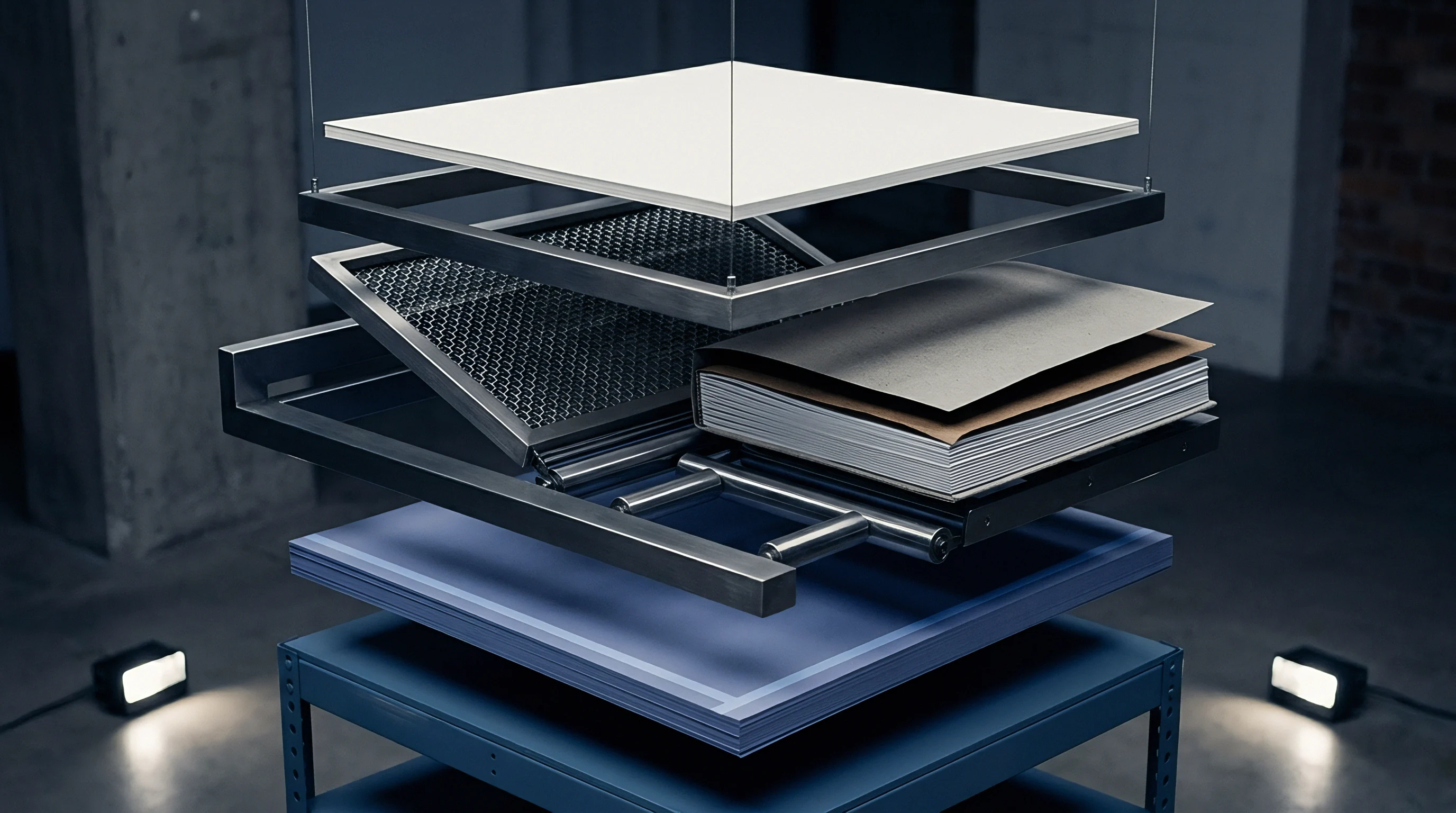
Extrusion-coated paperboard has an asymmetric mechanical profile through its cross section. The base substrate, typically a multi-ply folding boxboard or solid bleached sulphate between 200 and 450 micrometres in caliper, carries one or more coextruded functional polymer skins. These skins combine low-density polyethylene, linear low-density polyethylene, ethylene vinyl alcohol, or polybutylene succinate applied at coat weights between 12 and 45 grams per square metre.
Under a creasing rule, with lateral displacement governed by board density, the fibrous core undergoes delamination and compressive shear, while the synthetic skin experiences intense local elongation and hydrostatic pressure.
Base moisture content dictates whether the fibres hinge cleanly or the barrier film fractures. Running multi-layer board conditioned below 6.5 percent moisture produces brittle core fractures that propagate right through the polymer boundary. Equilibrating to 8.0 to 8.5 percent moisture under an ISO 187 standard atmosphere keeps the fibres pliable, though it increases the bulk volume displaced into the female channel.
Conditioning cartonboard to 8.0 percent moisture at 23 degrees Celsius and 50 percent relative humidity lowers the required scoring force by twelve percent compared to dry board.
The synthetic skins do not compress like unbleached kraft fibres. Applied molten during extrusion, the polymer chains solidify into semi-crystalline or amorphous matrices keyed directly into surface micro-fibrils through mechanical interlocking and corona oxidation. While polyethylene flows under dwell, ethylene vinyl alcohol lacks comparable yield strain, cracking once local outer elongation passes six percent along the crease shoulder.
Cross-web variations in extrusion coat weight shift the neutral bending axis of the carton blank. A five-gram deviation in outer polyethylene alters displacement volume by roughly five cubic micrometres per linear millimetre of rule contact. On high-barrier aseptic grades, converters must balance fibre wall displacement against the incompressible coextruded polymer, using symmetrical profiles to keep the liner from tearing.
Standard board channel settings run modern barrier coatings without modification when line speeds remain below five thousand sheets per hour.
Rule
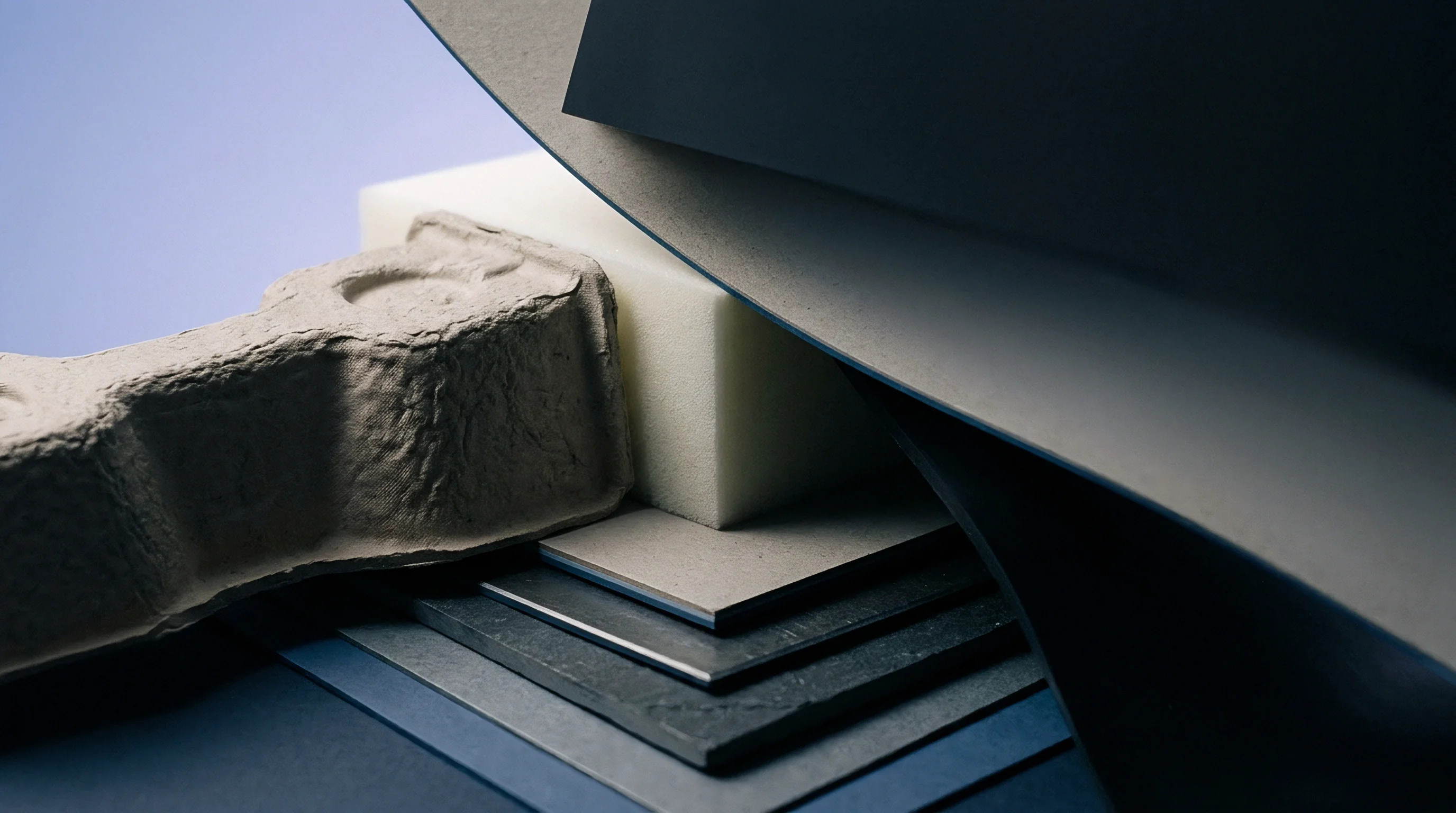
Creasing rule selection sets the initial geometry of deformation. Steel rules for barrier board require profile bevels, body thicknesses, and edge radii distinct from standard carton dies. Rule thickness, designated in point sizes where one point equals 0.353 millimetres, pairs directly with composite caliper: two-point rules running 0.71 millimetres handle calipers up to 350 micrometres, while three-point rules at 1.05 millimetres convert boards up to 600 micrometres.
Edge crown profile makes the difference between a clean crease and a punctured barrier film. A standard single-round edge concentrates vertical force directly onto the crest of the extrusion layer, whereas a double-bevel rule with a ground flat face or a parabolic profile distributes indentation loads over a wider contact footprint.
A creasing edge with a broken crown radius prevents film rupture where standard round rules score the barrier.
Platen temperature directly alters edge penetration. Heat transfer from the dies brings the coextruded layer past its secondary transition point, lowering yield stress during the brief dwell of the cut-and-crease cycle. When tool heaters maintain seventy degrees Celsius on the chase, the synthetic layer stretches across the crown without tearing the underlying bleached fibres, even as tensile stiffness drops cross-grain.
Excessive penetration shears the inner extrusion layer against the anvil bed. Rule height relative to the cutting knives controls this margin: setting the creasing rule 0.10 to 0.25 millimetres below adjacent knives fractures the core plies sufficiently without cutting into the polymer surface.
Crease deeper on cross-grain lines and back off the impression on machine-grain folds.
Counter
Female counter matrices define the lateral boundaries of the creased hinge. For barrier packaging, milled Pertinax or solid steel counter plates replace self-adhesive paper matrices, which widen under continuous mechanical stress after ten thousand cycles and cause fold stiffness to drift across a shift.
Pertinax counters machined on flatbed computer numerical control cutters deliver dimensional tolerances within five micrometres. Channel sidewalls must remain perpendicular or carry an outward bevel between two and five degrees to avoid shearing the outer liner during matrix evacuation, while the material holds registration across shifting humidity.
DIN 55437 specifies crease groove geometry for multi-ply cartonboard to ensure mechanical hinge formation without ply separation.
Channel depth governs internal shear delamination across the paperboard plies. As the rule forces board into the channel, the internal fibres split along their natural interfaces to create a delamination bead. In multi-layer barrier boards, this bead absorbs bending strain when the blank folds to ninety or one hundred and eighty degrees during gluing; an undersized channel chokes bead development, spiking bending resistance and stretching the external film.
Machined channel edges require careful dubbing. Sharp ninety-degree shoulders abrade the back-side polyethylene film, causing pinholes that leak liquid contents or admit atmospheric oxygen into aseptic cartons. Toolmakers run micro-chamfering cutters along each channel shoulder, producing a five-hundredth millimetre radius along all contact lines.
Standard procurement specifications require milled counter plates to maintain channel width within plus or minus 0.01 millimetres across thirty thousand linear metres of conversion.
Arithmetic
Sizing female counter channels for coextruded barrier board requires accounting for the volumetric displacement of incompressible synthetic films alongside compressible paper fibres. Standard folding boxboard calculations rely on simple empirical multipliers; multi-barrier structures demand adjusted equations to prevent barrier tearing and board bursting.

Empirical Clearances for Polyolefin Coated Substrates
Conventional channel depth D matches uncompressed board caliper C under light zero-gauge micrometer pressure. With coextruded barrier board, the polymer layer cannot compress, so channel depth must incorporate an expansion coefficient. The formula for channel depth D is:
D = C multiplied by the compaction factor k1, where k1 ranges from 0.90 to 1.05 depending on total polymer mass fraction.
Channel width W calculation involves rule thickness T, base board caliper C, and an empirical barrier expansion multiplier k2:
W = T plus (k2 multiplied by C).
On unprinted virgin board without coatings, k2 sits between 1.50 and 1.60. For barrier board bearing double-sided polyolefin extrusions exceeding thirty grams per square metre, k2 increases to a range between 1.70 and 1.85 to provide clearance for the displaced synthetic skin.
| Board Grade and Extrusion Layer Spec | Caliper (Micrometres) | Total Polymer (g/m²) | Rule Thickness (pt / mm) | Counter Width (mm) | Counter Depth (mm) |
|---|---|---|---|---|---|
| Cupstock SBS with 15g LDPE single side | 280 | 15 | 2 pt / 0.71 mm | 1.18 | 0.27 |
| Liquid Packaging Board with LDPE-Alu-LDPE | 360 | 42 | 2 pt / 0.71 mm | 1.34 | 0.36 |
| Folding Boxboard with EVOH-PE barrier | 320 | 30 | 2 pt / 0.71 mm | 1.27 | 0.32 |
| Heavy Barrier Carrier with 25g Bio-PBS | 450 | 25 | 3 pt / 1.05 mm | 1.84 | 0.45 |
Worked Case Construction
Assume a high-barrier aseptic folding carton blank built from a solid bleached sulphate base board. The job docket carries the following measured physical metrics:
- Total Caliper measures 0.400 millimetres including paper substrate and double-sided extrusion layers.
- Extrusion Configuration consists of twenty grams per square metre internal low-density polyethylene and thirty grams per square metre external coextruded polyethylene-EVOH blend.
- Rule Selection specifies a two-point flat-crown steel rule measuring 0.71 millimetres in body thickness.
- Grain Alignment evaluates machine-direction creases running parallel to web fibres versus cross-direction creases running perpendicular.
To calculate channel width for the cross-direction fold, use a higher displacement factor because fibres resist lateral compaction across their diameter. Set k2 to 1.80 for cross-direction scoring with high-viscosity EVOH layers. Multiplying 1.80 by board caliper 0.400 millimetres yields 0.720 millimetres of total side clearance; adding the rule thickness of 0.710 millimetres gives a counter channel width of 1.430 millimetres.
For channel depth, the heavy polymer mass resists vertical compression, so k1 is set to 0.95. Multiplying 0.95 by 0.400 millimetres yields a channel depth of 0.380 millimetres. Machining the Pertinax counter plate to these dimensions prevents pinholing while maintaining sufficient hinge stiffness during automated cartoning.
| Fiber Direction Relative to Score | Factor k1 (Depth) | Factor k2 (Width) | Mechanical Objective |
|---|---|---|---|
| With Grain (Parallel) | 0.90 to 0.95 | 1.65 to 1.70 | Prevents channel pinching and liner split |
| Across Grain (Perpendicular) | 0.95 to 1.00 | 1.75 to 1.85 | Enables internal plies to roll into bead |
The extent to which progressive router bit wear during computer numerical control counter milling alters channel width across large-format production dies remains difficult to quantify on the shop floor.
Rupture
Failure to maintain channel clearances causes microscopic barrier breakdowns that escape unmagnified inspection. When counter width runs ten percent too narrow, lateral pinching forces the extrusion skin past its ultimate elongation limit.
Under tension, the polymer film detaches from the fibre interface. Micro-cracking across the creased shoulder breaches oxygen barriers, elevating oxygen transmission rates from less than one cubic centimetre per square metre per day to over two hundred cubic centimetres.
Verification protocols detect barrier micro-failures before volume gluing and distribution:
- Cut representative carton blanks from every die position across the first pull of make-ready sheets.
- Fold all creases to ninety degrees using a calibrated mechanical crease-bend tester to simulate packaging machine forming jaws.
- Apply an isopropanol-based pinhole detection dye solution along the reverse side of every crease line.
- Inspect the outer bleached board liner under magnification for dye strike-through after two minutes of liquid dwell.
Because extrusion layers resist compaction and uniaxial stretching tears aluminium foil, setting the channel too shallow causes the rule to crush the board matrix into a hard glaze, splitting outer ply fibres during the ninety-degree fold on the cartoner. Excessive depth, on the other hand, shears the outer plies directly.
Incorrect clearance calculations trigger complete barrier package recalls through compromised aseptic sterility, leaking liquid cartons, and shelf-life failures that destroy batch inventory across distribution chains.