Correlation between Viscoelastic Resin Yield Thresholds and Non Uniform Optical Elevation along Carton Scores
Resin yield stress thresholds govern score line micro-elevation profiles, where controlling matrix clearance and coat weight prevents optical edge defects.


Rheology
Polymer networks applied over folding carton board endure rapid mechanical strain during converting operations. When a sheet passes through a die-cutting station, male creasing rules force the substrate and its surface layers into female grooves. Localized shear stress alters optical reflection, while resin flow dictates final score appearance.
This structural displacement subjects the coating or lamination adhesive to combined tensile, compressive, and shear forces within milliseconds. How the resin layer responds during high-rate deformation determines whether the surface retains optical uniformity or forms uneven elevation ridges along the score line.
Viscoelastic materials respond to mechanical stress through a combination of elastic energy storage and viscous dissipation. Elastic compliance allows the resin matrix to deform reversibly under stress and recover its original dimensions upon unloading. Viscous flow represents irreversible molecular displacement, where polymer chains slip past one another under shear.
The balance between these mechanisms depends on deformation rate, ambient temperature, polymer cross-link density, and molecular weight distribution. In UV-cured acrylates, waterborne soft-touch dispersions, and extrusion-coated polyethylene layers, the viscoelastic profile determines how the material behaves when forced around a score radius.

Polymer Stress Response under Shear
Formulations applied to folding boxboard undergo rapid mechanical elongation when die cutters strike the sheet. The mechanical energy delivered during impact frequently exceeds the yield threshold of lower-modulus resin formulations. Dynamic mechanical analysis defines this behavior through storage modulus (elastic energy storage) and loss modulus (viscous dissipation).
The ratio of loss modulus to storage modulus defines the loss tangent, where higher values indicate increased viscous dissipation relative to elastic recovery.
When localized stress generated during scoring exceeds the resin yield threshold, the polymer matrix transitions from linear elastic behavior into plastic yield. Below this threshold, internal stress distributions remain continuous across the resin thickness. Crossing the yield point initiates localized necking, micro-voiding, or irreversible polymer extension.
Resin forced past its yield threshold does not return to its original planar geometry after the creasing rule retracts. Instead, the polymer matrix retains a permanently deformed profile characterized by micro-ridges and uneven mass displacement along the fold axis.

Yield Strain Point Identification
Dynamic mechanical analysis measures the transition from elastic compliance to viscous dissipation across variable amplitude sweeps. Oscillatory shear rheometry identifies the precise yield stress threshold where structural breakdown begins. Viscoelastic coatings with high elongation at break resist optical micro-ridge elevation.
The storage modulus maintains a linear plateau at low strain amplitudes before dropping sharply at the critical yield strain point. This linear viscoelastic region establishes the boundary within which the coating deforms reversibly.
Resin formulations with high yield stress thresholds resist plastic displacement under moderate creasing forces, though excessive yield stress makes the material brittle, causing surface fracture and flaking along the score line. Conversely, resin systems with low yield stress thresholds flow readily under creasing pressure, creating non-uniform material accumulation along the outer boundaries of the crease channel. Optimizing resin yield thresholds requires balancing cohesive strength against molecular flexibility, preventing localized resin pooling while allowing the sheet to fold without structural failure.
A cross-linked acrylate resin system exhibiting a loss tangent above 0.45 at 23 degrees Celsius displays permanent molecular displacement when local tensile strain exceeds 3.2 percent during score line flexure.
The molecular weight between cross-links governs the elastic limit of UV-cured resin matrices. Higher cross-link density increases the storage modulus and elevates the yield stress threshold, restricting viscous flow. High cross-link density simultaneously reduces ultimate tensile elongation, rendering the cured film susceptible to micro-cracking when subjected to acute bending angles.
Formulations containing polyfunctional acrylates develop dense network architectures that resist compressive deformation in the score channel, yet exhibit severe micro-fracturing along the outer tension zone of the fold. Mono-functional and difunctional monomer diluents modify network density, shifting the viscoelastic yield threshold to accommodate mechanical creasing without localized mass displacement.
Temperature fluctuations on the converting floor directly alter how surface resins respond during creasing. A polymer’s glass transition temperature dictates whether it acts as a glassy solid, a rubbery matrix, or a viscous liquid at room temperature. Operating near this transition amplifies strain-rate sensitivity; a coating line running at eight thousand sheets per hour imposes strain rates orders of magnitude above laboratory testing speeds.
That rapid strain elevates the effective yield stress threshold, pushing an otherwise ductile resin toward brittle fracture during mechanical scoring.
Which thermodynamic and rheological kinetic factors prevent localized polymer relaxation when high-speed converting lines induce transient yield stress spikes across variable substrate calipers?

Crease
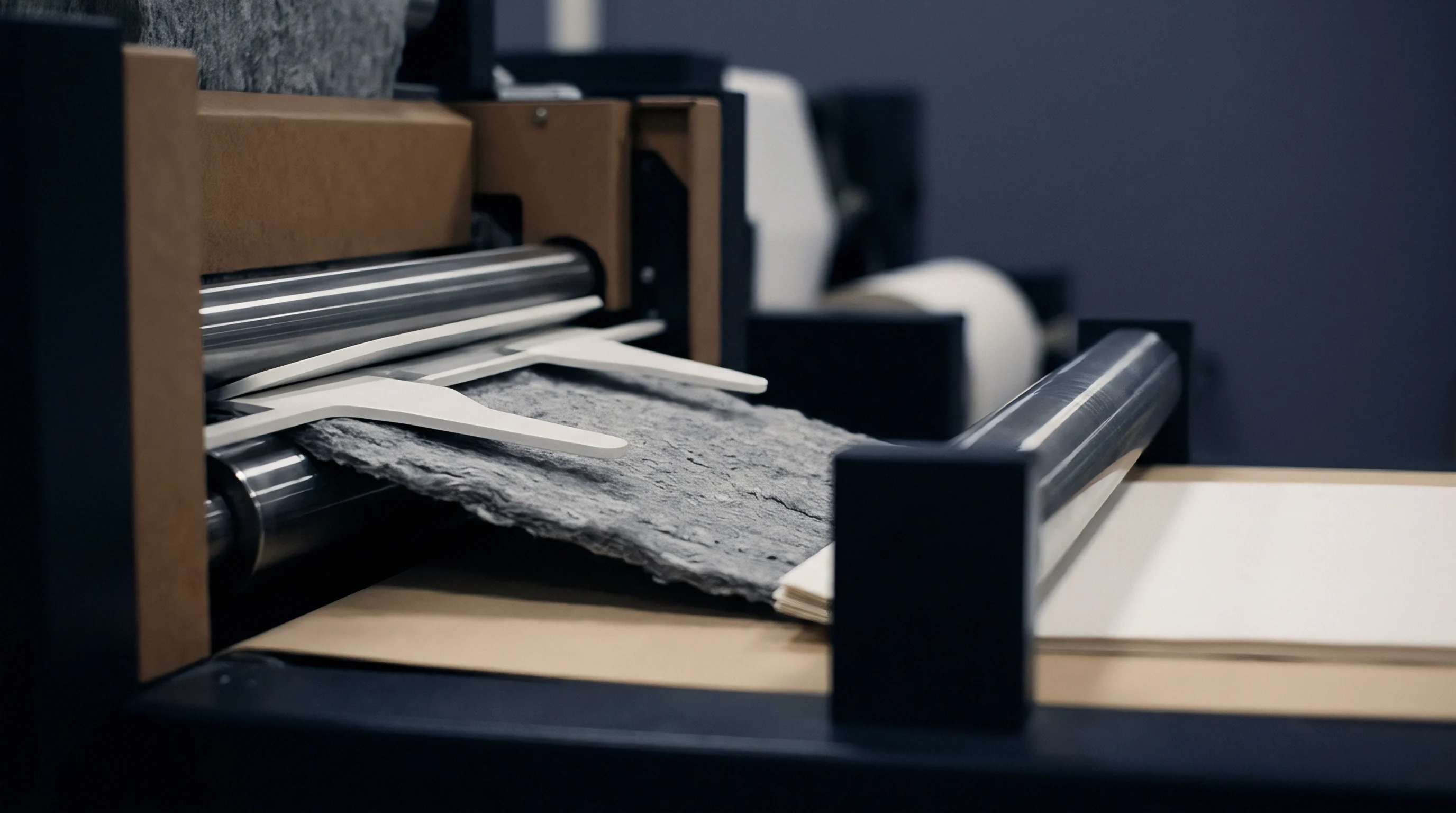
Score matrix tooling displaces cellulose fibers and overlying film layers along precise channel boundaries, where incorrect channel clearance destroys score consistency. Cellulose fibers compress during scoring impact as the paperboard substrate undergoes double-bevel bending ~ compressing internal fiber layers while expanding outer liner sheets under male rule penetration. The surface resin layer sits at the maximum distance from the neutral bending axis, experiencing peak tensile strain across the score crest.
Mechanical geometry choices made during make-ready dictate the magnitude and distribution of these surface stresses.
The width and depth of the female creasing matrix determine the clearance volume into which the board and coating are driven. A matrix channel that is too narrow increases compressive shear stress, forcing the board liner and surface resin upward along the edges of the creasing rule. This excessive mechanical confinement forces the polymer beyond its viscoelastic yield point, pushing fluid or plasticized resin into distinct lateral ridges.
A channel that is too wide permits excessive substrate displacement, failing to create a clean internal fiber delamination line and causing wide, poorly defined surface distortion.

Mechanical Channel Geometry Parameters
Female groove dimensions relative to board caliper dictate the clearance envelope available for substrate deformation. The standard formula for calculating female channel width adds the male rule thickness to 1.5 times the paperboard caliper for solid bleached sulfate grades, or 1.7 times the caliper for recycled folding boxboard. Deviations from these dimensional ratios alter the shear strain gradient imposed on the surface resin.
Narrow matrix channels amplify localized pressure, driving polymer mass displacement toward the outer edges of the scoring tool.
| Paperboard Caliper (mm) | Male Rule Width (mm) | Female Channel Width (mm) | Matrix Depth (mm) | Peak Surface Shear Stress (MPa) | Observed Resin Yield Mode |
|---|---|---|---|---|---|
| 0.40 | 0.71 | 1.30 | 0.40 | 14.2 | Cohesive Micro-Fracturing |
| 0.40 | 0.71 | 1.40 | 0.40 | 9.8 | Elastic Accommodation |
| 0.40 | 0.71 | 1.50 | 0.40 | 6.4 | Plastic Ridge Displacement |
| 0.50 | 1.05 | 1.80 | 0.50 | 12.6 | Viscous Flow Accumulation |
| 0.50 | 1.05 | 1.90 | 0.50 | 8.1 | Elastic Accommodation |
| Data gathered on solid bleached sulfate board using 100 percent solids UV acrylate coating at 4.2 g/m2 dry coat weight. Test speed set at 6,000 sheets per hour on a flatbed platen die cutter. | |||||
Tooling wear introduces further instability into score line mechanics. As male creasing rules flatten and female channel shoulders round over during extended production runs, pressure distribution across the score line shifts. Worn tooling delivers diffused, uneven mechanical force, causing localized variance in resin displacement.
The resin layer undergoes differential yield across the length of a single carton score line, resulting in alternating zones of elastic stretching and permanent plastic accumulation. Regular inspection of creasing matrix edges and penetration depth maintains uniform strain fields across the sheet.

Deformation Shear Vectors across Liners
Tensile forces concentrate along the apex of the outer liner fold as the male rule forces the sheet down. Score channel depths are specified based on measured sheet thickness and moisture levels. Substrate anisotropy plays a direct role in how mechanical forces translate to the resin layer.
Paperboard exhibits higher tensile strength and stiffness in the machine direction compared to the cross-machine direction. Creases made parallel to the machine direction force the surface resin to stretch across stiff, aligned cellulose fibers, concentrating strain within narrow mechanical boundaries. Creases running transverse to the machine direction allow broader fiber displacement, spreading resin strain over a wider geometric zone.
Compliance with ISO 187 atmospheric conditioning guarantees that outerboard moisture content remains within six to eight percent, preventing pre-mature yield failure along converted score edges.
Paperboard moisture content governs substrate compressibility and outer liner elongation capacity. Dry board with moisture levels below five percent exhibits high flexural rigidity and reduced tensile elongation. When die-cutting equipment strikes dry board, the substrate fails to yield internally through controlled fiber layer delamination.
Instead, mechanical forces transfer directly to the surface coating, driving local shear stress well beyond the polymer yield threshold. Maintaining converting floor ambient conditions between 45 and 55 percent relative humidity preserves substrate compliance, allowing internal fiber layers to absorb creasing energy without over-stressing the surface resin.
- Brittle network shearing occurs when high cross-link density resins experience acute localized tensile stress exceeding structural elongation limits.
- Lateral polymer extrusion happens when low yield threshold resins are squeezed laterally out of the primary channel by excessive male rule penetration.
- Substrate delamination fracture emerges when inadequate internal fiber bonding allows deep ply separation, creating uneven support under the surface coating.
- Micro-void nucleation develops within the resin matrix under high strain rates, generating internal light-scattering interfaces along the fold axis.
Platen parallelism and impression cylinder setting accuracy dictate force uniformity across the entire die-cutting form. A platen out of parallel by fractions of a millimeter imposes variable penetration depth across different cartons on the same sheet. Cartons positioned in high-pressure zones experience excessive male rule penetration, forcing surface resins past their yield threshold into raised lateral beads.
Cartons in low-pressure zones receive insufficient creasing force, resulting in incomplete score definition and poor folding performance on automated packaging lines. Precision make-ready patching balances impression force across all impression zones, stabilizing mechanical strain applied to surface resins.
Proper matching of female creasing matrix channel width to sheet caliper ensures elastic accommodation of surface resin layers without exceeding localized yield points.


Optics
Light reflection along folded package edges depends directly on the localized planarity of the cured resin layer. Specular gloss requires an optically smooth interface where incident light reflects at an angle equal to the angle of incidence, whereas microscopic elevation peaks impair packaging aesthetics as light scatters across broken polymer ridges. When mechanical creasing forces surface resin beyond its viscoelastic yield threshold, micro-topographical defects disrupt surface planarity.
Non-uniform optical elevation refers to microscopic height variations along the score line, where plastic deformation has created raised ridges, micro-valleys, or localized surface roughness.
These topographical variations alter the refractive behavior of the coated sheet. Specular light reflection transitions into diffuse scattering when surface roughness approaches or exceeds the wavelength of visible light. An un-creased, high-gloss UV coating exhibits specular gloss values exceeding 85 gloss units at a 60-degree measurement angle.
Yield deformation along the score line creates a localized drop in specular gloss, accompanied by visual light halos or edge-whitening effects. The magnitude of this optical degradation correlates directly with the height and frequency of resin elevation peaks along the creased edge.

Surface Elevation Topography Profiles
Non-contact white light interferometry captures microscopic peaks and valleys across score boundaries with nanometric vertical resolution. Three-dimensional profilometry maps surface topography, quantifying parameters such as average surface roughness, root-mean-square roughness, and peak-to-valley height. Un-deformed coating surfaces typically display peak-to-valley variations below 0.2 micrometers.
Surface regions subjected to severe creasing stresses display localized elevation peaks reaching 3.0 to 8.0 micrometers above the adjacent planar surface, forming continuous micro-beads along the fold edge.
When localized polymer elevation along folded edges exceeds the wavelength of visible light, specular gloss transitions into diffusive scatter across the score crest.
Micro-aperture glossmetry allows precise quantification of optical reflection within narrow zones centered over the score crest. Standard gloss meters utilize aperture areas too large to isolate score line defects, averaging specular reflection over broad surface regions. Micro-aperture optics isolate measurement beam widths down to 0.5 millimeters, enabling continuous gloss scanning across creased profiles.
Gloss reduction profiles reveal sharp troughs corresponding exactly with the topographical elevation peaks measured via optical profilometry, establishing a direct link between physical resin displacement and visual quality degradation.

Specular Light Scattering Effects
Reflection angle variations occur when microscopic plastic deformation ridges break up coherent incident light rays. When incident light strikes an elevated polymer ridge along a score, light refracts and reflects across multiple local angles rather than a single specular vector. This angular dispersion creates a visible halo, perceived by the human observer as a color shift, gloss reduction, or localized haze along the carton edge.
On dark-printed packaging, this optical disruption appears as a bright, reflective line, frequently misidentified as substrate fiber exposure or ink flaking.
- Position the creased carton sample securely on the motorized stage of a non-contact white light optical profilometer.
- Calibrate the vertical measurement range using a certified optical step-height standard to ensure sub-nanometer z-axis accuracy.
- Perform a raster scan across a five-millimeter section of the score line, capturing continuous elevation topography at one-micrometer lateral increments.
- Extract line profile data transverse to the score axis, identifying maximum peak height, valley depth, and lateral ridge spacing.
- Measure localized specular gloss along the exact scanned profile coordinates using a micro-aperture glossmeter set to a 60-degree angle of incidence.
- Cross-reference elevation profile data with specular gloss measurements to calculate the optical attenuation coefficient per micrometer of resin elevation.
Refractive index matching between coating components influences the visual severity of optical elevation defects. Formulations containing heterogeneous polymer blends, un-reacted monomers, or dispersed inorganic additives exhibit internal refractive index variations. When mechanical stress induces micro-voiding or shear necking within such coatings, internal scattering interfaces multiply rapidly.
Resin matrices with homogenous refractive indices reduce light scattering across micro-yield zones, mitigating perceived visual distortion even when minor physical elevation variations remain present along the converted score edge.
Ignoring surface elevation profiles across converted carton scores risks whole-lot rejection by consumer packaging brands due to visible edge haloing and localized gloss degradation.


Nip
Roller pressure application systems dictate coat weight uniformity across both machine and cross-machine directions. Metering gap settings, roll hardness, and line speed govern liquid resin film thickness delivered to the board surface, where excess coat weight exacerbates yield necking and unsuitable formulations degrade visual appeal. Fluctuations in wet coat weight translate directly into variations in cured film thickness, altering the total volume of polymer subject to mechanical displacement during creasing.
Precise control of nip mechanics establishes the physical foundation for uniform viscoelastic response across the web.
Anilox roll selection and flexo metering systems control coating distribution in inline application units. Anilox cell volume, screen angle, and doctor blade loading determine liquid coating transfer efficiency. Inconsistent doctor blade pressure allows hydraulic film pressure to lift the blade, increasing coat weight along localized web bands.
Heavy coat weight regions possess greater total resin mass, amplifying the volume of polymer extruded laterally during scoring operations. Maintaining precise fluid dynamics within the coating nip prevents wet-film mass variations before thermal or radiation curing locks in surface geometry.

Coating Thickness Uniformity Parameters
Dry film weights fluctuating by more than half a gram per square meter produce inconsistent elastic resistance during subsequent mechanical folding operations. Thicker coating zones absorb greater mechanical energy during scoring impact, increasing internal stress accumulation. Micro-aperture glossmeters measure gloss retention along converted score lines.
Variations in dry coat weight create corresponding shifts in the effective resin yield threshold across the sheet. Thin coat weight regions may lack cohesive film strength, cracking under tension, while heavy coat weight regions exceed matrix clearance volumes, extruding into continuous optical elevation ridges.
| Coating System Chemistry | Application Method | Dry Coat Weight (g/m²) | UV Curing Energy (mJ/cm²) | Mean Optical Elevation Δz (µm) | Gloss Loss along Score (%) |
|---|---|---|---|---|---|
| High-Elongation Polyester Acrylate | Anilox Coater | 3.5 | 180 | 0.8 | 4.2 |
| High-Elongation Polyester Acrylate | Anilox Coater | 5.2 | 180 | 2.4 | 12.8 |
| Standard Epoxy Acrylate | Roller Coater | 4.0 | 250 | 4.1 | 28.5 |
| Standard Epoxy Acrylate | Roller Coater | 6.0 | 250 | 7.3 | 46.0 |
| Waterborne Soft-Touch Dispersion | Air Knife | 2.8 | Thermal Dry | 0.5 | 2.1 |
Roll cover hardness, measured in Shore A durometer, influences the hydraulic nip pressure profile during liquid coating application. Softer roll covers deform under pressure, broadening the nip contact zone and reducing peak hydraulic pressure. This broader nip footprint promotes smooth liquid leveling before curing, minimizing micro-scale film thickness variations.
Harder roll covers concentrate hydraulic force into a narrow nip zone, increasing the likelihood of ribbing instabilities or film split patterning in the wet coating layer. These surface pattern defects act as stress concentration sites during subsequent scoring operations.

Thermal and Curing Gradients
Ultraviolet energy density distributed across the web sets the final cross-link density within the resin matrix. Curing lamps operating with uneven intensity profiles along their length create cross-directional variations in polymer network formation. Over-cured zones exhibit elevated glass transition temperatures and reduced ultimate elongation, predisposing the resin to brittle failure during creasing.
Under-cured zones retain residual photoinitiators and un-reacted monomers, lowering the viscoelastic yield stress threshold and allowing excessive viscous plastic flow under creasing rule pressure.
Excessive radiation during cure increases cross-link density, lowering resin elongation capacity and accelerating score line fracture.
Web speed variations during line bring-up and ramp-down alter UV exposure duration and substrate temperature. Modern UV curing systems utilize automated power scaling tied to press speed encoders, maintaining constant radiation dosage per unit area across variable production speeds. Thermal energy emitted by UV lamps heats the passing board, temporarily softening thermoplastic coating components and lowering their instantaneous yield stress threshold.
Fluctuations in web temperature alter the viscoelastic state of the coating at the exact moment sheets reach the die-cutting unit, leading to variable score line elevation profiles throughout a production run.
- Anilox cell geometry dictates fluid transfer volume, requiring precise alignment of line screen density to maintain uniform liquid film thickness.
- Doctor blade contact angle regulates hydraulic blade metering forces, preventing coat weight surges that increase cured film thickness.
- UV lamp reflector geometry focuses radiant energy across the web width, eliminating under-cured edge zones that exhibit low yield stress thresholds.
- Web tension control prevents substrate chatter within application nips, avoiding periodic coat weight oscillations along the machine direction.
Score line elevation defects stem from die-cutting matrix selection, formulation chemistry, and coat weight consistency alike.


Margin
Profitability on converted folding carton runs hinges on minimizing rejected pallets during high-speed filling line runs, where score cracks increase reject rates dramatically. Tight quality tolerances protect brand value, and non-uniform optical elevation along carton scores generates significant financial loss when finished packaging fails visual quality audits or causes automated machine downtime. When resin yields non-uniformly along score lines, carton blanks exhibit unpredictable flap resistance and erratic folding torque on automatic cartoning lines.
Understanding the financial consequences of surface yield failure allows converters to price materials, make-ready time, and finishing passes accurately.
Scrap Spoilage Calculations
Material loss rates escalate rapidly when optical score defects breach visual tolerance limits agreed upon in quality contracts. Rejecting a finished pallet of high-end cosmetic cartons after printing, coating, foil stamping, and die cutting incurs maximum cost accumulation. The value added at each sequential finishing pass amplifies the financial impact of scrap generated by score line failure.
Landed cost calculations for modified UV coatings weigh raw material expenses against line speed penalties. Selecting a higher-cost, high-elongation resin system adds minimal expense to the total job docket while protecting the entire financial investment made in paperboard, inks, and machine press time.
Automated visual inspection systems mounted on folder-gluers detect localized gloss loss, edge whitening, and micro-elevation ridges along carton scores in real time. Setting line inspection thresholds too tight generates false-positive rejections, increasing spoilage rates and reducing net production efficiency. Setting inspection thresholds too loose permits defective cartons to reach customer filling lines, resulting in expensive field rejections and formal quality claims.
Establishing objective, profilometry-backed visual standards harmonizes quality assurance metrics between converter and brand owner, protecting operating margins.

Recyclability Scheme Guidelines
Modern circular economy regulations evaluate packaging structures based on polymer removal efficiency during repulping operations. Extended Producer Responsibility fee structures penalize packaging formats utilizing non-recyclable plastic laminates or excessive cross-linked synthetic resin coatings. Standardized recyclability evaluation frameworks, such as EN 13430 and Cepi recyclability guidelines, specify maximum allowable non-paper fraction limits, typically capping total coating and adhesive mass at five to fifteen percent of gross pack weight.
Resins optimized for high elongation without excessive cross-linking allow clean fiber breakdown without generating persistent micro-plastic fragments during hydrapulping.
Modulated eco-desk packaging fees directly impact unit economics based on surface coating choices and recyclability certification levels. Standard poly-laminated paperboard constructions face escalating fee surcharges in European markets due to challenges in film separation during standard mill repulping. High-performance direct-applied waterborne or UV resin systems that maintain score line integrity while fully disintegrating during standard pulping operations qualify for reduced producer responsibility fees.
Evaluating resin yield thresholds includes analyzing total end-of-life fees, ensuring that coating selections minimize both conversion scrap costs and regulatory charges.
Standard quality agreements specify that score lines must show no visual surface fracturing or optical gloss degradation exceeding fifteen percent baseline value when folded one hundred eighty degrees at ambient conditions defined in ISO 187.