Thermal Polypropylene Film Adhesion Mechanisms on Bleached Paperboard
Thermal polypropylene film adhesion on bleached paperboard requires EVA melt flow at 95-115 °C to achieve mechanical micro-pore locking and fiber tear failure.

Contact
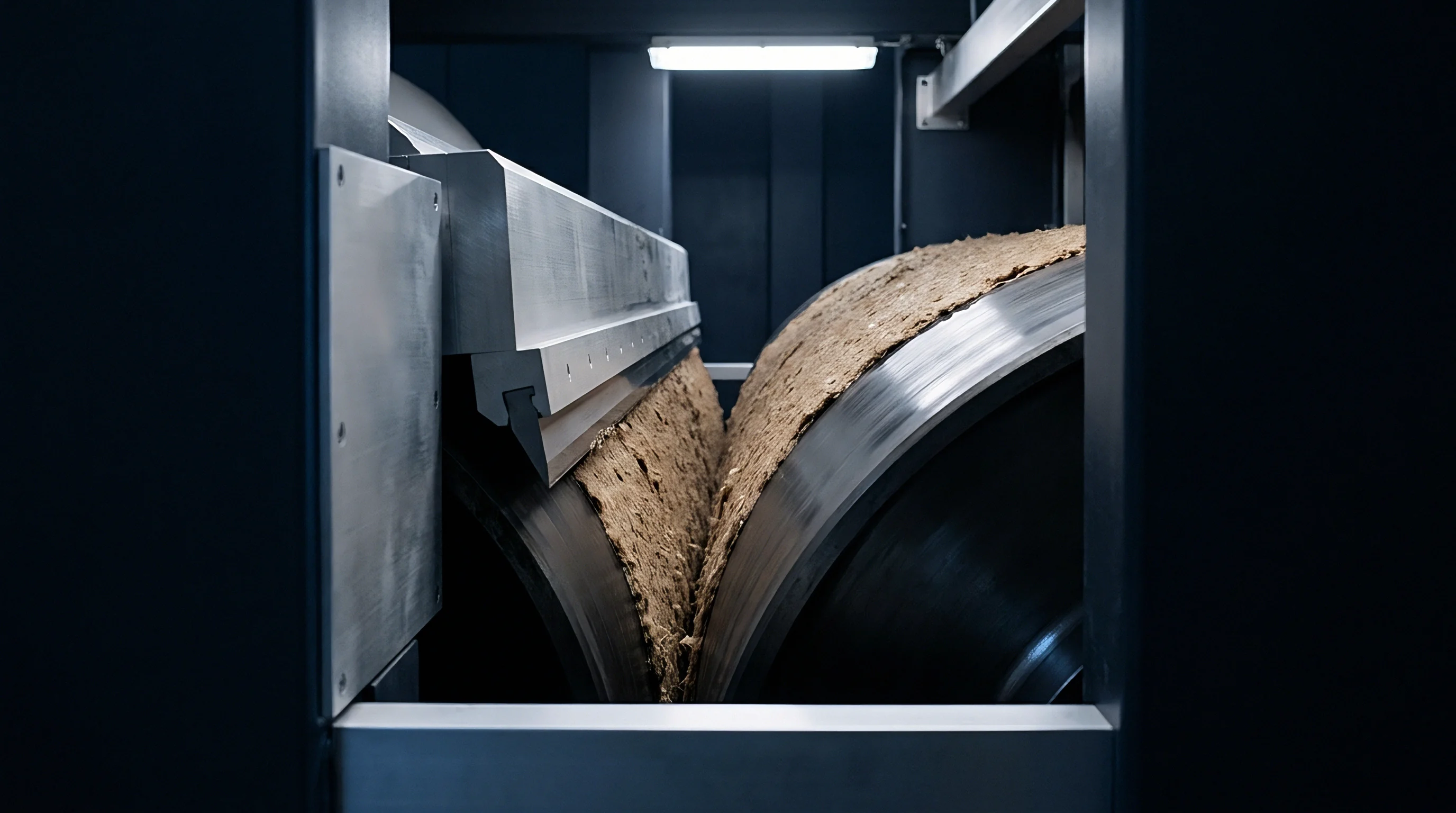
Thermal lamination of polypropylene onto solid bleached sulfate board relies on forcing a molten copolymer layer into the porous topography of the paperboard surface. Biaxially oriented polypropylene film carries an extrudable adhesive backing, typically ethylene-vinyl acetate, which transitions from a solid state to a low-viscosity fluid when exposed to heated laminating rolls. The heated nip assembly applies simultaneous thermal energy and fluid pressure, forcing the molten adhesive past the mineral clay coating and into the open pore structure of the bleached pulp fibers beneath.
Thermal Copolymer Flow Dynamics
The adhesive layer on thermal polypropylene film consists of ethylene-vinyl acetate co-polymerized to achieve a vinyl acetate content between 14 percent and 28 percent by weight. Increasing the vinyl acetate content lowers the melting point of the copolymer layer from 85 °C down to 70 °C, while simultaneously decreasing the crystallinity of the polymer matrix. Lower crystallinity yields higher mobility in the polymer chains at processing temperatures, accelerating viscous flow under the compression zone of the laminating nip.
Heat melts the copolymer.
During processing, the heated steel cylinder transfers energy through the film body into the copolymer backing. The interface temperature must reach a range between 95 °C and 115 °C to drop the adhesive melt viscosity below 150 Pascal-seconds. At line operating speeds ranging from 30 to 60 meters per minute, the dwell time within the compression nip spans only 12 to 25 milliseconds.
High pressure forces flow. If the interface temperature fails to cross the melting threshold during this brief window, the copolymer retains semi-crystalline rigidity, preventing mechanical anchor creation within the board surface.
Viscous polymer flows faster through open pores than across sealed mineral coatings.

Substrate Porosity and Surface Topography
Bleached paperboard grades receive mineral coatings composed of kaolin clay, calcium carbonate, and synthetic latex binders to build surface smoothness for print reproduction. The resulting coated layer exhibits pore diameters ranging from 0.05 to 0.5 micrometers, creating a dense capillary network. Mechanical interlocking occurs when the thermal adhesive penetrates these micro-pores and solidifies around the mineral pigment particles.
Substrate absorbency dictates the rate and depth of fluid adhesive penetration during the nip pass. Paperboard manufactured with low Cobb water-absorption values (below 25 grams per square meter over a 60-second ISO 535 test) limits latex binder migration, leaving micro-pores open for adhesive anchoring. Conversely, excessive latex binder content in the pigment formulation seals the surface microporosity, forcing reliance entirely on thermodynamic chemical wetting.
When fluid adhesive fails to anchor into board pores under nip pressure, low mechanical keying leads to film separation during subsequent blank converting.
The mechanical interaction during thermal lamination relies on precise sequence control on the converting line:
- Thermal activation stage transfers heat from the chrome nip roll through the oriented film core to melt the backing resin.
- Pressure compression stage forces the fluid copolymer into the surface profile of the clay coating while expelling entrapped ambient air.
- Capillary penetration stage maintains resin fluidity long enough for micro-pore infiltration prior to temperature drop.
- Cooling stabilization stage solidifies the amorphous polymer matrix to lock the mechanical bond before sheet discharge.
Energy
Thermodynamic wetting governs the initial atomic contact between the melted adhesive and the paperboard coating prior to mechanical solidification. Spontaneous wetting requires the surface energy of the liquid adhesive to sit well below the total surface free energy of the paperboard substrate. Surface tension components divide into dispersive forces, arising from non-polar Van der Waals interactions, and polar forces, driven by hydrogen bonding and dipole-dipole interactions across the interface.
Thermodynamic Wetting and Surface Free Components
Corona treatment elevates the surface energy of the biaxially oriented polypropylene film core from its base level of 30 millinewtons per meter up to an operating level between 38 and 42 millinewtons per meter. This surface modification oxidation generates polar hydroxyl, carbonyl, and carboxyl functional groups on the non-polar polypropylene chain. Bleached paperboard clay coatings display total surface free energy values between 44 and 54 millinewtons per meter, calculated via the Owens-Wendt-Rabel-Kaelble method using water and diiodomethane contact angle measurements.
A balanced surface energy profile requires the polar component of the board surface to match or exceed the polar component of the molten adhesive. Clay coatings formulated with high starch content yield elevated polar surface components exceeding 15 millinewtons per meter, which enhances thermodynamic compatibility with the polar ester groups of the ethylene-vinyl acetate copolymer layer. Low surface energy prevents bonding.
Substrates displaying surface tension below 38 millinewtons per meter fail ISO 2409 cross-hatch adhesion audits after forty-eight hours of ambient equilibration.
Ink Oils and Set-Off Powder Interference
Printing inks applied to bleached board prior to thermal lamination introduce organic resins, solvents, and vegetable oils that alter substrate surface energy. Fully covered heavy ink solid areas create a barrier film over the mineral coating, reducing effective surface free energy down to 28 to 32 millinewtons per meter. Cold resin fails.
Set-off powders sprayed during sheetfed offset printing present a physical barrier to film adhesion. Microscopic starch or calcium carbonate particles ranging from 15 to 30 micrometers in diameter rest on top of the dry ink film, elevating the laminating film off the board surface and preventing continuous thermodynamic contact. Chalking destroys surface wetting.
Residual printing inks containing silicone waxes or fluorocarbon additives similarly lower surface energy, forcing laminators to run elevated nip temperatures to drive adhesive around surface contaminants.
| Surface Material State | Total Surface Energy (mN/m) | Dispersive Component (mN/m) | Polar Component (mN/m) | Water Contact Angle (Degrees) |
|---|---|---|---|---|
| Unmodified BOPP Core Film | 30.2 | 28.8 | 1.4 | 94.5 |
| Corona Treated BOPP (40 Dyne) | 40.5 | 31.2 | 9.3 | 68.1 |
| Triple-Coated SBS Board (Unprinted) | 48.6 | 32.1 | 16.5 | 52.4 |
| Sheetfed Offset Litho Ink Solid | 31.8 | 27.4 | 4.4 | 88.2 |
| Water-Based Acrylic Primer Overprint | 44.1 | 30.5 | 13.6 | 58.9 |
Film suppliers frequently point to variance in mill board sizing formulas when thermal lamination bonds fail over unprinted sheet margins.
Stress
Converting operations impose severe mechanical deformation on laminated paperboard structures during rotary die-cutting, scoring, and folding. Creasing forces the paperboard substrate to yield internally along designated shear planes, forming a internal delamination bulge while stretching the external thermal film layer across the fold spine. The lamination must withstand high elongation without delaminating from the clay coating or fracturing along the score line.

Crease Mechanical Strain and Score Line Integrity
Paperboard scoring requires precise matching of male crease rule width, female channel clearance, and die penetration depth relative to board caliper. For a 350-micrometer caliper solid bleached sulfate board, standard scoring geometry utilizes a 2-point (0.71 mm) rule working into a 1.4 mm female channel depth. The folding process stretches the outer thermal polypropylene film by 15 percent to 35 percent strain along the exterior edge of a 180-degree crease.
Cross-direction folds generate higher mechanical stress than machine-direction folds because cellulose fibers align predominantly parallel to the paper machine direction. In cross-direction folds, rigid fiber bundles resist compression inside the crease bead, concentrating tensile strain directly into the adhesive interface behind the film. Tension pulls the sheet.
If the adhesive layer lacks sufficient shear strength or exhibits excessive brittleness from thermal degradation, the strain initiates interfacial propagation, resulting in score line delamination or visible film blistering.
A ninety-degree fold across the machine grain elevates interfacial shear stress beyond two megapascals when relative humidity shifts by twenty percent.
Can Biaxially Oriented Polypropylene Withstand Creasing without Delamination?
Film thickness directly dictates creasing survival without structural failure. Standard 12 to 15 micrometer biaxially oriented polypropylene films maintain sufficient flexibility to absorb folding strains without cracking. Thicker film shifts curl.
When film thickness exceeds 25 micrometers, the flexural rigidity of the polypropylene core increases proportionally to the cube of its thickness, driving interface stress above the yield strength of the EVA adhesive bond during folding.
Hygroexpansivity mismatch between the hydrophobic film core and the hydrophilic paperboard fiber matrix introduces long-term shear stress post-converting. Bleached paperboard expands or contracts in response to ambient relative humidity changes, altering dimensions by up to 0.15 percent per 10 percent change in moisture content. Polypropylene exhibits zero dimensional response to atmospheric moisture.
This dimensional differential generates continuous planar shear stress across the lamination interface, which manifests as panel curvature or edge lifting over extended storage periods.
Evaluation of physical integrity across converting processes focuses on specific structural failure points:
- Score line fracturing occurs when tensile strain exceeds the elongation limit of the biaxially oriented polypropylene core during folding.
- Interfacial delamination appears when peel stress generated at the score line exceeds the mechanical interlock strength of the EVA adhesive.
- Flaking along cut edges develops when blunt die-cutting blades shear the film without clean edge truncation, leaving unbonded film flaps.
- Hygroscopic sheet curl manifests when dimensional expansion of the board substrate pulls against the non-expanding plastic film layer.
Purchase specifications dictate that finished cartons exhibiting film delamination exceeding 0.5 millimeters along major crease lines during a ninety-degree bend audit trigger automatic lot rejection under standard quality agreement clauses.
Assay
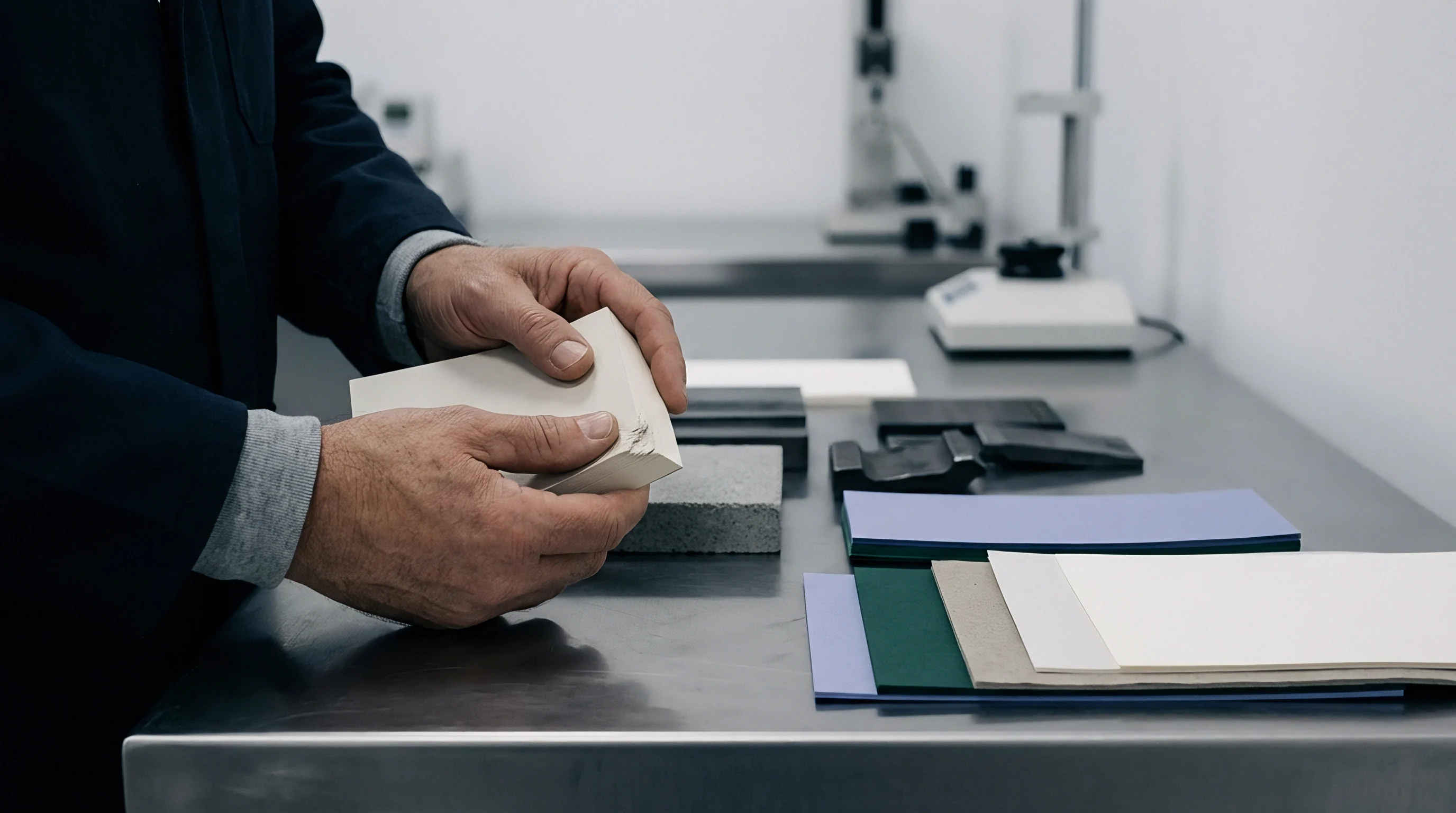
Verifying adhesion strength requires standardized quantitative mechanical testing backed by systematic visual failure mode classification. The standard evaluation benchmark relies on 180-degree peel testing performed on calibrated universal testing equipment, adhering strictly to ISO 8510-2 or ASTM D903 testing standards. Test specimens must undergo pre-test environmental conditioning at 23 °C and 50 percent relative humidity for a minimum of 24 hours to stabilize board moisture content and allow complete polymer stress relaxation.

Quantitative Peel Strength Protocol
Test strip preparation involves cutting 25-millimeter wide samples along both machine direction and cross direction axes. The test apparatus pulls the thermal film back from the paperboard substrate at a constant crosshead separation speed of 300 millimeters per minute over a total peel distance of 75 millimeters. Average peel force values recorded across the steady-state peeling zone reflect the interfacial bond performance, expressed in Newtons per 25 millimeters of sample width.
Commercial performance standards establish clear mechanical force thresholds for product qualification across different packaging categories:
| Substrate Board Type | Coating Weight (g/m²) | Mean Peel Force (N/25mm) | Dominant Rupture Mode | Commercial Qualification Status |
|---|---|---|---|---|
| Uncoated Solid Bleached Sulfate | 0.0 | 5.8 | 100% Fiber Tear | Passed High-Duty Specification |
| Single-Coated Folding Boxboard | 12.0 | 4.2 | 80% Fiber / 20% Clay Tear | Passed Standard Box Specification |
| Double-Coated Mineral SBS Board | 22.0 | 2.8 | Cohesive Coating Splitting | Passed Light Packaging Threshold |
| High-Gloss UV Overprinted Board | 28.0 | 1.1 | Interfacial Adhesive Separation | Failed Commercial Qualification |
| Calendered Recycled Linerboard | 8.0 | 3.4 | Delamination at Top Liner | Passed Standard Box Specification |
Diagnostic Categorization of Interfacial Rupture
Peel force values alone do not fully describe adhesion performance; the physical location of mechanical failure provides critical diagnostic insight into system performance. Fiber tearing indicates success. Complete fiber tear, where the adhesive pull tears structural wood fibers from the paperboard core, demonstrates that interfacial adhesive strength exceeds the internal cohesive strength of the paperboard matrix.
Cohesive coating failure occurs when the rupture runs clean through the mineral pigment coating layer, leaving clay bound to both the thermal adhesive and the pulp fibers beneath. This failure mode points to deficient latex binder levels within the board coating formulation rather than improper thermal laminating line settings. Clean interfacial adhesive separation, where film detaches cleanly from the board print surface without fiber or pigment removal, indicates incomplete thermodynamic wetting, insufficient thermal melt energy, or surface contamination by set-off powders.
The unresolved industrial question centres on whether non-destructive acoustic emission testing during high-speed inline blanking can predict long-term score line failure before mechanical stress propagation takes place on automated packaging lines.
Toll
Selecting film lamination introduces distinct commercial and regulatory costs that directly influence total package margin. While thermal polypropylene film adds barrier protection and scuff resistance, the composite material alters the end-of-life processing behavior of the packaging material. European compliance schemes under Extended Producer Responsibility regulations penalize plastic-laminated paperboard packaging through modulated fee structures designed to discourage non-separable composite materials.
Recyclability Grading and Repulpability Yield
Standard paper mill recycling operations re-pulp recovered paperboard in hydrapulpers using ambient water agitation to break hydrogen bonds between cellulose fibers. Thermal polypropylene film remains insoluble during aqueous pulping, forming large film fragments or continuous plastic sheets that clog screen plates and foul pulping impellers. According to the CEPI European Recyclability Guidelines and PTS-RH 021/97 laboratory assessment protocols, paperboard packaging must achieve a usable fiber yield exceeding 80 percent to earn a recyclable classification.
Film thickness and structural composition dictate pulping yield outcomes. Thin 12-micrometer film layers tend to fragment into micro-plastic contaminants under high-shear pulping, making physical separation via screening centrifuges difficult and reducing overall re-pulped pulp quality. Thicker 20 to 30 micrometer films remain largely intact, allowing pulper screens to capture the continuous plastic matrix, yet they carry higher initial plastic mass ratios that increase Extended Producer Responsibility fees per thousand finished units.
Film thickness above twenty-five micrometers moves board laminates into higher penalty fee brackets across European recycling compliance schemes.
Extended Producer Responsibility Tariffs and Material Yield
Modulated eco-contribution tariffs levy financial surcharges on packaging components that complicate secondary fiber recovery streams. Single-sided laminated paperboard structures where plastic mass accounts for less than 5 percent of total package weight incur base packaging fees. When double-sided lamination or heavy film gauges push total plastic content above 5 percent by weight, regulatory compliance systems reclassify the item as a non-standard composite, doubling or tripling the per-tonne fee applied to the brand owner.
Operational material efficiency metrics require calculated balancing across the total converting pass sequence:
- Raw material cost evaluation must aggregate paperboard caliper costs, thermal film unit area prices, and process energy consumption during lamination.
- Make-ready scrap accounting factors in sheet waste generated during laminator nip temperature ramp-up and web tension stabilization.
- EPR fee assessment calculates the financial penalty imposed per thousand finished cartons based on total residual plastic mass percentage.
- Scrap repulpability credit measures the loss of internal converting scrap revenue when laminated trim cannot be sold to local paper stock recyclers.
Laminating film thickness must remain below 5 percent of total package weight to avoid composite material regulatory surcharges.
Bond
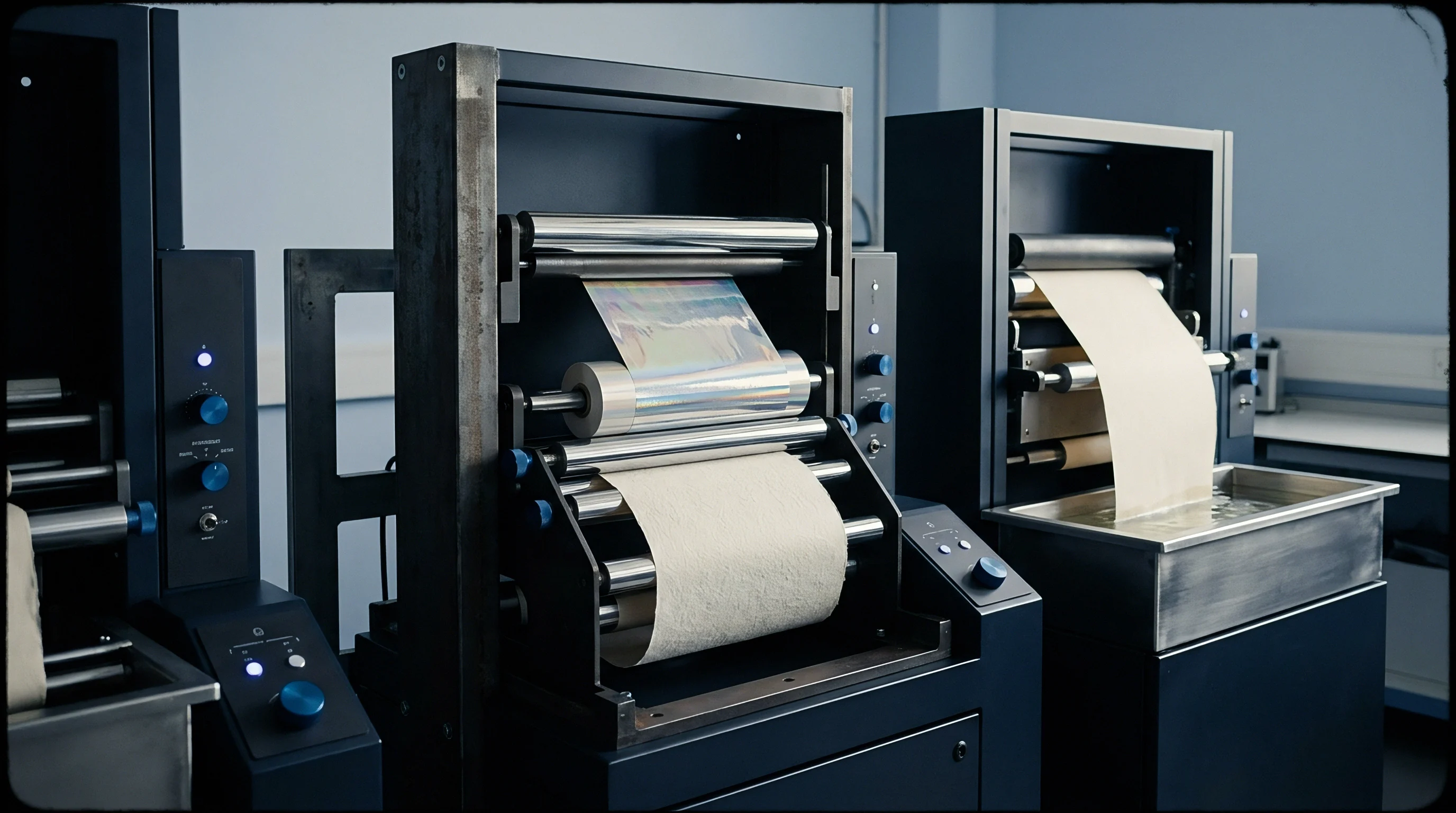
Operating a thermal laminating line requires balanced adjustments across three core machine parameters: nip cylinder temperature, web compression pressure, and line throughput speed. Each parameter influences the heat transfer rate into the copolymer layer, dictating the fluid rheology of the adhesive matrix as it enters the nip contact zone. Substrate caliper variations demand real-time process tuning to compensate for differences in thermal mass and paperboard compression behavior.
Line Speed and Nip Heat Transfer Parameter Mapping
Heat transfer from the chrome heating cylinder through the polypropylene film obeys Fourier’s law of thermal conduction. Higher line speeds reduce the dwell time during which the film remains in contact with the heated cylinder face. To maintain the required adhesive melt temperature of 105 °C at line speeds exceeding 50 meters per minute, operators must elevate the cylinder surface temperature setpoint up to 125 °C.
Nip impression pressure must match the Shore A hardness rating of the counter-pressure rubber roll. A 75 Shore A synthetic rubber roll deforms slightly under load, creating a nip contact footprint width between 10 and 15 millimeters depending on applied pneumatic cylinder pressure. Higher roll hardness narrows the contact footprint, elevating peak hydraulic pressure up to 4.5 MPa to force fluid adhesive into dense paperboard topcoats.
| Board Caliper (µm / g/m²) | Line Speed (m/min) | Nip Roll Temperature (°C) | Hydraulic Nip Pressure (MPa) | Rubber Roll Hardness (Shore A) |
|---|---|---|---|---|
| 250 µm / 215 g/m² SBS | 55 – 65 | 100 – 105 | 2.5 – 3.0 | 70 Shore A |
| 350 µm / 295 g/m² SBS | 45 – 55 | 105 – 110 | 3.0 – 3.5 | 75 Shore A |
| 450 µm / 370 g/m² FBB | 35 – 45 | 110 – 115 | 3.5 – 4.0 | 75 Shore A |
| 600 µm / 480 g/m² FBB | 25 – 35 | 115 – 125 | 4.0 – 4.8 | 80 Shore A |
Worked Process Calibration for Coated Folding Boxboard
Consider a production run processing a 350-micrometer folding boxboard carrying a 20 gram per square meter clay coat, laminated with a 15-micrometer thermal biaxially oriented polypropylene film carrying a 6 gram per square meter EVA backing layer. Machine parameters start at a baseline speed of 45 meters per minute, with the chrome nip roll regulated at 110 °C and pneumatic pressure set to 3.2 MPa. Mechanical testing of initial pull sheets shows clean interfacial film separation with an average peel force of 1.2 Newtons per 25 millimeters, indicating inadequate resin flow and poor mechanical anchoring.
Line adjustments increase the nip cylinder temperature to 118 °C while reducing line throughput speed to 38 meters per minute, extending the nip dwell duration from 16 milliseconds to 20 milliseconds. Operating pressure increases to 3.8 MPa to maximize fluid penetration into the mineral coat micro-pores. Re-testing first-off sheets after 30 minutes of room-temperature cooling demonstrates a shift in rupture mechanics from interfacial peeling to 100 percent solid fiber tear, elevating average peel force above 4.8 Newtons per 25 millimeters.
Stabilization of moisture regain post-lamination prevents post-converting roll curl and edge lift across finished pallets. Laminated sheets discharged from the delivery pile retain thermal energy, raising stack core temperatures up to 50 °C. Storage in controlled ambient conditions at 21 °C and 50 percent relative humidity allows the moisture content of the board core to re-equilibrate smoothly without inducing localized expansion stresses across the plastic film interface.