Transverse Thermal Gradient Control in Multi Ply Board Lamination
Transverse thermal gradient control in multi ply board lamination stabilizes cross direction web curl and prevents score line cracking across converting runs.


Heat
A twelve-degree Celsius temperature drop measured between the web center and deckle edges at 280 meters per minute destabilizes the bond line across a 1600 mm nip. Heat transfer through multi-ply paperboard relies on direct contact conduction during lamination. The thermal mass of the substrate resists rapid temperature equalisation.
Outer plies composed of fully bleached chemical pulp absorb and pass thermal energy quickly. Inner plies containing Chemi-Thermo-Mechanical Pulp hold low thermal conductivity due to air pockets trapped inside the bulk pulp network.
Density dictates conduction. Solid Bleached Sulfate board transfers heat uniformly across its homogeneous cross-section. Folding Boxboard exhibits internal thermal resistance variations caused by density steps between the smooth chemical pulp top liner, the bulky mechanical core, and the unbleached or bleached back liner.
When solventless polyurethane adhesive or molten polyethylene extrusion film meets the board surface, heat transfers downward into the sheet structure while simultaneously escaping laterally through exposed web edges.
Air pockets within mechanical pulp cores cut heat transfer rates across multi-ply board structures by up to forty percent compared to solid chemical pulp layers.
Evaporative cooling accelerates heat loss at web borders. Moisture within the paperboard matrix migrates toward the surface upon contact with heated lamination rolls at 120 to 160 degrees Celsius. At the deckle edges, water vapor escapes freely into surrounding ambient air.
Moisture shifts energy. Flash evaporation at outer borders drops local sheet temperature, creating a permanent transverse thermal gradient across the deckle width.

Thermal Conductivity Profiles across Substrates and Laminating Media
Bleached chemical pulp on the outer faces of folding boxboard transfers energy twice as fast as the high-bulk mechanical core. Polypeptide and polyolefin films introduce their own thermal barrier properties to the lamination interface. Aluminum foil acts as an immediate thermal conductor across the top surface, spreading heat laterally while the underlying paperboard substrate remains cold at the center core.
The following comparative material properties define thermal response times during high-speed contact lamination.
| Material Layer | Density (g/cm³) | Thermal Conductivity (W/m·K) | Specific Heat Capacity (J/kg·K) | Thermal Expansion Coefficient (10⁻⁶/K) |
|---|---|---|---|---|
| Bleached Chemical Top Liner | 0.85 – 0.95 | 0.13 – 0.15 | 1200 – 1350 | 6.0 – 8.0 |
| CTMP Mechanical Core | 0.45 – 0.55 | 0.06 – 0.08 | 1400 – 1550 | 3.0 – 5.0 |
| Unbleached Kraft Back Liner | 0.75 – 0.85 | 0.11 – 0.13 | 1250 – 1400 | 5.0 – 7.0 |
| BOPP Lamination Film (12 µm) | 0.90 – 0.92 | 0.11 – 0.16 | 1700 – 1900 | 100.0 – 120.0 |
| PET Lamination Film (12 µm) | 1.38 – 1.40 | 0.15 – 0.24 | 1200 – 1350 | 15.0 – 20.0 |
| Low-Density Polyethylene (LDPE) | 0.91 – 0.93 | 0.32 – 0.35 | 1900 – 2100 | 100.0 – 220.0 |
| Aluminum Foil (7 µm) | 2.70 | 220.0 – 235.0 | 890 – 910 | 23.0 – 25.0 |
Polyethylene film lamination demands uniform heat delivery to achieve complete interface wet-out. When transverse thermal gradients drop edge temperatures below the polymer melting threshold, adhesive failure occurs along outer web margins. The core of the web receives sufficient thermal exposure to form an instantaneous mechanical bond, whereas edge regions retain unbonded, tack-free polymer chains.
High deckle heat splits board. Oversupplying heat to compensation zones along web edges risks thermal degradation of surface coatings, leading to bubble formation, yellowing, and localized web expansion.
Mills often argue that ambient humidity shifts during transit account for edge temperature drops rather than roll chill at deckle borders.
Crown
Steel rolls undergo structural expansion along the central axis when hot oil circulates through internal channels at 140 degrees Celsius. Thermal growth along the roll core increases center diameter relative to roll ends, altering profile geometry. The resulting thermal crown alters transverse pressure distribution inside the lamination nip.
Rubber-covered counter-pressure rolls experience differential thermal expansion from heat conducted out of the web, compounding profile distortion across extended operating shifts.
Rubber deflects under pressure. Heat buildup inside the elastomeric cover reduces dynamic modulus along the middle section of the roll. Lower modulus reduces effective nip pressure, yielding uneven adhesive dwell times across the deckle width.
An uncompensated roll geometry creates a high-pressure zone at the web edges or center, driving adhesive outward and causing caliper variations across converted rolls.

Variable Profile Adjustments
Zone-controlled heating cylinders split the deckle into discrete ten-centimeter segments, allowing precise localized thermal input across the machine width. High-frequency induction coils mounted beneath the shell of the heated roll deliver targeted electromagnetic energy directly to colder edge sections. Induction responds in seconds.
Real-time temperature control systems modulate electrical frequency to maintain an absolute surface temperature profile within one degree Celsius across a 1600 mm web width.
The operational sequence below establishes baseline thermal uniformities prior to running complex multi-ply board substrates through high-speed laminating lines.
- Preheat the primary laminating cylinder to 80 degrees Celsius under low rotation speeds to prevent thermal shock and structural warping of the steel core.
- Engage internal oil recirculation pumps to establish fluid velocity across all internal distribution channels, checking for flow differential between center and drive side ports.
- Measure roll surface temperature at twenty points across the deckle using calibrated narrow-spot infrared pyrometers to establish baseline thermal topography.
- Activate edge-compensation induction zones, supplying targeted thermal correction to outer deckle margins until surface reading matches core web temperature within half a degree Celsius.
- Bring counter-pressure impression rolls into initial nip contact at two bar mechanical load, validating nip footprint symmetry across the deckle using pressure-sensitive diagnostic film.
- Accelerate web line speed to production target while continuous infrared thermal scanners provide real-time closed-loop feedback to dynamic induction zone controls.
Calibrated sensors prevent drift. Dynamic deflection rolls utilize internal hydraulic zones to apply counter-bending forces directly against thermal crown displacement. Hydraulic oil pressure adjusts automatically based on feedback from transverse infrared sensor arrays positioned immediately downstream from the laminating nip.
| Web Position (mm) | Uncompensated Temp (°C) | Uncompensated Pressure (kN/m) | Induction Compensated Temp (°C) | Hydraulic Compensated Pressure (kN/m) |
|---|---|---|---|---|
| 0 (Drive Edge) | 112.5 | 22.1 | 129.8 | 25.0 |
| 200 | 121.0 | 23.8 | 129.9 | 25.1 |
| 400 | 127.4 | 24.6 | 130.1 | 25.0 |
| 800 (Web Center) | 130.2 | 25.2 | 130.0 | 24.9 |
| 1200 | 127.1 | 24.5 | 130.1 | 25.0 |
| 1400 | 120.8 | 23.7 | 129.8 | 25.1 |
| 1600 (Operator Edge) | 111.8 | 21.9 | 129.7 | 25.0 |
Multi Zone Induction Heating Control
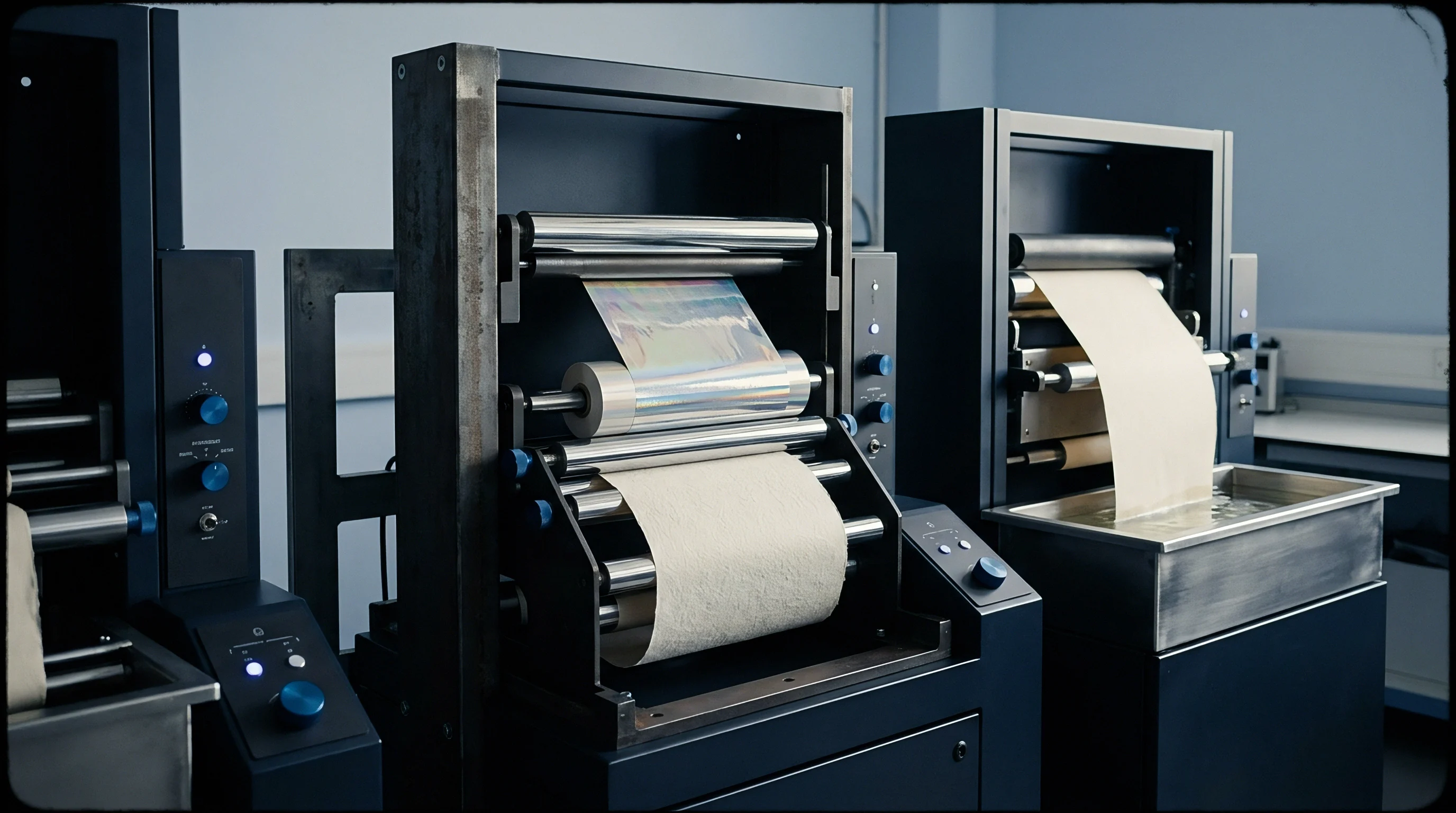
High-speed lamination demands immediate thermal adjustments when changing board callipers or web widths. Induction heating systems target shell surfaces without requiring thermal conduction through thick-walled cylinder cores. Current passed through localized coils induces eddy currents in the roll shell, generating precise heat directly where needed.
Closed-loop control software calculates real-time heat dissipation rates along the edge zones, adjusting power output to offset convective air cooling and substrate moisture evaporation.
Running a cold nip cylinder across a hot paperboard web creates permanent edge fluting that no downstream decurler can strip out.
Warp
Cross-direction curl develops when differential cooling rates across the web set up locked-in strain between top and bottom plies. The coefficient of thermal expansion for polymer laminating film exceeds that of cellulosic paperboard by an order of magnitude. As the laminated structure exits the nip, high-temperature regions shrink significantly more upon cooling than cooler regions.
Hot web centers contract faster than cold web edges, forcing the board structure into a three-dimensional complex saddle warp.
Edge strain creates twist. When a transverse temperature gradient exists during polymer solidifying phases, internal stress profiles become asymmetrical. The side of the web exposed to higher thermal input retains elevated tension after cooling.
Moisture loss drives shrinkage. Heat applied during lamination drives moisture out of outer paperboard plies. Because edges lose moisture faster than the core, differential hygrothermal strain locks into the fiber network as polymer chains freeze into solid state.
A five-degree Celsius transverse thermal gradient creates sufficient internal differential stress to cause severe cross-direction web twist during post-lamination conditioning.
Hygrothermal Stress Accumulation across Board Depth
Cellulosic fibers swell when absorbing moisture and shrink during desiccation. Thermoplastic films maintain thermal expansion behavior independent of atmospheric humidity. When a hot polyolefin film laminates onto a board substrate possessing a non-uniform transverse temperature profile, cooling down to ambient room temperature induces localized compressive stresses in the paperboard face and tensile stresses in the polymer film.
These opposing forces balance out while the web remains under machine direction winding tension, but manifest as severe sheet distortion once sheets are cut off line.
Polymer chains lock instantly. Below glass transition temperatures, thermal strain converted into elastic strain remains stored inside the multi-ply composite layer. Unbalanced strain manifests as cross-direction up-curl, down-curl, or diagonal twist warping, interfering with high-speed carton converting equipment.
Why Does Thermal Gradient Curl Peak after Moisture Equilibrium?
Unbound water molecules redistribute through the multi-ply board matrix over forty-eight hours following extrusion or film application. Moisture migrates from wet internal mechanical pulp layers toward dry outer chemical pulp plies that lost moisture during thermal nip exposure. Moisture redistribution changes the elastic modulus and physical dimensions of individual plies at different rates.
If the original thermal pass generated a non-uniform transverse temperature profile, moisture absorption occurs unevenly across the web deckle width, intensifying dimensional distortion during pallet storage.
The following worked calculation demonstrates transverse thermal strain differentials across a 1600 mm wide web of 350 g/m² Folding Boxboard laminated with 12 µm PET film under an uncompensated edge-to-center thermal gradient.
Assumptions for calculation:
- Web width: 1.6 meters
- Center web temperature at nip: 135 degrees Celsius
- Edge web temperature at nip: 118 degrees Celsius
- Ambient cooling temperature: 20 degrees Celsius
- PET film thermal expansion coefficient: 20 x 10⁻⁶ /K
- Paperboard cross-direction thermal expansion coefficient: 6 x 10⁻⁶ /K
- Paperboard cross-direction moisture shrinkage coefficient: 0.15% per 1% moisture change
- Moisture loss at web center: 1.2%
- Moisture loss at web edges: 2.8%
Thermal strain calculation at web center:
Thermal delta center = 135 – 20 = 115 K
Differential thermal strain center = (20 – 6) x 10⁻⁶ x 115 = 1.61 x 10⁻³ (0.161%)
Moisture strain center = 1.2 x 0.0015 = 1.80 x 10⁻³ (0.180%)
Total cross-direction strain center = 0.161% + 0.180% = 0.341%
Thermal strain calculation at web edge:
Thermal delta edge = 118 – 20 = 98 K
Differential thermal strain edge = (20 – 6) x 10⁻⁶ x 98 = 1.37 x 10⁻³ (0.137%)
Moisture strain edge = 2.8 x 0.0015 = 4.20 x 10⁻³ (0.420%)
Total cross-direction strain edge = 0.137% + 0.420% = 0.557%
Strain differential across deckle = 0.557% – 0.341% = 0.216%
This 0.216% strain differential across a 1600 mm width produces a physical edge-to-center length disparity of 3.45 mm. This dimensional variation exceeds standard flat-bed die cutter feeding tolerances, guaranteeing blank register faults, score line cracking, and folder-gluer feed jams.
The operational checklist below highlights critical assessment criteria when diagnosing transverse structural distortion on finished board pallets.
- Thermal Profile Mapping records real-time surface temperatures at five points across the nip using calibrated pyrometers to confirm deckle uniformity.
- Moisture Gradient Analysis determines water mass loss across drive, center, and operator positions immediately following the thermal pass.
- Inter-Layer Adhesion Testing validates bond integrity along edge margins to prevent film separation during scoring procedures.
- Score Line Crack Evaluation measures fiber rupture levels along cross-direction creases using a ten-times optical loupe on conditioned blanks.
- Pallet Flatness Auditing quantifies corner lift distances on stack corners forty-eight hours post-lamination under controlled atmospheric conditions.
Ignoring transverse thermal equilibrium yields thousands of distorted cartons that jam high-speed filling lines and trigger complete lot rejections.
Audit
Verification of web temperature profile demands continuous multi-point pyrometry aligned directly before and after the laminating nip. Fixed single-spot sensors miss localized cold bands and thermal edge drops. Infrared array cameras scanning at sixty hertz render a full real-time thermal map of the moving web, feeding data into automated profile correction loops.
Sensors require spectral filtering between 8 and 14 micrometers to prevent reflected radiation from hot metallic cylinders corrupting surface board readings.
Cold edges reject ink. Surface energy drops when adhesives cure improperly under low temperature conditions, causing subsequent print inks and varnishes to reticulate or fail cross-hatch tape tests. Validating thermal uniformity across the deckle guarantees consistent surface dyne levels for secondary converting operations.
Non Contact Surface Thermography Protocols
Measuring temperature profiles across high-speed webs requires precise sensor calibration tuned to paperboard surface emissivity. Uncoated bleached board features an emissivity coefficient of 0.92, whereas clay-coated surfaces range between 0.88 and 0.90. Metallic foil laminates exhibit emissivity levels below 0.15, rendering standard infrared pyrometry inaccurate without filtered broad-band sensor arrays or contact thermocouple verification wheels.
ISO 187 conditioning mandates standard atmosphere testing at twenty-three degrees Celsius and fifty percent relative humidity to isolate thermal strain from moisture induced warp.
Laboratory testing according to ISO 11528 establishes paperboard thermal resistance parameters under static contact conditions. Dynamic production verification relies on inline thermal logging equipment mounted directly to laminating frames. The diagnostic failure mode table outlines operational defects linked directly to transverse thermal imbalances.
| Observed Defect | Primary Physical Root Cause | Transverse Location | Corrective Action |
|---|---|---|---|
| Edge Delamination | Adhesive temperature below minimum activation threshold | Outer 100 mm deckle edges | Increase edge induction heating power output |
| Cross-Direction Twist Warp | Asymmetrical thermal profile cooling between drive and operator sides | Full web width diagonal | Rebalance heating oil circulation flow rates |
| Center Blistering | Overheating causing internal moisture vaporization and core rupture | Central 400 mm web zone | Reduce primary roll core heating fluid temperature |
| Score Line Fiber Fluting | Excessive moisture loss during lamination embrittling surface fibers | High-temperature zones | Adjust deckle moisture spray rehydration bars |
| Variable Surface Dyne Level | Non-uniform polymer film surface oxidation during thermal pass | Irregular transverse bands | Calibrate transverse air-gap corona treaters |
Calibrated Moisture and Temperature Logging
Portable hand-held contact pyrometers provide secondary validation during line make-ready procedures. Technicians take physical cross-check measurements across the stationery or low-speed roll profile to verify inline thermal imaging system accuracy. Documenting these measurements forms a core component of production lot traceability records.
Standard conversion contracts specify an edge-to-center temperature delta threshold of three degrees Celsius, shifting liability for post-lamination curl directly to the converter when unmonitored.

Penalty
Waste generation on high-speed converting lines scales exponentially when edge-to-center temperature differentials exceed four degrees Celsius. Substrate rejection begins at the laminator off-loader, where warped webs force operators to chop rolls into non-recoverable scrap. Trim losses expand when wide deckles are slitted into narrow ribbons, as thermal edge variances render outer mill rolls unusable for high-speed automated folding box lines.
Reject pallets destroy margins. A typical lamination line running at 300 meters per minute generates 18,000 meters of converted board per hour. If transverse thermal gradients create cross-direction twist that surfaces forty-eight hours post-converting, the resulting failure invalidates an entire production run.

Converting Waste Calculations for Laminated Folding Cartons
High-speed folder-gluers run at speeds up to 100,000 cartons per hour. Feeder mechanisms demand perfectly flat blank stacks. Web warp exceeding 5 mm per 300 mm sheet length causes feeder misfeeds, double-sheet stops, and glue flange misregistration.
Speed throttling expenses accumulate rapidly when operators drop line speed by fifty percent to process warped board stock.
Speed masks board variation. Operating at reduced throughput increases unit conversion costs, eating into job profitability. The worked commercial comparison below illustrates the cost impact of thermal gradient waste on a 50-tonne packaging job using 350 g/m² Folding Boxboard laminated to 12 µm metallized PET film.
Job baseline parameters:
- Order volume: 50 metric tonnes of board
- Board cost: 1,450 EUR per tonne
- Film and adhesive cost: 380 EUR per tonne equivalent
- Lamination pass processing cost: 220 EUR per tonne
- Total baseline material and processing investment: 102,500 EUR
Scenario A: Controlled Transverse Gradient (Temperature delta under 1.5 °C):
- Lamination line setup waste: 1.5% (750 kg)
- Edge trim waste: 2.0% (1,000 kg)
- Folder-gluer scrap rate: 1.0% (500 kg)
- Total job scrap mass: 2,250 kg (4.5%)
- Net converted salable product: 47,750 kg
- Total scrap cost: 4,612 EUR
- Final unit conversion waste penalty: 96.58 EUR per salable tonne
Scenario B: Uncompensated Transverse Gradient (Temperature delta of 6.5 °C):
- Lamination line setup waste: 3.5% (1,750 kg)
- Edge trim scrap expansion (slitting off cold edges): 6.0% (3,000 kg)
- Warped blank folder-gluer scrap rate: 7.5% (3,750 kg)
- Speed throttling throughput penalty (extra shift hours): 4,200 EUR
- Total job scrap mass: 8,500 kg (17.0%)
- Net converted salable product: 41,500 kg
- Total scrap cost (including labor penalty): 21,625 EUR
- Final unit conversion waste penalty: 521.08 EUR per salable tonne
The uncompensated thermal gradient increases waste expenses by 424.50 EUR per net salable tonne, turning a profitable run into a substantial net operating loss.
EPR Modulated Fee Penalties for Thermally Damaged Multi Material Substrates
Extended Producer Responsibility framework regulations penalize multi-material packaging formats that exhibit poor recyclability profiles. Heat damage suffered during excessive edge thermal compensation carbonizes surface coatings and degrades polyolefin coatings, reducing repulping efficiency during mill recycling operations. Under modern European Eco-Modulation guidelines, laminated board containing degraded, non-separable polymer fractions incurs higher EPR packaging fees.
The technical documentation list specifies required material test records for certifying lamination line thermal compliance before releasing finished packaging lots to pharmaceutical and food retail clients.
- Transverse Thermal Topography Log captures continuous pyrometer array readings across every master roll produced during the shift.
- Dynamic Nip Pressure Balance Sheet records hydraulic crown compensation pressure trends aligned with line speed transitions.
- Post-Lamination Flatness Certificate confirms sheet curl measurements comply with maximum 3 mm edge lift limits following 48-hour conditioning.
- Polymer Bond Energy Dossier provides dyne level test results and cross-hatch adhesion scores for drive, center, and operator edges.
- Recyclability Assessment Protocol verifies repulping yield percentage and fiber-reject fractions in accordance with EN 13430 standard testing.
The industry still lacks a low-cost inline dynamic sensor array capable of measuring inter-ply thermal gradients simultaneously with moisture content at line speeds exceeding three hundred meters per minute.