Cross Direction Bending Stiffness Variations in Solid Bleached Board
Cross direction stiffness variations in solid bleached board stem from wet-end fibre orientation and caliper profiles, driving converting errors and yield loss.

Deflection
Solid bleached board shows strong directional anisotropy formed at the wet end of the paper machine. On a Fourdrinier or multi-ply former, wood fibres align mainly parallel to the machine direction. This alignment makes bending stiffness in the machine direction two to three times higher than cross-direction stiffness on the same reel.
Whether an unbleached or fully bleached virgin carton holds its shape under side compression or bulges during high-speed filling comes down to cross-direction wall deflection.
Bending resistance in paperboard depends on the elastic modulus of the fibre network and the cube of sheet thickness. Bleached chemical pulps ~ made of fully delignified softwood and hardwood fibres ~ offer high tensile strength, but maximizing crosswise stiffness without adding weight requires careful density management and multi-ply structuring. Standard lab tests measure bending force at specific angles and sample spans, reporting values in millinewtons or millinewton-meters to quantify resistance to flexural deformation.
Bending stiffness measured at a five-degree angle under ISO 2493-1 conditioning at 23 degrees Celsius and 50 percent relative humidity runs roughly fifteen percent higher than fifteen-degree Taber readings on identical 350 micrometre board.
Differences in test values between standard methods stem from yield point behavior, shear deformation in the inner plies, and clamp friction. Two-point bending tests on solid bleached board highlight how much surface ply density contributes compared to the lower-density middle plies. Adjusting the jet-to-wire speed ratio on the machine alters crosswise fibre distribution, shifting the stiffness ratio across the width of the roll.
Standard Bending Test Methodologies
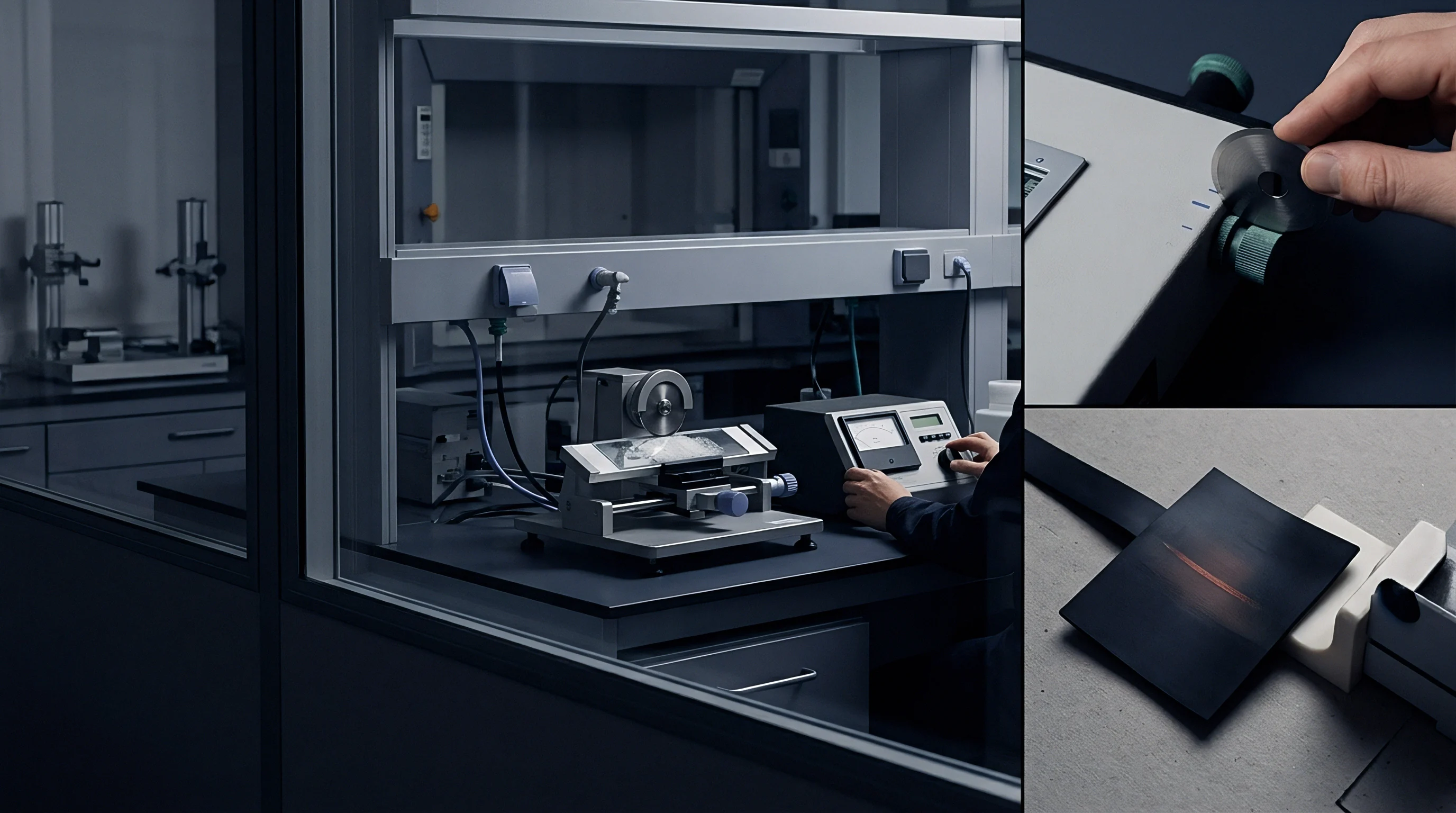
Laboratories quantify cross-direction stiffness using instruments that apply either constant bending angles or fixed deflection distances. Because the choice of instrument changes the result, direct numerical conversion between methods is unreliable without empirical factors calibrated for specific board calipers.
| Test Standard | Instrument Type | Bending Angle | Sample Span | Primary Measurement Unit |
|---|---|---|---|---|
| ISO 2493-1 | L&W Two-Point Resistance Tester | 15 Degrees | 50 Millimetres | Millinewtons (mN) |
| ISO 2493-2 | Taber V-5 Stiffness Tester | 15 Degrees | 50 Millimetres | Taber Stiffness Units (g-cm) |
| TAPPI T 556 | Resonance / Deflection Tester | 5 Degrees | 50 Millimetres | Millinewtons (mN) |
| DIN 53121 | Four-Point Bending Rig | Elastic Range | 100 Millimetres | Bending Stiffness (mNm) |
Cross-direction stiffness drops when sheet moisture rises above seven percent. As softwood fibres in the outer liner plies absorb water and expand laterally, inter-fibre hydrogen bonds weaken and the crosswise elastic modulus falls. High crosswise bending resistance stops carton panels from bowing on automated packaging lines, where push-rods force flat blanks into rectangular sleeves.
Without sufficient crosswise stiffness, board deflects inward under vacuum cup pickup, triggering feed jams on lines running above four hundred units per minute.
A lower threshold for cross-direction stiffness ensures packed cartons withstand side loads during transit and stacking, while an upper limit prevents excessive spring-back at flap closures. Although cross-direction stiffness targets sit below machine-direction metrics, variations across the machine width frequently cause asymmetrical carton deformation.
Because sheet thickness governs outer tension, mill web profiles showing caliper drops near the deckle edges systematically produce lower cross-direction stiffness in rolls cut from outer machine positions.
In practice, a five percent drop in caliper cuts bending stiffness by roughly fifteen percent along any cross-machine sampling line.
Formation
Cross-machine profile uniformity depends on headbox slurry delivery, dilution control, and press-section mechanics across the wire. Modern multi-ply board machines use composite headboxes or separate formers to lay down distinct furnish layers. Hardwood kraft pulp provides formation and surface smoothness in the outer plies, while long-fibre softwood kraft supplies tear strength and bulk in the centre.
Fluctuations in stock consistency or slice lip opening across the headbox create localized shifts in basis weight and fibre angle, causing stiffness variations across slitted reels.
Press nip pressures and differential drying shrinkage expand these crosswise differences. As the wet web moves through steam cylinders, the edges dry faster and shrink more than the centre. Edge restraints limit crosswise shrinkage, but residual stress profiles remain across the reel.
Fibres near the deckle edges turn slightly inward toward the centre line, shifting the principal mechanical axis away from the machine direction. As a result, cross-direction stiffness readings from edge rolls consistently differ from centre roll values cut from the same master reel.
Solid bleached board displaying an edge-to-center caliper variation of eight micrometres generates cross-direction stiffness swings exceeding twelve percent across a single mill roll width.
Downstream converting operations feel these profile imbalances during blanking and high-speed folding. If crosswise stiffness varies across a printed sheet, cartons cut from edge lanes require different folding forces than those from middle lanes. Automatic cartoning lines set up for uniform stiffness suffer feeding errors and inconsistent creasing when running mixed-lane stock.

Converting Defects Driven by Stiffness Drift
Fluctuations in cross-direction sheet properties cause distinct structural and operational failures on converting and packaging lines. Line stoppages and distorted box geometry directly follow crosswise property gradients.
- Panel bulge under top load occurs when low cross-direction stiffness allows carton side walls to flex outward under vertical stacking stress, leading to warehouse stack collapse.
- Carton squareness failure arises from unequal spring-back across opposite fold lines, causing filled boxes to assume a rhomboidal profile on palletized loads.
- Vacuum cup pick-up failure develops when insufficient crosswise rigidity allows the blank to bow away from suction heads on feeder magazines.
- Side-seam glue line shear results from differential crosswise expansion and spring-back tension pulling glued overlaps apart before hot-melt adhesive fully cures.
Because caliper dictates bending moment, when chemical furnish refining levels drift during a run, the balance between bulk and stiffness shifts. Heavy refining increases fibre bonding and density ~ improving tensile strength, but lowering caliper at a given basis weight. That lost caliper drops cross-direction bending stiffness significantly, compromising wall rigidity despite higher tensile numbers.
Calendering units adjust sheet thickness to smooth the coated surface for gravure and offset printing. Excessive nip pressure during soft- or hard-nip calendering crushes the porous middle ply, permanently sacrificing crosswise flexural rigidity to hit surface smoothness targets. Maintaining a uniform coat-weight profile across the machine prevents variations in moisture absorption that would otherwise distort crosswise stiffness over storage.
Cross-machine stiffness drift often stems from wet-end thermal gradients and minor slice lip adjustments made to maintain uniform basis weight profiles across wide machine wires.
Flexure
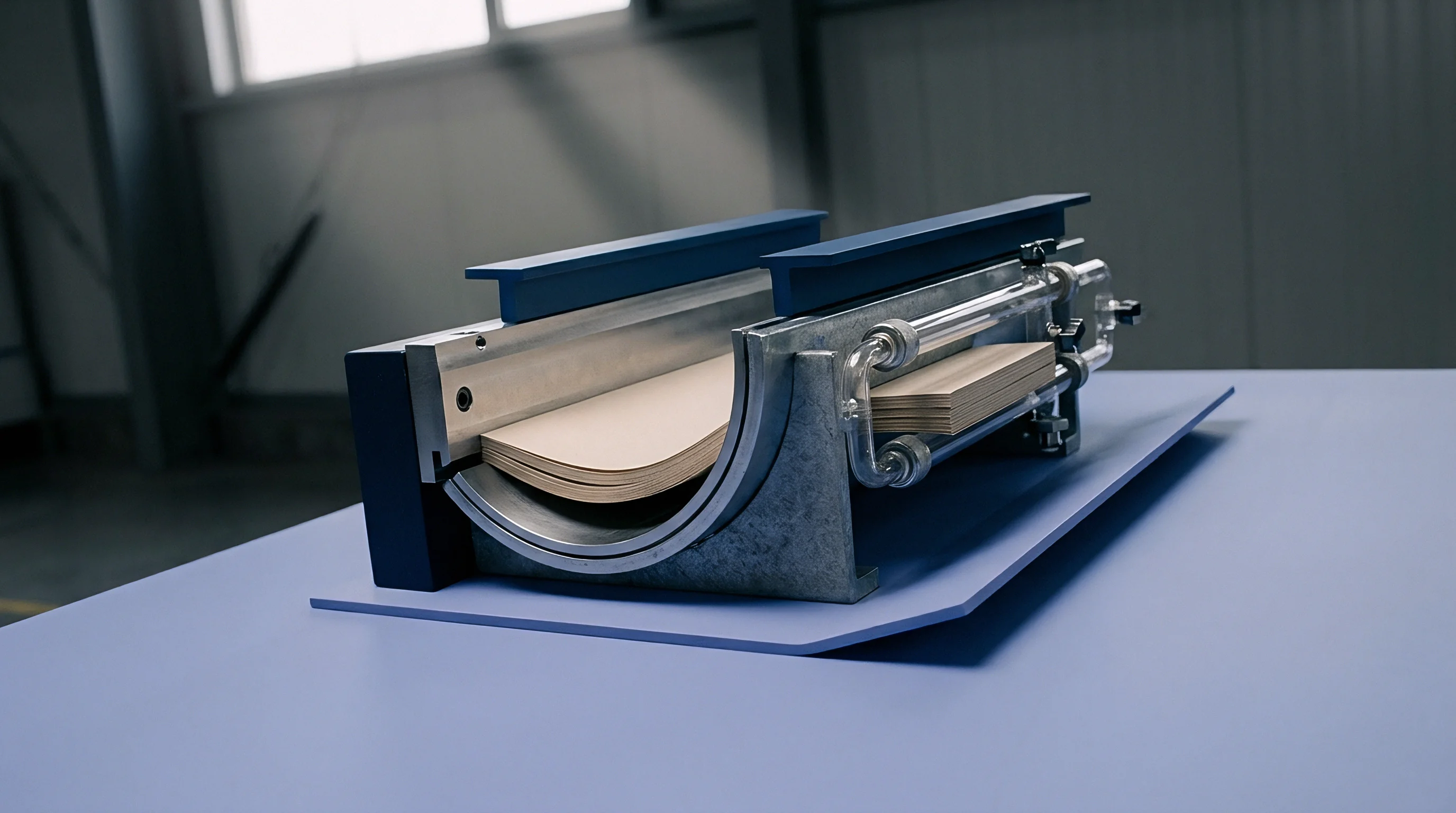
Two-point bending places the outer convex ply in tension, the inner concave ply in compression, and the central neutral axis in shear. Solid bleached board relies on high flexural rigidity to keep large packaging panels flat. The elastic modulus of the outer bleached kraft layers determines most of the bending moment of inertia.
When cross-direction flexural stiffness falls below specification, overall structural integrity drops, reducing vertical box compression strength in top-load crush tests.
Moisture uptake alters flexural response unevenly across machine axes. Because softwood fibres swell mainly in diameter rather than length as they absorb water, cross-direction expansion far exceeds machine-direction expansion. This swelling breaks inter-fibre bonds within internal plies, causing a rapid fall in crosswise elastic modulus.
Laboratory testing relies on strict conditioning under ISO 187 to prevent ambient humidity from disguising underlying structural variations.

Why Does Cross Direction Resistance Decay under High Humidity?
Water molecules penetrate amorphous regions in the outer plies, breaking secondary hydrogen bonds between microfibrils. Because cross-direction stiffness depends on matrix shear transfer and lateral bond points rather than longitudinal fibre strength, moisture absorption causes a steeper percentage drop in crosswise resistance than in the machine direction. At relative humidity levels above sixty-five percent, cross-direction stiffness in bleached virgin board drops by up to twenty-five percent, causing panel bulge in cold supply chains.
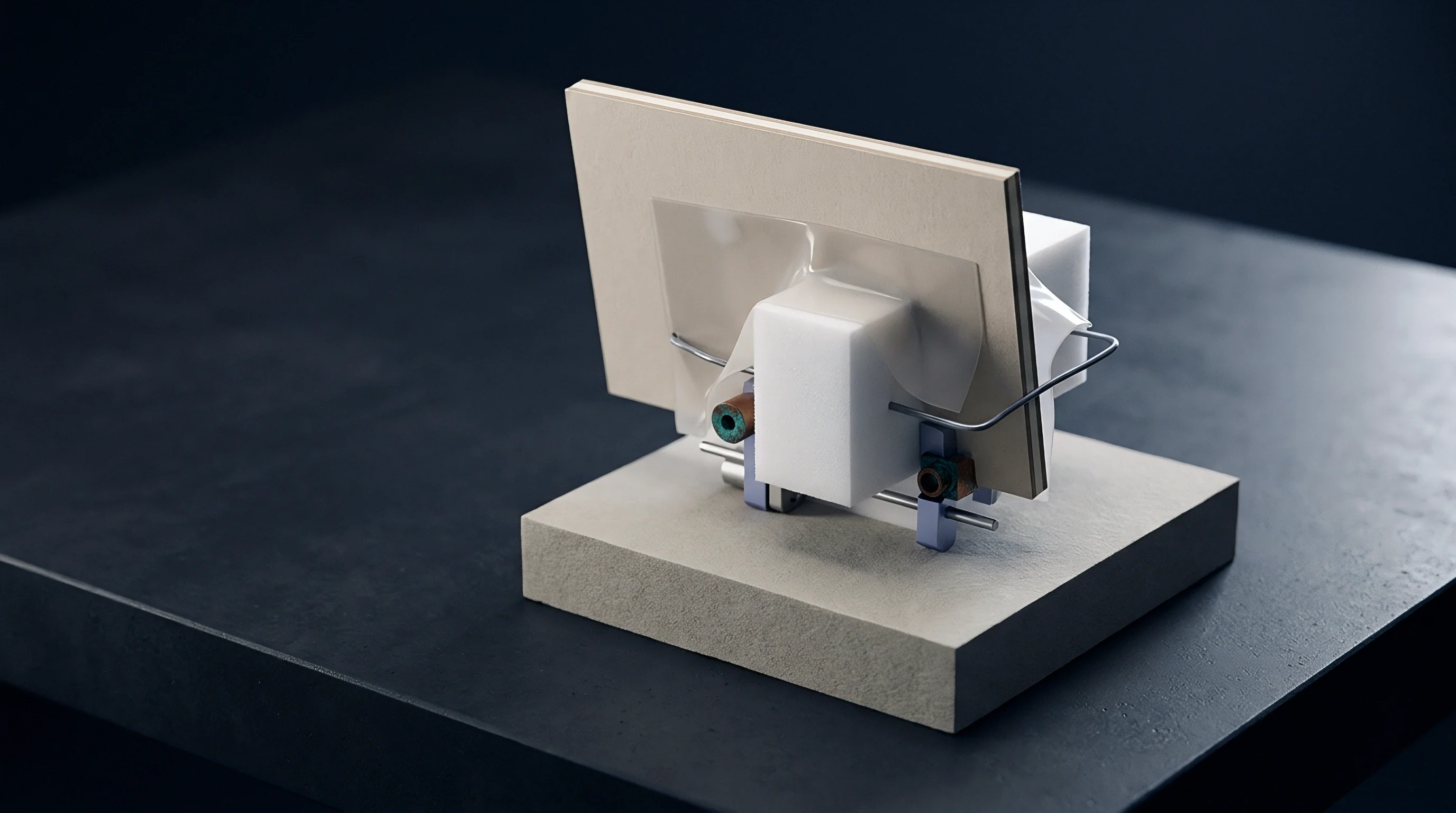
Establishing precise cross-direction testing protocols requires standardized specimen preparation and strict control over force application rates. The following procedure outlines a two-point cross-direction bending stiffness test using standard L&W apparatus.
- Condition the test sheets in an atmosphere maintained at 23 degrees Celsius and 50 percent relative humidity for a minimum of twenty-four hours in compliance with ISO 187.
- Cut rectangular test specimens measuring exactly 38 millimetres in width and 70 millimetres in length, ensuring the long axis aligns perpendicular to the machine direction marking.
- Inspect cut specimen edges under magnification to confirm clean die cuts free from fibrous burrs, delamination, or crushing induced by dull cutter blades.
- Calibrate the electronic load cell and position the bending clamp to establish a fixed test span of 50 millimetres between the clamp edge and the load knife.
- Insert the specimen securely into the pneumatic clamp, ensuring perpendicular alignment to prevent torsional force components during deflection.
- Deflect the specimen through an angular displacement of 15 degrees at a constant angular velocity of 5 degrees per second while recording peak resistance force in millinewtons.
- Calculate mean cross direction bending stiffness from ten consecutive valid sample breaks across both felt and wire side bending orientations.
Modifying internal sizing with alkenyl succinic anhydride or alkyl ketene dimer slows liquid water penetration, but does not prevent atmospheric water vapor equilibrium shifts. Board with inconsistent internal sizing loses cross-direction stiffness rapidly when moved from dry storage into humid converting environments.
| Nominal Grammage (g/m²) | Caliper at 50% RH (µm) | CD Stiffness 50% RH (mN) | CD Stiffness 75% RH (mN) | Stiffness Retention (%) |
|---|---|---|---|---|
| 230 | 305 | 115 | 88 | 76.5 |
| 270 | 370 | 195 | 146 | 74.8 |
| 310 | 430 | 310 | 229 | 73.8 |
| 350 | 500 | 480 | 350 | 72.9 |
Uncontrolled cross-direction stiffness leads directly to packaging line jams, crushed cartons in transit, product returns, and high material waste during converting runs.
Score
Creasing across the machine direction presents mechanical challenges that do not occur along the machine direction. A cross-direction crease must break internal fibre bonds cleanly along a narrow line to create an internal hinge while keeping the outer print liner intact. Lower cross-direction stiffness reduces resistance to matrix penetration, producing shallow score profiles that exert high spring-back force when folded ninety degrees on high-speed gluers.
When cross-direction stiffness drops unexpectedly across a batch, male creasing rules sink deeper into the female groove without generating the required internal shear delamination. The outer liner stretches past its limit, cracking the clay coating and exposing raw bleached fibres along the crease spine. This cracking ruins print quality and lets moisture penetrate the raw substrate directly along box edges.
Adjusting female channel width and rule thickness compensates for minor stiffness shifts, but rapid variations across a single sheet layout force press operators into compromise tool setups. Those compromise settings increase carton reject rates during automated packing.
A standard mill quality clause permits a cross-direction bending stiffness tolerance band of plus or minus ten percent around the target mean value across any supplied reel batch.
Converter quality protocols rely on tight acceptance thresholds to keep unusable reels off the line. Setting explicit physical parameter ranges in supply contracts forces mills to actively manage cross-machine web uniformity.
- Cross direction stiffness tolerance limits defined within plus or minus eight percent of specified nominal values across ninety-five percent of delivered master roll samples.
- Cross-machine profile delta threshold prohibiting a stiffness variation greater than six percent between edge lanes and center lanes on any single slit reel.
- Crease stiffness ratio boundaries specifying that cross direction folding force after scoring must not exceed forty-five percent of uncreased cross direction board stiffness.
- Moisture profile variation caps setting maximum allowable cross-machine moisture band spreads to two percent across the entire usable deckle width.
Standard supply contracts reference ISO 2493 stiffness values measured at 23 degrees Celsius and 50 percent relative humidity, establishing that delivered stock failing to meet specified minimum cross-direction stiffness levels grants the buyer full rights to reject the non-compliant lot.
Disparity
The financial impact of cross-direction stiffness variation centres on yield and raw material consumption. Paper mills sell solid bleached board by weight in metric tonnes, while packaging converters use stock by the sheet or blank. When mills run into wide crosswise stiffness variations, they routinely increase target grammage so that even the weakest lane on the web meets contract specifications.
Adding excess fibre raises nominal basis weight and cuts sheet yield per tonne for the converter.
A worked example demonstrates the commercial cost of boosting grammage to compensate for stiffness deficits. Consider a converter ordering 100 tonnes of nominal 300 g/m² solid bleached board for liquid packaging or luxury cartons. Baseline caliper is 400 micrometres, yielding a theoretical sheet area of 333,333 square metres per 100-tonne order.
If cross-machine stiffness drift forces the mill to raise average sheet grammage to 312 g/m² to keep edge-lane stiffness above a guaranteed 240 mN minimum, landed sheet area drops to 320,512 square metres for the same paid tonnage.
This yield loss cuts available carton blanks by nearly four percent without adding value to the packaging. At an average board price of 1,450 Euros per tonne, the reduction represents an effective penalty of 5,655 Euros per 100-tonne order in lost surface area. Converters running fixed-footprint jobs absorb this margin loss directly unless contracts tie pricing to minimum caliper and functional stiffness targets rather than weight alone.
| Target Nominal Grammage (g/m²) | Delivered Average Grammage (g/m²) | Delivered Caliper (µm) | Yield per Tonne (m²/tonne) | Effective Substrate Yield Loss (%) | Financial Loss per 100 Tonnes (€) |
|---|---|---|---|---|---|
| 300 | 300 | 400 | 3,333 | 0.0 | 0 |
| 300 | 306 | 408 | 3,268 | 2.0 | 2,900 |
| 300 | 312 | 416 | 3,205 | 3.8 | 5,510 |
| 300 | 318 | 424 | 3,145 | 5.6 | 8,120 |
Standardizing on precise multi-ply caliper targets instead of grammage metrics protects converters against unannounced furnish shifts. Modern multi-gap formers and automated dilution headboxes allow advanced mills to keep cross-machine stiffness variation within plus or minus five percent, making heavy grammage overshoots unnecessary.
Bending moment controls box squaring.
Downgauging solid bleached board safely depends on tightening cross-direction stiffness tolerances across the full machine deckle. A converter shifting from a 350 g/m² sheet to an optimized 320 g/m² high-bulk board gains an immediate nine percent yield expansion, provided the supplier guarantees that cross-direction stiffness on edge rolls remains above critical converting thresholds.
How far high-consistency micro-fibrillated cellulose additions and layered foam forming can reduce cross-machine stiffness anisotropy without compromising creasing integrity remains an open technical question in virgin fibre packaging mills.