Cross Direction Grammage Drift Analysis in Rotary Sheeter Deckle Yield
Cross-direction grammage drift forces wider edge trim allowances on rotary sheeters, reducing deckle yield and creating converting quality issues.
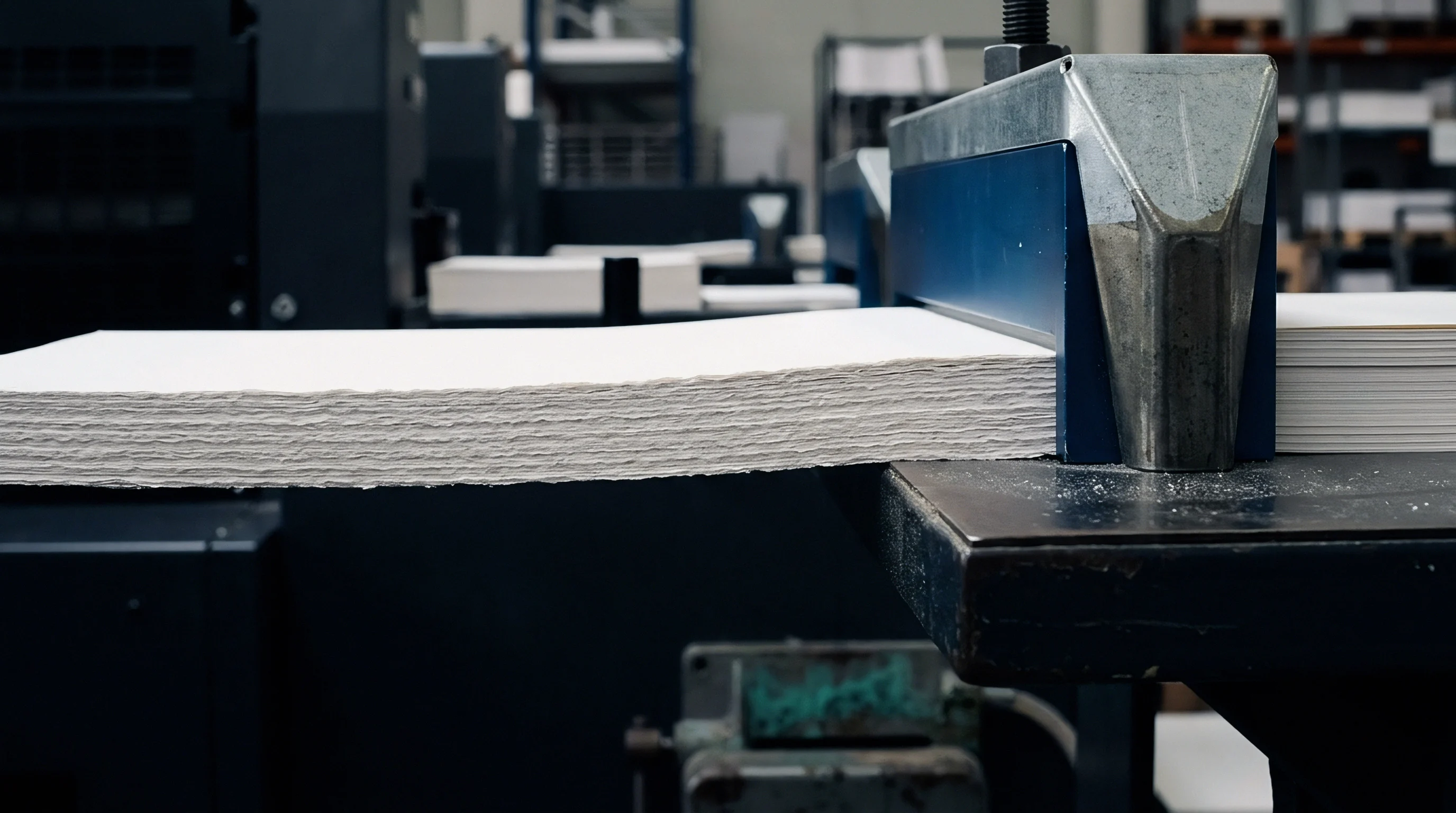

Profile
Cross direction grammage drift originates in the wet end hydraulics and drying section mechanics of the paper machine. Mass profiles shift. As stock leaves the headbox, slice lip adjustments and dilution control valves regulate the local fiber mass flux across the wire width.
Water removal across the vacuum boxes and wire section proceeds unevenly due to drainage resistance variations, creating subtle cross-machine variations in fiber network consolidation. As the damp web enters the dryer section, unrestrained edge shrinkage causes physical cross-direction contraction. This thermal shrinkage pulls material inward from the reel edges, yielding higher grammage per unit area near the deckle borders compared to the web center unless compensated by machine profiling software.

Web Hydrodynamics and Thermal Edge Shrinkage
Modern paper machines employ automated profile control systems, yet cross-direction mass profiles retain systematic non-uniformities. Edge trim allowance calculations often fail because the grammage profile is not flat. Thermal expansion of slice lip actuators, local variations in press felt conditioning, and steam pocket humidity gradients introduce cross-web basis weight wave patterns.
A nominal 250 g/m² folding boxboard web frequently exhibits a heavy center bulge or low-density edge valleys, where local basis weight deviates by 3 to 6 percent from the reel mean. When measuring cross-machine grammage variations in accordance with TAPPI T 410 or ISO 536 standards, testing samples extracted at 100-millimeter intervals across a 3.2-meter master reel reveals localized basis weight slopes that alter local sheet thickness and density.
Cross-direction basis weight profiles display inherent parabolic drift due to edge shrinkage during web drying.
Moisture content affects shrinkage. Cross-direction moisture variations compound basis weight anomalies because damp fiber regions contract differently during final drying. When a converter mounts a parent roll onto a rotary sheeter brake stand, localized grammage variations translate directly into differential web tension profiles across the slitting bed.
High-grammage bands carry higher tension than adjacent light bands, generating web baggy lanes. Web tension spikes suddenly. These localized tension disparities force the web to drift laterally across the cutter draw rollers, compromising cut accuracy and slitting alignment.
Reel Mechanics and Edge Profile Contraction
Master roll winding converts web density variations into internal spool stress concentrations. Soft roll edges occur where cross-machine basis weight falls below nominal spec, while hard bands form over high-grammage ridges. Rotary sheeter unwinds struggle to maintain uniform web draw across uneven reel profiles.
Low grammage creates weave. As the parent roll depletes, mechanical tension fluctuations induce cross-web registration slippage during slitting. Uncontrolled web skew across the knife cylinder degrades sheet squareness, causing edge trim width requirements to widen to compensate for geometry loss.
Mill technical representatives often attribute outer-lane basis weight spikes to thermal expansion across the headbox slice lip rather than uncalibrated actuator response.

Knife
Rotary sheeter efficiency relies upon clean shear mechanics between upper flying knives and lower stationary anvil blades. Slitter heads slip. When cross-direction basis weight fluctuates across the slitting station, shear forces shift unevenly along the blade axle.
Low-grammage edge strips lack the structural density required to resist blade impact without deflection, resulting in continuous dust generation, fibrous tear edge formation, and blade dulling. Conversely, high-grammage lanes exert elevated vertical reaction forces against the slitter shaft, causing shear blade separation and burred sheet edges.
Purchasing specifications adhering to ISO 536 require ten sample cuts across the full web width to establish contractual grammage compliance.
Slitter Force Distributions and Shear Quality
Blade engagement geometry requires constant contact pressure across the entire working deckle. Variations in fiber mass per unit area alter the knife penetration depth and kinetic friction coefficient during high-speed cutting. Rotary knives cut clean.
When converting paperboard at speeds reaching 300 meters per minute, localized grammage spikes induce blade chatter and micro-chipping along tungsten carbide cutting edges. The resulting dust accumulates on the sheet surfaces, causing downstream press friction dropouts and coating adhesion defects in packaging converting.
| Web Profile Zone | CD Mass Drift (g/m²) | Caliper Variance (µm) | Slitter Knife Wear Index | Cut Edge Flaw Profile |
|---|---|---|---|---|
| Front Edge Trim Lane | -8.2 to -4.1 | -12 to -6 | 1.42 | Fibre pullout and micro-tearing |
| Front Center Lane | -1.5 to +1.0 | -2 to +3 | 1.00 | Clean shear separation |
| Web Center Deckle | +2.0 to +5.4 | +4 to +9 | 1.18 | Mild edge burring |
| Back Center Lane | -0.8 to +1.8 | -1 to +2 | 1.02 | Clean shear separation |
| Back Edge Trim Lane | -7.9 to -3.8 | -11 to -5 | 1.39 | Slitter dust and edge fracture |
Converting Failure Modes under Profile Instability
The operational consequences of uncompensated cross-direction grammage drift manifest throughout the rotary sheeting process.
- Slitter Dust Generation occurs when low-mass edge zones collapse under shear impact rather than cutting cleanly, releasing loose fibers into the rotary sheeter collection hood.
- Sheet Skew Error develops as differential reel tension pulls the web unevenly across draw rollers, exceeding specified dimensional squareness tolerances of ISO 216.
- Pallet Stack Lean emerges when high-grammage lanes build cumulative caliper height on one side of the delivery jogger, causing stack destabilization during transportation.
- Knife Edge Chipping happens when dense basis weight surges overstress slitter shear overlaps, increasing blade maintenance frequency and shear bed downtime.
Calipers decrease near edges. Edge trim expands scrap. When sheet squareness drifts beyond acceptable threshold limits, operators widen side-trim cuts to remove damaged web margins, directly reducing net deckle yield and increasing repulping volume.
Standard paper mill sales conditions specify a target mass tolerance band of plus or minus five percent across the full reel deckle, shifting all financial exposure for edge trim scrap onto the converter.


Tolerance
Managing deckle yield under cross-direction grammage drift requires quantitative evaluation of reel profile logs against rotary sheeter setup parameters. Slice lips adjust hydrodynamics. When parent rolls enter the converting facility, individual web profile maps determine the optimal trim allowance and slit layout.
A mill rolling a 2,800-millimeter master web to cut four 650-millimeter packaging board streams leaves 200 millimeters of nominal total deckle margin for edge trim and slitter cuts. If the outer 100 millimeters of the web exhibit a 5 percent grammage drop, the physical properties of those outer lanes fall outside specified structural thresholds, rendering outer sheets unusable for rigid carton conversion.
Does off Gauge Edge Trim Affect Slitter Alignment?
Off-gauge edge trim forces slitter heads out of perpendicular alignment due to asymmetric web resistance. High web tension on high-grammage zones pulls slitter shafts laterally, inducing micro-steering of the continuous web. This dynamic displacement creates wavy cut edges across all interior lanes, compromising sheet dimensions across the deckle width.
Knife blades wear. When slitter alignment drifts by as little as 0.8 millimeters across a 2,000-millimeter web span, sheet squareness errors propagate through the delivery jogger, causing feeder stops during offset printing or die-cutting runs.
Conditioned paper stock at 23 degrees Celsius and 50 percent relative humidity exhibits a two percent cross-direction dimensional shift under web tension variations.
To quantify the financial and physical impact of cross-direction basis weight drift, consider a worked calculation for a 60-tonne sheeting run of 250 g/m² folding boxboard across a 2,800-millimeter rotary sheeter deckle. Yield drop drives loss. The nominal order requires 650-millimeter finished rolls converted into sheet stacks.
Under ideal uniform profile conditions, deckle utilization reaches 92.8 percent, leaving 200 millimeters total trim scrap split between front and back edges.
| Drift Band Index | CD Mass Variation Range | Effective Edge Trim Width (mm) | Net Deckle Utilization (%) | Tonnage Lost to Scrap (Tonnes) |
|---|---|---|---|---|
| Class A Profile | ±1.5% (±3.75 g/m²) | 100 | 92.8% | 4.32 |
| Class B Profile | ±3.5% (±8.75 g/m²) | 140 | 91.4% | 5.16 |
| Class C Profile | ±6.0% (±15.0 g/m²) | 210 | 88.9% | 6.66 |
| Class D Profile | ±8.5% (±21.25 g/m²) | 290 | 86.1% | 8.34 |
When cross-direction grammage drift widens the off-spec edge margin from 50 millimeters to 145 millimeters per side, usable deckle width shrinks from 2,600 millimeters to 2,410 millimeters. Target mass shifts. The converter must re-layout the slitting deckle, dropping from four 650-millimeter streams to three 650-millimeter streams plus an off-size 460-millimeter side roll, or widen edge trim scrap significantly.
Yield calculation under Class C profile conditions demonstrates a direct 3.9 percent drop in prime sheet tonnage, generating 2.34 additional tonnes of trim scrap per 60-tonne reel lot.
- Obtain cross-machine basis weight radiometric profile scans from the paper mill reel certificate documentation for each master batch.
- Measure cross-web thickness profiles at 50-millimeter increments using an ISO 534 dead-weight micrometer to verify physical caliper correlation with grammage.
- Map outer-lane low-mass boundaries to establish the minimum edge trim width required to remove sub-specification web stock.
- Calculate adjusted net deckle yield by dividing usable slit stream width by master roll width.
- Adjust rotary sheeter draw roller nip pressure profiles to balance tension differentials caused by center-to-edge basis weight gradients.
- Set knife overlapping depth based on local mass density to reduce shear edge dust generation during high-speed cutting.
Deckle utilization collapses fast. Core waste grows. A deckle layout designed without accounting for edge profile drop-off forces sheet trimmers to widen slitting bands beyond standard allowance.
Scrap
Financial losses from cross-direction grammage drift extend beyond initial raw material waste. Sheet trimmers trim excess. When off-gauge paperboard passes through rotary sheeters and enters the print room, structural variations create converting faults during offset or flexographic runs.
Sub-specification edge sheets exhibit reduced bending stiffness, causing feeding misalignments in packaging folder-gluers. These converting failures trigger customer claims, sorting costs, and rejected pallet returns that outweigh the original parent roll purchase savings.
Reel edges carrying low basis weight require higher slitter tension, increasing web weave across rotary shear blades.
Converting Headroom and Stack Stability
Stack height variations across delivered sheet pallets reveal underlying cross-direction basis weight drift. High-density web sections accumulate thickness across hundreds of stacked sheets, causing physical pile slope. A stack carrying a 3 percent left-to-right caliper bias develops a visible tilt across a 1,000-sheet pallet, complicating automatic feeder suction cup pickup on printing presses.
Press operators must slow line speeds or insert wedging strips to level feeder piles, driving up conversion operating costs.
| Paperboard Substrate Grade | Nominal Basis Weight (g/m²) | Base Tonne Price (USD) | Scrap Rate at ±2% Drift | Scrap Rate at ±7% Drift | Net Financial Penalty Per 100 Tonnes |
|---|---|---|---|---|---|
| Solid Bleached Board (SBB) | 220 | 1,450 | 3.2% | 7.8% | 6,670 USD |
| Folding Boxboard (FBB) | 280 | 1,180 | 3.5% | 8.4% | 5,782 USD |
| Coated Recycled Board (CRB) | 350 | 890 | 4.1% | 9.6% | 4,895 USD |
| Uncoated Kraft Back (UKB) | 300 | 1,050 | 3.8% | 8.9% | 5,355 USD |
Evaluation Criteria for Parent Roll Selection
Sourcing engineers evaluate parent roll quality using specific incoming qualification checks before mounting reels on the sheeting line.
- Cross Machine Profile Radiometric Logs must accompany mill test certificates to verify mass uniformity across full web deckle.
- Edge Caliper Drop Off Limits require maximum thickness loss along outer 150-millimeter margins not to exceed 2.5 percent of nominal sheet caliper.
- Moisture Gradient Thresholds specify maximum cross-web moisture variation below 1.2 percent to prevent post-sheeting web curl and edge wave.
- Roll Hardness Uniformity verified via Schmidt hammer or Parotester testing ensures balanced internal reel stress distribution without soft edges.
Accepting paper reels with uncorrected edge profile drift reduces finished sheet output while increasing repulping handling expenses at the rotary knife station.
Margin
Optimizing rotary sheeter deckle yield demands strict commercial and technical alignment between paper mills and converting operations. Modern high-speed paper machines utilize dynamic dilution headboxes and automated continuous scanning frames to narrow cross-direction basis weight bands. However, physical constraints in drying sections continue to create residual edge shrinkage and localized density shifts.
Converters who ignore these physical profiles risk high trim waste rates, cutter downtime, and unstable sheet delivery stacks.

Commercial Settlement and Specification Clauses
Procurement specifications that define grammage limits as simple reel averages leave buyers exposed to significant cross-machine variance. A reel meeting average mass specifications can still contain off-gauge lanes that render outer deckle cuts unusable for prime packaging. Sourcing contracts must include strict cross-direction profile uniformity clauses, specifying maximum peak-to-valley mass drift across the slittable web width.
Establishing clear technical parameters for cross-machine tolerance ensures fair commercial terms, protecting converters from bearing the cost of mill-side profile instabilities.
Whether real-time radiometric slice control systems will eventually allow paper mills to guarantee uniform cross-machine caliper out to the extreme deckle edges remains uncertain for high-speed board machines.