Fractionated Recycled Furnish Processing Strategy for High Compression Containerboard
Fractionated stock preparation isolates long fibers for low-intensity refining, raising compression strength and enabling containerboard grammage reduction.

Slurry
Old corrugated container stock entering a modern mill system carries a wide distribution of softwood kraft and hardwood semi-chemical pulp fibers. Processing this heterogeneous raw material for high compression containerboard requires separating long structural fibers from short filler elements before mechanical refining. Un-fractionated stock forces papermakers to refine the entire fiber mass simultaneously, which cuts short hardwood fibers into unusable flour while under-treating resistant long softwood tracheids.
Selective mechanical treatment through hydrodynamic separation isolates pulp fractions based on length, coarseness, and flexibility, allowing targeted energy application to the long fiber stream.
Pressure Screen Hydrodynamics and Aperture Selection
Separation of recycled pulp relies on velocity differentials created by rotor foils spinning against cylindrical baskets. Stock entering the screen at two to three percent consistency flows tangentially across the basket face. Slotted screen baskets featuring zero point one two to zero point one eight millimeter apertures isolate long fibers by forcing flexible elements through under high hydraulic shear while stiff, un-pulped coarse fragments remain in the reject stream.
Perforated baskets with hole diameters between zero point eight and one point two millimeters perform separation based primarily on fiber length rather than stiffness.
Basket contoured profiles generate micro-turbulences that prevent fiber mat deposition on the screen face. Foil rotation speeds ranging from twenty-two to twenty-eight meters per second maintain continuous pulsation across the aperture gap. Operating at volumetric reject rates of fifteen to twenty-five percent ensures stable stock flow through the screen without blinding.
High rotor speeds generate frictional heat and shear forces that degrade fragile short fibers if stock residence time within the screen chamber exceeds optimal thresholds.
Laboratory testing under ISO 5267 confirms that short-fiber fraction freeness drops by forty milliliters Canadian Standard Freeness when screen reject rates exceed thirty percent at twenty-three degrees Celsius.
Rotor geometry dictates fluid pulse frequency and amplitude across the basket profile. Step-rotor designs deliver sharp suction pulses that pull accumulated fiber mats off the slot entries without diluting the feed stock. Profile heights of zero point nine to one point two millimeters on the basket surface optimize shear friction, allowing long fibers to align parallel to fluid flow vectors.
Fibre length governs network density.

Mass Split Ratios and Pulp Freeness Parameters
Operating primary fractionators at a forty-sixty distribution sends the longer softwood tracheids to the accept port while short hardwood elements pass through the basket openings. Mass split ratios shift continuously in response to incoming stock quality, requiring automated control loops tied to optical fiber length analyzers. Increasing feed pressure differential across the basket forces longer fibers into the short-fiber stream, corrupting the chemical dosing calculations down the line.
Freeness values diverge dramatically between separated streams. The long-fiber fraction exiting the primary screen exhibits freeness values between five hundred fifty and six hundred twenty milliliters Canadian Standard Freeness, carrying the bulk of structural load-bearing capacity. The short-fiber fraction registers freeness values from two hundred eighty to three hundred fifty milliliters Canadian Standard Freeness, containing fine particles, filler clay, and degraded parenchyma cells.
Freeness drops rapidly. Managing these distinct drainage profiles requires independent stock chest monitoring.
Inconsistent reject management during primary fractionating destabilizes containerboard production lines, leading to predictable process disturbances across the wet end.
- Basket Blinding Flake Accumulation Un-pulped wet-strength paper flakes seal basket apertures, causing sudden spikes in differential pressure across the screen housing.
- Short Fiber Carryover Stream Contamination Excess volumetric throughput forces coarse softwood elements into the short-fiber stream, depleting the long-fiber chest of structural strength material.
- Rotor Foil Cavitation Wear Incorrect dilution water pressures induce localized vapor bubble collapse along foil trailing edges, pitting stainless steel surfaces and disrupting fluid pulsation balance.
- Mass Split Drift Fluctuation Variable feed consistency alters viscosity, causing mass split ratios to wander beyond five percent of target settings within short operating windows.
Correcting mass split imbalances requires adjusting primary screen dilution water valves in direct proportion to feed consistency changes. Maintaining feed consistency within a tight tolerance band of zero point two percent consistency stabilizes fluid dynamics within the screening zone. Slurry suspension stability in the primary feed tank prevents flocculation prior to headbox delivery.

Shear
Mechanical treatment applied to the long-fiber stream alters the cell wall architecture through fibrillation and internal delamination. Un-fractionated pulps subjected to aggressive disk refining experience severe fiber shortening, which degrades tear resistance and short-span compressive strength. Isolating the long-fiber fraction allows mills to apply targeted specific edge load parameters that flex and fibrillate heavy-walled softwood tracheids without generating fines.
Fibrillation increases available surface area for hydrogen bonding, directly raising the density and elastic modulus of the final containerboard sheet.

Disc Refiner Plate Patterns and Specific Edge Load
Low intensity mechanical action preserving fiber length while raising swelling capacity requires narrow bar widths below two millimeters. Specific edge load values maintained between zero point six and zero point nine Joules per meter develop internal fibrillation within softwood fibers while minimizing cutting action. Plate geometries featuring fine bar patterns with three millimeter groove widths provide adequate hydraulic passage for high consistency stock while maximizing bar-crossing impact frequency.
Refiner plates wear unevenly.
Disk refiner rotation speed controls specific surface load and bar crossing speed. Operating a double-disk refiner at tip speeds of twenty-four meters per second imparts sufficient mechanical energy to break intra-fiber hydrogen bonds inside the S2 cell wall layer. Specific energy application ranging from forty to eighty kilowatt-hours per tonne elevates the tensile index of the long-fiber fraction from thirty-five to fifty-eight Newton meters per gram.
| Specific Energy (kWh/t) | Specific Edge Load (J/m) | Freeness Drop (mL CSF) | Tensile Index (Nm/g) | SCT Index (kNm/g) |
|---|---|---|---|---|
| 20 | 0.5 | 35 | 42.1 | 24.5 |
| 40 | 0.7 | 75 | 49.8 | 28.2 |
| 60 | 0.9 | 120 | 55.4 | 31.6 |
| 80 | 1.2 | 180 | 57.0 | 30.8 |
| 100 | 1.5 | 240 | 53.2 | 28.1 |
| Data generated using a 26-inch double-disk refiner on 100% recycled softwood kraft fraction under ISO 5267 freeness and ISO 1924 tensile test conditions. | ||||
Exceeding an energy threshold of eighty kilowatt-hours per tonne causes excessive fiber shortenings, reducing short-span compression values despite increases in apparent sheet density. Specific edge loading above one point two Joules per meter cuts fibers cleanly across their longitudinal axis, diminishing the average fiber length from two point two millimeters down to one point four millimeters. Drainage resistance rises.
Refining energy applied to long fibers beyond eighty kilowatt-hours per tonne lowers short-span compressive strength by shortening cell walls.
Enzymatic treatment introduced prior to disk refining reduces electrical power demand while preserving fiber length. Cellulase and endo-glucanase enzymes added at dosages of one hundred fifty to three hundred grams per tonne of dry pulp hydrolyze amorphous cellulose regions along the fiber surface. This enzymatic action loosens the rigid outer S1 layer of the cell wall, allowing lower mechanical refining energy to achieve target fiber swelling and fibrillation.
Combining enzymatic pre-treatment with low-intensity mechanical shear lowers energy consumption by twenty-five percent while maintaining superior fiber length retention.
Adjusting refiner gap settings via electro-mechanical positioners compensates for plate pattern wear across campaign cycles. Real-time monitoring of refiner motor load and stock temperature differential provides indirect measurement of energy transfer efficiency to the pulp suspension. Equipment manufacturers frequently state that rapid plate wear stems from unremoved micro-sand rather than excessive specific edge loading.

Ply
Layered sheet architecture allows mills to place fractionated fiber fractions where structural demands are highest across the board caliper. Multi-ply containerboard machine configurations feature separate headboxes feeding distinct stock compositions onto moving forming fabrics. Placing refined long fibers in the outer plies maximizes bending stiffness and score-line crack resistance during box converting operations.
Depositing short fibers, fines, and mechanical filler elements into the center ply optimizes bulk and internal bond strength without compromising surface smoothness or print performance.
Wet End Dosing Sequences for High Density Sheets
Chemical additives introduced into the stock flow before the headbox form ionic networks that bind fine particles to the coarse structural fibers. Cationic starch carrying a degree of substitution between zero point two five and zero point three five serves as the primary dry strength agent. Adding cationic starch at dosages of eight to twelve kilograms per tonne increases internal bond strength measured by Scott Bond testing under ISO 16260.
Cationic demand shifts hourly.
Glyoxalated polyacrylamide resin provides permanent dry strength and initial wet strength development across recycled fiber networks. Dosing synthetic resins into high-density stock loops maximizes polymer adsorption onto fiber surfaces before dilution water lowers chemical concentration gradients. Microparticle retention systems comprising anionic silica or bentonite clay added after the final shear stage lock starch-fiber complexes into place, accelerating drainage on the wire.
Executing wet end chemical addition requires precise physical order to avoid charge neutralization and additive precipitation before web formation.
- Charge neutralization of the stock chest using polyaluminum chloride until the zeta potential reaches minus five millivolts.
- Addition of amphoteric or cationic corn starch at ten kilograms per tonne under moderate shear agitation to enable deep absorption into fibrillated fiber walls.
- Injection of glyoxalated polyacrylamide resin at three kilograms per tonne into the stock line downstream of the refiner discharge valve.
- Introduction of high molecular weight anionic polyacrylamide retention polymer immediately before the headbox fan pump intake port.
- Dosing of colloidal silica microparticles at one point five kilograms per tonne directly into the headbox pressure tube array to trigger micro-flocculation.
Stratified headboxes allow multi-ply forming within a single twin-wire unit by using rigid or flexible vanes to separate fiber fractions up to the nozzle exit. Flow velocities within individual headbox channels must match fabric speeds within two meters per minute to prevent inter-ply mixing at the slice jet contact zone. The top ply seals early.
Dewatering rates across individual plies determine inter-ply bonding strength during web consolidation in the couch roll nip. Excess moisture differences exceeding five percent between adjacent plies cause delamination under high compression loads during container box usage. Steam boxes positioned over vacuum dewatering elements raise sheet temperature to sixty degrees Celsius, lowering water viscosity and accelerating wet web compaction prior to the press section.
Under standard packaging procurement contracts, failure to maintain ply bond values above two hundred joules per square meter under ISO 16260 invalidates the mill specification warranty.
Crush
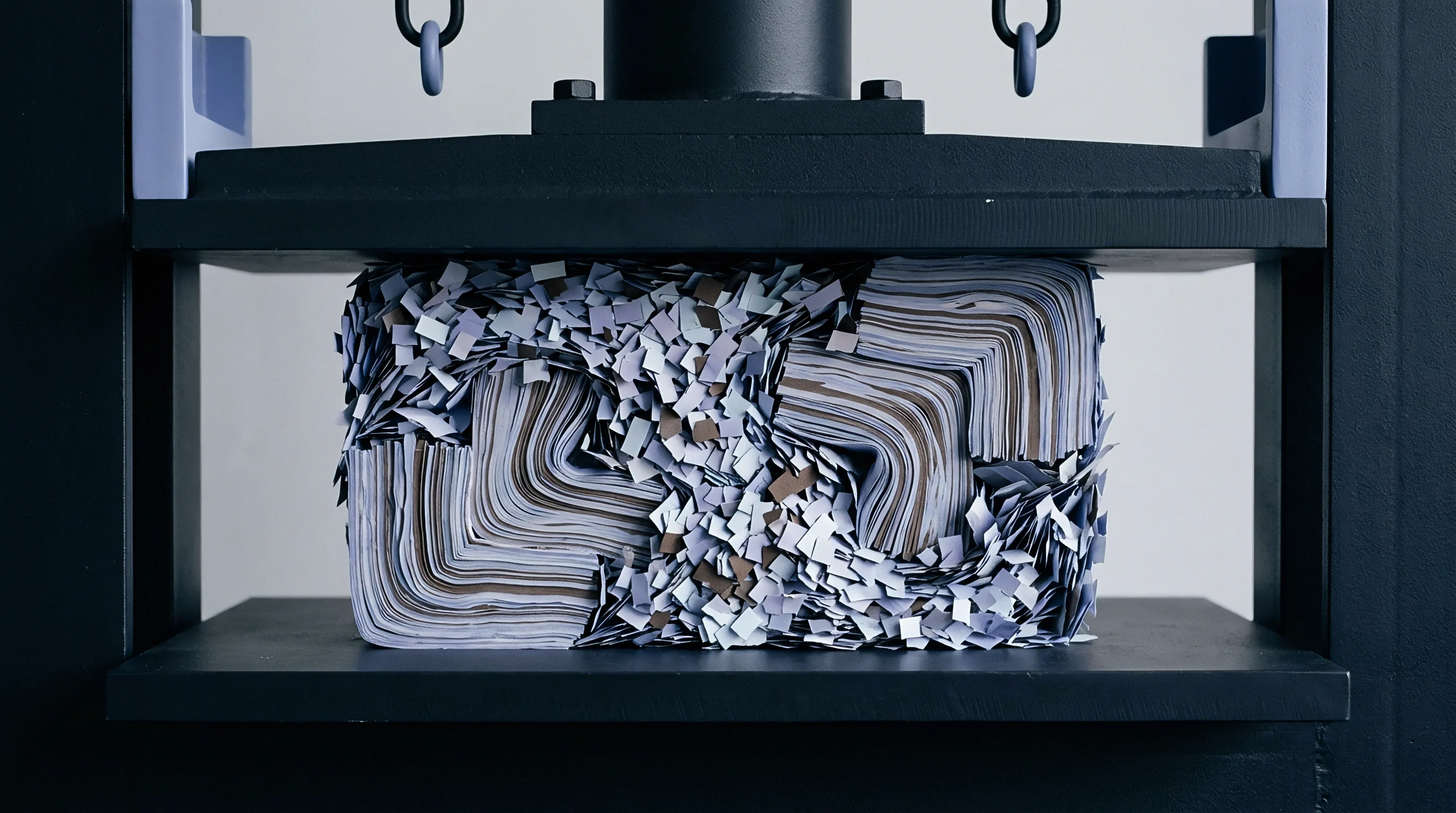
Compressive failure in containerboard under axial loading originates from localized micro-buckling of individual fiber walls. Un-fractionated recycled sheets collapse along continuous shear bands because short fibers and un-fibrillated bundles fail to transmit compressive stress uniformly across the sheet profile. Fractionated multi-ply structures distribute stress along continuous long-fiber networks in the outer plies, delaying the onset of elastic instability during box compression test sequences.
Mechanical strength values depend directly on fiber orientation distribution, sheet apparent density, and intra-fiber hydrogen bond density.
Why Does Short Span Strength Diverge from Ring Crush?
Evaluation of heavy containerboard under ISO 9895 isolates pure compressive resistance of the fiber matrix across a zero point seven millimeter gap. Ring crush testing under ISO 12192 measures a combination of intrinsic compressive strength and structural buckling resistance influenced by sample geometry and edge preparation quality. Short-span compression testing eliminates specimen buckling phenomena, yielding precise data regarding fiber-to-fiber bond integrity and cell wall compressive modulus.
Short-span compressive values correlate directly with finished box compression test performance under high stacking loads.
Sheet density achieved through pressing and calendering elevates short-span compressive index up to an optimal threshold of zero point eight five grams per cubic centimeter. Beyond this density limit, excessive fiber crushing damages individual cell walls, causing short-span strength values to decline despite further increases in sheet compactness. Compression resistance dominates box performance.
| Furnish Processing Strategy | Grammage (g/m²) | Density (g/cm³) | ISO 9895 SCT MD (kN/m) | ISO 12192 RCT MD (N) | Scott Bond (J/m²) |
|---|---|---|---|---|---|
| Un-fractionated Recycled OCC | 181.2 | 0.68 | 3.82 | 285 | 145 |
| Single-Ply Fractionated (Un-refined) | 180.5 | 0.71 | 4.15 | 310 | 160 |
| Multi-Ply Fractionated (Refined LFF) | 179.8 | 0.78 | 4.95 | 375 | 225 |
| Multi-Ply Fractionated + 1% GPAM | 180.2 | 0.82 | 5.48 | 420 | 265 |
| Tested under ISO 187 conditioning protocols at 23 °C and 50% relative humidity using standard machine direction testing orientation. | |||||
Moisture content skews test values. Recycled fibers absorb ambient moisture rapidly, weakening internal hydrogen bond networks within cellulose matrices. Elevating relative humidity from fifty percent to eighty-five percent drops short-span compressive strength by forty-two percent in standard containerboard grades.
Fractionated sheets carrying refined long fibers in the outer layers retain six to eight percent higher compressive resistance under elevated humidity due to enhanced cross-linked network density.
Qualifying heavyweight recycled containerboard for high-load packaging applications requires verifying physical properties against standardized performance parameters.
- Short Span Compressive Strength Compliance ISO 9895 index values must exceed twenty-eight Newton meters per gram in machine direction to guarantee box stacking safety factors.
- Internal Bond Delamination Resistance ISO 16260 Scott Bond readings above two hundred Joules per square meter prevent score-line cracking during high-speed box folding.
- Water Absorptiveness Sizing Limit ISO 535 Cobb sixty values maintained below thirty grams per square meter restrict moisture ingress into structural plies during cold chain transit.
- Cross Direction Tensile Strain Margin ISO 1924-3 failure stretch values exceeding two point five percent prevent web breaks acrosscorrugator double-facer heating plates.
Parent rolls require strict conditioning. Testing containerboard immediately after reel spool winding yields inaccurate strength data because internal hydrogen bonds require twenty-four hours to achieve thermodynamic equilibrium. Whether hyper-fractionation can maintain short span compression strength when recycled containerboard streams drop below forty percent virgin softwood content across European collection networks remains open.

Index
Commercial viability of fractionated pulping hinges on balancing capital equipment power consumption against savings in virgin fiber substitution. Processing recycled containerboard through fractionating screens increases electricity demand at the wet end while reducing total thermal energy required for sheet drying. Long-fiber refining consumes additional electrical energy, but targeted treatment lowers total system power draw compared to refining unfractionated pulp to equivalent strength targets.
Quantitative evaluation of net landed cost per thousand square meters provides the objective metric for stock preparation investment decisions.
Comparative Process Yield and Energy Balance
Calculating the cost per thousand square meters delivered requires quantifying screen reject rates, refiner power demand, and chemical additive consumption. Consider a comparative operational model for producing one hundred eighty grams per square meter high compression linerboard on a five meter trim machine running at eight hundred meters per minute.
Model Assumption A evaluates un-fractionated recycled OCC stock processing. Total electrical energy consumption for stock preparation and refining stands at one hundred twenty kilowatt-hours per tonne. Dry strength chemical additions require fifteen kilograms per tonne of cationic starch at zero point eight five Euros per kilogram, yielding a chemical cost of twelve Euros and seventy-five cents per tonne.
Achieving target machine direction short-span compression strength of four point five kilonewtons per meter requires running a target sheet grammage of one hundred eighty-eight grams per square meter to offset lower intrinsic fiber strength. At a raw material fiber cost of one hundred sixty Euros per tonne delivered, total fiber and strength chemical expenditure reaches forty-two Euros and eighty-six cents per thousand square meters.
Model Assumption B evaluates fractionated multi-ply processing with targeted long-fiber refining and chemical stratification. Fiber mass split isolates forty percent long-fiber fraction and sixty percent short-fiber fraction. Stock preparation power consumption rises to one hundred forty-five kilowatt-hours per tonne due to primary screen foil operation and targeted disc refining.
Cationic starch dosing drops to eight kilograms per tonne due to improved starch retention on fibrillated long fibers, while GPAM resin added at two point five kilograms per tonne costs two Euros and ten cents per kilogram. Total chemical expenditure equals twelve Euros and five cents per tonne. Energy tariffs dictate refiner speed.
Higher intrinsic sheet strength enables downgauging sheet grammage from one hundred eighty-eight down to one hundred seventy-eight grams per square meter while maintaining the target four point five kilonewtons per meter short-span compression threshold. Linear mass distribution alters stiffness. Fiber input savings achieved through grammage reduction lower raw material demand by ten kilograms per thousand square meters.
Accounting for an incremental screening reject yield loss of one point two percent, net fiber and chemical landed expenditure under Assumption B drops to thirty-eight Euros and forty-two cents per thousand square meters. Yield losses compound across passes.
Downgauging sheet weight through multi-ply fractionation reduces landed containerboard material costs by four Euros and forty-four cents per thousand square meters.
Long-term operational profitability depends on maintaining precise screen slot tolerances against abrasive wear caused by inorganic contaminants in recycled furnish. Abrasive micro-sand accelerates aperture enlargement, shifting mass split ratios and allowing un-refined fibers into the short-fiber chest. Replacing primary screen baskets every eight months adds an amortized capital cost of zero point thirty-two Euros per tonne of production.
Failing to replace worn screen baskets causes un-refined long fibers to enter the short-fiber chest, reducing web consolidation and lowering overall short-span compression values. Running un-fractionated recycled stock through a single-ply line forces mills to increase sheet grammage by twelve percent to achieve target box compression values, driving freight and fiber expenditure beyond profitable limits.