Quantifying Hydroplasticization and Viscoelastic Strain in Waterborne Barrier Coatings
Hydroplasticization depresses barrier coating glass transition, driving viscoelastic strain that degrades moisture resistance across creased paperboard packages.

Mechanics
Aqueous polymer dispersion coatings applied to paperboard substrates interact continuously with environmental water vapor. Water depresses the glass transition. When ambient relative humidity rises, polar functional groups within the polymer film absorb water molecules, expanding the internal free volume of the matrix.
This sorption alters the thermomechanical baseline of the coating, driving a transition from a rigid, glassy solid to a compliant, viscoelastic state at operating temperatures well below the dry glass transition temperature (Tg). In barrier packaging applications, this physical transformation governs whether a coated boxboard retains structural stiffness and moisture resistance or experiences premature barrier degradation.
Thermodynamics of Water Sorption in Polymer Films
Water absorption into synthetic dispersion layers proceeds through molecular diffusion into accessible free volume spaces and specific binding to hydrophilic polymer sites. In waterborne barrier formulations based on styrene-butadiene latex, carboxylated acrylic copolymers, or poly(vinyl alcohol) blends, functional groups such as carboxyls, hydroxyls, and esters act as primary sorption centers. Water sorption isotherms, measured gravimetrically under ISO 12571 conditioning, demonstrate non-linear moisture uptake patterns that follow Guggenheim-Anderson-de Boer (GAB) sorption models.
Free volume expands with moisture. As water molecules penetrate the intermolecular spaces between polymer chains, they disrupt existing interchain hydrogen bonds. The low molecular weight water molecules increase the mobility of the polymer segment chains by acting as a internal plasticizer.
The Gordon-Taylor equation models the resulting depression of the glass transition temperature based on the mass fractions and glass transition temperatures of the dry polymer and pure water:
T_g(w_w) = (w_p T_gp + K w_w T_gw) / (w_p + K w_w)
where w_p and w_w represent the mass fractions of the polymer and water, T_gp and T_gw represent their respective glass transition temperatures in Kelvin (taking 136 K for pure water), and K is an empirical fitting parameter related to polymer-solvent interaction density. For a carboxylated acrylic latex barrier coating with a dry Tg of 28 °C (301 K), exposure to an atmosphere of 85 percent relative humidity increases film moisture content to 4.2 percent by weight, depressing the operational Tg to minus 4 °C (269 K). This shift moves the coating from a brittle glass into its rubbery plateau under standard room-temperature converting conditions.
Conditioned at 23°C and 85 percent relative humidity under ISO 187, acrylic dispersion films exhibit a glass transition temperature drop from 28°C down to minus 4°C.
Substrate fibers also absorb water. Uncoated paperboard fibers swell upon exposure. This differential moisture uptake between the paperboard substrate (which experiences dimensional expansion along the cross-machine direction) and the synthetic coating layer creates localized interfacial shear stress.
As the paperboard substrate expands, the plasticized coating layer must deform elastically or viscoelastically to maintain continuous adhesion across the fiber surface.
Glass Transition Shifts under Ambient Humidity
The insertion of polar water molecules between polymer backbones disrupts intermolecular hydrogen bonding networks. This reduction in cohesive energy density allows micro-Brownian motion of polymer chain segments to initiate at significantly lower thermal energy thresholds. Paperboard absorbs ambient moisture rapidly.
Standard test atmospheres defined in ISO 187 (23 °C and 50 percent relative humidity) establish a baseline moisture content of approximately 6 to 7 percent within solid bleached sulfate (SBS) or folding boxboard (FBB) substrates. When packaged goods move into tropical storage environments (38 °C and 90 percent relative humidity per ASTM E96 standard conditions), substrate moisture content rises above 11 percent, saturating the adjacent polymer interface.
The extent of hydroplasticization depends on polymer crosslinking density and surfactant concentration. Residual emulsifiers left behind during latex film formation form hydrophilic micro-domains within the dried coating film. These domains draw liquid water and water vapor into the bulk polymer matrix via osmotic pressure gradients, accelerating free volume expansion.
Polymer chains slide under load. How far localized moisture accumulation at the cellulose interface accelerates long-term delamination under static load remains an open question in paper science.
Rheology
Time-dependent deformation under mechanical load governs the structural stability of aqueous barrier coatings. Viscoelastic materials exhibit simultaneous viscous fluid and elastic solid characteristics when subjected to stress fields. Dynamic Mechanical Thermal Analysis (DMTA), conducted across controlled relative humidity ranges in accordance with ASTM E2254 principles, quantifies the shift in dynamic moduli resulting from hydroplasticization.
As water enters the matrix, the storage modulus (E’), representing elastic energy storage, experiences a multi-decade decline, while the loss tangent (tan δ = E” / E’) shifts its peak position toward lower temperature regimes.
Dynamic Mechanical Response in High Humidity
Instrumental measurement using oscillatory thermal analysis tracks shifts in storage and loss moduli under controlled atmospheric conditions. Below the plasticized glass transition, the storage modulus of an unplasticized acrylic-styrene barrier layer ranges between 1.5 and 2.5 GPa. Upon exposure to 75 percent relative humidity, the storage modulus drops below 50 MPa at ambient converting temperatures (21 °C to 23 °C).
Modulus drops sharply above saturation.
This drop in mechanical stiffness directly impacts the creep compliance J(t), defined as the time-dependent strain ε(t) divided by the applied constant stress σ0:
J(t) = epsilon(t) / sigma_0 = J_e + t / eta_0 + sum
where J_e represents instantaneous elastic compliance, eta_0 is zero-shear viscosity, J_i are retardation compliances, and tau_i are discrete retardation times governing polymer segment reorientation. Hydroplasticization decreases the retardation times τi by several orders of magnitude, allowing fast irreversible viscous flow under applied external loads.
| Coating Formulation Base | Conditioning RH (%) | Conditioned T_g (°C) | Storage Modulus E’ (MPa) | Tensile Strain at Break (%) | WVTR (g/m²·day) |
|---|---|---|---|---|---|
| Styrene-Acrylic Dispersion | 50 | 24.5 | 1850 | 12.4 | 3.8 |
| Styrene-Acrylic Dispersion | 75 | 8.2 | 420 | 48.6 | 14.2 |
| Styrene-Acrylic Dispersion | 85 | -3.1 | 38 | 145.0 | 52.7 |
| PVOH / Wax Emulsion Blend | 50 | 38.0 | 2400 | 4.5 | 1.2 |
| PVOH / Wax Emulsion Blend | 75 | 14.1 | 610 | 22.1 | 8.9 |
| PVOH / Wax Emulsion Blend | 85 | -12.4 | 12 | 210.0 | 115.0 |
| Ethylene Acrylic Acid (EAA) | 50 | 18.0 | 1120 | 85.0 | 5.1 |
| Ethylene Acrylic Acid (EAA) | 85 | 2.5 | 185 | 265.0 | 18.4 |
| WVTR measured via gravimetric cup method ISO 2528 at 23°C using a 12 g/m² dry coat weight applied to 230 g/m² SBS board. | |||||
The time-temperature-humidity superposition principle (TTHS) allows prediction of long-term viscoelastic creep by shifting short-term compliance curves along the time axis using humidity shift factors (aRH). Moisture accelerates polymer chain relaxation, effectively accelerating the physical aging and deformation timeline of the packaging material stored under heavy stack loads.
Coating formulations operating within ten degrees of their conditioned glass transition temperature experience exponential increases in stress relaxation rates during folding.

Why Do Barrier Polymers Yield under Moisture Stress?
Saturated polymer chains exhibit enhanced segmental mobility under external stress fields. Storage humidity dictates film performance. When a waterborne barrier film undergoes rapid mechanical deformation, such as during high-speed web slitting or rotary die creasing, the plasticized polymer segments uncoil and slip past adjacent chains.
If the relaxation time of the polymer is significantly shorter than the timescale of the applied mechanical deformation, the strain energy dissipates through viscous flow rather than elastic storage.
This viscous dissipation alters the recovery dynamics of the packaging structure. In a creased carton blank, residual elastic stress is required to maintain scoreline squareness and fold precision. Hydroplasticized coatings exhibit excessive viscous flow during folding, leading to permanent scoreline relaxation, coating thinning over the radius of the crease, and subsequent loss of gas and vapor barrier integrity.
Polymer matrices with high carboxyl content absorb ambient water faster than non-ionic formulations, making them prone to unrecoverable strain under prolonged pallet stacking.
Cracks
Physical breakdown of protective barrier films occurs during converting processes like scoring, folding, and slitting. Stiff films fracture at scores. Creasing a paperboard substrate forces the outer surface layer into high tensile elongation while the inner surface undergoes compressive deformation.
If the hydroplasticized coating lacks sufficient elongation at break or if it has entered an excessively soft viscoelastic regime where tensile strength is compromised, structural failure develops along the fold axis.

Crease Strain Dynamics on Converting Lines
High-speed carton blanking exposes protective surface layers to severe localized elongation forces. Line speeds ranging from 250 to 500 meters per minute apply deformation strains across a crease channel in milliseconds. Under these high strain rates, the effective glass transition of the coating shifts upward due to time-strain rate equivalence.
A film that behaves in a ductile, viscoelastic manner under slow laboratory testing may undergo brittle fracture under industrial converting speeds if the local deformation rate exceeds the polymer relaxation rate.
Evaluating coating failure requires differentiating between macro-cracking, micro-fissuring, and interfacial delamination. Micro-fissures, often invisible to the unassisted eye, measure between 0.5 and 5.0 micrometers in width. Pinholes destroy moisture barrier integrity.
These small disruptions create direct capillary pathways for liquid water and water vapor, causing catastrophic increases in Cobb absorption values (ISO 535) and Water Vapor Transmission Rates (ISO 2528 / ASTM F1249).
Mechanisms driving barrier coating failure during converting operations include several distinct deformation patterns:
- Interfacial Shearing occurs when the substrate surface fibers separate internally under bending stress, transferring shear forces directly into the polymer coating interface.
- Micro-Fissure Propagation develops along pinhole flaws or local coat-weight variations where localized tensile stress concentrations exceed the ultimate tensile strength of the plasticized film.
- Matrix Blocking happens when hydroplasticized, low-Tg coatings on stored rolls adhere to the adjacent uncoated paperboard backside under high roll winding tension.
- Fiber Swell Mismatch emerges during cyclic environmental exposure, as the expanding cellulose backing tears the less extensible polymer membrane.
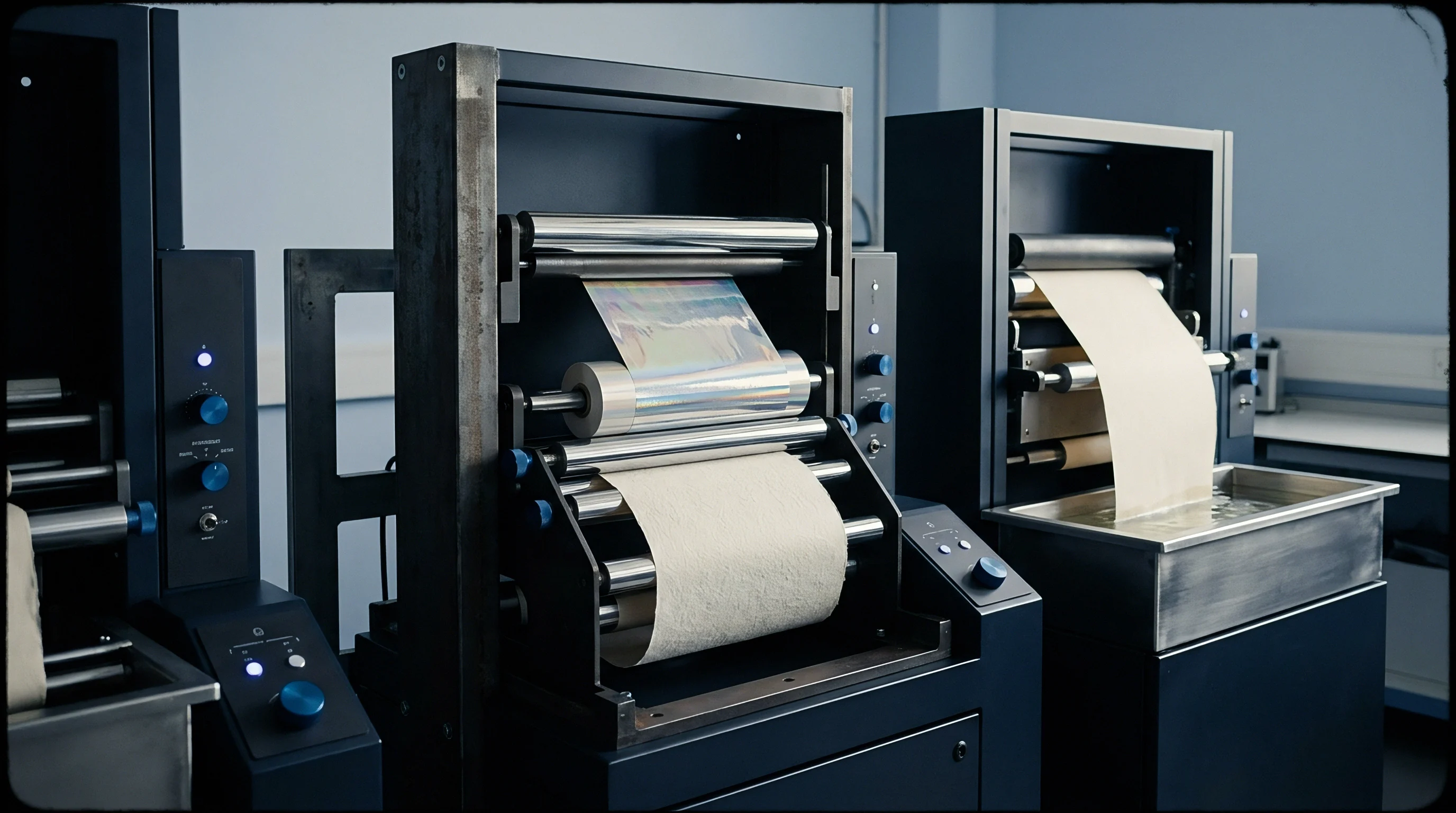
Substrate Delamination and Pinhole Generation
Fibre bond failure at the paperboard surface leads to coating layer detachment under mechanical bending. Crease recovery demands elastic behavior. When a coated FBB substrate is folded 180 degrees, the tensile strain (ε) imposed on the outer coating layer can be calculated based on board thickness (t), crease rule width (w), and female die channel depth (d):
epsilon = (t / (2 R_{fold})) 100
where Rfold is the internal bend radius governed by the die geometry. For a 350 micrometer (0.35 mm) FBB sheet folded with a bend radius of 0.5 mm, outer layer tensile strain reaches 35 percent. If hydroplasticization depresses the film’s tensile strength below the peak stress required to sustain 35 percent strain, the film yields non-uniformly, necking down and forming micro-voids.
| Substrate Base & Grammage | Dry Coat Weight (g/m²) | Crease Condition (ISO 5628) | Flat WVTR 38°C/90% RH (g/m²·day) | Creased WVTR 38°C/90% RH (g/m²·day) | Primary Failure Mode Observed |
|---|---|---|---|---|---|
| Folding Boxboard 250 g/m² | 8.0 | Standard Rule / Groove | 12.5 | 145.0 | Brittle film cracking along score line |
| Folding Boxboard 250 g/m² | 14.0 | Standard Rule / Groove | 4.2 | 28.4 | Micro-fissuring and localized necking |
| Solid Bleached Board 230 g/m² | 8.0 | Standard Rule / Groove | 10.1 | 88.0 | Substrate fiber splitting and film tear |
| Solid Bleached Board 230 g/m² | 14.0 | Standard Rule / Groove | 3.1 | 8.5 | Elastic deformation without pinholing |
| Unbleached Kraftboard 280 g/m² | 12.0 | Modified Large Radius Rule | 5.5 | 11.2 | Minor interfacial delamination |
Increasing total dry coat weight from 8.0 g/m² to 14.0 g/m² improves baseline barrier continuity, but thick coatings experience higher absolute bending stresses on the outer radius of a fold. A double-coat application (e.g. a 4.0 g/m² soft, highly flexible primer layer covered by an 8.0 g/m² rigid high-barrier topcoat) accommodates substrate roughness while dampening peak tensile strains. Miscalculating film elongation limits at the creasing matrix leads to total barrier failure and immediate batch rejection at customer receiving.
Compliance with ISO 2528 water vapor permeability testing mandates pre-conditioning under ISO 187 atmospheres to prevent artificial baseline shifts during gravimetric cell weighing.
Hysteresis
Non-reversible structural alterations occur within waterborne barrier layers subjected to cyclic humidity shifts. Retained water drives coating creep. When packaging materials encounter fluctuating ambient conditions during ocean transport or unconditioned warehouse storage, the coating continuously absorbs and desorbs moisture.
The physical path followed during moisture sorption differs from the desorption pathway, generating thermodynamic moisture hysteresis that alters internal stress distributions over time.

Sorption Isotherms and Structural Memory
Equilibrium moisture content curves display distinct path divergence between wetting and drying cycles. At any given relative humidity, a polymer film drying down from a saturated state retains a higher moisture content than a dry film absorbing water up to that same humidity level. Plasticized layers yield under stack pressure.
This retained water keeps the glass transition depressed for extended periods after ambient humidity drops, maintaining elevated viscoelastic creep rates long after ambient dry conditions resume.
Plastic deformation accumulates over multiple humidity cycles. Each cycle of moisture-induced swelling followed by desiccation alters the micro-morphology of latex particle interfaces within the film. latex particles that incomplete coalesced during initial thermal drying undergo secondary consolidation when plasticized by environmental water. Plasticizer migration, surfactant phase separation, and micro-void coalescence alter the barrier structure, permanently impairing performance.
Managing viscoelastic strain accumulation during conversion and storage involves systemic quality control steps across the processing sequence:
- Conditioning Verification requires stabilizing raw reel stock under ISO 187 standard atmosphere (23 °C, 50% RH) for 24 hours prior to converting.
- Modulus Screening measures storage modulus (E’) across the expected relative humidity operating window using dynamic mechanical analysis.
- Crease Radius Matching adjusts die male rule width and female channel dimensions to match the plasticized elongation limits of the coating.
- Pallet Stack Calibration establishes maximum safe stacking heights based on time-dependent creep compliance data under high relative humidity.
A systematic methodology for evaluating converting parameters involves precise physical validation under factory conditions:
- Measure baseline grammage of uncoated substrate according to ISO 536.
- Determine gravimetric dry coat weight on post-drying production samples using ISO 287 oven-drying methods.
- Subject creased specimens to ISO 2528 gravimetric dish testing under 38°C and 90 percent relative humidity conditions.
- Calculate total cost per thousand units incorporating converting scrap rates generated during high-humidity folding runs.
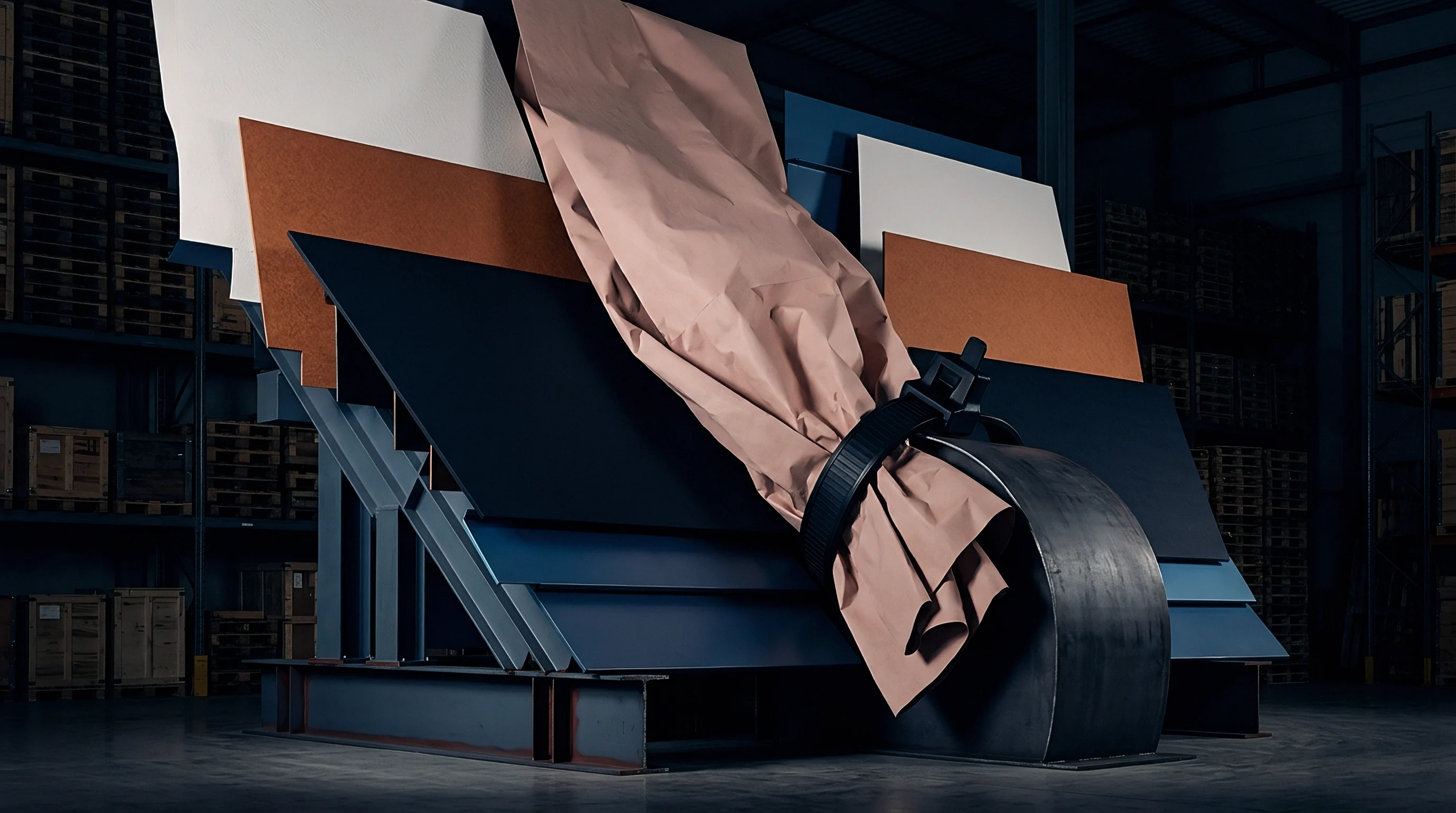
Irreversible Strain in Staked Pallet Storage
Extended static loading on stacked packaging pallets generates permanent physical deformation in plasticized coating layers. Wet stock clings to rollers. In a warehouse setting, bottom-tier pallets endure compressive loads exceeding 500 kPa.
If ambient relative humidity reaches 85 percent, the combined compressive stress and hydroplasticization cause the barrier layer to flow viscoelastically into the porous surface structure of the adjacent board in the stack.
Cyclic changes in ambient relative humidity cause irreversible strain accumulation in paperboard barrier layers through localized polymer reorientation.
This localized creep causes two primary failure modes: blocking (where adjacent sheets cold-weld together, tearing the fiber matrix upon unstacking) and barrier thinning (where the polymer film is squeezed out from high-pressure contact points over raised fiber nodes). Coating suppliers frequently attribute elevated moisture transmission in converted stock to excessive web tension rather than baseline polymer plasticization.

Valuation
Commercial specification of waterborne dispersion coatings balances barrier performance against substrate throughput and total landed expenditure. High coat weights increase costs. Replacing traditional extruded polyethylene (PE) or wax coatings with aqueous dispersion formulations introduces complex economics linked to dry coat weight optimization, converting speed constraints, and end-of-life recycling fee structures under extended producer responsibility (EPR) regulations.
Coat Weight Arithmetic and Barrier Yield
Dry film deposition levels determine both moisture vapor protection capacity and total raw material outlay per batch. Waterborne barrier dispersions are sold on a wet mass basis at solids contents ranging from 45 to 60 percent. Achieving a continuous, pinhole-free barrier on raw folding boxboard requires a minimum dry coat weight of 10 to 14 g/m², whereas smoother solid bleached boards require 6 to 10 g/m².
Calculating the true material cost per thousand packaging units requires accounting for dry solids content, wet application rates, substrate absorption during coating, and scrap rates driven by humidity-induced converting defects. Take a converting operation running a 250 g/m² FBB substrate at a web width of 1.2 meters. Standard extrusion coating applies 18 g/m² of low-density polyethylene (LDPE), whereas a waterborne acrylic dispersion requires 12 g/m² dry coat weight to achieve equivalent target WVTR under standard tropical test conditions.
| Barrier Technology | Applied Dry Weight (g/m²) | Wet Dispersion Cost (€/kg) | Dry Polymer Cost (€/kg) | Material Cost (€/1000 m²) | Converting Scrap Rate (%) |
|---|---|---|---|---|---|
| Extruded LDPE Film | 18.0 | N/A | 1.65 | 29.70 | 2.1 |
| Waterborne Styrene-Acrylic (50% Solids) | 12.0 | 2.80 | 5.60 | 67.20 | 4.5 |
| Waterborne PVOH / Wax Blend (45% Solids) | 8.0 | 3.40 | 7.55 | 60.40 | 6.2 |
| Double-Coat EAA / Acrylic System | 10.0 | 3.10 | 6.20 | 62.00 | 3.0 |
While raw polymer material costs for waterborne dispersions exceed bulk commodity LDPE resins by a factor of three to four, downstream commercial balances are modified by circular economy fee structures. Under European packaging waste directives (such as EN 13430 standards for material recycling), mono-material paper packaging containing less than 5 percent non-paper content by weight qualifies for significantly lower packaging tax levies than traditional plastic-laminated boards.
Converting Headroom and Total Landed Cost
Production line tolerance margins depend heavily on the mechanical stability of the barrier formulation under moisture stress. If a waterborne coating possesses narrow viscoelastic headroom, minor ambient humidity spikes force press operators to reduce converting speeds to prevent scoreline cracking or roller blocking. Operating a folding-gluing line at 250 cartons per minute instead of its rated 400 cartons per minute increases operational conversion cost per unit by 60 percent, negating small savings achieved by downgauging coat weight.
Process yield loss during high-humidity converting runs represents a major cost driver. Line stoppages caused by matrix blocking on unwinding reels generate immediate web scrap and require labor-intensive washdowns. Selecting a higher-Tg polymer formulation modified with hydrophobic wax nano-emulsions increases raw dispersion cost per tonne, but expands the operational humidity window, protecting overall converting throughput.
Inserting EN 13430 recyclability compliance criteria into procurement contracts forces mills to balance barrier coat weight against repulping yield limits.