Supply Chain Verification Audits for Unannounced Substrate Substitutions in Multi-Tier Export Networks
Unannounced substrate substitution alters box compression strength and tariff classification; laboratory fiber audits and batch thickness checks prevent failure.


Furnish
Paper stock specifications set target limits for mechanical and chemical pulps. Substrate substitutions across multi-tier supplier networks frequently involve replacing pure virgin bleached softwood kraft with cheaper mechanical or recycled pulps. A packaging converter might contractually specify Solid Bleached Sulfate board but deliver Folding Boxboard containing an unbleached Chemical Thermo-Mechanical Pulp middle layer.
This swap retains basic sheet caliper while dropping unit raw material costs for the mill. Downstream, converted cartons buckle under compressive loads in maritime shipping containers.
Microscopic Fiber Profiling and Mineral Identification
Differential staining under optical microscopy exposes structural blends in commercial paperboards. According to ISO 9184-4, treating fiber preparations with Graff C stain differentiates bleached hardwood chemical pulps from unbleached mechanical pulps based on color reaction. Bleached kraft fibers develop a blue-violet hue, whereas lignin-rich mechanical fibers turn yellow.
Quantitative fiber analysis under TAPPI T401 quantifies the weight factor of each species. A delivered board batch claiming one hundred percent bleached sulfate pulp reveals its true composition when yellow mechanical fiber clumps exceed three percent of total count.
Fiber morphology and chemical composition differ significantly across pulping grades.
Inorganic filler substitution alters both print characteristics and physical strength. Mills add calcium carbonate or kaolin clay to increase sheet opacity and surface smoothness at low cost. TAPPI T413 testing at 525 °C measures total inorganic content.
A virgin packaging board specification capped at five percent ash content exhibits compromised internal bond strength when laboratory testing reveals twelve percent calcium carbonate loading. Higher filler content reduces fiber-to-fiber hydrogen bonding, costing the sheet its Z-direction tensile strength under converting tension.
Solid bleached sulfate board conditioned at 23 °C and 50 percent relative humidity loses nine percent of its Z-direction tensile strength for every three percent increase in groundwood fiber content.
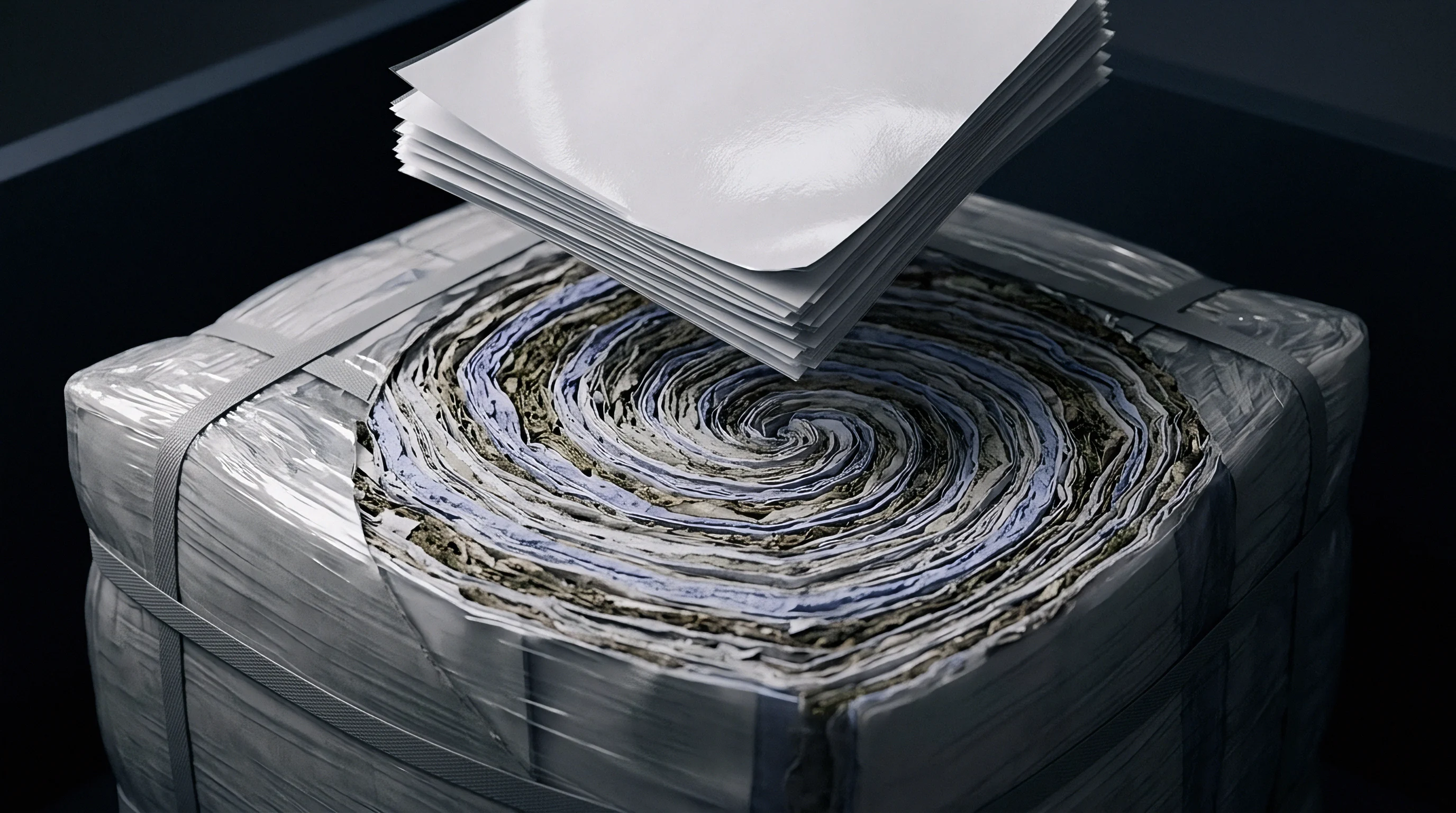
Chemical Ash Testing and Spectroscopy Signals
Combustion of paper samples at 525 °C isolates non-combustible inorganic fillers without decomposing calcium carbonate into calcium oxide. Ash testing at 900 °C under ISO 1762 converts carbonates to oxides, allowing precise stoichiometric calculation of mineral loads. Attenuated Total Reflectance Fourier Transform Infrared spectroscopy complements thermal combustion by identifying specific chemical binders and surface coatings.
Groundwood pulps display strong infrared absorption bands near 1510 reciprocal centimeters, signaling aromatic ring vibrations in residual lignin.
Thermal and spectroscopic analyses isolate unannounced furnish substitutions.
Spectral signatures provide immediate evidence of unannounced substrate modifications. Pure chemical pulps show flat baseline response in the lignin-sensitive infrared bands. When an export supplier blends de-inked pulp into a premium top-liner, synthetic latex binders and residual ink carrier resins produce unexpected absorption spikes at 1730 reciprocal centimeters.
These chemical markers confirm the presence of recycled stock regardless of surface bleaching treatments applied by the mill. Unresolved discrepancies in fiber origin leave brand owners vulnerable to unexpected batch strength failures during seasonal humidity transitions.


Crate
Export shipping environments expose paperboard containers to severe cyclic humidity. Outer shipping cartons relying on recycled fluting mediums lose structural integrity much faster than virgin kraftliner containers when relative humidity crosses seventy-five percent. Multi-tier supply chains often substitute semi-chemical fluting with waste-paper recycled medium to trim freight packaging costs.
The resulting box compression failure surfaces during ocean transit rather than at the converting plant gate.
Box Compression Loss in High Humidity Export Routes
Standardized box testing at tropical equilibrium reveals rapid structural decay. ISO 12048 establishes container compression testing parameters under static loads. Corrugated boxes constructed from genuine virgin kraftliner and semi-chemical medium hold fifty percent of their dry compressive strength at eighty-five percent relative humidity.
Substituting recycled linerboard drops that retention value below thirty-two percent under identical conditioning. Moisture absorption swells fiber networks, breaking inter-fiber bonds and causing sidewall bulging in stacked export pallets.
Elevated humidity degrades stacking rigidity across corrugated structures.
Containerized freight routes experience temperature swings that create internal condensation cycles. Paperboard containers absorb liquid water rapidly when surface Cobb values exceed specified limits. ISO 535 Cobb testing measures water mass absorption per square meter over a sixty-second exposure window.
A virgin kraftliner treated with internal rosin size maintains a sixty-second Cobb value below twenty-eight grams per square meter. Recycled liners with inadequate surface sizing register Cobb values above forty-five grams per square meter, leading to catastrophic pallet collapse inside tropical shipping containers.
| Substrate Fluting Combination | ECT Dry (TAPPI T811) | ECT Wet (27 °C / 80% RH) | Retained BCT Strength |
|---|---|---|---|
| Virgin Kraftliner / Semi-Chemical Medium | 8.5 kN/m | 6.2 kN/m | 72.9% |
| Virgin Kraftliner / Recycled Medium | 7.2 kN/m | 4.1 kN/m | 56.9% |
| Testliner / Recycled Medium | 5.8 kN/m | 2.8 kN/m | 48.2% |
| Recycled Testliner / Waste Fluting | 4.9 kN/m | 1.9 kN/m | 38.7% |

Corrugated Fluting Substitution under Static Top Load
Tier-two packaging plants frequently substitute semi-chemical fluting with lower-tier recycled medium. Edge Crush Test performance measured under TAPPI T811 drops immediately upon substitution. Semi-chemical hardwood pulp retains rigid tube geometry under severe compression due to high native lignin stiffness.
Recycled medium fibers, shortened by multiple repulping loops, lack bending stiffness. The flute walls buckle under static top-loads, reducing total pallet stacking height limits by up to forty percent.
Corrugated containers specified under ISO 12048 fail top-load compression requirements when relative humidity exceeds eighty percent if semi-chemical fluting is swapped for recycled medium.
Converters often defend fiber downgrades on the grounds that target basis weights held across the batch, equating nominal mass with structural protection across transport routes.


Gauge
Mechanical thickness measurements reveal structural discrepancies that standard weight checks miss. Grammage alone fails to detect substrate swaps because mills adjust mechanical pulp content or filler loading to match target sheet mass per unit area. ISO 534 defines caliper determination under a static pressure of fifty kilopascals.
A solid bleached board and a folding boxboard may share an identical basis weight of three hundred grams per square meter, yet their structural performance diverges under high-speed converting.

Caliper Drift and Bending Stiffness Deficits
High-speed packaging equipment relies on uniform board rigidity during creasing. Bending stiffness scales with the third power of sheet thickness according to fundamental plate mechanics. ISO 2493 Taber stiffness testing demonstrates that a five percent drop in caliper produces a fourteen percent loss in bending resistance.
When a mill subtlely downgauges a sheet while maintaining basis weight through heavy mineral loading, the carton folding lines buckle incorrectly during high-speed cartoning assembly.
Caliper loss directly undermines carton rigidity and stack performance.
Density variations alter crease formation mechanics. Dense, filler-heavy boards lack the internal shear elasticity required for clean score folds. High-speed packaging lines apply creasing dies at fixed depth settings.
If the delivered substrate exhibits uneven caliper drift across the web width, shallow creasing causes liner tearing while deep creasing fractures the back ply. The converting plant experiences frequent machine jams, dropping line efficiency below acceptable operational thresholds.
| Grade Specification | Basis Weight (ISO 536) | Caliper (ISO 534) | Taber Stiffness 15° (ISO 2493) | Score Cracking Limit |
|---|---|---|---|---|
| Solid Bleached Sulfate (SBS) | 300 g/m² | 380 µm | 18.5 mN·m | Zero Failure at 180° |
| Folding Boxboard (FBB Virgin CTMP) | 300 g/m² | 460 µm | 24.2 mN·m | Zero Failure at 180° |
| FBB (Substituted Waste CTMP) | 300 g/m² | 415 µm | 17.1 mN·m | 12% Failure at 180° |
| Coated Recycled Board (CRB) | 300 g/m² | 370 µm | 11.8 mN·m | 28% Failure at 180° |
Converting Failure Modes from Caliper Variance
Substrate density drops create severe operational bottlenecks on automated carton lines. Lower density materials compress excessively inside feed rollers, causing misfeeds and printing misregistration. The following operational failure modes indicate unannounced substrate changes at goods-in receiving checks.
- Score line fracturing occurs when short-fiber recycled pulps replace long virgin softwood fibers in the back ply of folding cartons.
- Delamination under gluing happens when low internal bond strength, measured via TAPPI T569 Scott Bond testing, allows adhesive to pull surface fibers away during transit.
- Blistering during extrusion coating develops when unannounced moisture retention inside substituted mechanical pulps vaporizes during polyethylene application.
- Dusting at die-cutting units escalates when high calcium carbonate filler levels loosen during mechanical shearing operations.
As an operational baseline, a bulk shift greater than seven percent at constant basis weight indicates an unannounced change in furnish proportions.


Proof
Discrepancies between mill test reports and delivered physical stock demand rigorous material tracking. A mill test certificate represents a single reel sample pulled under ideal machine conditions. Export shipments contain hundreds of jumbo rolls or sheet pallets produced across multiple production shifts.
Verifying material compliance across a multi-tier export network requires disciplined receiving protocols and independent laboratory verification.

Which Analytical Bench Tests Confirm Fiber Origin Inconsistencies?
Laboratory verification combines physical tear resistance tests with optical brightness measurements. TAPPI T414 Elmendorf tear testing isolates fiber length variations between virgin and recycled stock. Long softwood chemical fibers deliver tear index values above eight millinewtons square meters per gram.
Recycled pulp blends drop tear index values below five point five millinewtons square meters per gram due to repeated mechanical refining damage. Physical tear metrics expose recycled content far faster than visual surface inspection.
Shorter fiber networks systematically reduce tear resistance across the sheet.
Optical brightness measurements under ISO 2470 reveal chemical bleaching alterations. Substituted recycled sheets rely heavily on Optical Brightening Agents to match virgin white top-liner aesthetics. UV-filtered spectrophotometry differentiates native pulp brightness from artificial fluorescent whitening.
When an export batch displays high UV-excited luminescence alongside reduced tear strength, the material furnish contains secondary recovered fibers rather than specified virgin chemical pulp.
Failure to verify ISO 2859-1 sampling protocols on incoming paperboard pallets allows unauthorized grade substitutions to bypass dockside receiving controls.

Chain of Custody Auditing and Batch Sampling Methods
Receiving docks pull representative sheet samples across delivered pallets according to statistical standards. Testing every single package remains commercially impossible. The plain numbered sampling procedure below establishes clear forensic proof for claims against multi-tier packaging vendors.
- Isolate incoming shipment pallets by mill batch lot numbers recorded on outer transport labels.
- Extract ten full sheets per pallet from five randomly selected pallets per fifty-tonne lot according to ISO 186 guidelines.
- Condition extracted sheet samples for twenty-four hours at twenty-three degrees Celsius and fifty percent relative humidity per ISO 187.
- Measure grammage across ten points per sheet using a calibrated electronic balance under ISO 536.
- Perform mechanical caliper testing under ISO 534 using an instrument applying fifty kilopascals static pressure.
- Execute chemical ash content combustion at five hundred twenty-five degrees Celsius under TAPPI T413 to quantify filler load.
- Document all analytical variances against signed technical purchase specifications before signing final goods release notes.
Standard procurement contracts explicitly state that any lot failing three independent physical parameters under ISO 187 conditioning empowers the buyer to reject the entire shipment at the vendor’s expense.


Tariff
Cross-border packaging imports face stringent classification rules under global customs frameworks. Substrate swaps alter the material composition of exported finished packaging, triggering customs code reclassification upon import clearance. A packaging shipment declared under Harmonized System Code 4810 for coated virgin paperboard faces seizure or severe penalty duties when customs laboratory audits detect unannounced recycled fiber content or unauthorized plastic laminations.
Customs Reclassification Risk from Recycled Stock Shifts
Declared harmonized tariff codes depend on exact fiber origins and coating chemical percentages. Code 4810 covers paper and paperboard coated with kaolin or inorganic substances, provided at least ninety-five percent of total fiber content consists of chemical pulps. Substituting mechanical pulp or de-inked recycled fiber pushes the material into code 4811 or 4805.
These headings carry vastly different tariff rates and import quota restrictions across North American and European trade borders.
Misdeclared material compositions trigger rejection during customs clearance.
Extended Producer Responsibility regulations impose escalating plastic and packaging taxes based on verified material circularity. Under the European Union Packaging and Packaging Waste Regulation, exported packaging constructed from mixed unannounced materials forfeits reduced eco-contribution rates. Unannounced plastic lining additions or unverified fluorinated chemical treatments alter the packaging recyclability grading, subjecting brand owners to substantial regulatory fines.

Contractual Traceability Clauses and Quality Guarantees
Procurement teams insert mandatory material audit provisions within multi-tier vendor contracts. These legal safeguards ensure full supply chain transparency from pulp mill to converted carton. Key contract clauses must cover explicit material specifications and verification rights.
- Furnish composition guarantees state exact allowable percentages for virgin chemical pulp, mechanical pulp, and recycled post-consumer waste content.
- Unannounced substitution prohibitions forbid converting plants from altering substrate specifications without written approval ninety days prior to production.
- Audit access rights grant third-party inspection teams immediate physical access to sub-tier paper mills and converting facilities during active order runs.
- Financial indemnity provisions hold tier-one suppliers fully liable for customs penalties, freight demurrage, and line-downtime costs resulting from unannounced substrate changes.
A detailed supplier decision protocol evaluates proposed substrate modifications before authorization.
- Technical equivalency validation requires full ISO bench testing of proposed replacement stocks prior to trial batch approval.
- Customs classification review verifies that proposed furnish shifts maintain identical Harmonized System tariff code declarations.
- Environmental fee re-calculation checks if modified paperboard grades alter Extended Producer Responsibility tax obligations in export destination markets.
- Converter equipment trial runs verify that alternative substrates run at full rated press speed without score cracking or adhesive failure.
Ignoring customs composition thresholds results in total cargo confiscation at port import terminals, accompanied by non-negotiable regulatory compliance fines.


Yield
Purchasing paper stock by the metric tonne requires careful calculation of sheet output. Mill pricing operates on gross tonnage, but packaging converters sell finished folding cartons by unit count. Unannounced substrate swaps alter sheet bulk, changing the total square meters of packaging material delivered per tonne of purchased raw material.
Understanding this tonnage-to-area arithmetic exposes the economic motivation behind vendor grade substitutions.

Financial Analysis of Bleached Board versus Recycled Duplex
Mill cost models illustrate the false economy of lower unbleached fiber pricing. A converter ordering one hundred metric tonnes of Solid Bleached Sulfate board at three hundred grams per square meter expects a specific total sheet surface yield. If the supplier delivers Coated Recycled Board at the same three hundred gram weight, the raw tonnage mass appears identical on the delivery scale.
Lower bulk in the recycled sheet yields fewer total converted cartons while increasing structural failure risks.
Freight costs reflect gross shipping tonnage rather than usable sheet surface area.
Density differences directly dictate sheet area output. SBS board exhibits a typical bulk factor of one point two seven cubic centimeters per gram. Recycled duplex board drops to a bulk factor of one point two3 cubic centimeters per gram due to short crushed fibers and heavy mineral filler content.
To achieve equivalent bending stiffness, a converter must increase recycled board basis weight to three hundred forty grams per square meter. The total sheet area yielded per purchased tonne drops sharply, eliminating initial raw material cost savings.
| Substrate Parameter | Specified SBS Board | Substituted Recycled Duplex | Compensated Recycled Board |
|---|---|---|---|
| Basis Weight (ISO 536) | 300 g/m² | 300 g/m² | 340 g/m² |
| Caliper (ISO 534) | 380 µm | 325 µm | 380 µm |
| Taber Stiffness 15° | 18.5 mN·m | 9.8 mN·m | 18.1 mN·m |
| Delivered Tonnage | 100 Tonnes | 100 Tonnes | 100 Tonnes |
| Total Area Yielded | 333,333 m² | 333,333 m² | 294,117 m² |
| Cartons Produced (0.05 m²/unit) | 6,666,660 Units | 6,666,660 Units | 5,882,340 Units |
| Carton Structural Failure Rate | 0.02% | 14.5% | 1.1% |
| Effective Good Cartons Landed | 6,665,327 Units | 5,699,994 Units | 5,817,634 Units |

Tonnage Arithmetic for a Hundred Tonne Export Order
Material calculations prove how minor thickness reductions erode total carton yield. Assume a buyer purchases one hundred tonnes of paperboard at a base price of one thousand two hundred dollars per tonne. The specified three hundred gram SBS sheet yields exactly three hundred thirty-three thousand three hundred thirty-three square meters of material.
At a carton size requiring zero point zero five square meters, the run yields six million six hundred sixty-six thousand six hundred sixty finished cartons.
Recovering secondary converting and freight losses from lower yields proves difficult in practice.
When the tier-two supplier substitutes unannounced recycled board of identical basis weight, initial unit output appears unchanged. High failure rates during high-speed folding and ocean transit destroy fourteen point five percent of total production. The effective yield drops to five million six hundred ninety-nine thousand nine hundred ninety-four usable packages.
The landed cost per usable carton rises from eighteen cents to twenty-one cents despite identical initial raw material invoices. The apparent savings achieved by buying cheaper substituted stock dissolves completely under true yield analysis.
Solid bleached sulfate board delivers higher usable carton yield per metric tonne than substituted recycled board despite higher initial purchasing costs per raw weight unit.
Evaluating raw substrate pricing requires factoring converting spoilage rates, shipping compression losses, and eco-contribution fees into the final landed cost per unit. Brand owners managing multi-tier export networks protect profitability by enforcing strict laboratory verification protocols, statistical goods-in sampling, and uncompromising contract liability terms across all global supply partners.