Thermodynamic Equilibrium Boundaries for Interfiber Hydrogen Bond Disruption in High Speed Converting Systems
High speed converting strain rates drive local heating that disrupts interfiber hydrogen bonds, requiring precise web moisture control to prevent delamination.


Equilibrium
Interfiber adhesion in paperboard substrates depends on a network of hydroxyl bonds formed during wet pressing and drying. These hydrogen bonds, with dissociation energies between 15 and 25 kilojoules per mole, give the fibrous sheet its structural integrity. Under standard conditioning per ISO 187 of 23 degrees Celsius and 50 percent relative humidity, water molecules occupy sorption sites within amorphous cellulose.
Moisture bound in the sheet acts as a plasticizer, dropping the glass transition temperature of hemicellulose from about 180 degrees Celsius when bone-dry down to 60 degrees Celsius at 8 percent web moisture. As paperboard passes through converting equipment, mechanical strain puts kinetic energy straight into this matrix, shifting hydrogen bond sites into dynamic equilibrium.
Thermodynamic Disruption of Cellulose Hydrogen Bonds
Mechanical stress during high-velocity web transport inputs energy straight into the interfiber matrix. Often, mechanical energy enters the sheet faster than the surrounding fiber network can dissipate the heat. At equilibrium, hydrogen bonds break and reform at equal rates.
High-speed converting alters this balance as internal friction drives up local matrix temperatures. Once local thermal energy approaches the activation energy for hydroxyl separation, hydrogen bonds rupture faster than they can reform. This weakens z-direction tensile strength measured under TAPPI T 541, triggering internal fiber failure before the sheet yields macroscopically.
Bound water molecules act as localized plasticizers that lower the thermal energy required to rupture interfiber bonds during rapid deformation.
Finding the thermodynamic equilibrium boundary means looking at both the enthalpy of bond dissociation and entropy changes from web moisture loss. When localized shear heating pushes web temperatures above 75 degrees Celsius, bound moisture turns to steam, absorbing 2260 Joules per gram. This phase change pulls out latent heat, briefly cooling the matrix as heat moves through the board’s thickness.
But under extremely high shear loading rates, local evaporation cannot shed heat fast enough. The matrix suffers adiabatic temperature spikes, pushing thermodynamic equilibrium toward bond rupture and micro-structural failure.
Higher web moisture drops the thermal energy threshold required to disrupt interfiber bonding during fast folding operations.

Nip
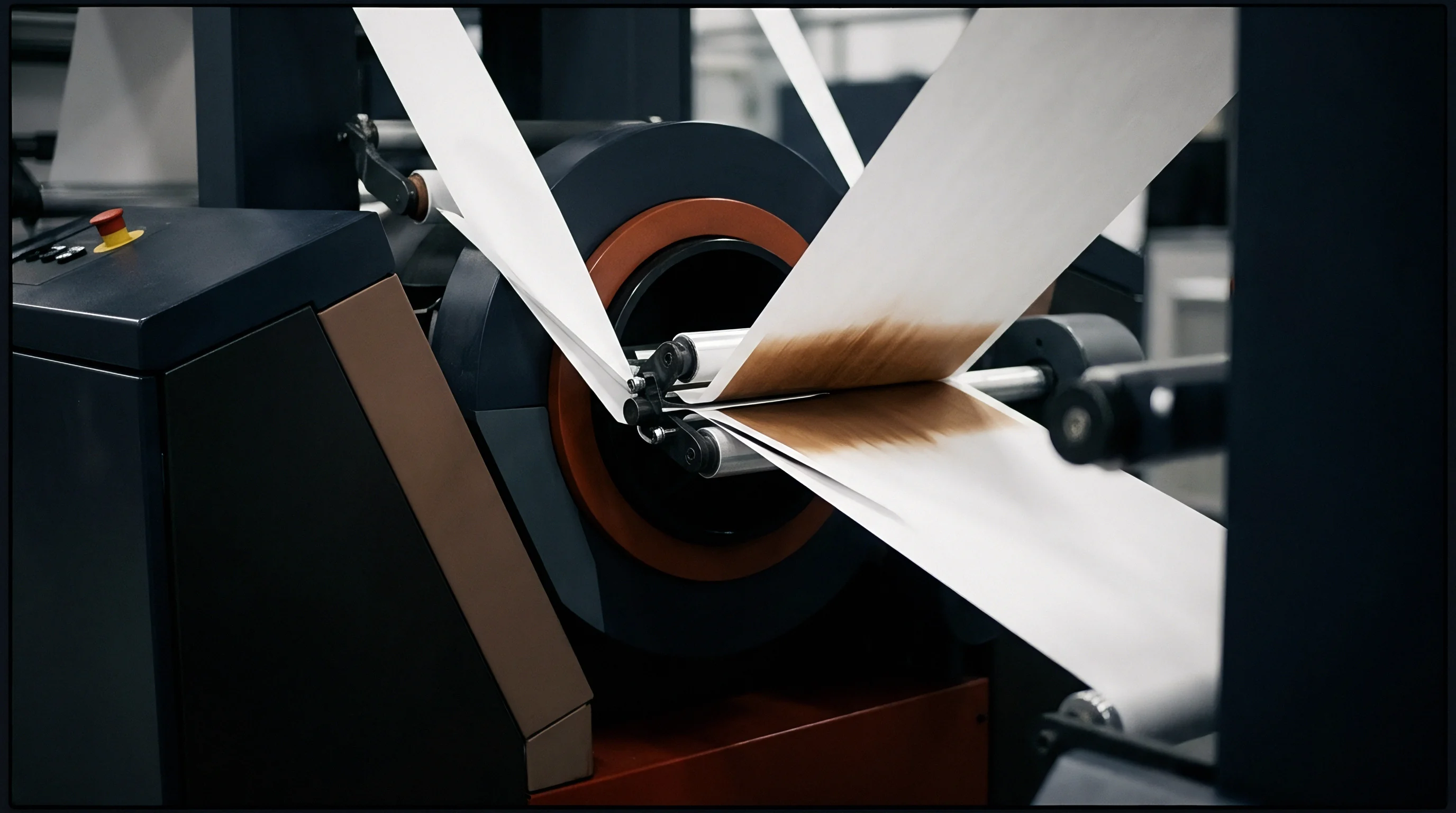
Rotary converting subjects moving webs to severe local forces over millisecond interaction windows. As paperboard passes into a scoring matrix, embossing roll, or slitting tool, nip geometry imposes heavy compressive and shear forces. At modern line speeds between 400 and 1000 metres per minute, dwell time in a converting nip falls below 2 milliseconds.
Under these transient conditions, energy builds faster than stress relaxation can relieve internal tension, driving up localized strain rates along fiber-to-fiber contacts inside the ply structure.

Strain Rates and Localized Thermal Dissipation
Line speeds exceeding eight hundred metres per minute generate significant friction inside the fiber matrix. During sharp score creation, where shear forces concentrate, the strain rate inside the nip can pass 100000 inverse seconds. At these rates, paperboard behaves like a rigid, brittle material instead of a viscoelastic network, and internal bond strength drops rapidly.
Kinetic energy from the tool converts directly to heat within the narrow footprint of the nip line. Temperature spikes of 20 to 35 degrees Celsius take place in fractions of a millisecond, triggering local thermal disruption of interfiber hydrogen bonds.
| Line Speed (m/min) | Shear Rate (s⁻¹) | Temperature Rise (°C) | Dissociation Energy Loss (%) | Primary Failure Mode |
|---|---|---|---|---|
| 400 | 25000 | 8.5 | 4.2 | Controlled score creasing |
| 600 | 55000 | 14.0 | 9.8 | Minor surface linting |
| 800 | 85000 | 22.5 | 18.5 | Z-direction delamination |
| 1000 | 120000 | 34.0 | 31.0 | Deep score cracking and fracture |
Substrate failures in the nip stem directly from this local thermal overload. When heat disrupts hydrogen bonding across the z-direction, several operational defects show up during high-speed converting.
- Z-Direction Delamination occurs when internal hydrogen bonds rupture under high shear, splitting plies apart during bending.
- Score Line Cracking happens when dry fibers fracture instantly rather than sliding past one another in high-speed male-to-female creasing.
- Edge Dusting stems from local bond failure along slitting blades, creating loose micro-fibers that cling to printing plates.
- Surface Linting occurs when surface fibers pull away under high web tension, showing local thermal cleavage of top-layer fiber anchors.
At a line speed of 800 metres per minute and 50 percent relative humidity, local nip friction elevates internal web temperature by 28 degrees Celsius within 1.2 milliseconds.
Measuring sheet temperature right after the nip shows the thermal signature of matrix disruption. Infrared thermography confirms peak temperatures line up with areas facing maximum compression and shear. When substrate moisture drops below 5 percent, internal friction rises, speeding up heat generation and bond failure.
Score line delamination stems from improper ambient humidity rather than inconsistent internal sizing.


Thermodynamics
Energy balance calculations across the deformation zone show how kinetic work converts to heat during high-speed scoring. The total mechanical energy input per unit volume equals the integral of stress over strain. Most of this energy ~ typically 85 to 92 percent ~ turns directly into thermal energy through internal friction within the matrix.
The remainder is stored elastically or goes into breaking hydrogen bonds. When mechanical work exceeds the cohesive energy density of the paperboard, those bonds rupture catastrophically.

Why Does High Converting Speed Shift Activation Energy?
Dynamic testing under varying shear regimes shows an apparent drop in required dissociation enthalpy. At low strain rates, thermal fluctuations help break hydrogen bonds over longer timeframes. High line speeds eliminate this buffer.
Mechanical force from high-speed tools acts directly on bond potentials, flattening the activation energy barrier for bond disruption. As a result, bonds break at substantially lower macro-temperatures than static thermodynamic models predict.
Consider a 350 gram per square metre solid bleached sulfate (SBS) board running through a folder-gluer at 750 metres per minute. Assumptions for this calculation include a sheet thickness of 450 micrometres, specific heat capacity of 1.34 Joules per gram per Kelvin, initial moisture content of 6.5 percent, and a score nip width of 1.5 millimetres. The scoring tool delivers 4.8 Joules of mechanical energy per metre of score length.
| Furnish Type | Equilibrium Moisture (%) | Dissociation Enthalpy (kJ/mol) | Critical Temperature Tg (°C) | Scott Bond Strength (J/m²) |
|---|---|---|---|---|
| Bleached Softwood Kraft | 7.2 | 22.5 | 68 | 210 |
| Bleached Hardwood Kraft | 6.5 | 18.0 | 74 | 165 |
| Unbleached Recycled Fiber | 5.8 | 14.5 | 82 | 125 |
| High-Yield Mechanical Pulp | 8.0 | 12.0 | 58 | 95 |
Assuming 90 percent of this mechanical energy converts to heat within a score zone volume of 6.75乘以10 to the minus 7 cubic metres per metre, volumetric energy input reaches 6.4 Joules per cubic centimetre. At a board density of 0.78 grams per cubic centimetre, localized temperature within the score volume rises by 3.6 degrees Celsius per millisecond pass. Over consecutive tight-radius bends, cumulative heat quickly passes the critical glass transition boundary of the wet hemicellulose matrix.
Failure to meet the minimum 180 Joules per square metre Scott Bond requirement under TAPPI T 569 results in immediate batch rejection at the rotary cutter.
Recycled pulp furnishes have lower dissociation enthalpy thresholds than virgin softwood kraft. Repeated recycling shortens fibers and reduces internal hydrogen bonding through hornification. Because hornified fibers present fewer surface hydroxyl groups, the network breaks down more readily under high thermal shear.
Accounting for these furnish differences requires adjusting converting parameters to stay below the thermodynamic disruption boundary.
Operating above this thermodynamic boundary creates micro-cracks along score lines, increasing web breaks and causing unscheduled downtime.

Cohesion
Internal bonding under rapid mechanical loading determines whether a sheet stays intact or delaminates in the z-direction. Cohesive energy density inside the board depends heavily on the softwood-to-hardwood ratio, refining intensity, and dry-strength wet-end additives. Polymer additives like cationic starch and polyacrylamide reinforce internal bonding by adding ionic and covalent cross-links alongside native hydrogen bonds, while ambient moisture ~ often governed by pallet storage conditions ~ can soften the network.

Fibre Furnish and Chemical Sizing Influences
Softwood kraft fibers act as long structural anchors, spreading shear forces across a larger volume. Hardwood fibers improve surface smoothness but have shorter bond lengths, reducing net cohesive energy per unit area. Excessive filler ~ such as calcium carbonate added above 15 percent ~ directly disrupts fiber-to-fiber contact, lowering internal bond strength measured by Scott Bond testing under TAPPI T 569.
Raw material specifications must balance surface printability against internal cohesion.

Converter Rheology and Micro-Fracture Mechanics
Bending paperboard around narrow radii pulls the outer ply in tension while compressing the inner surface. Once outer ply strain exceeds the ultimate tensile elongation limit in ISO 1924-2, micro-fractures form along fiber interfaces. These fractures propagate along paths of broken hydrogen bonds, causing visible cracking on the score crown and generating edge dusting that accelerates tool wear.
Optimizing score geometry reduces local strain, keeping energy dissipation below the bond rupture threshold.
- Verify raw material mill certificates to confirm basis weight compliance per ISO 536 and moisture levels per ISO 287 upon reel arrival.
- Measure Scott Bond internal strength under TAPPI T 569 across five test samples taken across the full machine width.
- Perform Cobb water absorption testing per ISO 535 to confirm surface sizing efficiency and internal moisture transfer resistance.
- Adjust male-to-female creasing tool clearances based on measured board caliper according to ISO 534 to minimize localized shear strain.
When internal cohesion drops below mill specifications, converting lines must slow down to avoid web breaks ~ and those yield losses add up quickly. Operating at lower speeds rapidly wipes out any savings from buying cheaper paperboard.
Standard purchase terms under ISO 1924-2 require substrate suppliers to credit converter spoilage whenever internal bond strength falls below agreed minimums.
Envelope
Process parameters must fit within the substrate’s thermodynamic boundaries to prevent web breaks and edge dusting. Setting an effective operating window requires mapping line speed against sheet moisture and ambient plant conditions. Moisture levels kept between 6.5 and 7.5 percent optimize viscoelastic energy absorption, preventing brittle fractures while preserving structural stiffness.
Below 5.5 percent moisture, hydrogen bonds turn rigid and tend to snap under high shear.
Boundary Limits for Converting Speed and Moisture Content
Keeping web moisture between six and eight percent provides optimal viscoelastic energy absorption during rapid deformation. Outside this window, material behavior changes noticeably. Above 8.5 percent moisture, internal friction drops, but so does the elastic modulus, leading to register drift and web instability.
Keeping plant relative humidity at 50 percent stops edges from drying out during unrolling and transport.
Higher refining intensity increases hydrogen bonding surface area but accelerates thermal energy concentration during high-speed mechanical shearing.
Specifying paperboard for high-speed converting requires evaluating the entire operating window before settling purchase contracts. Matching material behavior to equipment limits prevents downtime and batch rejections.
- Furnish Composition Verification confirms the softwood fiber ratio meets cohesive energy needs for high-speed scoring.
- Moisture Content Control ensures delivered reel moisture stays within the target 6.5 to 7.5 percent specification band.
- Tool Geometry Optimization matches matrix scoring clearances to board caliper to avoid localized shear concentration.
- Temperature Monitoring Protocols track real-time infrared web temperatures right after high-shear nip passes.
Substrate selection always balances unit cost against runnability. Choosing board with higher internal bond strength allows lines to run at full speed, increasing yield and lowering unit production costs.
Adjusting web tension relative to ambient moisture prevents local matrix shear while maintaining structural rigidity throughout the run.