Thermodynamic Phase Change Effects on Inter-Fiber Pore Condensation in Recycled Pulp Furnish under Low Thermal Gradient Transit
Low thermal gradients trigger capillary condensation in small recycled furnish pores, disrupting hydrogen bonds and weakening packaging without direct water contact.
Pore
Furnish Hornification and Capillary Architecture
Recycled pulp furnish possesses a fundamentally altered physical void structure compared to virgin wood pulp. Repeated repulping, pressing, and thermal drying cycles induce irreversible structural changes within the cellulosic matrix. Fiber walls undergo hornification, characterized by the internal collapse of macropores and the tight cross-linking of adjacent microfibrils through hydrogen bonding.
Moisture movement within the dry sheet relies heavily on the resulting network of inter-fiber spaces rather than intra-fiber lumens.
Pore geometry dictates uptake. The pore size distribution shifts toward smaller radii ranging between two and fifty nanometers. Fine fraction accumulation further fills the spaces between damaged fibers, creating dense clusters of micro-capillaries.
These narrow channels increase total internal surface area while altering liquid transport dynamics.
Recycled furnish with elevated fine content condenses vapor at relative humidity levels ten percent lower than virgin softwood pulp.
Capillary attraction governs water vapor condensation within these micro-pores through the Kelvin phenomenon. At ambient temperatures, water vapor condenses into liquid water inside small pores at relative humidity levels below saturation. As recycling loops increase, the proportion of sub-ten-nanometer capillaries rises, lowering the ambient water vapor pressure threshold needed to initiate liquid phase change.
Cellulose surfaces inside recycled fibers exhibit lower swelling potential than virgin fibers due to hornification. Liquid water condensed within inter-fiber pores cannot be absorbed efficiently into the rigid fiber walls. Condensed moisture remains concentrated at fiber-to-fiber contact points, localized directly within the load-bearing hydrogen-bonded regions.
Microstructural Failure Modes under Hydration
Mechanical strength in recycled paper and board relies on inter-fiber hydrogen bonds developed during machine drying. Water acts as a plasticizer within cellulose networks, disrupting these bond sites upon contact.
Dry fiber holds load. When condensation forms within inter-fiber capillaries, liquid water bridges weaken the localized hydrogen bonding network. Surface tension of the liquid draw draws fine particles together, yet the mechanical shear strength between primary fibers drops significantly.
The structural consequences of inter-fiber condensation depend on specific furnish characteristics:
- Fine fraction accumulation fills interstitial voids, accelerating capillary suction rates while concentrating water at critical structural joints.
- Shortened fiber lengths decrease the average number of bond sites per fiber, making the sheet susceptible to moisture-induced shear failure.
- Ash and inorganic filler content alters surface energy within pores, promoting local condensation zones while resisting fiber swelling.
- Residual sizing agent decay allows uncontrolled capillary migration along hydrophobic-hydrophilic boundaries within the web structure.
Ignoring the altered capillary profile of recycled stock leads to structural box failure under stack loading during climate shifts.


Swell
Thermodynamics of Capillary Condensation
Pore geometry dictates local thermodynamic equilibrium during transport. The Kelvin equation relates the vapor pressure over a curved liquid meniscus inside a capillary to the bulk saturated vapor pressure. Equating the thermodynamic potential across the phase boundary yields the critical condensation radius:
Critical radius equals twice the liquid surface tension multiplied by the molar volume of water, divided by the gas constant, thermodynamic temperature, and the natural logarithm of relative humidity. Liquid water condenses inside pores below this critical radius even when ambient relative humidity remains below one hundred percent.
| Pore Radius (nm) | Condensation Relative Humidity (%) | Dominant Furnish Type | Capillary Saturation State |
|---|---|---|---|
| 1.5 | 48.2 | Highly Recycled OCC Fines | Spontaneous Liquid Phase |
| 3.0 | 70.1 | Standard Recycled Containerboard | Partial Capillary Condensation |
| 5.0 | 81.2 | Mixed Waste Pulp Voids | Vapor Phase Dominant |
| 10.0 | 90.3 | Unbleached Virgin Kraft Softwood | Bulk Vapor Exchange |
| 50.0 | 98.0 | Coarse Virgin Wood Lumens | No Capillary Phase Change |
Transit conditions rarely present uniform thermal environments. Low thermal gradient transport occurs when ambient temperatures drop gradually over extended shipping routes, creating temperature differentials between five and fifteen degrees Celsius across a container load over several days.
A four degree thermal drop in sealed packaging triggers capillary condensation in pores below five nanometers at eighty percent relative humidity.
Vapor pressure drives flux. Air contained within the void space of a palletized stack holds water vapor. When the outer boundary of the packaging cools, a micro-gradient develops between the warm interior of the reel or stack and the cold outer perimeter.
Phase Transition Dynamics across Wrapped Stock
Water vapor migrates toward the cooler zone along the vapor pressure gradient. As air temperature approaches the local dew point near the outer wraps, relative humidity within inter-fiber voids reaches the critical threshold defined by the Kelvin equation.
Condensation occurs internally inside micro-pores before dew forms on exterior packaging surfaces. Moisture moves fast. Liquid water condenses within sub-five-nanometer capillaries, initiating localized hygroexpansion of adjacent cellulose networks.
Fibers swell in radius. Cross-directional swelling of recycled fibers is up to twenty times greater than axial elongation. As micro-capillaries fill with liquid, swelling forces push adjacent fiber segments apart, breaking localized hydrogen bonds that cannot reform in the presence of liquid water.
Small thermal gradients sustained over long durations cause progressive moisture accumulation in outer pallet zones. Capillary condensation continuous cycle disrupts compressive load distribution within the containerboard sheet.
Cold transport zones convert ambient internal humidity into internal pore water without exterior film breach.
Transit
Environmental Exposure during Low-Gradient Transport
Logistics chains subject packaged paper stock to sustained thermal gradients during intermodal freight transport. A closed shipping container traversing temperate zones experiences diurnal temperature fluctuations alongside geographic climatic shifts. Stacking pallets creates significant thermal inertia within the core of the load, while outer edges respond rapidly to external ambient cooling.
1. External transport container ambient temperature drops eight degrees Celsius during night transit across coastal routes.
2. Peripheral paperboard layers lose heat via conduction through timber pallets and exterior stretch wrap barriers.
3. Internal thermal gradient establishes a steady vapor pressure differential from warm stack core toward cold perimeter.
4. Inter-fiber vapor migrates along pore network pathways to cool outer zones until local relative humidity exceeds critical Kelvin threshold.
5. Liquid water condenses inside five-nanometer pores within the outer three centimeters of stacked corrugated board layers.
Transit gradients alter equilibrium. Moisture distribution becomes highly non-uniform across the width of a single pallet sheet. The core of the stack remains at six percent moisture content while outer edges exceed eleven percent moisture content within forty-eight hours.
Where Does Condensate Accumulate during Low Thermal Gradient Transport?
Condensation concentrates primarily within the contact interfaces between flute tips and linerboard surfaces in corrugated media. These regions contain elevated concentrations of starch adhesive, which acts as a hydrophilic sink. Starch film softens under capillary water accumulation, reducing joint rigidity.
ISO 187 preconditioning requires drying below target equilibrium prior to climate equilibration to eliminate sorption hysteresis.
Stacking weight compounds damage. Static load from upper pallets forces wet, softened flute tips to undergo plastic deformation. The compressive strength of corrugated board relies on geometry; once flutes lean or crease under load, stack integrity drops precipitously.
Edge crush test metrics drop faster in recycled furnish than virgin kraft under identical thermal gradients. Recycled fibers lack lumen bulk, meaning condensed liquid stays on outer fiber walls, immediately lubricating fiber-to-fiber slip planes.
Suppliers frequently attribute transit stack collapse to gross water exposure, ignoring ambient thermal gradient phase change within original protective packaging.
Assay
Laboratory Qualification of Moisture Dynamics
Standard quality control assays carried out under static conditions fail to capture thermodynamic phase changes triggered by thermal gradients. ISO 187 defines standard atmosphere testing at twenty-three degrees Celsius and fifty percent relative humidity. Static testing measures equilibrium moisture content but misses micro-pore condensation dynamics under transit conditions.
Evaluating capillary absorption requires dynamic testing protocols. ISO 535 Cobb water absorption assays measure bulk surface uptake over specified timeframes, yet fail to characterize capillary rise in narrow pores. ISO 8787 determines capillary rise through vertical wicking, offering precise insight into inter-fiber pore structure transport.
| Grade Description | Furnish Composition | Baseline SCT ISO 9895 (kN/m) | Post Gradient SCT (kN/m) | Baseline RCT ISO 12192 (N) | Post Gradient RCT (N) |
|---|---|---|---|---|---|
| Virgin Kraftliner 175g | 100% Unbleached Softwood | 3.85 | 3.42 | 380 | 345 |
| Testliner 1 160g | 100% Recycled High Selection | 3.10 | 2.25 | 290 | 210 |
| Testliner 3 140g | 100% Mixed Recycled Waste | 2.45 | 1.55 | 220 | 135 |
| Fluting Medium 120g | Recycled Semi-Chemical Substitute | 1.95 | 1.10 | 160 | 90 |
Test values drop rapidly. Short span compression testing per ISO 9895 reveals significant strength losses when stock experiences temperature drops during transport. Short span compression testing measures load-bearing capacity of individual fiber networks before structural buckling occurs.
Simulating Transit Condensation Cycles
Testing laboratories employ environmental chambers capable of low thermal gradient simulation to qualify packaging design. Samples undergo climate cycling between fifteen and twenty-eight degrees Celsius while holding ambient absolute humidity constant.
Assay programs must include criteria verifying performance under moisture gradient exposure:
- Equilibrium moisture hysteresis curves generated via dynamic vapor sorption instruments to identify critical capillary condensation points.
- Short span compression testing performed immediately upon removal from temperature gradient environmental conditioning chambers.
- Z-direction tensile strength evaluation according to ISO 15754 to detect internal delamination caused by inter-fiber swelling.
- Adhesive bond durability testing assessing pin adhesion strength under elevated localized moisture content.
Incorporate ISO 9895 short span compression limits adjusted for eleven percent equilibrium moisture into purchase specifications to protect against transit failure claims.

Audit
Commercial Impact of Substrate Selection
Selecting recycled furnish options involves balancing lower raw material costs against increased risk of moisture-induced structural failure during freight transit. Recycled containerboard trades at a lower cost per tonne than virgin kraftliner. Tonnage yield benefits disappear when thermal gradient condensation causes container stack collapse.
Sizing barriers delay saturation. Internal chemical sizing agents like alkenyl succinic anhydride slow liquid water entry into pores. Sizing agents do not prevent vapor phase diffusion into micro-pores, where capillary condensation occurs regardless of surface hydrophobicity.
Palletized board stored under low temperature differentials loses structural edge crush strength before visible dampness appears on the outer wrapper.
Packaging redesigns often increase grammage to compensate for strength losses in high humidity transit zones. Adding weight increases landed costs per unit, freight expenditures, and extended producer responsibility fees across European markets.
Barrier Wrapping and Supply Chain Protections
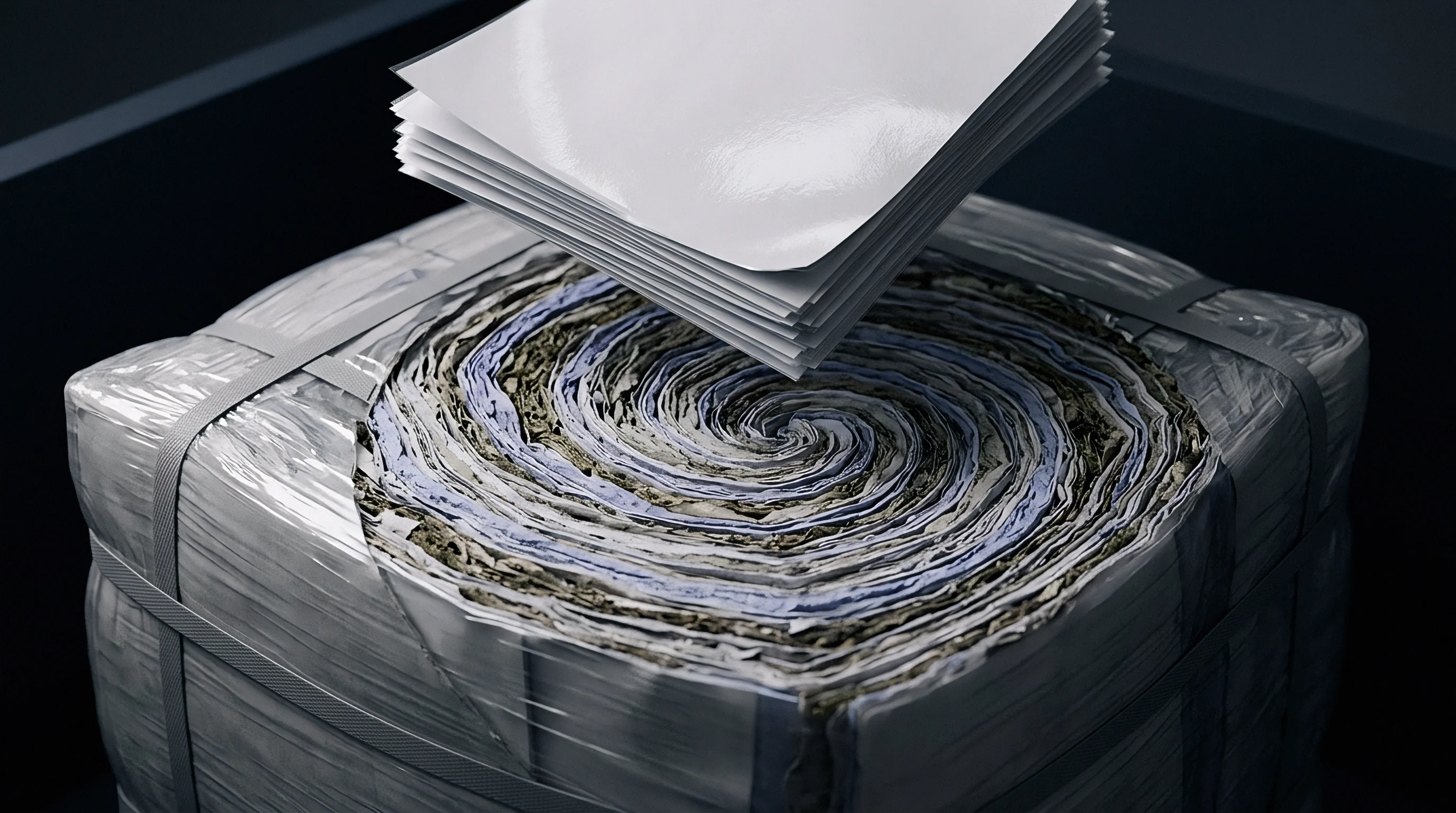
Mitigating capillary condensation requires modifying thermal transport across outer packaging boundaries. Polyethylene stretch film wrapping seals liquid water out but traps internal air moisture. When thermal gradients emerge, internal trapped air fuels inter-fiber capillary condensation.
Desiccant inclusion within pallet shrouds manages internal air vapor pressure, keeping relative humidity below the critical Kelvin radius threshold for recycled fine pores. The added cost of vapor protection measures must be weighed against the price differential between virgin kraft and recycled testliner grades.
Yield calculations must account for scrap generated by edge-softened reels that fail automated converting reel-stand chucks due to localized hygroexpansion deformation.
Which thermodynamic threshold determines whether adding expensive desiccant packaging provides better cost per delivered sheet than simply upgrading from recycled testliner to a virgin kraftliner outer sheet?