Fiber Alignment
Virgin wood pulp destined for folding boxboard production requires precise mechanical orientation during the wet end formation stage on the Fourdrinier wire. The gd3 board specification establishes longitudinal tensile property thresholds by controlling stock velocity relative to wire speed. Differential shear forces across the forming table determine how many fibres lie parallel versus transverse to the machine direction.
Converters rely on this anisotropic profile to predict creasing resistance and folding endurance during high speed blank feeding. Surface smoothness and caliper uniformity depend directly on how evenly the headbox distributes the suspension before drainage begins.
Ply Bonding
Internal delamination resistance relies on optimal starch pick up and press nip pressures during consolidation. When moisture gradients remain too steep across the multi-ply web, interlayer shear stress causes blister formation during subsequent UV coating and infrared drying passes. Starch add on rates must balance stiffness requirements against dimensional stability, because excessive binder saturation increases curl tendencies upon atmospheric exposure.
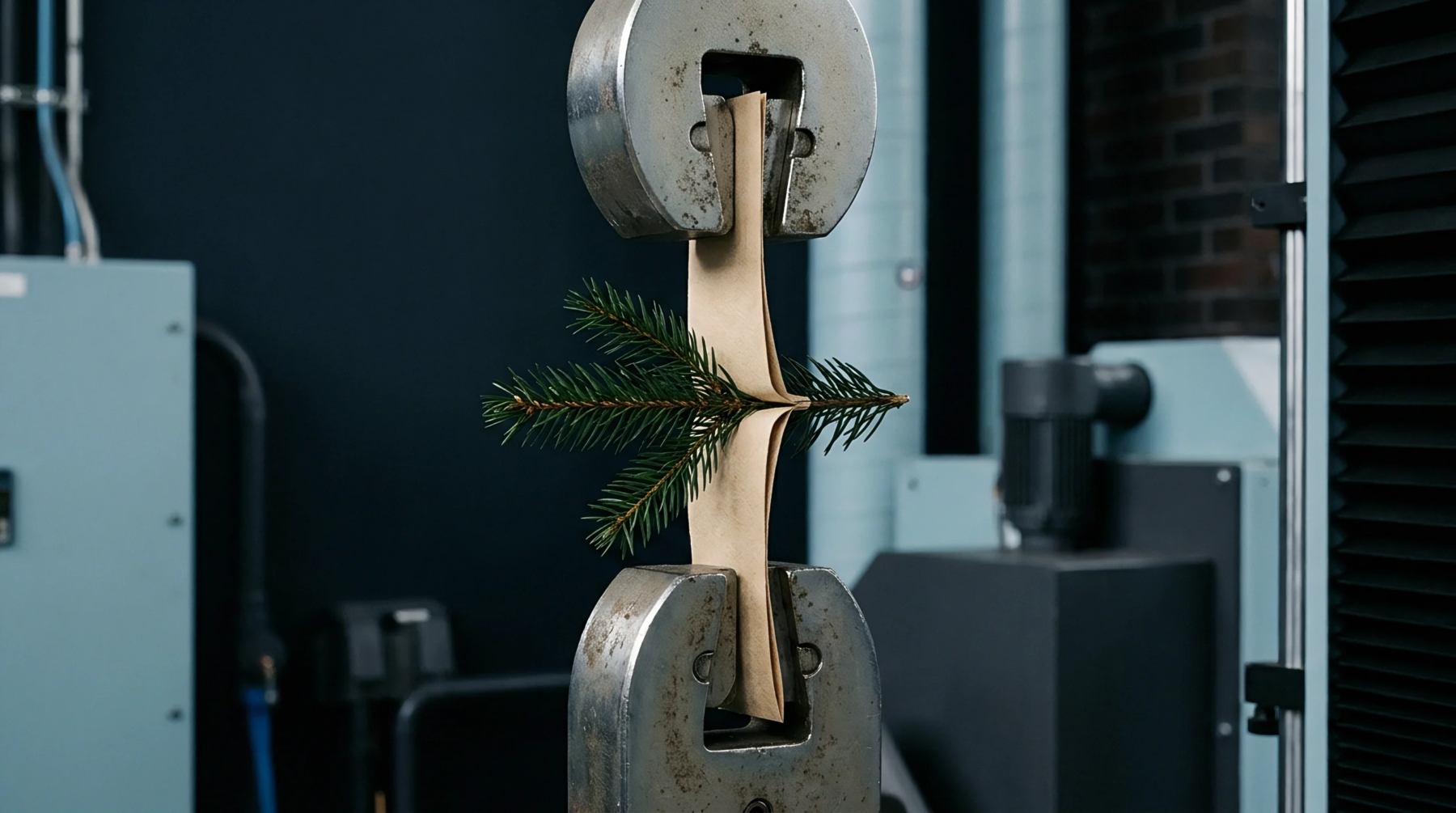
Laboratory Scott bond testing quantifies the energy required to separate internal fibrous layers under dynamic loading conditions.
Surface Porosity
Printing ink setting rates and gloss development depend on microstructural void volumes within the mineral pigment coating layer. Particle size distributions of ground calcium carbonate and kaolin determine the capillary network geometry that absorbs offset vehicle fractions. Excessively closed surfaces retard oil penetration and lead to ink smear during perfecting press operations, whereas high porosity reduces final print density and gloss retention.
Inline air permeability measurements verify that calendering nip loads achieve target smoothness without crushing the underlying fibrous matrix.