Standardizing Cross Direction Crease Shear Thresholds across Multi Ply Recycled Content Board Batches
Standardizing CD crease shear in recycled board requires holding a 1.40 to 2.10 crease ratio via controlled internal ply delamination to stop cartoner line jams.


Shear
Delamination failure during folding carton conversion traces directly to the delamination resistance of the board core under perpendicular creasing tools. In multi-ply recycled content board, known commercially as white lined chipboard or coated recycled board, standardizing cross direction crease shear thresholds requires setting an exact operational window: a crease stiffness ratio between 1.40 and 2.10, paired with an internal delamination shear force between 35 percent and 52 percent of the uncreased board bending resistance measured under DIN 55437 and ISO 5628 at 23 degrees Celsius and 50 percent relative humidity. Outside this window, carton blanks either crack along the exterior liner during folding or resist high-speed cartoning machines through excessive crease recovery force.
Converters running automated packaging lines at 400 to 700 cartons per minute depend on this balance. Cross direction creases place the pulp fibres perpendicular to the creasing rule. Virgin chemical pulp accommodates this mechanical displacement through elongation and fibre slip.
Recovered wastepaper furnish contains hornified, shortened fibres with low intrinsic bonding capability, creating localized stress concentrations during rule impact.

Fibre Alignment and Deformation Thresholds
Tensile stress concentrates immediately in the outer plies when a steel rule drives board into a female channel. The cross direction orientation aligns the stiffest mechanical axis parallel to the crease line. Fibres resist elongation across their diameter.
The internal recycled plies absorb the vertical displacement through controlled inter-ply shear, peeling the individual strata apart to form an internal hinge.
When the internal shear resistance of the recycled furnish exceeds 52 percent of the uncreased board bending moment, the middle plies refuse to shear cleanly. The displacement forces transfer directly to the tension side of the board. The coated top liner ruptures instantly.
When internal shear resistance drops below 35 percent, the internal plies disintegrate entirely. The resulting score lacks mechanical memory, yielding carton panels that bow inward during case packing.
| Board Caliper (microns) | Basis Weight (grams per square metre) | Uncreased CD Bending Resistance (millinewtons) | Target CD Crease Resistance (millinewtons) | Target Crease Ratio (Uncreased to Creased) | Permissible Shear Resistance Range (millinewtons) |
|---|---|---|---|---|---|
| 350 | 280 | 195 | 95 to 125 | 1.56 to 2.05 | 68 to 101 |
| 400 | 320 | 290 | 140 to 185 | 1.57 to 2.07 | 101 to 150 |
| 450 | 360 | 410 | 200 to 260 | 1.58 to 2.05 | 143 to 213 |
| 500 | 400 | 560 | 270 to 355 | 1.58 to 2.07 | 196 to 291 |
| 550 | 440 | 740 | 360 to 470 | 1.57 to 2.06 | 259 to 385 |
Mechanical Fault Profiles across Batches
Batch-to-batch inconsistency in recovered paper stocks stems from variable starch application, uneven mechanical refining of mixed recovered fibres, and fluctuating ash contents in the filler plies. Converters record distinct mechanical failure signatures when running variable board supplies on automated die-cutters.
- Outer liner cracking occurs when high core shear resistance forces surface plies to absorb vertical tensile strain beyond their six percent elongation limit.
- Carton skewing appears when asymmetric ply shear causes one side of the crease groove to delaminate deeper than the opposing side.
- Crease blowout develops when low z-directional bond strength allows delamination to run laterally into the unprinted panel face.
- Springback jamming emerges when inadequate shear penetration leaves intact core fibres that generate high opening resistance during side-seam folding.
A procurement specification that writes DIN 55437 crease ratio parameters directly into the purchase contract prevents converters from absorbing the tooling adjustments caused by unannounced mill furnish changes.

Strata
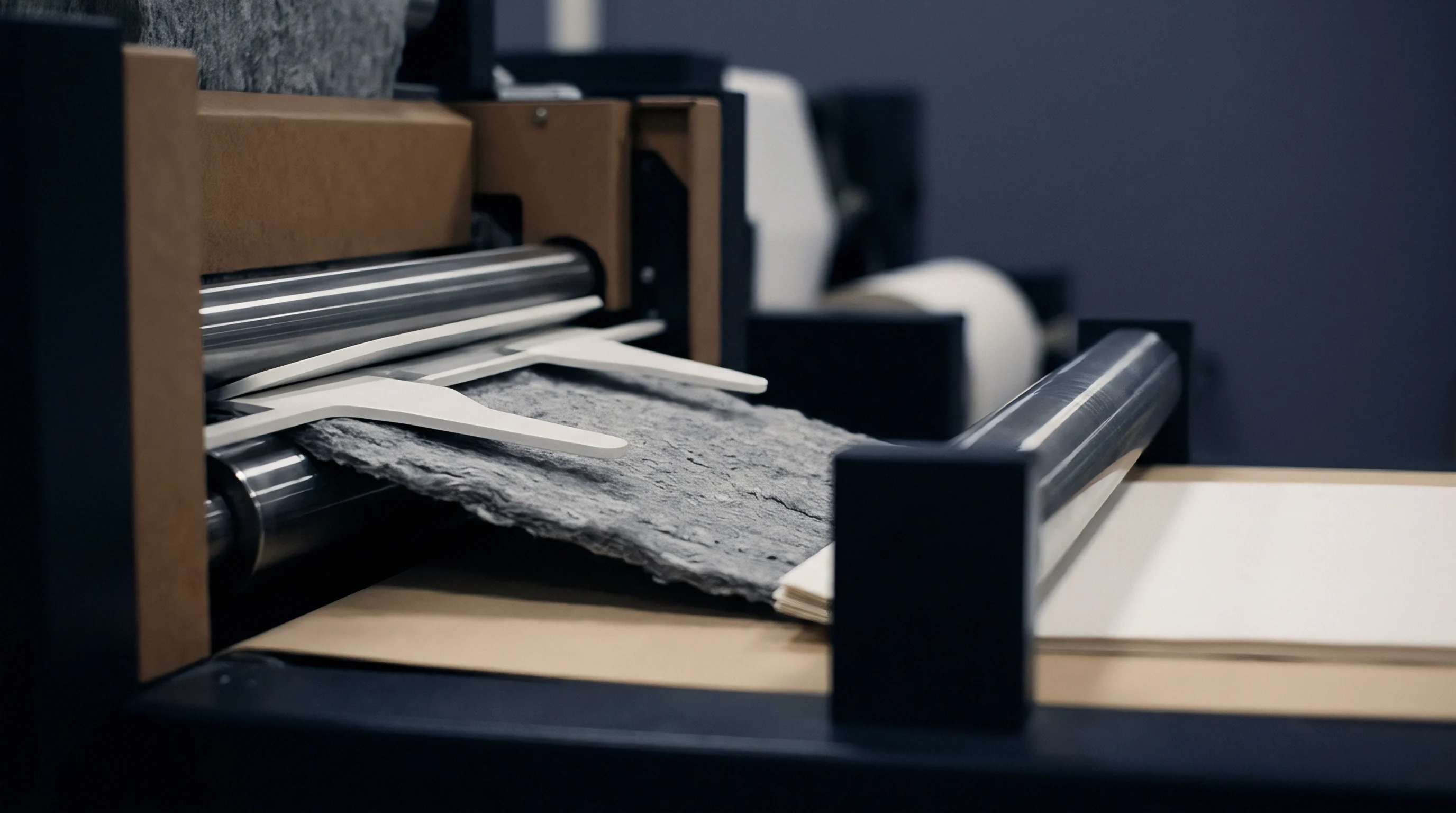
Recycled cartonboard derives its structural thickness from stacked, distinct fibrous plies formed on individual cylinder vats or multi-fourdrinier wires. The typical coated recycled sheet sandwiches a bulky filler core of mixed unsorted waste between under-liner layers of sorted deinked pulp, capped with a bleached chemical pulp top liner and an unbleached kraft back liner. Each interface between these layers represents a plane of controlled mechanical vulnerability.
Fibre hornification restricts the flexibility of the secondary furnish. Repeated drying cycles collapse the internal lumen of recycled cellulose fibres, reducing their specific surface area and water retention value. Secondary fibres cannot form the dense, hydrogen-bonded network seen in virgin kraft pulps.
Mills add cationic potato or corn starch at the wet end to recover internal bond strength. Uneven starch distribution across the plies creates shear strength spikes that disrupt crease delamination.
The Scott internal bond strength of the middle recycled filler plies measures between 110 and 160 Joules per square metre under TAPPI T 569 at 23 degrees Celsius and 50 percent relative humidity.
Fibre stiffness is unyielding in secondary furnishes. When a creasing rule compresses the sheet into the die channel, the board structure undergoes combined transverse compression and interlaminar shear. The middle plies must delaminate precisely within their horizontal plane.
This controlled failure permits the outer plies to form a neat hinge without tensile rupture. When secondary fibres carry excessive mineral filler, such as calcium carbonate or clay loads exceeding 18 percent, the z-directional shear threshold collapses prematurely.

Internal Bond Distribution
The Scott bond profile through the thickness of a multi-ply recycled sheet reveals sharp mechanical gradients. The bleached chemical pulp liner achieves internal bond figures exceeding 220 Joules per square metre. The grey wastepaper core plies drop to 120 Joules per square metre.
This deliberate differential protects the outer surfaces while encouraging shear failure in the board interior.
Controlling this gradient across variable recycled furnish consignments presents constant mill-floor difficulties. When a recycling facility processes high volumes of coated magazine papers, the resulting recovered stock carries short mechanical fibres and fine mineral particles. The middle layer loses cohesive strength.
During creasing, the shear zone spreads across the entire core rather than forming a discrete, sharp delamination plane. The crease line loses definition, and panel fold accuracy deteriorates.
Delamination Geometry under Compression
Microscopic examination of a cross direction crease reveals a delamination bulb. The creasing rule forces the middle recycled plies downward, causing horizontal shear slip between the lamellae. In virgin boards, this slip creates several clean, parallel delamination fractures.
In multi-ply recycled boards, the fractures follow the chaotic paths of short recovered fibres and filler pockets.
Creasing tools introduce rapid shear rates. The tool impact lasts between 15 and 30 milliseconds on high-speed flatbed autoplaten presses running 7,000 sheets per hour. At these strain rates, viscoelastic relaxation within the recycled fibre web is minimal.
The ply bonds respond elastically until brittle failure occurs. The moisture content of the board governs this brittle-to-ductile transition directly, rendering water balance the dominant chemical control parameter.
Whether secondary furnish mills can stabilize z-directional shear distribution without inflating starch consumption remains an open operational question across current recycling networks.

Die
Tooling configurations compensate for the lower shear elasticity of recycled fibre sheets through precise channel dimensioning. Flatbed cutting dies use hardened steel rules interacting with counter-creasing matrices composed of phenolic resin, Pertinax, or milled steel plates. Achieving standard cross direction crease performance across variable recycled board lots demands deliberate adjustments to channel width and penetration depth.
A standard converter formula for virgin board sets the creasing channel width to the rule thickness plus 1.5 times the board caliper. Coated recycled board demands a channel width equal to the rule thickness plus 1.65 to 1.75 times the board caliper. The shorter fibres and higher bulk density of the recycled core require extra lateral clearance.
Narrow channels pinch the recycled sheet, shearing the back liner and cracking the top liner.
A wide creasing matrix channel prevents liner bursting on recycled cartonboard by lowering lateral shear restriction during rule entry.

Counterplate Channel Clearance Rules
The rule penetration depth controls the degree of interlaminar shear achieved during the platen dwell. Penetration depth is the distance the creasing rule enters the counter matrix channel, measured relative to the board surface. For a 400-micron recycled board, the rule enters the matrix to a depth equal to the board caliper minus 0.05 millimetres.
Insufficient penetration fails to trigger core delamination, leaving an unyielding ridge that overloads cartoning machine fold arms.
| Board Caliper (microns) | Rule Thickness (points / mm) | Matrix Channel Depth (mm) | Virgin Matrix Width (mm) | Recycled Matrix Width (mm) | Clearance Expansion Factor |
|---|---|---|---|---|---|
| 300 | 2 pt / 0.71 mm | 0.30 | 1.16 | 1.22 | 1.72 |
| 400 | 2 pt / 0.71 mm | 0.40 | 1.31 | 1.39 | 1.70 |
| 500 | 2 pt / 0.71 mm | 0.50 | 1.46 | 1.56 | 1.70 |
| 600 | 3 pt / 1.05 mm | 0.60 | 1.95 | 2.07 | 1.70 |
| 700 | 3 pt / 1.05 mm | 0.70 | 2.10 | 2.24 | 1.70 |

Makeready Stabilization Variables
Flatbed platen preparation establishes equalized pressure across the full surface of the cutting form. Caliper drift across a recycled board sheet introduces uneven crease shear stresses. A 20-micron caliper surge on a back platen section elevates local creasing force by 15 percent, forcing the creasing rule through the board core.
- Crease rule profile utilizes rounded tops with a 0.35 to 0.50 millimetre radius to eliminate sharp stress risers along the outer coating layer.
- Counterplate material selection prioritizes milled Pertinax or solid steel counters to eliminate matrix wall deflection under platen pressure.
- Patching tape precision requires 0.015-millimetre calibrated foils to level pressure across the chase without creating abrupt transition shoulders.
- Ejection rubber durometer matches 35 Shore A open-cell profiles near CD crease rules to stabilize the sheet during platen withdrawal.
Die-cutters frequently claim that a slight liner tick along the score is harmless cosmetic crazing that disappears after offset varnish drying.

Drift
Delivered batches of multi-ply recycled board exhibit basis weight and moisture swings that alter crease mechanics unpredictably. Virgin chemical board grades maintain moisture levels within a narrow band of 0.5 percent across reel widths. Coated recycled board consignments frequently arrive with moisture variations exceeding 2.0 percent between outer pallet edges and the pallet core.
Water plasticizes cellulose fibres and weakens the starch bonds holding the middle plies together. When incoming board moisture drops below 5.5 percent, the secondary fibres turn brittle, reducing the shear tolerance window. The board tears under standard rule penetration.
When moisture rises above 8.0 percent, the sheet softens excessively. The creasing rule creates a wide, spongy depression without breaking the interlaminar bonds, generating high crease recovery resistance.
Consider long-distance maritime freight in non-insulated containers. Ambient humidity shifts force ambient moisture into sheet edges, creating severe hygroscopic gradients from the pallet perimeter to its centre. The press operator sets die-cutting makeready for the dry centre sheets, only to experience delamination failures when processing the humid perimeter stock.

Batch Qualification Sequence
Goods-in verification separates acceptable cartonboard deliveries from high-risk batches before sheets reach the press feeder. An incoming batch verification sequence establishes strict mechanical limits across every pallet lot.
- Cut ten test specimens measuring 38 by 38 millimetres from both edge and centre sections across five separate pallets per delivery.
- Measure absolute moisture content instantly using an calibrated capacitive moisture meter cross-referenced against gravimetric oven drying under ISO 287.
- Condition duplicate test strips in a climate chamber at 23 degrees Celsius and 50 percent relative humidity for two hours under ISO 187 standards.
- Evaluate uncreased cross direction bending resistance using an automated two-point bending tester with a 15-degree deflection angle and a 50-millimetre test length.
- Perform test creasing using a standardized laboratory flatbed platen fitted with calibrated rules and interchangeable matrix channels.
- Record the crease resistance and calculate the uncreased-to-creased bending ratio, rejecting any batch falling outside the 1.40 to 2.10 control boundary.
Purchase contracts specifying ISO 187 preconditioning rights protect the converter from accepting out-of-spec moisture consignments that fail on the platen.

Worked Tolerance Modeling
Take an industrial order of 45 tonnes of 450-micron coated recycled board intended for pharmaceutical packaging. Assume an uncreased cross direction bending resistance target of 410 millinewtons with an allowable mill tolerance of plus or minus 10 percent, establishing a permissible raw board range between 369 and 451 millinewtons.
Batch test data across twelve sampled pallets reveals an uncreased bending resistance range of 380 to 445 millinewtons, which satisfies raw mill delivery specifications. Applying the target crease ratio range of 1.58 to 2.05 produces an acceptable post-creasing resistance window between 185 and 281 millinewtons. Two tested pallets demonstrate post-crease resistances of 315 millinewtons due to starch overload in the filler furnish.
The ratio drops to 1.35. These pallets will jam packaging line folding arms. The goods-in team quarantines the shipment immediately.
Moisture drives the score.

Runnability
Packaging line productivity depends on consistent carton blank response during feed, folding, and gluing operations. Modern packaging lines operate at speeds where mechanical fingers erect, fill, and seal individual cartons within fractions of a second. If cross direction creases present excessive stiffness, the vacuum pick-and-place mechanisms drop blanks, bringing high-speed bottling or cartoning lines to an emergency halt.
Carton opening force is the mechanical force required to erect a flat-folded carton into an open rectangle. The cross direction score forms the primary hinge along the carton body. In recycled content boards, crease recovery force decays slower than in virgin boards.
When a folded carton blank is released, the crease acts as a spring, exerting continuous outward pressure against the glued side seam. High springback force pops freshly applied hot-melt adhesive bonds before the glue sets.
Crease recovery resistance on recycled board drops by 30 percent over the first twenty seconds following mechanical folding.

Erection Mechanics on Cartoning Lines
Vacuum pick heads pull carton blanks from a magazine and force them open across fixed mechanical guides. A carton blank displaying a cross direction crease resistance above 300 millinewtons resists vacuum opening heads, resulting in feed jams. Conversely, a blank with a crease resistance below 120 millinewtons collapses under the insertion force of the product pusher.
Glue flap retention demands consistent internal shear. The carton glue flap is folded 180 degrees during folder-gluer processing. If the cross direction score line was cut instead of sheared, the outer ply splits along the seam, exposing grey recycled filler fibres.
This exposed porous core draws water out of emulsion adhesives too fast, starving the bond line and causing split-open cartons on retail shelves.
| Crease Ratio Category | Measured Crease Ratio | Cartoning Speed (units / min) | Jam Rate (stops per 10,000 units) | Adhesive Failure Rate (percent) | Net Conversion Efficiency (percent) |
|---|---|---|---|---|---|
| Severely Under-Creased | Under 1.30 | 220 | 14.2 | 4.50 | 76.5 |
| Slightly Under-Creased | 1.30 to 1.45 | 310 | 4.8 | 1.20 | 88.2 |
| Standard Target Window | 1.50 to 2.00 | 450 | 0.3 | 0.05 | 98.4 |
| Slightly Over-Creased | 2.05 to 2.25 | 420 | 0.8 | 0.15 | 96.1 |
| Severely Over-Creased | Above 2.30 | 260 | 6.5 | 3.80 | 81.0 |
Economic Balance in Delivered Sheets
Downgauging virgin board to multi-ply recycled chipboard yields significant raw material cost reductions per metric tonne. A brand switching from a 350-micron virgin folding boxboard at 1,450 dollars per tonne to a 400-micron recycled board at 920 dollars per tonne captures immediate procurement savings. The heavier basis weight of the recycled sheet offsets some area yield, but net material savings remain around 22 percent per thousand blanks.
Uncontrolled crease shear thresholds eliminate these procurement savings on the packaging floor. A packaging line scheduled to produce 40,000 retail cartons per hour costs roughly 650 dollars per hour in operating labour and machine depreciation. A jam rate increase from 0.3 to 4.8 stops per 10,000 units reduces net output by 28 percent, adding 4.80 dollars per thousand finished cartons in overhead spoilage.
Substrate savings disappear into machine downtime.
A failure to enforce strict incoming crease shear thresholds across recycled board batches translates directly into higher packaging machine scrap, adhesive failures, and elevated unit conversion costs.