Acceptance Quality Limit Calculations for Corrugated Carton Lot Inspection
Acceptance Quality Limit carton inspection pairs ISO 2859-1 sampling math with physical flute and joint testing to validate lots before paper release.


Sampling
An intake inspection for corrugated carton lots operates on statistical acceptance sampling governed by ISO 2859-1 or ANSI/ASQ Z1.4. The receiving team matches the declared delivery volume against a defined batch size, extracts a randomized sample, and inspects each pulled container against an indexed defect classification. A shipment containing 35,000 double-wall shipping containers arrives on wooden skids.
Under ISO 2859-1 General Inspection Level II, this lot size dictates Sample Size Code Letter N. Table 2-A of the standard translates Code Letter N into an exact pull volume of 500 individual units. A lot acceptance decision rests on whether the tally of detected nonconformities stays at or falls below the Acceptance Number, or meets the Rejection Number.
Carton receiving docks routinely set distinct Acceptance Quality Limit thresholds across three severity classes. Critical defects, involving structural failures that cause package collapse or hazards like exposed metal stitch wires, typically carry an Acceptance Quality Limit of 0.0 or 0.10. Major functional defects, including joint adhesive delamination, scuffed barcodes, or crushed flutes that compromise Box Compression Test values by more than twenty percent, follow an Acceptance Quality Limit of 1.0 or 1.5.
Minor defects, covering non-critical graphic misregistration or surface dirt below defined square millimeter thresholds, resolve at an Acceptance Quality Limit of 4.0. For Code Letter N at an Acceptance Quality Limit of 1.0, the sampling table assigns an Acceptance Number of 10 and a Rejection Number of 11. An eleventh defective box triggers immediate lot rejection.
Under ISO 2859-1 single sampling at General Inspection Level II, an intake lot of 35,000 corrugated cartons requires pulling 500 samples, admitting up to 10 major defects at an Acceptance Quality Limit of 1.0 before mandatory rejection.
Sampling plans assume randomized, representative selection across the physical geometry of the delivery. Warehouse workers frequently commit the error of sampling only from the exterior top tiers of perimeter pallets. Fluting defects and joint bonding weaknesses concentrate in production sub-runs: an adhesive application nozzle clogs halfway through a mill conversion shift, or moisture swings affect specific base paper reels.
A valid receiving procedure mandates pulling cartons from the top, middle, and bottom tiers of randomly selected pallets across the entire trailer length. When an inspector cannot sample representative strata, the probability calculations supporting the Operating Characteristic curve collapse.
Corrugated carton lot acceptance sampling demands clear operational definitions before pallets enter the bay:
- Critical Nonconformity prevents product containment entirely, presents sharp hazard points, violates transport safety regulations, or contains toxic chemical contaminants.
- Major Functional Nonconformity impairs structural stacking performance, disrupts automated case-erecting lines, prevents secure closure tape adhesion, or renders inventory bar codes unscannable.
- Minor Aesthetic Nonconformity departs from visual printing standards or surface cleanliness limits without degrading box structural integrity or mechanical packing performance.
- Sample Size Code Letter indexes lot volume bands to specific test pull quantities according to the agreed inspection rigor level.
Failing to establish written inspection thresholds before production leaves the receiving department powerless when structural collapse ruins stacked pallet inventories inside high-bay storage racks.

Flute
Flute profile integrity determines the vertical compressive resistance of corrugated board. Edge Crush Resistance, measured via ISO 3037 or TAPPI T 811, depends directly on caliper maintenance during printing and slotting. Converting operations run high-speed flexographic printer-slotters that apply heavy mechanical pressure across feed rolls and impression cylinders.
Excessive squeeze crushes the sinusoidal medium, lowering structural caliper and dropping overall box top-to-bottom compression capacity. When receiving inspectors pull flat-packed containers for dimension checks, testing flute height with an anvil micrometer reveals press-room caliper crushing.
Dimensional stability interacts with the internal adhesive bond holding the corrugated medium to the linerboards. Pin Adhesion testing under TAPPI T 821 evaluates the mechanical strength of the starch adhesive line. An insufficient starch paste volume, under-cooked adhesive starches, or excessive web tension produces brittle glue lines that pop open under ambient moisture changes.
Box joints constructed with water-based emulsion adhesives or hot-melt formulations demand strict pull-apart evaluation during the physical inspection walk.
| Evaluation Parameter | Test Protocol | Acceptance Boundary | Defect Severity |
|---|---|---|---|
| Caliper Crushing (B-Flute) | ISO 3034 Micrometer | Caliper drop exceeds 0.25 mm from target 2.80 mm | Major Nonconformity |
| Caliper Crushing (C-Flute) | ISO 3034 Micrometer | Caliper drop exceeds 0.35 mm from target 3.80 mm | Major Nonconformity |
| Edge Crush Resistance | ISO 3037 / TAPPI T 811 | Drop exceeds 10 percent of rated specification | Major Nonconformity |
| Pin Adhesion Strength | TAPPI T 821 | Separation force below 200 N per linear meter | Major Nonconformity |
| Manufacturer Joint Peel | Manual Cleave at 180 Deg | Fiber tear less than 85 percent of joint contact area | Critical Nonconformity |
| Moisture Content | ISO 287 Oven Dry / Dielectric | Substrate moisture outside 6.5 to 8.5 percent range | Minor Nonconformity |
An inspector assessing the manufacturer joint cuts strips across the lap and pulls the seam apart by hand. True adhesive integrity yields full fiber tear across the paper substrate. An adhesive failure showing a clean, unblemished paper surface indicates poor heat transfer or starch starvation on the corrugator.
If an inspector uncovers adhesive starvation across the pulled sample units, the lot shifts rapidly toward the Rejection Number boundary.
The corrugator operator argues that minor caliper loss from flexographic printing plates never reduces actual warehouse stacking life.

Mechanics
Acceptance Quality Limit math relies on the cumulative binomial distribution when lots are large relative to sample sizes, or the hypergeometric distribution when sample sizes exceed ten percent of the lot. The Operating Characteristic curve plots the actual percentage of defective units in a submitted lot against the mathematical probability of accepting that lot. Under single sampling, Normal Inspection, the probability of lot acceptance P(a) calculates as the sum of probabilities of finding d defectives, where d runs from zero through the acceptance integer c.
A buyer purchasing 10,000 RSC shipping cartons operates at General Inspection Level II, which dictates Code Letter L and a pull size n of 200 units. For a Major defect Acceptance Quality Limit set at 1.5, Table 2-A lists an Acceptance Number c of 7 and a Rejection Number r of 8. The supplier produces a run running a three percent true defect rate due to worn slotting blades causing ragged corner scores.
The mathematical probability that an inspector pulls seven or fewer defective cartons out of 200 random samples follows the binomial expansion:
P(d defectives) = (n! / (d! (n – d)!)) (p^d) ((1 – p)^(n – d))
Summing this expression from d = 0 to d = 7 at n = 200 and p = 0.03 yields a cumulative acceptance probability of 0.747. The buyer faces a 74.7 percent mathematical likelihood of accepting this nonconforming shipment on standard intake. The remaining 25.3 percent represents the Producer Risk, which is the probability of rejecting a lot whose defect rate matches the nominal Acceptance Quality Limit.
Acceptance Quality Limit does not mean zero defectives. The metric represents the maximum defect percentage that a sampling plan considers acceptable as a process average.
When a standard clause specifies an Acceptance Quality Limit of 1.0, the buyer legally contracts to accept ninety-five percent of lots containing that defect proportion over extended production runs.
If an inspector evaluates the same 10,000-unit lot under an Acceptance Quality Limit of 0.65, Table 2-A assigns an Acceptance Number c of 3 and a Rejection Number r of 4 for Sample Size Code Letter L. Calculating the cumulative binomial probability from d = 0 through d = 3 at a three percent defect rate yields an acceptance probability P(a) of 0.151. Shifting the contractual threshold from 1.5 to 0.65 drops the buyer intake exposure from roughly three chances in four down to fifteen chances in one hundred. Tightening the Acceptance Quality Limit imposes a sharper Operating Characteristic curve without changing sample pulling labor.
A supplier faced with tightening Acceptance Quality Limit requirements recalculates internal converting floor scrap rates to price the added scrap back into the carton unit rate.


Transit

Why Do Climatic Shifts Shift Test Results?
Carton lots that clear origin factory acceptance testing frequently fail receiving inspections at destination ports. Cellulosic paper fibers are hygroscopic, exchanging water molecules dynamically with surrounding air until achieving moisture equilibrium. Standard testing under ISO 187 dictates twenty-three degrees Celsius and fifty percent relative humidity.
Marine transit inside ocean containers exposes paperboard to relative humidity exceeding eighty-five percent. As corrugated board absorbs moisture, the hydrogen bonding between cellulose microfibrils weakens, halving the structural compression strength of virgin liners and dropping recycled flute performance by sixty percent.
The McKee formula models carton top-to-bottom compression strength as BCT = 5.87 ECT sqrt(U d), where BCT represents Box Compression Test in Newtons, ECT is Edge Crush Test in kilonewtons per meter, U represents the carton box perimeter in millimeters, and d is the total corrugated board thickness in millimeters. When high transit humidity swells board thickness while softening the fiber network, Edge Crush Resistance collapses. An intake inspector pulling samples directly from an unconditioned shipping container records artificially depressed mechanical performance values that lead to false lot rejections.
| Ambient Relative Humidity (at 23 Deg C) | Linerboard Moisture Content | Retained Compressive Strength | Inspection Protocol Response |
|---|---|---|---|
| 30 Percent Relative Humidity | 4.8 Percent | 108 Percent of Rated BCT | Accept lot; test values flatter sample |
| 50 Percent Relative Humidity (Standard) | 7.2 Percent | 100 Percent of Rated BCT | Baseline lot acceptance qualification gate |
| 65 Percent Relative Humidity | 9.1 Percent | 84 Percent of Rated BCT | Condition samples 24 hours prior to pull testing |
| 80 Percent Relative Humidity | 12.4 Percent | 61 Percent of Rated BCT | Mandatory laboratory reconditioning per ISO 187 |
| 90 Percent Relative Humidity | 15.8 Percent | 42 Percent of Rated BCT | Lot hold; verify flute delamination or washboard collapse |
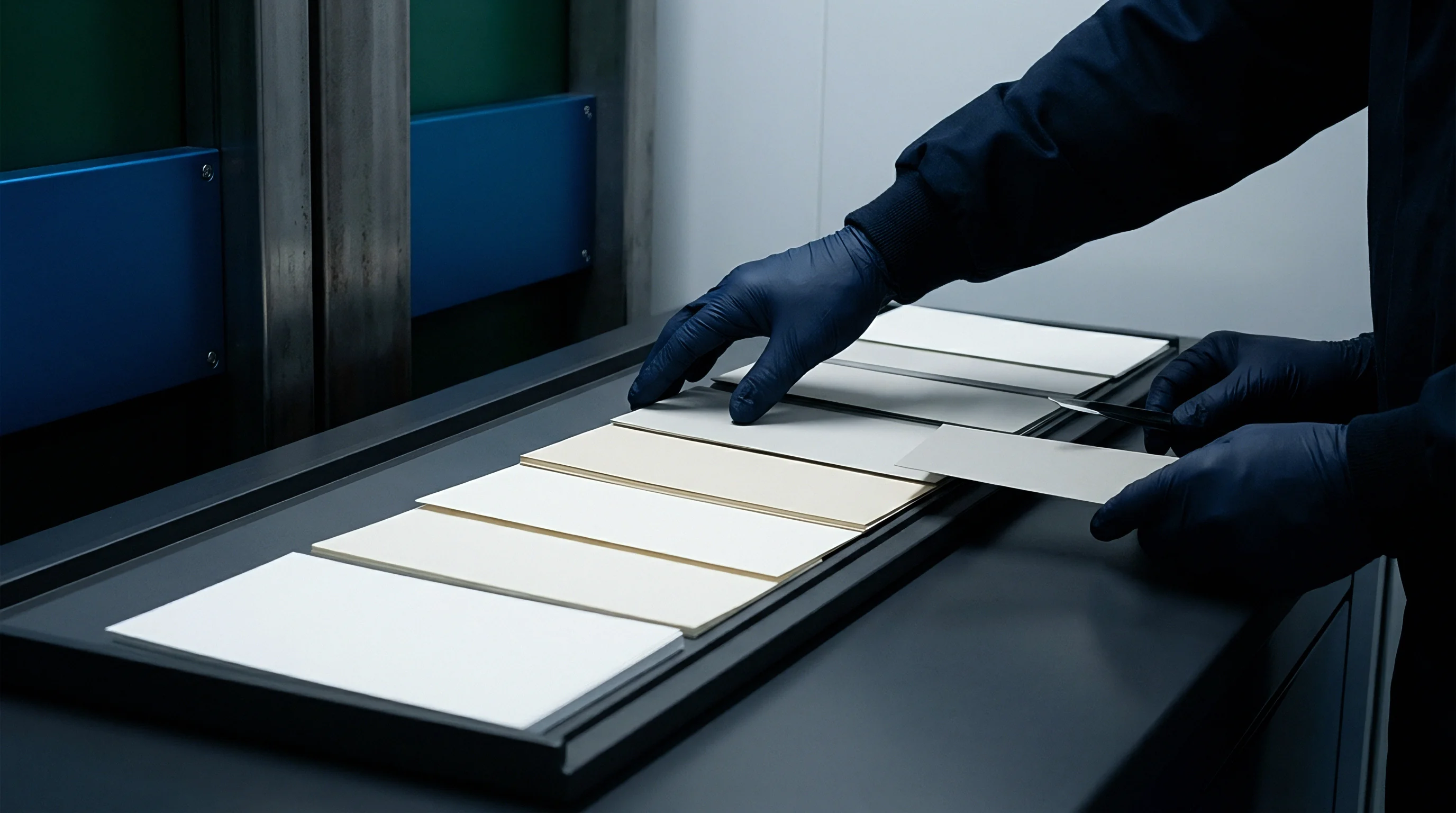
When an incoming lot shows depressed compression values, receiving protocol mandates transferring the 500 pulled sample blanks to an environmental chamber maintained strictly at ISO 187 conditions for twenty-four hours. Testing unconditioned samples produces invalid data that voids contractual rejection claims against paper converters. If board fails Edge Crush Resistance testing after twenty-four hours of ISO conditioning, structural under-specification or improper furnish blending at the paper mill stands verified.
Pre-conditioning corrugated board samples at low humidity before full chamber stabilization prevents hysteresis from skewing ultimate moisture equilibrium measurements.
Governance

What Exclusions Break Recycled Content Claims?
Acceptance testing for sustainable packaging includes paper certification and environmental claim defense alongside physical burst or crush metrics. Under the EU Packaging and Packaging Waste Regulation, commercial brand owners face escalating mandatory recycled content thresholds and heavy financial penalties for unsupported environmental statements. If a carton delivery arrives stamped with an FSC Recycled claim or a specific post-consumer waste percentage mark, the receiving inspector validates the transaction paper trail before releasing the shipment into manufacturing inventory.
Chain-of-custody tracking collapses when receiving docks accept delivery notes lacking matching claim codes. An FSC Mix or FSC Recycled carton purchase demands that the supplier invoice and delivery slip explicitly cite the supplier valid FSC Certificate Code and the exact claim associated with each line item. If an invoice lists plain kraft cartons without the certified claim line, those cartons cannot support a verified recycled packaging claim in the company annual environmental balance sheet.
The physical delivery may contain genuine recycled fiber, yet the missing documentary link creates commercial liability under consumer transparency regulations.
A certificate code checked against a public register protects an intake shipment only when the supplier invoice matches the line-item claim text verbatim.
Inspectors follow an explicit verification sequence when reviewing incoming certified paperboard packaging dossiers:
- Confirm the active status of the converter FSC or PEFC certificate on the public registry database.
- Audit the product schedule of the certificate to confirm that corrugated packaging and folding cartons sit within the validated scope.
- Cross-examine the bill of lading and commercial invoice to confirm that the unique certificate registration number appears on the document face.
- Verify that the specific claim type, such as FSC Mix Credit or PEFC Certified seventy percent, attaches directly to the itemized product description.
- Check the physical cartons within the sample pull to confirm that printed certification logos contain the assigned on-pack license code.
A supplier invoice that omits the specific certification claim transfers full compliance liability to the downstream brand owner when regional trading standards authorities demand documentation for recycled packaging claims.

Dossier
A lot acceptance inspection yields an intake dossier containing quantitative physical data, calculated defect tallies, and documentary proof. When an inspector identifies eleven Major defects in an ISO 2859-1 Code Letter N sample, the lot triggers an official Notice of Non-Conformance. The buyer commercial team freezes payment terms, flags the lot in the enterprise resource planning ledger, and issues a formal quarantine hold.
The supplier must receive the primary test data, including raw micrometer measurements, photographic records of joint bond failures, and environmental conditioning logs.
Commercial contracts dictate the financial resolution of rejected packaging lots. The buyer issues a debit note for sortation labor when internal packing lines must operate without delivery delays. If the defect rate exceeds the Rejection Number substantially, the supplier covers full return freight, scrap handling fees, and expedited replacement runs using certified virgin pulp liners.
Without an unbroken sampling log and documented Acceptance Quality Limit math, suppliers easily overturn receiving dock rejections by claiming unrepresentative sampling methods or improper warehouse conditioning.
Standard packaging supply agreements stipulate that the buyer sampling dossier serves as primary evidence in dispute proceedings unless the supplier demands independent third-party laboratory arbitration within five business days of formal notice.