Calculating Mechano Sorptive Creep Acceleration Factors for Recycled Fluting
Calculating mechano sorptive creep acceleration factors for recycled fluting requires modeling cyclic moisture flux to adjust structural box safety margins.

Kinetics
When paperboard is loaded in a fluctuating atmosphere, it deforms much faster than under stable humidity. Known as mechano-sorptive creep, this effect hastens structural failure in corrugated packaging during transport. As ambient moisture rises and falls, water molecules move into and out of the cellulose cell wall, breaking and reforming intermolecular hydrogen bonds under load.
This continuous moisture flux induces localized micro-slip across the fibrillar network, building up irreversible strain over successive sorption cycles.

Microstructural Sorption Dynamics
Cellulose fibers in containerboard swell unevenly as they absorb moisture. Tensile and compressive loads alter the sorption equilibrium, shifting the threshold where structural slip begins. In virgin hardwood semi-chemical fluting, intact lignin-carbohydrate complexes limit cell wall swelling and suppress micro-structural sliding during humidity shifts.
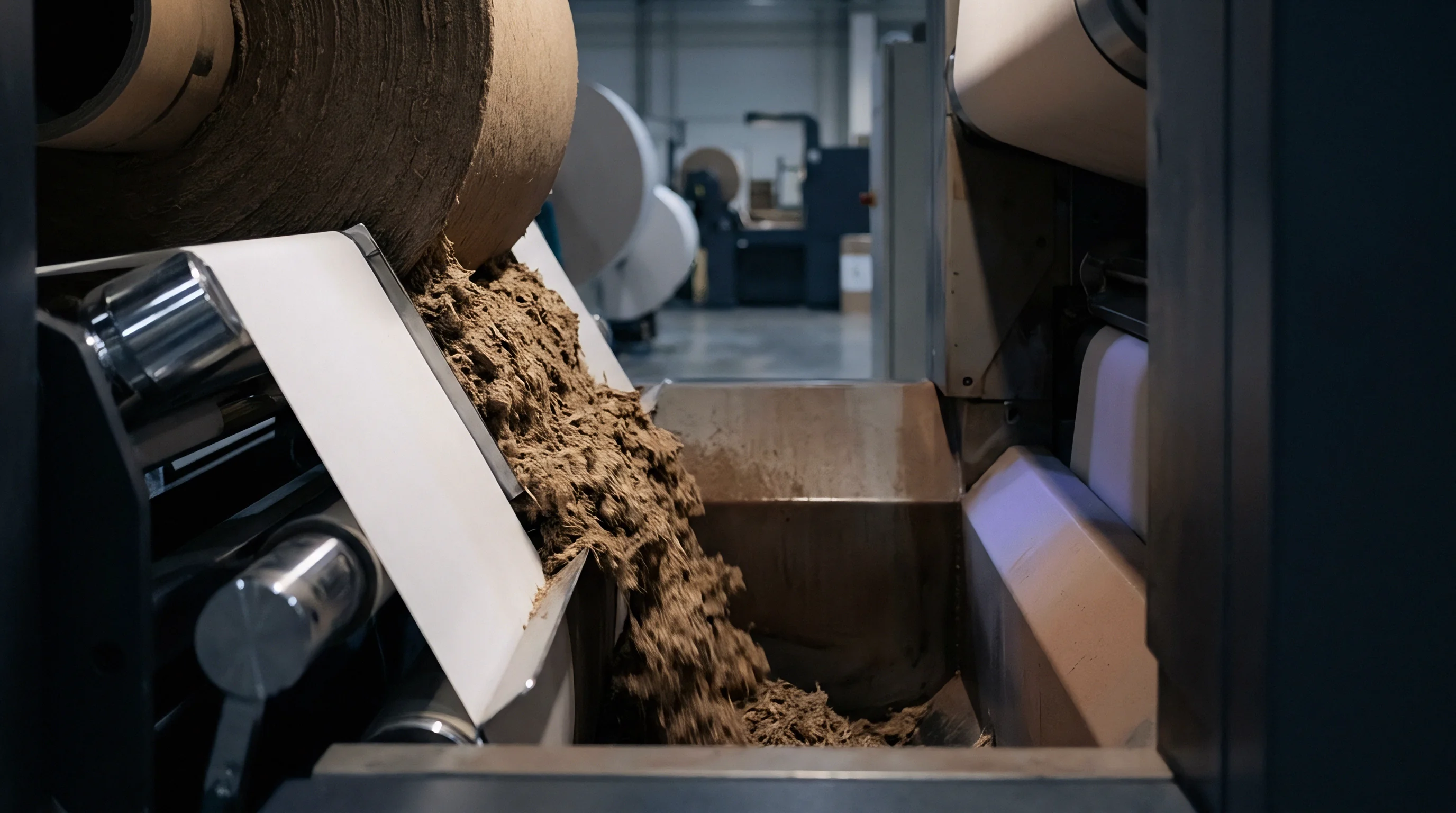
By contrast, recycled fluting ~ made largely from old corrugated containers ~ lacks this restraint because repeated pulping and chemical degradation break down those structural bonds.
Repeated wetting and drying cycles cause fiber hornification, an irreversible closure of internal pores within the fiber wall that lowers internal surface area, water retention, and flexibility. Short fibers and fines build up in recycled stock, creating a higher density of inter-fiber joints. Under cyclic relative humidity, these rigid short-fiber interfaces lack the viscoelastic compliance of virgin stock, focusing shear stress straight onto starch bonds and hydrogen links.
At ninety percent relative humidity and forty degrees Celsius, recycled fluting creep rates double compared to fifty percent ambient condition.
Sorption kinetics vary significantly between steady high humidity and active cycling. At a constant ninety percent relative humidity, paper reaches equilibrium moisture content, and creep rates settle into a predictable secondary phase. When humidity swings between fifty percent and ninety percent, however, moisture movement never stops.
Each absorption and desorption cycle continuously breaks hydrogen links and triggers fresh transient slip before the network can stabilize, pushing cumulative strain three to eight times higher than under static conditions.

Failure Modes in Recycled Containerboard
Fluting layers carry vertical compressive loads while keeping the outer linerboards separated. Under mechano-sorptive conditions, the structural failure of fluting follows specific physical pathways tied to furnish purity and refining history.
- Inter-fiber Bond Dislocation occurs when moisture flux weakens surface starch and hydrogen bonds, allowing adjacent recycled fibers to slip past one another under transverse compression.
- Flute Profile Asymmetry develops as differential creep between the inner and outer radius of the corrugation wave causes geometric distortion, lowering section modulus.
- Cell Wall Delamination takes place inside heavily hornified recycled fibers where internal stress concentrations shear the weakened secondary cell wall layers.
- Micro-buckling of Flute Crests appears at stress concentration points where local moisture accumulation reduces short-span compressive strength below applied load limits.
Fluting made from heavily recycled stock requires larger safety margins than virgin semi-chemical grades when assigned to uncontrolled transport climates.


Span
Short-term compressive testing under standard, static laboratory conditions does not predict long-term performance in fluctuating ambient humidity. Standard conditioning at twenty-three degrees Celsius and fifty percent relative humidity sets baseline short-span compressive strength under ISO 9895 or TAPPI T 839, but these bench measurements overlook the transient moisture flux behind field stacking failures. Reliable acceleration factors require protocols that measure strain accumulation directly under dynamic humidity regimes.
Cyclic Humidity Bench Testing
Dynamic creep testing requires environmental chambers that can cycle relative humidity rapidly while maintaining a constant mechanical load. The test specimen ~ either fluting paper or assembled corrugated board ~ is mounted in clamps connected to a load cell and a high-resolution displacement transducer. Applied loads typically run between twenty percent and forty percent of the static short-span compressive strength or box compression test value.
Relative humidity inside the chamber cycles between fifty percent and ninety percent over set intervals, usually three to six hours per complete cycle. Keeping temperature fixed at twenty-three degrees Celsius isolates moisture sorption from thermal expansion. Continuous displacement tracking records initial elastic deformation, viscoelastic creep, and the transient mechano-sorptive creep rate across each humidity ramp.
Doubling the amplitude of relative humidity cycles quadruples the rate of strain accumulation in recycled containerboard.
Procedure for Calculation of Acceleration Factors
Determining the dimensionless mechano-sorptive creep acceleration factor requires comparing creep compliance rates in static versus cyclic humidity. The following laboratory sequence yields this parameter:
- Cut representative fluting specimens in the machine direction and cross direction according to ISO 186 sampling standards.
- Condition samples at twenty-three degrees Celsius and fifty percent relative humidity for twenty-four hours to achieve moisture equilibrium.
- Determine baseline ultimate compressive strength using short-span compression testing per TAPPI T 839.
- Mount secondary specimens in the dynamic creep apparatus under a constant static load equal to thirty percent of ultimate strength.
- Maintain constant fifty percent relative humidity for twelve hours to record baseline viscoelastic creep strain.
- Initiate relative humidity cycling between fifty percent and ninety percent with a cycle duration of four hours for a total test duration of ninety-six hours.
- Record total strain continuously at one-minute intervals using linear variable differential transformers.
- Extract the transient creep compliance slope during moisture uptake periods and divide by static compliance slope at equivalent average moisture content.
The table below summarizes measured creep metrics for common fluting furnishes exposed to cyclic humidity regimes.
| Fluting Furnish Grade | Fibre Furnish Composition | Static STFI (kN/m) | Static Creep Compliance (1/GPa) | Cyclic Strain Rate (%/hr) | Acceleration Factor (alpha_MS) |
|---|---|---|---|---|---|
| Virgin NSSC | 100% Semi-Chemical Hardwood | 2.85 | 0.12 | 0.018 | 2.8 |
| Semi-Recycled Waste | 50% NSSC / 50% OCC | 2.30 | 0.18 | 0.042 | 4.3 |
| Recycled Fluting (Wellenstoff) | 100% Mixed OCC / Waste Paper | 1.95 | 0.26 | 0.088 | 6.7 |
| High-Density Sized Recycled | 100% OCC + Surface Starch | 2.25 | 0.21 | 0.061 | 5.1 |
Elevated initial short-span compression values do not guarantee long-term box performance across relative humidity fluctuations during ocean transit.

Model
Calculating transient strain components isolates moisture flux effects from background viscoelastic creep. Under combined mechanical stress and changing relative humidity, total creep strain breaks down into three components: elastic strain, viscoelastic strain, and mechano-sorptive strain.
Constitutive Equations for Transient Strain
Total strain at time t follows the structural summation expression:
epsilon(t) = epsilon_elastic + epsilon_viscoelastic(t) + epsilon_mechano_sorptive(t)
Elastic strain responds instantly to load based on the elastic modulus. Viscoelastic strain evolves over time under constant moisture. Mechano-sorptive strain, by contrast, accumulates only while moisture content is actively changing.
The rate of mechano-sorptive strain couples directly to absolute moisture flux and applied stress:
d(epsilon_MS)/dt = alpha_MS abs(dm/dt) sigma
Here, alpha_MS is the mechano-sorptive creep acceleration factor, abs(dm/dt) is the absolute rate of moisture change per unit time, and sigma is the applied compressive stress. In recycled fluting, alpha_MS rises with each recycling loop, reflecting weaker inter-fiber bonding and higher internal strain energy release during moisture transfer.

Does Recycled Furnish Require Higher Creep Multipliers?
Recycled containerboard degrades much more severely under dynamic moisture conditions than virgin semi-chemical fluting. Virgin semi-chemical hardwood fluting retains native lignin networks that resist internal micro-shear, whereas recycled stock consists of fibers damaged by repeated repulping, refining, and pressing. High fines content in recycled sheets expands the surface area available for water absorption, raising the local moisture change rate dm/dt during any humidity shift.
Estimating structural load retention in recycled fluting therefore requires higher alpha_MS values to avoid underestimating field failures.
Consider an engineering comparison between a 100 percent virgin semi-chemical fluting sheet (135 g/m²) and a 100 percent recycled fluting sheet (140 g/m²). Assume a forty-tonne containerized shipment of boxes stored for thirty days in a microclimate undergoing two daily relative humidity cycles between fifty percent and ninety percent. Let the applied compressive stress on the bottom row equal thirty percent of initial short-span compressive strength, accounting for initial sorption reductions from surface sizing.
For virgin NSSC fluting, the benchmark alpha_MS is 2.8, with an average moisture flux abs(dm/dt) of 0.012 kg/kg/hour during humidity transitions. Over seven hundred twenty hours, cumulative mechano-sorptive strain reaches 1.45 percent, retaining seventy-two percent of initial stacking strength.
For recycled fluting, benchmark alpha_MS reaches 6.7, with an average moisture flux abs(dm/dt) of 0.018 kg/kg/hour driven by higher hydrophilic fines. Under identical stress and cycling, cumulative mechano-sorptive strain reaches 4.34 percent. This exceeds the critical deflection limit of the flute geometry, triggering micro-buckling in the flute walls and dropping retained stacking strength to forty-one percent of its initial value.
ISO 22424 requires continuous deformation tracking during relative humidity transitions between fifty percent and ninety percent.
Relying strictly on initial static compression strength leads to significant overestimation of box load capacity when specifying recycled fluting grades.
| Parameter | Virgin NSSC (135 g/m²) | Recycled Fluting (140 g/m²) | High-Starch Recycled (160 g/m²) |
|---|---|---|---|
| Initial STFI Index (Nm/g) | 21.1 | 13.9 | 14.1 |
| Creep Acceleration Factor (alpha_MS) | 2.8 | 6.7 | 5.1 |
| Moisture Flux Rate abs(dm/dt) (1/hr) | 0.012 | 0.018 | 0.015 |
| 30-Day Cumulative Strain (%) | 1.45 | 4.34 | 2.87 |
| Retained Box Compression Strength (%) | 72% | 41% | 58% |
While sieve analysis confirms fiber distribution, applying starch surface treatments to recycled fluting reduces moisture sorption rates, lowering absolute moisture flux and dampening cumulative strain during atmospheric transitions.


Audit
Verifying recycled containerboard claims requires tracing fiber origin through chain of custody documents while verifying structural performance against transport mandates. FSC Recycled 100%, FSC Mix, and PEFC claims track fiber mass balances through mill operations, but they do not guarantee mechanical performance under environmental stress. Environmental audits should therefore be paired with material qualification protocols to confirm that recycled stock meets safety criteria set by regional packaging directives.

Furnish Qualification and Chain of Custody
Chain of custody certificates verify that post-consumer waste inputs match percentage or credit accounting ledgers. FSC-STD-40-004 requires strict physical separation or credit accounting during recycled pulp runs, but sourcing documentation confirms origin without addressing material performance. High recycled content often correlates with shorter average fiber length and higher fine fractions ~ factors that directly increase the mechano-sorptive creep acceleration factor alpha_MS.
The European Union Packaging and Packaging Waste Regulation (PPWR) mandates structural optimization for transport packaging. Article 9 requires packaging weight and volume to be kept to the minimum needed to ensure safety, functionality, and load stability. Over-packaging to offset unknown fiber degradation conflicts with these limits, so structural safety margins ought to be calculated using verified alpha_MS factors rather than arbitrary grammage increases.
Recycled fluting furnished with low starch pickup shows rapid compression collapse under cyclic moisture flux.
Building a robust audit trail for recycled fluting requires pairing chain of custody certificates with batch-specific bench testing. Technical compliance dossiers should match raw material origin receipts against ISO 22424 creep test certificates.
- Chain of Custody Certification Scope verifying mill registration, scheme audit dates, and accurate transfer system accounting for recycled post-consumer waste.
- Fiber Length Distribution Record obtained via optical fiber analysis confirming minimum average weighted fiber length above 0.85 millimeters.
- Starch Additive Quantification Report verifying enzymatic or chemical surface starch application rates exceeding twenty grams per square meter to control moisture absorption rates.
- Cyclic Creep Compliance Docket documenting measured alpha_MS acceleration factors under ISO 22424 fifty-to-ninety percent relative humidity cycling regimes.
| Regulatory / Scheme Standard | Scope of Certificate / Document | Mechanical Integrity Coverage | Required Technical Dossier Evidence |
|---|---|---|---|
| FSC-STD-40-004 | Chain of Custody Fibre Origin Tracking | Excluded | Transfer / Credit Ledger Receipts |
| PEFC ST 2002:2020 | Fibre Sourcing Chain of Custody | Excluded | Percentage Claim Verification Documents |
| EU PPWR Article 9 | Transport Box Weight and Volume Minimization | Mandated | Optimized Load Stability Calculation Report |
| ISO 22424 / ISO 12048 | Transport Packaging Creep Performance | Mandated | Dynamic Humidity Creep Test Certificate |
Incorporating ISO 12048 test conditioning under Clause 6.3 into procurement contracts shifts liability for structural failure back to suppliers who deliver fluting below specified performance thresholds.

Margin
Commercial box design relies on structural safety factors to prevent pallet collapse during international freight. Standard McKee formulas estimate ultimate box compression strength (BCT) from edgewise compressive strength (ECT), caliper, and box perimeter:
BCT = 5.876 ECT sqrt(U d)
Where U represents box perimeter and d is corrugated board thickness. Because this standard equation assumes baseline room conditions, designers divide calculated BCT by an environmental safety factor Sf to account for transport creep in dynamic microclimates.

Adjusting McKee Multipliers for Humid Freight
Conventional design tables specify safety factors between 1.5 and 2.0 for standard warehousing. But when 100 percent recycled fluting is used in tropical corridors or ocean reefers exposed to continuous humidity swings, those standard factors prove inadequate. The higher mechano-sorptive creep acceleration factor of recycled stock requires modifying the safety factor calculation dynamically.
Modified safety factor calculations integrate alpha_MS directly into the structural multiplier:
Sf_modified = Sf_base (1 + k_env alpha_MS Delta_RH)
Here, Sf_base is the static loading safety factor (typically 1.6), k_env is the microclimate severity constant (0.015 for ocean shipping), alpha_MS is the measured fluting acceleration factor, and Delta_RH is peak relative humidity amplitude in transit. Replacing virgin NSSC fluting (alpha_MS = 2.8) with recycled fluting (alpha_MS = 6.7) in an environment with a forty percent humidity swing increases the required safety factor from 1.87 to 2.24.
Failing to adjust these design multipliers when specifying recycled fluting leads to lower-box buckling in pallet stacks, load tipping, port rejections, and unrecoverable freight claims.