Calculating Cross Direction Bending Stiffness and Short Span Compression in Boxboard
Cross direction bending stiffness scales with the cube of ply thickness, while short span compression governs vertical carton stack strength under ISO 9895.

Deflection
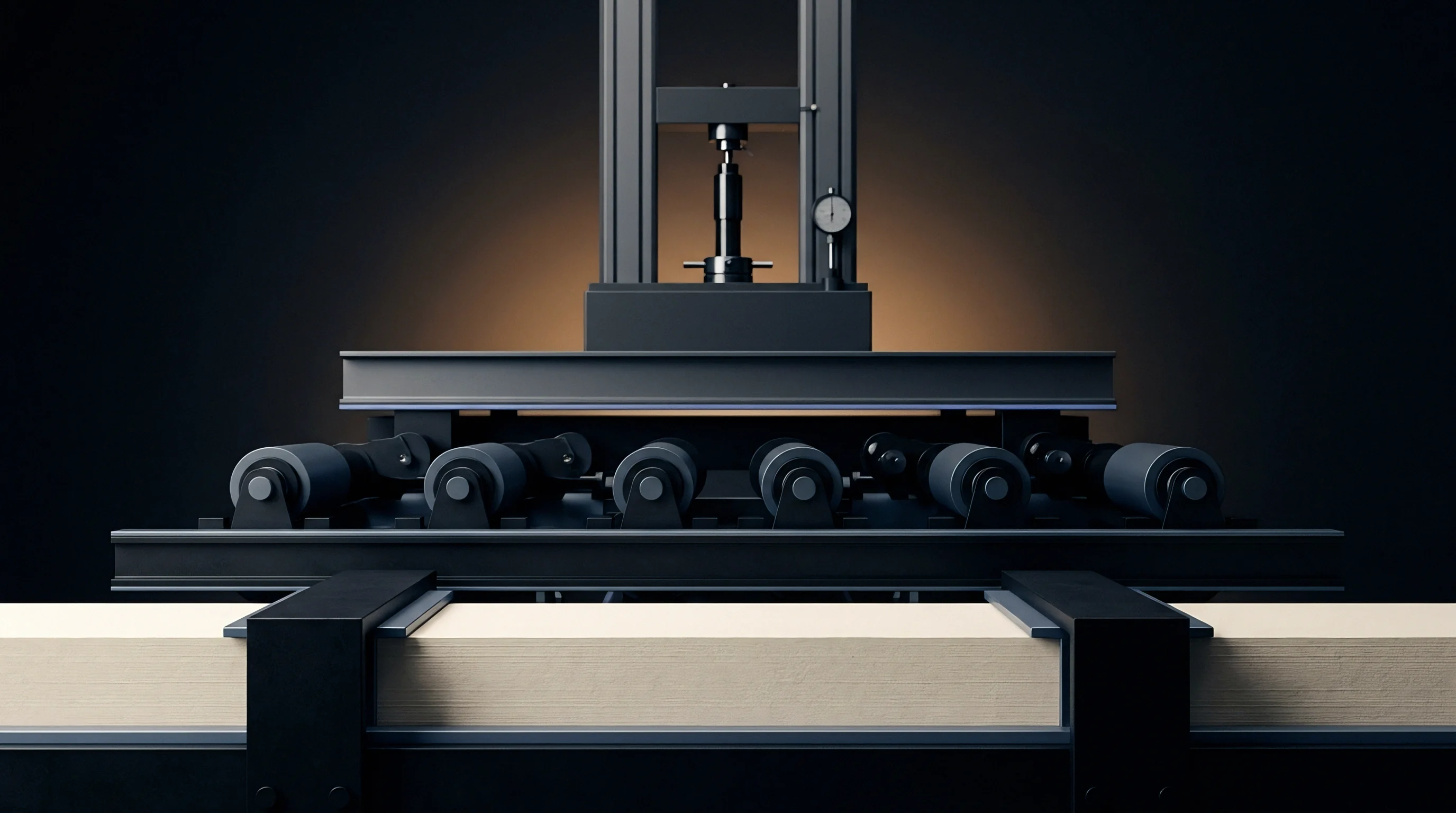
Standard boxboard specifications record bending resistance in millinewtons or bending moment in millinewton-metres under ISO 2493-1 at a 15-degree angle over a 50-millimetre test length. Evaluating the structural capacity of a folding carton requires translating those bench force readings into pure cross direction bending stiffness, denoted as S_b,CD and expressed in Newton-metres or millinewton-metres. The fundamental relationship links the applied bending moment to sheet curvature, isolating material elastic rigidity from geometry effects.
Pure bending stiffness per unit sheet width equals the product of the cross direction elastic modulus, E_CD, and the area moment of inertia per unit width, I. Because the area moment of inertia per unit width for a solid sheet equals caliper cubed divided by twelve, thickness dominates stiffness outcomes. A ten percent drop in board thickness reduces bending resistance by approximately twenty-seven percent.
Cross direction values consistently lag machine direction measurements because fibre orientation on the paper machine wire aligns preferentially with the web flow direction. Machine direction to cross direction stiffness ratios typically range from 1.8 to 2.2 in virgin solid bleached sulphate, and from 2.5 to 3.5 in multi-ply folding boxboard or coated recycled board. When calculating S_b,CD from resonant stiffness instruments under ISO 5628, the test measures natural frequency across an oscillating strip, yielding pure elastic stiffness free from clamping shear distortion.
When calculating S_b,CD from a two-point deflection test under ISO 2493-1, the calculation uses the measured bending force F in Newtons, strip width b in metres, bending angle theta in radians, and bending length L in metres through the elastic beam deflection formula: S_b,CD = (60 F L^2) / (pi b theta). Fibre orientation governs elastic stiffness.
A 350 g/m² folding boxboard at 23 °C and 50 percent relative humidity achieves a cross direction short span compression value of 21.5 kilonewtons per metre under ISO 9895.

Two-Point and Four-Point Test Geometries
Laboratory measurements follow either a fixed clamp with an angled loading edge or a support span loaded symmetrically at two interior points. The standard two-point method introduces shear stress and local clamping compression near the jaws, which artificially inflates measured deflection in high-bulk boxboard grades exceeding 400 micrometres in thickness. Four-point bending under ISO 5628 applies pure bending moments across the central evaluation span without transverse shear forces.
Converting operations using two-point L&W or Taber testers observe lower calculated elastic modulus values because the recorded displacement includes transverse shear strain alongside pure flexural bending. When specifying substrate performance for automated cartoning lines, procurement teams specify whether stiffness data derives from resonant frequency, two-point deflection, or four-point pure bending.

Deriving Elastic Modulus across the Cross Direction
Pure board stiffness equals the product of elastic rigidity and the area moment of inertia per unit width. For a homogeneous single-ply sheet, calculating the apparent cross direction elastic modulus E_CD requires dividing twelve times the calculated bending stiffness S_b,CD by the cube of sheet thickness t: E_CD = 12 S_b,CD / t^3. In multi-ply boards, apparent modulus represents a composite figure rather than a single material constant, because outer plies contain high-density chemical pulps whereas core plies contain low-density mechanical pulps.
Thickness controls panel bulge limits.
| Grade Designation | Grammage (g/m²) | Caliper (µm) | CD Bending Stiffness (mN·m) | CD SCT (kN/m) | Geometric Ratio (SCT/Stiffness) |
|---|---|---|---|---|---|
| Solid Bleached Sulphate (SBS) | 300 | 380 | 14.2 | 5.8 | 0.408 |
| Folding Boxboard (FBB) | 300 | 490 | 28.5 | 4.9 | 0.172 |
| White Lined Chipboard (WLC) | 300 | 410 | 15.8 | 4.4 | 0.278 |
| Solid Unbleached Board (SUB) | 300 | 420 | 18.1 | 6.4 | 0.354 |
| Folding Boxboard (FBB) | 350 | 580 | 46.2 | 5.9 | 0.128 |
Converting lines running high-speed carton erectors encounter carton panel bowing whenever cross direction stiffness falls below 12 millinewton-metres on panels wider than 120 millimetres. The board panel bows outward under internal product pressure, preventing vacuum cups from establishing reliable seal suction during cartoning machine cycles.

Clamp
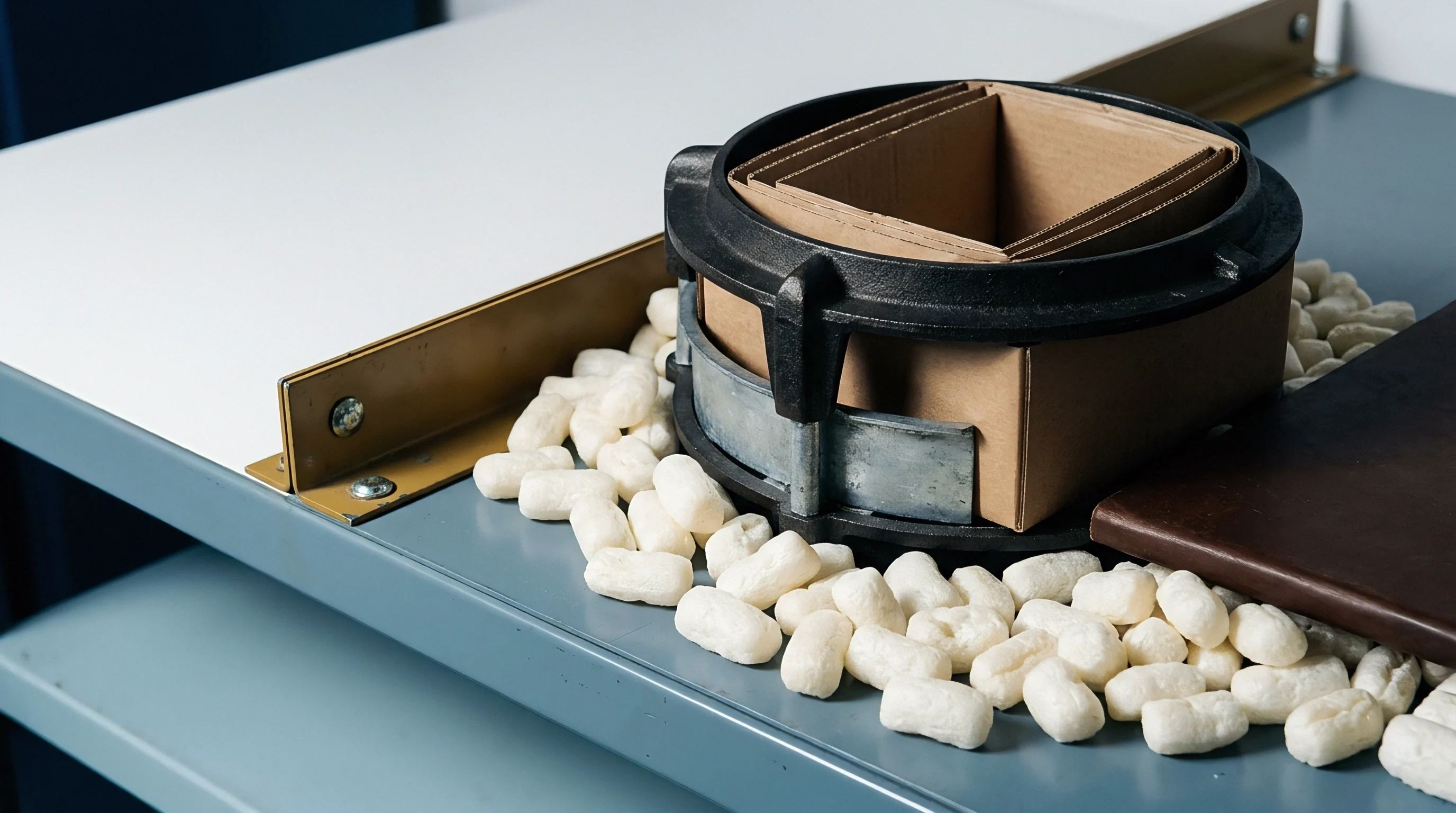
Short span compression testing measures the maximum compressive force per unit width that a board test piece bears before structural collapse occurs under ISO 9895. The instrument holds a 15-millimetre-wide strip of boxboard between two pneumatic jaws set at an axial separation distance of exactly 0.70 millimetres. This minute gauge length suppresses Euler column buckling, forcing the cellulose matrix to fail under pure compressive yield.
Testing boxboard along the cross direction produces the CD short span compression test value, SCT_CD, expressed in kilonewtons per metre. Calculating the intrinsic compressive index requires dividing SCT_CD by basis weight, yielding Newton-metres per gram. While bending stiffness dictates carton panel bulge resistance under light interior pressure, SCT_CD governs the ultimate stacking load capacity of finished folded cartons in warehouse pallets.
Microscopic cell structure dictates compressive failure behavior. Under cross direction compression, individual wood fibres experience lateral crushing perpendicular to their longitudinal axes, which causes micro-fibril collapse at significantly lower loads than axial compression along the machine direction. The cross direction short span compression index ranges from 14 to 18 Newton-metres per gram in premium chemical pulp liners, but drops to 9 to 13 Newton-metres per gram in recycled pulp furnishes containing shortened fibres and high mineral filler fractions.
The ratio drops under humidity.

Compressive Resistance across the Gauge Gap
Pulp fibres exhibit anisotropic load capacity, with axial yield strength far exceeding transverse compression limits. In virgin kraft pulps, hemicellulose bridges and inter-fibre hydrogen bonds distribute compressive stress throughout the network. In recycled fluting or duplex board, dried fibre walls exhibit internal hornification, limiting bonding surface area and reducing transverse shear resistance between contiguous plies.
Delamination destroys compression capacity.
- Inter-fibre shearing occurs between adjacent fibre lamellae when shear stress exceeds local hydrogen bond density, creating microscopic slip planes before gross sheet collapse.
- Cell wall buckling develops within hollow fibre lumens as thin-walled springwood fibres collapse transversely under compressive stress fields.
- Z-direction delamination splits multi-ply sheet interfaces where tensile stress peaks in the transverse plane during compressive crushing.
- Fibre micro-kinking produces localized plastic deformations across cellulosic fibrils, inducing irreversible creases across the test strip.

Failure Mechanics along the Fibre Axis
High-yield unbleached softwood furnish displays microscopic dislocation bands in cell walls long before gross delamination tears the test coupon. Clamping pressure settings in ISO 9895 instruments exert profound influence over recorded values. Clamping force must remain calibrated between 2300 and 2500 Newtons; insufficient clamping allows sample slippage within the serrated jaws, artificially lowering the compressive peak, while excessive pressure crushes the bulky middle plies of folding boxboard, initiating premature structural breakdown inside the test gap.
Pulp fibres buckle internally first.
Clause 7.2 of ISO 2493-1 rejects stiffness measurements conducted on test strips exhibiting visible delamination or diagonal creases.
Mill technical sales representatives often argue that lower SCT values on recycled board are compensated by running slightly heavier basis weights, yet the converter discovers that heavier grammages fail to restore the lost top-to-bottom pallet compression once warehouse relative humidity climbs above sixty percent.


Bulking
Folding boxboard layers virgin bleached chemical pulp on outer surfaces while packing mechanical stone groundwood or chemi-thermomechanical pulp into the core. This sandwich construction maximizes flexural rigidity at minimum total basis weight by exploiting the parallel axis theorem from classical beam mechanics. The high-modulus chemical pulp liners sit at the maximum distance from the neutral bending axis, bearing tensile and compressive stresses during bending.
The low-density mechanical pulp core acts as an internal shear web, maintaining separation between outer plies without adding unnecessary mass. Calculating the bending stiffness of multi-ply boxboard requires segmenting the cross-section into discrete plies, calculating the individual area moment of inertia and elastic modulus for each layer, and summing their transformed rigidities.
The transformed section method establishes total bending stiffness through the formula S_b = sum(E_i I_i), where E_i is the directional elastic modulus of layer i, and I_i is the area moment of inertia of layer i about the composite neutral axis. For a symmetric three-ply board with two identical surface liners of thickness t_liner and modulus E_liner, and a core ply of thickness t_core and modulus E_core, the neutral axis sits at the precise geometric midpoint. Total caliper t equals 2 t_liner + t_core.
The area moment of inertia of the core per unit width equals t_core^3 / 12. The area moment of inertia of the two outer liners per unit width equals (t^3 – t_core^3) / 12. Surface liners dictate outer stress.

What Governs Pure Bending versus Shear Deflection?
Thick multilayer structures experience internal shear sliding between plies whenever span-to-depth ratios drop below twenty to one. When calculating the deflection of folding boxboard under load, total deflection delta combines pure flexural deflection delta_b and transverse shear deflection delta_s. In a standard two-point stiffness test with strip length L, width b, and load F, total deflection follows Timoshenko beam theory: delta = (F L^3) / (3 S_b) + (F L) / (k G A), where G represents the through-thickness shear modulus, A represents cross-sectional area, and k is the shear correction factor, typically 5/6 for rectangular cross sections.
Shear deformation lowers measured rigidity.
| Layer Component | Furnish Composition | Caliper (µm) | CD Modulus (MPa) | Moment of Inertia (m⁴/m) | CD Stiffness Contribution (mN·m) |
|---|---|---|---|---|---|
| Top Liner | Bleached Chemical Kraft | 45 | 2800 | 4.42 × 10⁻¹² | 12.38 |
| Middle Core | Chemi-Thermomechanical | 460 | 850 | 8.11 × 10⁻¹² | 6.89 |
| Bottom Liner | Bleached Chemical Kraft | 45 | 2800 | 4.42 × 10⁻¹² | 12.38 |
| Composite Sheet | Full Multi-Ply Structure | 550 | 1837 | 13.87 × 10⁻¹² | 31.65 |
| Outer liners represent 16.4 percent of total sheet thickness but generate 78.2 percent of total cross direction bending stiffness. | |||||

Multi-Ply Rigidity and Core Shear Stress
Outer liners carry tensile and compressive membrane loads while central plies keep the surface sheets apart. If the core ply lacks sufficient internal bond strength, measured by Scott Bond under TAPPI T 569, the board delaminates internally during creasing or sharp bending. A Scott bond reading below 130 Joules per square metre indicates insufficient inter-fibre cohesion within mechanical core pulp.
Under high flexural strain, the core shears along its central plane, causing the outer liners to act as two independent sheets rather than a unified composite beam. When two liners bend independently, their collective stiffness equals only the sum of their individual stiffness values, shedding over seventy percent of the composite structure’s original rigidity.

Worked Symmetric Sandwich Calculation
Assume a 350-gram folding boxboard with a total thickness of 550 micrometres, comprising two outer chemical pulp plies of 45 micrometres each and an internal mechanical pulp layer of 460 micrometres. The cross direction elastic modulus of the chemical outer plies is 2800 Megapascals, while the cross direction modulus of the bulky mechanical core is 850 Megapascals. To find total CD bending stiffness per metre width, calculate the moment contributions separately.
The core moment of inertia per metre width is (0.460 × 10^-3)^3 / 12 = 8.11 × 10^-12 m^4/m. Multiplying by core modulus 850 × 10^6 Pascals yields 6.89 × 10^-3 Newton-metres, or 6.89 millinewton-metres. The two surface plies possess an area moment of inertia equal to ((0.550 × 10^-3)^3 – (0.460 × 10^-3)^3) / 12 = 5.76 × 10^-12 m^4/m.
Multiplying by liner modulus 2800 × 10^6 Pascals yields 16.13 millinewton-metres. Core and liner contributions sum to 23.02 millinewton-metres for this component configuration, demonstrating how outer liners govern total flexural rigidity.
Whether dynamic delamination under high-speed scoring can be fully suppressed by altering core refining levels without incurring unacceptable sheet density increases remains an open industrial challenge across modern board mills.


Buckling
Compressive loading on erect folding carton panels forces the flat sheet into out-of-plane distortion governed by plate stability equations. In transport packaging, box compression test strength determines maximum pallet stack heights. For corrugated containers, the classical McKee formula estimates box compression strength from combined board edge crush test, bending stiffness, and container perimeter.
In solid folding boxboard cartons, container performance relies directly on cross direction short span compression and cross direction bending stiffness, because carton panels flex outward along their vertical creases under top-to-bottom load. Calculating folding carton compression resistance, BCT_carton, requires combining cross direction material properties with carton geometry.
The modified carton compression calculation takes the form BCT = k (SCT_CD)^alpha (sqrt(S_b,MD S_b,CD))^(1-alpha) (P)^beta, where P is the carton perimeter in millimetres, and alpha typically calibrates between 0.60 and 0.75 based on carton height and panel aspect ratio. The square root of the product of machine direction and cross direction bending stiffness provides the geometric mean bending stiffness, accounting for plate biaxial rigidity. When cartons possess wide panels with high width-to-height ratios, panel buckling dominates failure, elevating the exponent on bending stiffness.
For slender, tall cartons, the failure mechanism shifts toward pure compressive crushing along vertical corner creases, increasing the sensitivity to SCT_CD. High caliper preserves carton squareness.
Bending stiffness follows the cube of thickness while compression resistance scales linearly with furnish grammage.

McKee Formula Limits for Folding Cartons
Predicting finished carton compression strength relies on cross direction short span compression values alongside cross direction bending resistance. Classical corrugated McKee equations assume deep fluted structures where shear deflection is negligible compared to overall panel flexure. Solid boxboard lacks internal fluting; its caliper is thin relative to panel length, making local crease score damage the primary initiator of box collapse.
If die-cutting rules over-crease the hinge, local compressive stiffness plummets, rendering standard theoretical calculations overly optimistic by twenty to thirty-five percent.

Scoring Crease Retention and Panel Rigidity
Converting dies impress female channels into board surfaces to create predictable folding hinges. Creasing crushes central mechanical fibres. The ratio between the bending moment required to fold the creased hinge and the bending moment of the uncreased board defines the crease recovery or spring-back ratio.
Maintaining high carton compression strength requires preserving maximum residual rigidity adjacent to the crease line while achieving a clean ninety-degree fold along the hinge. Crease depth alters residual stiffness.
- Verify anvil clearance and counter-die matrix channel depth on the flatbed cutting platen before running production tonnage.
- Measure residual crease folding force at ninety degrees using an automated score quality tester under TAPPI T 577.
- Confirm that crease bending resistance falls between thirty and fifty percent of uncreased board bending resistance.
- Reject cartons exhibiting liner cracking or outer ply rupture along vertical corner folds during ninety-degree erection trials.
When compressive loads bear down on the assembled pack, panels that buckle outward prematurely transfer excess axial stress to the four folded vertical edges, precipitating rapid structural failure across the entire unit. Bending stiffness follows the cube of thickness while compression resistance scales linearly with furnish grammage.


Rebate
Commercial delivery contracts price boxboard by metric tonnage, whereas die-cut production schedules consume material by unit area. A procurement commitment based strictly on basis weight exposes buyers to significant financial and mechanical risks if the mill allows sheet caliper or fibre orientation to drift. If a board mill delivers stock at the heavy end of the grammage tolerance band while allowing sheet thickness to decline, the converter experiences a dual penalty: delivered sheet count per purchased tonne decreases, and carton panel stiffness plummets due to cubic thickness loss.
Sourcing specifications must tie commercial settlement directly to verified cross direction bending resistance and cross direction short span compression values.
Moisture absorption accelerates compressive failure. Basis weight drift penalizes yield. Test pieces require conditioned equilibration.
Off-spec board stalls packing lines. When moisture content increases from seven percent to eleven percent in unconditioned warehousing, short span compression values decline by twenty-five to thirty-five percent, while bending stiffness drops by eighteen to twenty-four percent. Ambient water molecules disrupt hydrogen bonds between fibres, softening the cellulosic framework and precipitating premature stacking collapse on palletized goods.
Cartons fail in warehouse stacks when panel bulge exceeds half of sheet caliper under vertical load.

Goods Inward Moisture and Caliper Drift
Delivered pallets entering a conversion plant undergo immediate basis-weight checks under conditioned relative humidity. Quality inspection routines require extracting three full-width sheets from the center of selected reels or pallets, conditioning test specimens under ISO 187 at 23 °C and 50 percent relative humidity for a minimum of twenty-four hours before running bench verification. Mills operating fast multi-ply machines often adjust calender roll nip pressure to smooth surface roughness, inadvertently sacrificing caliper and destroying cross direction bending stiffness without altering certified sheet grammage.

Contractual Thresholds for Technical Lot Rejection
Procurement documents specify rigid performance envelopes for short span compression and bending moments. Contracts lacking explicit mechanical property thresholds leave converters vulnerable to grade substitution, where mills ship recycled-content substrates under bleached board trade names. Technical annexes incorporate commercial debit formulas that penalize tonnage drifting below minimum physical standards.
- Cross direction bending resistance measured under ISO 2493-1 must not fall more than five percent below published specification nominals on any delivered batch.
- Short span compression strength measured under ISO 9895 across the cross direction must maintain a process capability index Cpk exceeding 1.33 across delivered rolls.
- Sheet caliper variations exceeding four percent of target thickness trigger automatic invoice debit calculations proportional to lost carton yield per metric tonne.
- Equilibrium moisture content outside the contractual envelope of 6.5 to 8.5 percent justifies immediate rejection of the entire delivered transport container.
Technical purchase contracts stipulate that if delivered cross direction bending stiffness or short span compression falls below guaranteed minimum thresholds across two consecutive audit samples, the commercial settlement automatically defaults to a fifteen percent unit price rebate on the affected batch.