Corrugated Flute Instability under Dynamic Maritime Humidity Environments
Dynamic ocean humidity triggers mechano-sorptive creep in corrugated fluting, requiring dynamic ECT safety derating and moisture-resistant adhesive specifications.
Deck
Standard laboratory conditioning under ISO 187 specifies twenty-three degrees Celsius and fifty percent relative humidity. Closed ocean freight containers crossing equatorial shipping lanes generate environmental conditions far removed from those bench settings. Solar radiation on top container decks drives internal temperatures above sixty degrees Celsius during daylight hours.
Nighttime radiational cooling drops ambient steel temperature rapidly, pushing internal relative humidity to ninety-eight percent and triggering liquid condensation on ceiling panels.
Moisture enters through exposed flute edges. Standard corrugated boxes undergo continuous moisture exchange with surrounding air across trans-oceanic voyages lasting eighteen to thirty-five days. Relative humidity inside the cargo space cycles dynamically twice every twenty-four hours: a heat-driven desorption phase followed by a moisture saturation phase as air cools past dew point.
| Paper Grade Type | ISO 187 EMC (%) at 50% RH | Tropical EMC (%) at 85% RH | Saturated EMC (%) at 95% RH | Cross-Direction Swell (%) |
|---|---|---|---|---|
| Unbleached Kraftliner (175 gsm) | 7.2 | 13.8 | 21.4 | 1.42 |
| Recycled Testliner (170 gsm) | 8.1 | 15.2 | 24.8 | 2.15 |
| Semi-Chemical Hardwood Fluting (127 gsm) | 6.8 | 12.9 | 19.8 | 1.18 |
| Recycled Medium Fluting (120 gsm) | 7.9 | 14.9 | 23.6 | 1.88 |
Paperboard strength decays non-linearly as equilibrium moisture content rises. Virgin unbleached kraftliner maintains structural fiber bonds up to twelve percent internal moisture content. Recycled paperboard grades absorb ambient moisture faster due to short fiber fraction density and fine particle distribution within the sheet matrix.
High absorption rates accelerate dimensional expansion across the cross direction, altering the precise wave geometry of corrugated flutes.
Relative humidity cycling between sixty and ninety-five percent accelerates creep deformation in loaded paperboard five times faster than static exposure at ninety percent relative humidity.
Container rain drops directly onto top-tier pallets when cargo lacks vapor barrier liners or desiccant coverage. Top-deck thermal swings transform closed freight boxes into dynamic moisture pumps, drawing damp marine air into the internal volume of every package through structural gaps and closure seams. Temperature drops trigger interior condensation.
Mills frequently attribute ocean cargo collapse to unrecorded stacking overhang or improper pallet assembly at the loading dock. Their technical documentation relies on static laboratory compression data measured at standard atmospheric equilibrium.

Sorption
Cellulose fibers absorb water molecules through hydrogen bonding at open hydroxyl sites along the polymer chain. Water acts as a plasticizer within the amorphous regions of hemicellulose and cellulose. As water molecules penetrate the cell wall, inter-fiber distance expands, relaxing pre-stressed internal bonding networks created during paper drying on the paper machine machine rolls.
Directional orientation during web formation dictates paper moisture movement. Machine direction fibers resist axial extension, directing hygro-expansion into the cross direction thickness and width. Corrugated flute architecture relies on consistent arched geometries to convert compressive loads into membrane stress along the flute sidewalls.
Cross-direction expansion forced by moisture intake disrupts this arch curvature, shifting structural load distribution away from the vertical axis.

Anisotropic Swelling and Fiber Matrix Disruption
Dimensional shifts alter flute pitch and flute height non-uniformly along the packaging panel. Semi-chemical hardwood fluting utilizes short, stiff birch or beech fibers bonded with high residual lignin, offering natural resistance to cell wall collapse. Recycled medium contains broken fibers, secondary fines, and residual starch, creating micro-voids that accelerate water vapor diffusion.
Disruption occurs primarily at the flute tips where paperboard undergoes sharp deformation during corrugation. High bending strain at the flute crest creates micro-fractures in the outer fiber layer. Water vapor concentrates within these stressed zones, reducing local elastic modulus and triggering asymmetric profile deformation across the board surface.
Mechano Sorptive Creep Acceleration Factors
Mechano-sorptive creep occurs when paperboard carries a mechanical load while undergoing active moisture exchange with surrounding air. Under static relative humidity, cellulose molecules rearrange slowly under stress. Under dynamic humidity cycling, water vapor movement through the paper matrix breaks and reforms hydrogen bonds continuously.
Each moisture cycle allows load-bearing cellulose chains to slide past one another, accumulating permanent plastic deformation.
Palletized boxes sitting at the bottom of a container stack sustain continuous top load stress from stacked cargo. Dynamic maritime humidity cycling forces continuous moisture absorption and desorption through the fluting sidewalls. The combined load and moisture flux induce progressive flute bowing, leading to micro-buckling long before the static compression rating of the paperboard is reached.
Unbleached virgin kraftliner exposed to dynamic relative humidity cycling retains thirty-four percent of its original dry compression strength at twenty-two percent equilibrium moisture content.
Sizing agents retard liquid water penetration. Rosin size, alkenyl succinic anhydride, and alkyl ketene dimer modify surface energy, raising water contact angles to delay liquid uptake. Sizing chemistry leaves vapor sorption untouched; water vapor bypasses hydrophobic surface treatments, migrating directly into hydroxyl sites within the interior fiber wall.
Recycled fibers swell faster than virgin.
What fundamental crosslinking threshold prevents mechano-sorptive slipping without compromising the repulpability of secondary fiber streams during recycling operations?
Adhesion
Flute architecture relies entirely on the adhesive bond line joining linerboard facings to corrugated medium crests. Standard corrugating adhesives utilize native corn or wheat starch suspended in an aqueous carrier gelled by sodium hydroxide and borax. Gelatinization occurs on the corrugator machine at temperatures between sixty-two and sixty-eight degrees Celsius, forming a rigid, crystalline starch network upon drying.
Unmodified starch adhesive lines absorb liquid water and high ambient vapor readily. Moist environments soften the starch matrix, lowering shear strength at the liner-to-medium interface. Under dynamic ocean transit, cyclic shear stresses from stack vibration act directly on weakened glue lines, causing bond delamination at loads well below specified box strength.

Pin Adhesion Failure Modes at High Humidity
Pin adhesion strength, evaluated under ISO 3036 or TAPPI T 821, measures the force required to separate linerboard facings from flute tips. Standard native starch bonds lose up to eighty percent of their dry separation force when paper moisture content exceeds eighteen percent. Moisture softens the adhesive bridge, shifting failure mode from paper fiber tear to adhesive interfacial separation.
Hydrolysis weakens the starch molecular structure when exposed to continuous relative humidity above eighty-five percent. As water molecules penetrate the glue line, the crosslinked starch structure swells, creating micro-cracks along the flute contact length. Flute tips detach from the liner under minor side-impact loads or stack shifts inside the shipping container.
Can Starch Crosslinking Prevent Flute Line Shear?
Chemical modification of corrugating adhesives improves moisture resistance across maritime transport routes. Adding crosslinking resins to the starch formulation creates water-insoluble covalent bonds alongside standard hydrogen bonds.
- Ketene Dimer Additives increase hydrophobic properties across the dried glue line, reducing water vapor absorption rate at exposed flute tips.
- Ketene Monomer Resins react directly with hydroxyl groups on both starch molecules and cellulose fibers, establishing moisture-resistant covalent links.
- Polyamine Epichlorohydrin Crosslinkers form self-crosslinking networks that reinforce the starch matrix against softening during prolonged high-humidity storage.
- Urea Formaldehyde Polymers lock starch chains into rigid networks, retaining fifty percent of dry pin adhesion force under water immersion conditions.
Starch hydrolysis degrades flute pin adhesion. Wet-strength additives modify rheology during adhesive preparation, demanding tight temperature control on the corrugator glue pan. Insufficient heat during corrugation leaves resin crosslinking incomplete, yielding glue lines that degrade rapidly when exposed to tropical ocean transit humidity.
Adhesive failure at the flute crest destroys the structural link needed for double-face board to act as a unified I-beam section.

Compression
Box Crush Test values determine the maximum vertical top load a corrugated box sustains before structural failure. Industry standard calculations utilize the McKee equation, linking box compression strength to Edge Crush Test values, overall box perimeter, and bending stiffness across machine and cross directions. Standard McKee formulas assume dry laboratory testing conditions under ISO 187.
Maritime logistics environments invalidate standard static safety factors. A package designed for a three-to-one safety factor based on laboratory BCT values fails in ocean transit when relative humidity cycling drives paperboard equilibrium moisture content past sixteen percent. Compressive strength loss accelerates when recycled liners replace virgin kraftliners in humid routes.
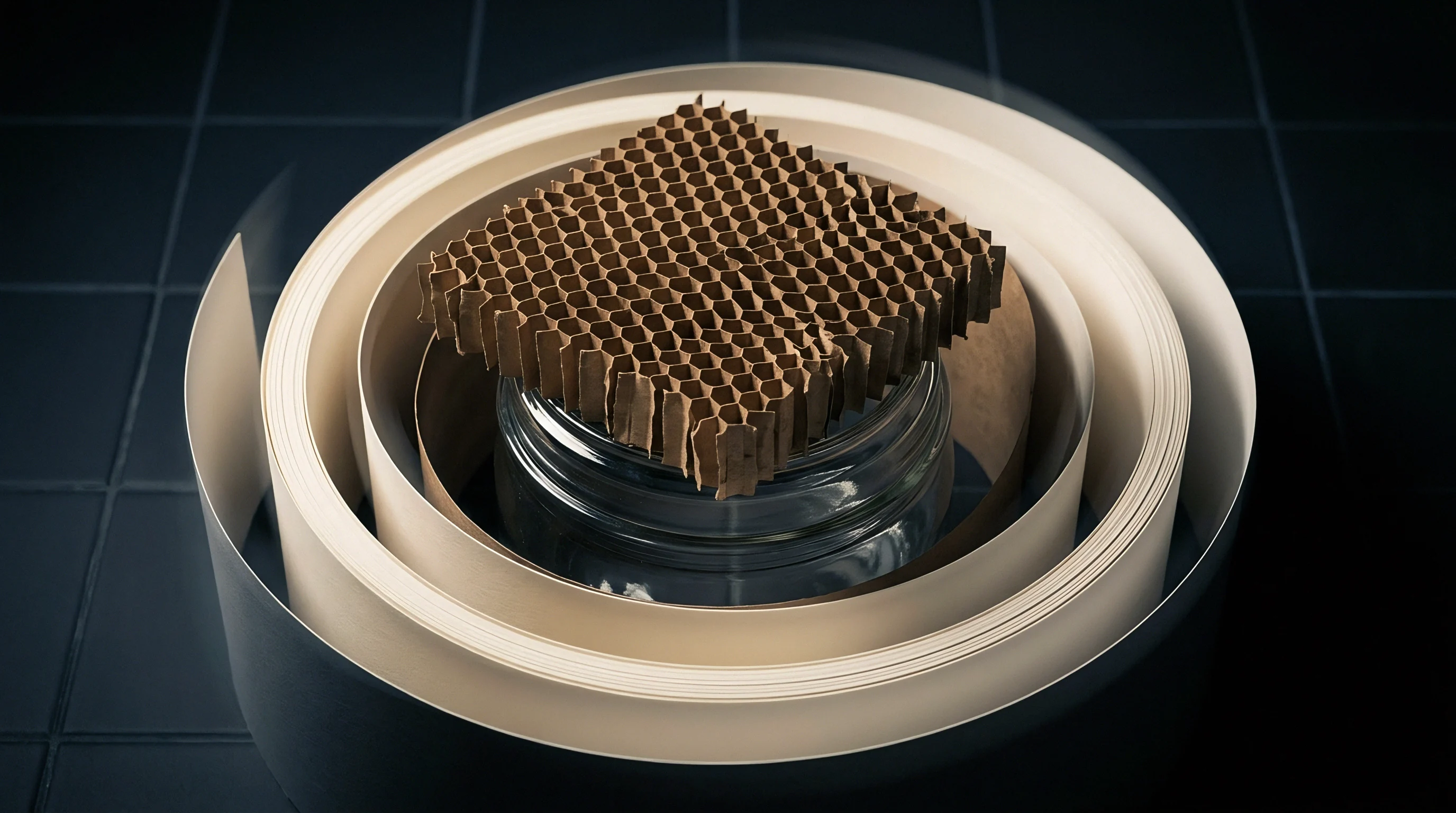
Compressive Decay under Cyclic Relative Humidity
Edge Crush Test performance correlates directly with flute sidewall stability under load. As humidity rises, the compression modulus of elasticity drops sharply in both linerboard facings and corrugated medium. Flute sidewalls lose structural rigidity, transitioning from compression failure to elastoplastic elastic buckling.
Recycled fibers exhibit severe compressive decay due to lower intrinsic fiber strength and short average fiber length. Secondary fibers suffer from micro-compressions accumulated during previous pulping and drying cycles. These internal defects act as stress concentration points when the sheet absorbs moisture, initiating early sidewall buckling under vertical stack loads.
McKee Equation Dynamic Derating Worked Construction
Evaluate a master carton containing electronics, measuring 400 mm length by 300 mm width by 300 mm height, stacked four pallets high in an ocean freight container for a twenty-one day transit. Total gross weight per carton equals fifteen kilograms. Base stack height places a static load of 441 Newtons on the bottom carton.
Standard dry laboratory testing establishes baseline board properties for two distinct construction options.
Option A utilizes a 175 gsm unbleached virgin kraftliner, 127 gsm semi-chemical hardwood fluting (C-flute), and 175 gsm virgin kraftliner. Option B utilizes a 170 gsm recycled testliner, 120 gsm recycled medium fluting (C-flute), and 170 gsm recycled testliner.
| Performance Parameter | Option A: Virgin Board (Dry) | Option A: Virgin Board (90% RH Cycle) | Option B: Recycled Board (Dry) | Option B: Recycled Board (90% RH Cycle) |
|---|---|---|---|---|
| Edge Crush Test (ISO 3037, kN/m) | 7.2 | 4.3 | 5.8 | 2.4 |
| Calculated BCT (McKee, N) | 2840 | 1695 | 2290 | 947 |
| Static Stack Safety Factor | 6.44 | 3.84 | 5.19 | 2.14 |
| Dynamic Mechano-Sorptive Derating Factor | 1.00 | 0.48 | 1.00 | 0.31 |
| Effective Transit BCT (N) | 2840 | 1363 | 2290 | 710 |
| Effective Transit Safety Factor | 6.44 | 3.09 | 5.19 | 1.61 |
Calculation details rely on precise assumptions. Take a baseline dry Edge Crush Test value of 7.2 kN/m for Option A. Under dry ISO 187 conditions, applying the simplified McKee formula generates a predicted box compression strength of 2840 Newtons, providing a safe 6.44 safety factor against the 441 Newton static bottom-box load.
Exposing Option A to dynamic marine humidity cycling between sixty and ninety-five percent RH drops the effective ECT to 4.3 kN/m. Mechano-sorptive creep introduces an additional structural derating factor of 0.48 to account for sustained load under moisture flux. The effective transit BCT drops to 1363 Newtons, yielding a real transit safety factor of 3.09.
Option B displays extreme sensitivity to humidity cycling. Secondary fiber shortening reduces initial dry ECT to 5.8 kN/m, giving a dry calculated BCT of 2290 Newtons. Under dynamic marine humidity, wet strength loss lowers ECT to 2.4 kN/m.
Mechano-sorptive creep degrades recycled paperboard severely, applying a derating factor of 0.31. Effective transit BCT falls to 710 Newtons. Continuous ocean transit vibration combined with top load dynamics reduces the effective safety factor to 1.61, crossing the threshold for stack collapse during minor ship rolling movements.
Applying static safety factors to recycled corrugated board specifications in tropical sea lanes causes stack failure whenever relative humidity exceeds eighty-five percent for more than forty-eight hours.
Static crush testing underestimates transit risk. Safety factors demand dynamic derating adjustments. Designing for ocean transport requires accounting for combined moisture absorption, paper strength decay, and mechano-sorptive creep acceleration within the McKee calculation framework.
Selecting board grammage based strictly on dry laboratory test certificates exposes the shipper to catastrophic stack collapse once cargo enters high-humidity shipping lanes.
Qualification
Verifying board capability demands rigorous documentary and physical proof before committing to high-volume procurement. Certificates issued by raw material mills must match the exact paperboard grades used by the converter. Claims regarding wet strength retention or recycled content carry financial risk if customs authorities or retail clients conduct verification audits.
European Packaging and Packaging Waste Regulation obligations tighten material compliance limits, demanding certified recyclability alongside structural performance. Adding wet-strength resins like polyamide-epichlorohydrin or urea-formaldehyde improves moisture resistance but creates compliance barriers during paper recycling process evaluations under EN 13430 standard protocols.
Chemical Wet Strength Resin Vs Recyclability Qualification
High wet-strength resin additions prevent fiber repulpability during standard mechanical agitation. Resins form insolubilizable covalent networks that hold fibers together even in hot water suspension. Pulping facilities reject board lots that fail disintegration testing, generating disposal liabilities for the importer of record.
FSC and PEFC chain of custody certificates require complete traceability from forest source to converted box. Claim declarations on delivery notes must specify whether virgin or recycled credit systems govern the delivered batch. Substituting recycled medium into a specification previously qualified with virgin semi-chemical fluting invalidates original structural performance declarations.
- Verify mill test reports for ISO 2233 environmental pre-conditioning compliance, ensuring sample exposure matched target transit humidity profiles.
- Check FSC public register database codes against converter delivery notes to confirm chain of custody continuity for specified virgin kraftliner grades.
- Audit starch adhesive formulations for wet-strength resin additive percentages, confirming chemical compliance with food contact regulations where applicable.
- Validate repulpability test certificates under Cepi recyclability guidelines to guarantee high wet-strength board passes standard paper mill recycling filters.
Adding polyamine epichlorohydrin wet-strength resin above one point five percent by dry fiber weight prevents repulpability under standard Cepi laboratory recycling protocols.
Recycled fibers swell faster than virgin. Sourcing specifications must balance moisture resistance additives against regulatory packaging recyclability targets enforced at destination ports.
EN 13430 Clause 4.2 requires explicit documentation proving that functional chemical additives introduced to maintain structural integrity under humid transport do not inhibit secondary fiber repulping efficiency during standard processing operations.

Clause
Commercial contracts often distribute moisture damage liability vaguely, leaving brand owners vulnerable when container cargo collapses. Standard bill of lading terms exempt ocean carriers from damage resulting from inherent vice of the goods or atmospheric condensation within freight containers. Converter guarantees based strictly on dry laboratory test parameters fail to protect buyers against transit losses caused by dynamic humidity degradation.
Purchase orders must include explicit performance metrics tied to environmental conditioning protocols. Contracting parties must define specific moisture thresholds, testing standards, and financial remedies for packaging failure prior to releasing production runs.
Contractual Allocation of Transit Compression Risk
Packaging specifications must shift legal baseline standards from dry ISO 187 metrics to dynamic humidity testing parameters. Incorporating minimum retention values for Edge Crush Test and Pin Adhesion after ISO 2233 Tropical Conditioning creates a clear baseline for legal claims against converters when material fails in sea transit.
Responsibility for internal container climate mitigation must sit explicitly with designated supply chain partners. Contracting clauses dictate who provides desiccant bags, container liners, or humidity monitoring logs throughout cargo transit.
Mandatory Specification Addenda for Ocean Shipping
Integrating clear test requirements into purchase contracts protects cargo owners against uncompensated loss.
- Require converter proof of compliance showing minimum fifty percent ECT retention following seventy-two hours of pre-conditioning at thirty-eight degrees Celsius and ninety percent relative humidity under ISO 2233 Condition Annex C.
- Specify complete chemical disclosure of all wet-strength adhesive additives used in board manufacture, accompanied by accredited lab test reports confirming compliance with EN 13430 recyclability mandates.
- Mandate continuous data logger placement inside cargo containers to record relative humidity and temperature profiles, establishing proof of environmental conditions during ocean transit.
- Define clear financial liability provisions holding the converter responsible for freight damage costs if post-transit laboratory failure analysis demonstrates glue line delamination or liner separation caused by sub-specification adhesive preparation.
Data loggers recording container relative humidity above ninety percent provide essential evidence for resolving disputed transit claims between shippers and packaging suppliers.
Moisture meters require seasonal calibration checks. Defensible risk mitigation relies on continuous data collection from factory floor to container discharge port.
Box failure exposes the buyer entirely. Standard purchase order terms referencing basic grammage specifications offer no legal recourse when un-derated recycled fluting buckles under tropical container humidity.