Basic Compressive Creep Mechanics in Coated Paperboard Packaging
Paperboard compressive creep accelerates under dynamic moisture flux, requiring safety factor multipliers to prevent warehouse stack failure under static load.
Matrix

Cellulose Viscoelasticity and Primary Deformation Mechanics
Paperboard under compressive load undergoes time-dependent deformation through three distinct structural domains. The initial elastic response stems from the bending and stretching of individual wood fibers within the network. Beyond this immediate compliance, viscoelastic strain engages as amorphous regions of cellulose and hemicellulose polymers slide past one another.
The third domain involves permanent plastic creep, driven by the progressive breaking and re-formation of intermolecular hydrogen bonds under continuous stress. In coated folding boxboard and solid bleached sulfate grades, this internal structural realignment dictates the rate at which a carton wall loses structural resistance under static stacking loads.
Fiber orientation established on the paper machine wire creates a pronounced anisotropy in compressive creep rates. Machine direction fiber alignment offers higher initial compressive stiffness due to axial alignment of cellulose microfibrils. Cross direction orientation relies heavily on inter-fiber bond shear, exhibiting creep rates two to three times faster under identical normalized loads.
When a carton experiences top-to-bottom compression, the vertical panel panels absorb stress primarily through out-of-plane plate buckling and localized shear yielding. The viscoelastic creep compliance of the raw fibrous substrate governs how rapidly these localized shear zones widen into full-scale structural creases.
Coated paperboard under permanent compression continuously trades structural stiffness for structural strain as hydrogen bonds shift within the fiber matrix.
Mineral coatings modify substrate stress distribution by establishing a high-modulus shell over the viscoelastic web. Solid starch binders and cross-linked latex latexes within the coating formulation restrict surface fiber motion under short-term loading. Long-term static loading causes micro-cracking within the brittle inorganic pigment layer, transferring localized strain spikes directly into the top fibrous ply.
This strain redistribution accelerates the onset of secondary tertiary creep, where the deformation rate accelerates toward sudden wall collapse.
Secondary Bond Dynamics under Continuous Static Strain
At the molecular scale, compressive creep represents an thermally activated bond-breaking process. Hemicellulose networks act as a dampening matrix between rigid crystalline cellulose fibrils. Applied compressive stress lowers the activation energy required for water molecules to break existing hydrogen cross-links between polymer chains.
Once broken, the structural chains shift position relative to one another before forming new bond pairs at lower strain energy states. This continuous rupture and reformation sequence produces measurable creep deformation without requiring total macro-level fiber fracture.
The rate of hydrogen bond exchange scales non-linearly with applied stress levels relative to short-term compressive yield strength. Below thirty percent of ultimate Box Compression Test capacity, paperboard exhibits linear viscoelastic creep where deformation scales directly with applied force. Above forty-five percent of short-term capacity, non-linear creep mechanisms dominate.
Internal micro-buckling of individual fiber walls accelerates, causing rapid web thinning and irreversible loss of package stacking height.
How does the internal shear distribution evolve across multi-ply board structures under stack load?
Multi-ply paperboard grades distribute compressive stresses through layered fiber networks designed to balance bending stiffness against substrate weight. Bleached chemical pulp outer plies carry high tensile and compressive stresses, while mechanical pulp center plies provide bulk and shear resistance. Compressive creep initiates inside the low-density middle ply, where weaker inter-fiber bonding permits micro-shear deformation.
As the middle ply compresses, the flexural rigidity of the combined structure drops, triggering secondary plate buckling in the outer coated faces.
What structural mechanism ultimately limits the continuous load-bearing life of an unsealed carton wall?

Crate
Box Compression Test Retention under Continuous Load
Standard short-term Box Compression Test values obtained under ISO 12048 or TAPPI T 804 conditions measure peak load capacity at a constant displacement rate of twelve point five millimeters per minute. Warehouse stacking performance depends instead on static load retention over months of storage. Under continuous static load equal to sixty percent of initial BCT strength, an unconditioned paperboard package undergoes steady strain accumulation until failure occurs.
This reduction in load-bearing capacity over time is the fundamental operational challenge of compressive creep mechanics.
The progression of crate deformation follows a predictable timeline under static warehouse loading. The load path transitions through distinct mechanical states before panel failure occurs.
- Instantaneous elastic strain compresses the top and bottom flutes or carton panel edges within the first two minutes of load application.
- Primary creep slows as internal fiber networks consolidate and redistribute initial load concentrations across the panel faces.
- Secondary steady-state creep establishes a constant rate of panel bulge, driven by hemicellulose slip and ambient moisture exchange.
- Tertiary creep initiates as corner crease micro-cracks propagate into structural shear lines, producing exponential deformation until collapse.
Panel length, width, and corner radius geometry interact directly with viscoelastic creep rates. Vertical corners carry up to eighty percent of total compressive load in square and rectangular cartons. When corner panels creep, load transfers toward the long, unsupported face panels, which possess significantly lower out-of-plane bending stiffness.
This stress transfer speeds up secondary panel buckling, reducing total package stack life.
| Substrate Grade | Caliper (mm) | Coating Configuration | Initial BCT (N) | 30-Day BCT Loss (%) | Steady Creep Rate (mm/day) |
|---|---|---|---|---|---|
| Solid Bleached Sulfate (SBS) | 0.45 | Double Clay Latex Surface | 850 | 28.5 | 0.042 |
| Folding Boxboard (FBB) | 0.52 | Triple Pigment Barrier Back | 920 | 22.1 | 0.031 |
| Coated Recycled Board (CRB) | 0.48 | Single Clay PVA Top | 710 | 37.4 | 0.068 |
| Laminated Heavyweight SBS | 0.76 | PET Barrier Lamination | 1420 | 16.8 | 0.018 |
Creep Mechanics in Stacking Configurations
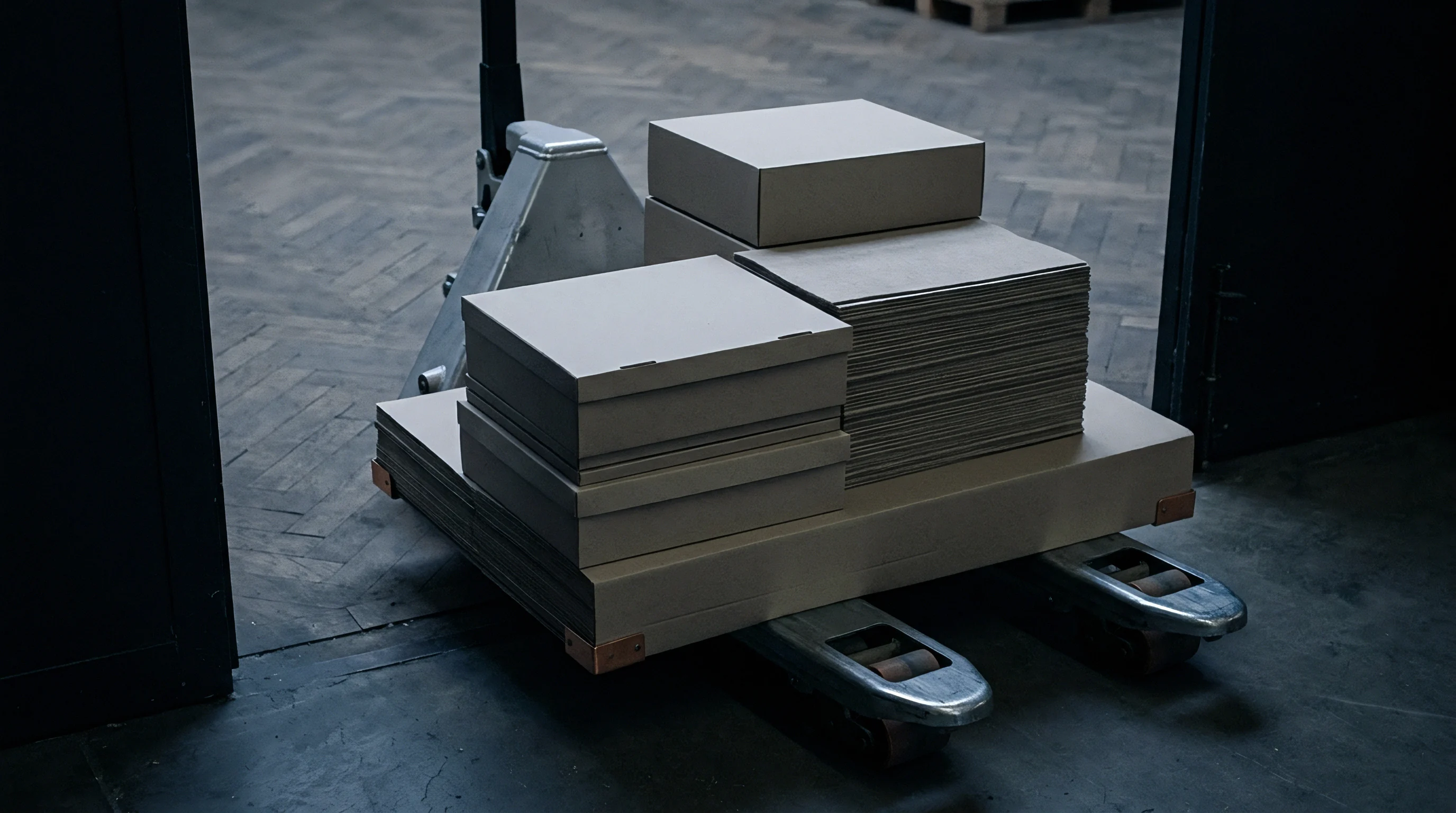
Interlocking stacking patterns multiply local compressive creep strain compared to column-stacked pallets. Column stacking aligns vertical corners directly above one another, maximizing structural efficiency. Interlocking patterns place the corner of an upper package over the unsupported center panel of a lower package.
The localized bending moment applied to the lower panel accelerates viscoelastic shear creep within the fiber core. Stack strength drops by forty to fifty percent when switching from column to interlocked configurations purely due to modified creep stress distribution.
Pallet overhang exacerbates creep rates across bottom-tier cartons. Board extending past the wooden pallet deck edge by as little as fifteen millimeters loses load distribution support along its perimeter. Concentrated shear stresses concentrate at the edge of the deck boards, initiating rapid localized creasing within thirty-six hours of load placement.
Bottom cartons suffer severe strength degradation long before top tier units show measurable strain.
Long-term stack integrity requires balancing short-term compression test figures against long-term viscoelastic relaxation rates.
Barrier
Moisture Flux and Mechano-Sorptive Creep Coupling
Atmospheric humidity variations dramatically accelerate compressive creep rates through the phenomenon of mechano-sorptive deformation. When paperboard experiences simultaneous mechanical stress and moisture content changes, the measured creep rate exceeds the sum of pure mechanical creep and pure moisture swelling combined. Sorptive moisture flux through the board matrix mobilizes water molecules, allowing hydrogen bonds under stress to break and slip at lower threshold energies.
A coated package held under static load in a cycling humidity environment fails significantly faster than an identical package stored at a constant high relative humidity.
Coating layers function as active water vapor transport regulators that directly influence the magnitude of mechano-sorptive response. Aqueous pigmented coatings containing kaolin clay and ground calcium carbonate bound with styrene-butadiene latex create tortuous paths for vapor penetration. By slowing the rate of moisture ingress during high-humidity cycles, these mineral barriers flatten internal moisture gradient peaks.
Lower peak moisture content dampens the bond-breaking dynamics that drive rapid mechano-sorptive strain bursts.
Does Relative Humidity Cycling Accelerate Structural Creep Failure?
Relative humidity cycling accelerates structural collapse by inducing transient moisture gradients through the thickness of the paperboard panel. As surface fibers absorb water, they expand, while the drier core resists movement, establishing severe internal shear stresses. When combined with an external compressive load, these internal moisture-induced shear stresses force rapid structural slip within the fiber network.
Panels subjected to humidity cycling between fifty percent and eighty-five percent RH lose load capacity twice as fast as panels stored continuously at eighty-five percent RH.
Standard ISO 187 conditioning atmospheres fail to capture the severe strength degradation driven by dynamic moisture transport during transit storage.
Extrusion coatings and film laminations modify moisture dynamics even more aggressively than dispersion coats. Polyethylene, polypropylene, and polyethylene terephthalate films present near-absolute barrier properties to liquid water and vapor. A single-sided film lamination creates an asymmetrical vapor barrier across the board thickness.
During humidity shifts, moisture enters exclusively through the uncoated face, driving strong moisture gradients and severe panel curl. This structural curl shifts the compressive load path away from vertical package corners, inducing premature out-of-plane buckling creep.
Surface Passes and Moisture Redistribution
Applying functional barrier coatings requires careful evaluation of liquid vehicle absorption during converting passes. Water-based barrier varnishes introduce localized moisture spikes into the top ply during application, swelling surface fibers and temporarily weakening inter-fiber bonds. If the web enters drying ovens with uneven thermal profile settings, stress concentrations freeze into the board structure.
These residual processing stresses reactivate under warehouse compressive loading, increasing initial creep compliance.
Structural failure in barrier-coated paperboard packaging occurs through distinct operational mechanisms under dynamic environment storage.
- Asymmetrical Vapor Migration moisture enters through uncoated interior plies, creating internal stress differentials that distort flat carton panels under load.
- Pinholes and Surface Voids localized defects in thin barrier coatings permit concentrated moisture ingress, triggering isolated creep hot-spots along package edges.
- Coating Interface Delamination high shear stresses within creeping surface fibers force functional lamination film to detach from the paper base.
- Score Crease Micro-Fracturing bending along crease lines ruptures brittle barrier layers, exposing bare fiber webs directly to ambient humidity variations.
Suppliers frequently claim that synthetic film laminations eliminate all environmental compressive strength losses under stack loading.

Decay

Rheological Creep Modeling and Strain Rate Equations
Analytical prediction of paperboard creep compliance requires rheological models capable of capturing both immediate elastic behavior and delayed viscoelastic response. The four-element Burger model, combining a Maxwell element and a Kelvin-Voigt element in series, provides the standard mathematical representation for paperboard compressive creep. The Maxwell spring models immediate elastic strain, while the Maxwell dashpot accounts for permanent viscous flow.
The parallel spring-dashpot pair within the Kelvin-Voigt element models the delayed, reversible elastic strain characteristic of cellulose networks.
The mathematical formulation for total creep strain over time under constant stress obeys the classic viscoelastic relationship:
strain(t) = (stress / E_0) + (stress / E_1) (1 – exp(-t / tau)) + (stress / eta_0) t
Where E_0 represents instantaneous elastic modulus, E_1 and eta_1 define Kelvin-Voigt stiffness and viscosity, tau is the characteristic retardation time, and eta_0 represents long-term viscous flow resistance. In high-caliper coated boards, mineral surface layers alter the retardation time tau by restricting rapid initial alignment of underlying surface fibers.
| Substrate & Conditioning | E_0 (MPa) | E_1 (MPa) | eta_1 (MPa s) | eta_0 (GPa s) | Retardation Time tau (s) |
|---|---|---|---|---|---|
| SBS (23C / 50% RH) | 4250 | 8100 | 2.4e7 | 1.8e8 | 2963 |
| SBS (23C / 85% RH) | 2800 | 4200 | 8.5e6 | 4.2e7 | 2023 |
| FBB (23C / 50% RH) | 3800 | 7400 | 1.9e7 | 1.4e8 | 2567 |
| FBB (23C / 85% RH) | 2100 | 3100 | 5.2e6 | 2.8e7 | 1677 |
| CRB (23C / Dynamic RH) | 1650 | 2100 | 1.8e6 | 9.5e6 | 857 |
Extending the Burger model to dynamic storage environments demands incorporating mechano-sorptive strain coefficients. Mechano-sorptive strain acts as a multiplier on the viscous dashpot term, accelerating the rate of irreversible plastic flow during moisture transitions. When modeling variable-humidity storage, failure occurs when accumulated creep strain crosses the critical buckling threshold of the carton wall panel.

Finite Element Implementation and BCT Degradation
Modern package design software integrates non-linear viscoelastic constitutive models into shell-element finite element simulations. Wall panel buckling modes change as viscoelastic deformation progresses. Under initial load, stress concentrates tightly along vertical package corners.
As corner regions undergo localized compressive creep, stress redistributes horizontally across the middle regions of the panel faces. This stress redistribution increases out-of-plane displacement, shifting the failure mode from localized edge crushing to global panel buckling.
A twenty percent increase in average storage relative humidity reduces long-term structural package life by more than sixty percent under identical static loading.
Consider a standard folding carton manufactured from 0.50 mm Folding Boxboard with an initial short-term BCT of 1000 Newtons. Stored under static warehouse loading of 500 Newtons at a constant 50 percent relative humidity, the package exhibits a steady creep strain rate of 0.02 mm per day, retaining structural stability beyond 90 days. Placing the same loaded package in an unconditioned warehouse experiencing daily humidity cycling between 50 percent and 85 percent increases the effective creep strain rate to 0.18 mm per day.
Total allowable panel deformation of 3.0 mm is reached in just 16.6 days, leading to top-tier stack failure.
The standard supply agreement for performance packaging specifies compliance with ISO 2234 static load testing under fixed ambient conditions, leaving environmental cycling risk entirely with the package buyer.

Yield

Score Line Creep and Crease Geometry
Converting passes introduce localized structural damage along score lines, fundamentally altering local creep mechanics. Scoring pushes paperboard through a die groove to break internal fiber bonds along defined lines, enabling clean folding without surface cracking. This intentional bond disruption reduces the local compressive yield strength of the corner edge.
Under vertical stack loading, the damaged score line acts as a pre-strained hinge, creeping faster than the un-scored wall panel.
Rule-to-groove clearance during scoring dictates the structural density of the finished corner crease. Inadequate die depth crushes the board plies across a wide area, causing broad fiber delamination that accelerates viscoelastic creep slip. Excessive die width creates an loose crease that bulges outward under load, introducing immediate eccentric loading on adjacent vertical panels.
Correct scoring rule geometry matches female channel width to board caliper plus twice the rule thickness, maintaining tight corner radii that resist lateral creep deflection.
Coating integrity along the score crease determines long-term environmental durability. Pigmented surface coatings lack the elasticity of raw cellulose fibers. Bending the board ninety degrees stretches the outer coating layer beyond its ultimate strain limit, causing microscopic surface fractures.
These micro-cracks open direct pathways for atmospheric moisture to reach bare internal fibers, destroying the environmental barrier performance of the outer face.

Lamination Passes and Added Processing Steps
Adding functional lamination film or heavy dispersion varnish passes introduces manufacturing variables that alter compressive creep resistance. Extrusion lamination applies molten polymer directly to the board surface under high nip pressure. The thermal load from molten plastic drives moisture out of surface plies, setting transient internal drying stresses.
If the board moisture content is not re-equilibrated before die-cutting and folding, the finished carton exhibits residual panel twist, accelerating out-of-plane buckling creep under stack pressure.
Film lamination selection involves trade-offs between mechanical stiffening, moisture barrier performance, and end-of-life processing costs. Polypropylene films provide excellent water vapor resistance but exhibit low elastic modulus, offering minimal mechanical reinforcement against long-term panel bulge. Polyethylene terephthalate films possess higher modulus, stiffening the panel face and slowing initial creep, but increase material costs and complicate pulp repulpability during recycling operations.
An incorrectly specified scoring profile or uncalibrated lamination pass reduces effective warehouse stacking lifetime, leading to carton sidewall bulging, crushed contents, and rejected freight shipments.
Loss

Safety Factors and Warehouse Stacking Arithmetic
Translating laboratory short-term compression values into safe static stack performance requires calculating an operational safety factor. The global safety factor accounts for dynamic warehouse factors including continuous creep load retention, humidity cycling, pallet pattern efficiency, handling fatigue, and long-term storage duration. Standard practice applies a cumulative multiplication factor to calculate required short-term BCT strength from actual static weight loads.
The calculation of required initial Box Compression Test strength follows the established industry formulation:
Required BCT = Static Top Load Factor_Time Factor_Humidity Factor_Stacking Factor_Handling
Where Factor_Time isolates viscoelastic load decay, ranging from 1.5 for short storage periods up to 2.0 for storage exceeding thirty days. Factor_Humidity compensates for mechano-sorptive creep, scaling from 1.0 at fifty percent constant RH to 2.5 for cycling environments up to ninety percent RH. Stacking pattern choices introduce Factor_Stacking values of 1.0 for straight column alignment or 1.5 for interlocked configurations.
Pallet handling and transport vibration add a Factor_Handling multiplier between 1.1 and 1.3.
| Storage Scenario | Time Factor | Humidity Factor | Pattern Factor | Combined Safety Factor | Required BCT (N) |
|---|---|---|---|---|---|
| Controlled Ambient (30 Days, Column) | 1.50 | 1.00 | 1.00 | 1.65 | 1618 |
| High Humidity Constant (90 Days, Column) | 1.80 | 1.70 | 1.00 | 3.37 | 3302 |
| Cycling Humidity (90 Days, Interlocked) | 1.80 | 2.20 | 1.40 | 6.10 | 5984 |
| Export Container (180 Days, Interlocked) | 2.00 | 2.50 | 1.50 | 7.80 | 7652 |
Assume a packaged product applies a 100 kg (981 N) static load to the bottom carton in a pallet stack. Under ideal controlled conditions, a combined safety factor of 1.65 demands an initial BCT of 1618 N. If that same package ships in interlocked stacks through dynamic tropical environments, the combined safety factor escalates to 6.10. The required initial short-term BCT jumps to 5984 N. Specifying paperboard based on short-term laboratory figures without accounting for these multiplicative environmental creep factors results in stack collapse.
Commercial Verification and Specification Control
Protecting packaging investments requires establishing clear specification protocols that link substrate properties, coating specifications, and target storage conditions. Standard purchase contracts often specify basis weight and caliper while ignoring viscoelastic creep compliance. Quality assurance documentation must explicitly define minimum long-term load retention under specified relative humidity profiles.
Technical qualification of new board suppliers requires submitting sample cartons to continuous load creep testing according to ASTM D642 or ISO 2234 standard procedures.
Uncoated recycled board grades require up to forty percent higher initial BCT safety factors than virgin fiber SBS grades to survive identical continuous creep loading.
Converter audit protocols verify that production runs maintain required structural performance across variable fiber lots. Mill certificate reviews track fiber mix percentages, refining history, and internal sizing levels that directly influence moisture resistance. Converting line inspections monitor scoring depth, crease symmetry, and coating film weight uniformity across the web.
Implementing strict quality audits prevents lower-grade substrate substitutions that meet short-term compression targets but fail prematurely under long-term warehouse creep stress.
Substrate selection balances raw material costs against potential warehouse failure liabilities. Recycled content grades offer lower base material prices and favorable environmental scoring metrics. Higher creep compliance in short-fiber recycled pulps demands thicker calipers or heavy functional barrier coatings to achieve equivalent stack life.
Virgin chemical fiber SBS and FBB grades carry higher initial per-ton costs but provide superior long-term viscoelastic stability, allowing reductions in package wall thickness. Calculating landed package costs requires evaluating initial board prices alongside long-term structural reliability under real-world warehouse stacking conditions.