Crease Resistance Mechanics under Multi Pass Print Finishing Sequences
Multi-pass thermal finishing dries cellulose and embrittles varnishes, requiring compensated die matrix channels and altered pass orders to stop score cracking.
Rupture
Tensile failure along an exterior carton bead originates in the differential strain developed across distinct substrate plies during rotary scoring. When folding boxboard passes through finishing operations, subsequent passes deposit polymers, heat, and mechanical pressure onto coated surfaces. Bending paperboard creates severe structural shear.
The outer liner splits. Tensile failure immediately follows. Coated board grades depend on controlled internal delamination to form a hinge without surface fracture, yet cured inks and barrier films restrict the microscopic ply displacement needed to relieve outer tensile forces.
A standard 350-micron Solid Bleached Sulfate (SBS) board exhibits an ultimate tensile elongation limit between 2.0% and 3.5% in the cross-machine direction. Depositing a cross-linked ultraviolet coating reduces this elongation limit to less than 1.2%. The outer surface layers fracture during folding because the rigid resin coat transfers tensile stress directly into the top cellulose plies.
Instead of spreading stress across the sheet caliper, the score line concentrates force along a micro-fracture line.
Solid bleached sulfate cracks along the score bead when delamination fails to separate internal fiber plies before peak bending displacement.
Mechanical Strain across Multilayer Calipers
Bending paperboard through one hundred and eighty degrees forces outer fibers into sharp elongation while the inner ply undergoes localized compression. Folding boxboard (FBB) features chemical pulp outer plies sandwiching a mechanical pulp core. That mechanical core fractures under initial tool impact to create an internal bulge or bead.
Multi-pass finishing alters the modulus of elasticity across these layers. A thermal lamination film adheres to the exterior with an adhesive layer that penetrates the board coating. The stiff composite skin resists bending radius reduction.
The tension exceeds fiber tensile strength at twenty degrees of fold rotation.
Delamination behavior determines structural survival. The list below itemizes primary mechanical failure modes observed during scoring runs on multi-pass coated sheets:
- Outer liner rupture happens when surface tensile elongation exceeds the plastic yield point of exterior cellulose fibers and cured mineral coatings.
- Matrix-induced shearing occurs when excessive male rule penetration severs internal plies instead of forcing a controlled, delaminated internal bead into the female channel.
- Film delamination peel arises when bending shear stresses overcome the interfacial surface tension between the extruded primer and the underlying offset ink film.
- Flap spring-back drift appears when incompletely crushed mechanical fibers in the central ply retain residual elastic stiffness, opposing final folding alignment.

Delamination Dynamics and Internal Bond Shear
Multi-ply boards absorb bending energy by separating cleanly into micro-layers between the wire and felt sides. Paper scientists measure this resistance via TAPPI T 569 internal bond testing, commonly termed Scott Bond. Virgin folding boxboard registers Scott Bond values between 180 and 260 Joules per square meter.
Recycled board grades often drop below 130 Joules per square meter. Low internal bond strength promotes uncontrolled separation that spans beyond the crease channel, causing edge softening and soft carton corners.
High internal bond strength presents the opposite hazard. A board with a Scott Bond rating exceeding 320 Joules per square meter resists internal ply separation. The solid sheet behaves like an isotropic beam rather than a laminated leaf spring.
When scoring rules indent the surface, unyielding middle plies transmit shear outward, tearing the top liner. Carton flap spring-back inside automated high-speed cartoners jams the feeding pocket and trips the packing line into an emergency shutdown.
Heat
Thermal radiation from mercury-vapor UV lamps and heated stamping dies evaporates unbound water from the cellulose network. Cellulose relies on moisture as an internal plasticizer. Free and bound water molecules sit between polysaccharide chains, facilitating smooth fiber displacement under mechanical load.
Running a printed carton through multiple drying tunnels strips this internal plasticizer. Moisture drops below four percent. Cellulose fibers turn brittle.
Brittleness impairs folding performance.
Offset lithography deposits water-in-oil emulsions, but subsequent inline hot foil stamping applies platen temperatures between 110 and 150 degrees Celsius under hydraulic dwell pressures exceeding twenty megapascals. That thermal shock drives moisture out of the outer plies. The sheet contracts non-uniformly across its grain.
Cross-direction shrinkage outpaces machine-direction contraction by a ratio of three to one, generating residual internal tensile stresses before the carton die ever strikes the sheet.
Three passes through ultraviolet curing lamps at eighty meters per minute reduce board core moisture from seven percent to below three point two percent.

Can Inter-Pass Curing Cycles Destroy Board Plasticity?
Successive drying tunnels strip moisture down to three percent by weight, collapsing the flexible hemicellulose matrix into a brittle structural grid. Water loss alters hydrogen bonding between microfibrils. Fiber walls shrink, increasing bulk density while diminishing cross-directional strain to failure.
The foil barrier traps vapor. Re-moisturization occurs unevenly across pallet stacks. Outer edges absorb atmospheric water while the dense pile center remains parched for weeks.
This hygroscopic gradient leads to variable scoring depths across a single production pallet.
- First ink pass drying drives initial sheet moisture from 6.8% down to 5.4% under conventional infrared lamps and medium-wave hot air impingement.
- Secondary UV cure exposure subjects the moving paperboard web to high-intensity mercury lamps, stripping internal hydration to 3.8% while elevating surface temperature past 70 degrees Celsius.
- Hot stamping platen compression concentrates localized heat up to 140 degrees Celsius, forcing residual core moisture toward unprinted sheet margins.
- Final varnish cross-linking locks the depleted fiber network under an impermeable synthetic polymer shell, preventing rapid ambient re-equilibration.
Polymer Embrittlement under Ultraviolet Cross-Linking
Radical photopolymerization in overprint varnishes produces high glass transition temperatures exceeding sixty degrees Celsius. Standard multi-functional acrylate monomers polymerize into tightly cross-linked three-dimensional networks. When ambient storage temperatures fall below this glass transition point, the coating behaves as an unyielding glassy solid.
Bending the board creates micro-fissures in the varnish film. These micro-cracks act as stress concentrators, propagating directly downward through the pigment coating layer into the top cellulose plies.
Electron beam (EB) coatings eliminate photoinitiator migration risks in food packaging, yet generate equivalent polymeric rigidity. The cross-link density scales with absorbed radiation dose, measured in kilograys. Applying twenty-five kilograys to achieve scratch resistance generates a brittle exterior shell.
The desk accounts for this brittleness by reducing varnish film weight from four grams per square meter down to two point five grams per square meter on score lines via knocked-out flexographic plates. Trade coaters routinely insist that ambient warehouse humidity within forty-eight hours restores any fiber pliability lost under the curing hoods.
| Pass Sequence | Sheet Moisture Content (%) | Cross-Direction Strain (%) | Varnish Glass Temp (°C) | Visual Score Integrity |
|---|---|---|---|---|
| Base Board (Unprinted FBB) | 6.8 – 7.2 | 3.2 – 3.8 | Not Applicable | Intact, clean bead |
| 4-Color Offset + Aqueous Primer | 5.8 – 6.2 | 2.8 – 3.1 | 12 – 18 | Intact, clean bead |
| Offset + UV Varnish (Single Lamp) | 4.1 – 4.5 | 1.8 – 2.1 | 55 – 65 | Micro-crazing at liner |
| Offset + Hot Foil + UV Spot Gloss | 3.1 – 3.4 | 1.1 – 1.4 | 68 – 78 | Severe liner splitting |
| Offset + Matt BOPP + Spot UV | 4.6 – 4.9 | 4.2 – 5.0 | 62 – 70 | Coating peel along score |

Die
Scoring geometry dictates the mechanical strain profile imparted to the laminated board during platen impression. Tooling configurations designed for unprinted board fail catastrophically on four-pass conversion stocks. Male steel rules force paperboard into female matrix channels cut into counter-plates or pre-formed pertina channel matrices.
Caliper dictates groove width. Narrow channels pinch the sheet. The matrix depth sets compression.
In composite airframe manufacturing, engineers interleave pliable adhesive films between carbon plies to absorb inter-laminar shear before micro-cracks propagate. Multi-ply paperboard demands the same structural accommodation. Mechanical delamination must occur along the neutral axis before surface tensile limits are breached.
Matrix channel width calculations require specific adjustment factors when films or high-solid coatings cover the substrate. A conventional matrix formula sets channel width equal to one point five times the board caliper plus the rule thickness. For multi-pass laminated sheets, that multiplier must scale to one point seven or one point eight.
Expanding the channel lowers vertical shear resistance, allowing the sheet to deflect downward into the matrix without pinching the outer shoulder of the crease bead against sharp counter edges.
A wider counter matrix channel preserves outer print coatings at the expense of carton squareness on automated folder-gluers.

Channel Clearance and Scoring Rule Selection
Female matrix channels establish the lateral boundary for paperboard displacement under male steel profiling. Steel creasing rules feature rounded crowns, typically classified as two-point (0.71 mm) or three-point (1.05 mm) body thicknesses. A standard two-point rule pressing a 400-micron board requires an interior matrix depth matching the compressed board caliper, usually rated at seventy percent of nominal thickness.
Failing to account for added varnish layers compresses the board beyond its elastic limit, crushing the outer liners and causing immediate flaking.
Polymer laminates resist shear. Bially Oriented Polypropylene (BOPP) film stretches under the rule tip, dragging the underlying ink film laterally. If the channel shoulder features a burr or an abrupt ninety-degree edge, the film shears cleanly under pressure.
Phenolic or milled steel counter-plates provide chamfered entry shoulders that guide the composite board into the groove, preventing edge shear. The desk specifies round-edge rules over flat-top profiles to prevent shear concentrating at the rule shoulders.
Will Symmetric Matrix Channels Prevent Bead Rupture?
Offset groove geometries distribute female matrix counter-pressure unevenly across the machine direction of the sheet. Folding cartons feature creases running parallel to the fiber grain and perpendicular to the grain. Fiber alignment across the machine direction offers higher stiffness and lower tensile stretch.
Scoring parallel to the fiber grain risks dropping the rule directly between parallel fibers, cleaving the sheet in half. Increasing rule thickness while reducing matrix depth creates a broader, shallower internal bead, preventing deep fiber fracture.
Traversing grain directions requires distinct rule configurations across the same cutting die. Toolmakers install two-point rules for cross-direction scores and three-point rules with wider matrix grooves for machine-direction scores. When a hot foil pass coats only half a carton blank, that blank carries two separate compressibility profiles.
Die make-ready demands localized carbon shimming behind the counter matrix to relieve pressure over the foiled zone. Rule penetration depth stops where delamination begins, because pushing a bead past the internal shear limit splits the surface before the carton ever meets the folder-gluer.
| Board Caliper (mm) | Finishing Layers Applied | Rule Thickness (mm) | Channel Width (mm) | Channel Depth (mm) | Penetration Limit (mm) |
|---|---|---|---|---|---|
| 0.30 (FBB) | Offset Ink + Aqueous Varnish | 0.71 | 1.20 | 0.21 | 0.28 |
| 0.30 (FBB) | Offset + Foil + Screen UV | 0.71 | 1.30 | 0.23 | 0.25 |
| 0.45 (SBS) | Offset Ink + Aqueous Varnish | 0.71 | 1.45 | 0.32 | 0.41 |
| 0.45 (SBS) | Offset + 18µm BOPP Thermal Film | 0.71 | 1.60 | 0.35 | 0.38 |
| 0.60 (CRB) | Offset Ink + Aqueous Varnish | 1.05 | 2.00 | 0.42 | 0.54 |
| 0.60 (CRB) | Double White Offset + Matte UV | 1.05 | 2.15 | 0.45 | 0.50 |
| Calculations assume standard 2-point (0.71 mm) and 3-point (1.05 mm) steel creasing rules stamped against milled phenolic counters at 20 degrees Celsius. Penetration limit indicates maximum downward platen stroke before liner micro-fracture occurs. | |||||

Ledger
Adding finishing passes directly compounds job waste, press downtime, and raw material expenditure. Every additional machine setup incurs make-ready sheet loss. Make-ready spoilage compounds quickly.
Fourth passes multiply setup waste. A single pass sheet-fed offset press running an in-line aqueous coater converts paperboard with three to five percent total scrap. Introducing a second pass for offline hot foil stamping adds another four percent in setup sheets and register alignment.
Adding a third pass for screen UV spot varnish generates three percent further losses. The gross board requirement expands from 10,000 net carton sheets to 11,500 gross sheets before die-cutting begins.
Calculated machine setup charges reflect running speeds and labor overheads. Offline hot stamping platens run at 3,500 sheets per hour, while modern offset presses run at 15,000 sheets per hour. Spot UV screen printing operates between 2,500 and 4,500 sheets per hour.
Queuing jobs across three distinct production departments stretches order lead time from five working days to fifteen working days. Working capital remains locked in intermediate pallet inventories while moisture evaporates from uncured board piles.
Specifying recyclability assessment under EN 13430 classifies double-sided polyethylene laminations as non-recyclable composite packaging subject to elevated disposal tariffs.
Pass Sequence Optimization and Waste Ratios
Positioning an overall flood varnish after foil stamping shields delicate metallic borders from scuffing while preserving underlying board foldability. Swapping pass order changes mechanical outcome. Hot foil stamping directly over a fully cured UV varnish yields zero foil adhesion because silicone flow additives migrate to the varnish surface, dropping surface energy below 32 dynes per centimeter.
Stamping onto untreated ink yields clean transfer, yet leaves the metal boundary exposed to shearing stresses during folder-gluer belt transit.
Converters evaluate multi-pass sequences via operational check parameters before issuing production dockets:
- Surface tension compatibility verifies dyne levels exceed 42 dynes per centimeter across base inks before secondary coating or foil application.
- Thermal dwell tolerance tracks cumulative exposure seconds under IR hoods and UV lamps to prevent substrate dehydration below critical four percent moisture.
- Coating knockout alignment confirms scoring zones remain free of brittle radical-cured UV clear coats via precise three-millimeter plate setbacks.
- Grain direction conformity aligns major carton hinge scores perpendicular to machine direction fibers, optimizing folding endurance and carton squareness.
Extended Producer Responsibility Penalties for Barrier Films
Modulated European packaging levies impose substantial fees on paper packaging containing synthetic polymer linings above five percent total weight. Thermal lamination adds a BOPP or PET film layer ranging from 12 to 25 microns in thickness. While film lamination eliminates score line splitting by acting as a high-tensile external bridge, it invalidates repulpability certifications under PTS-RH 021/97 or CEPI recyclability protocols.
The paper mill hydropulper cannot cleanly separate plastic film from long cellulose fibers without excessive fiber yield loss.
Disposal fee variances change unit economics across large volumes. A standard luxury cosmetic carton run of 100,000 units weighing 35 grams per carton represents 3.5 metric tonnes of finished packaging. Under modulated EPR systems, mono-material paperboard bearing water-based varnishes incurs standard recycling charges between 50 and 90 euros per tonne.
Adding plastic barrier lamination triggers fee surcharges exceeding 400 euros per tonne. Recyclers deduct heavy sorting surcharges. Specifying DIN EN 643 scrap grade adherence inside the purchase schedule assigns all landfill tipping costs and sorting deductions directly to the printer when laminated waste exceeds five percent of gross reel tonnage.
| Finishing Configuration | Added Passes | Total Waste (%) | Production Days | Cost / 1,000 Units (€) | EPR Fee / Tonne (€) |
|---|---|---|---|---|---|
| Inline Aqueous Coating | 0 | 4.2 | 4 | 128.50 | 65.00 |
| Offline UV Flood Varnish | 1 | 7.8 | 7 | 152.00 | 85.00 |
| Hot Foil + Offline Spot UV | 2 | 11.5 | 12 | 215.30 | 110.00 |
| Thermal BOPP Film + Spot UV | 2 | 9.8 | 11 | 232.00 | 440.00 |

Threshold
Standard laboratory testing separates functional scored folding boxboard from brittle packaging destined for production failure. When cartons leave the die cutter, internal scoring beads must retain specific elastic recovery profiles. Carton flaps resist ninety-degree folding.
Bending moment measures score resistance. If a carton flap displays extreme bending resistance, erecting station suction cups slip off carton faces, causing cartoner jam-ups. If crease resistance is near zero, the bead has ruptured, leaving carton panels misaligned and edges ragged.
The desk models scoring behavior through the ratio between scored board bending stiffness and unbroken board bending stiffness. This crease stiffness ratio, expressed as a percentage, defines conversion functionality. Unprinted base board exhibits a ratio between 40% and 55%.
Introducing multi-pass UV varnishes drops this ratio below 25% when the bead fractures internally, or elevates it past 70% when unyielding surface coatings prevent the hinge from forming. Both conditions cause packaging line failure.
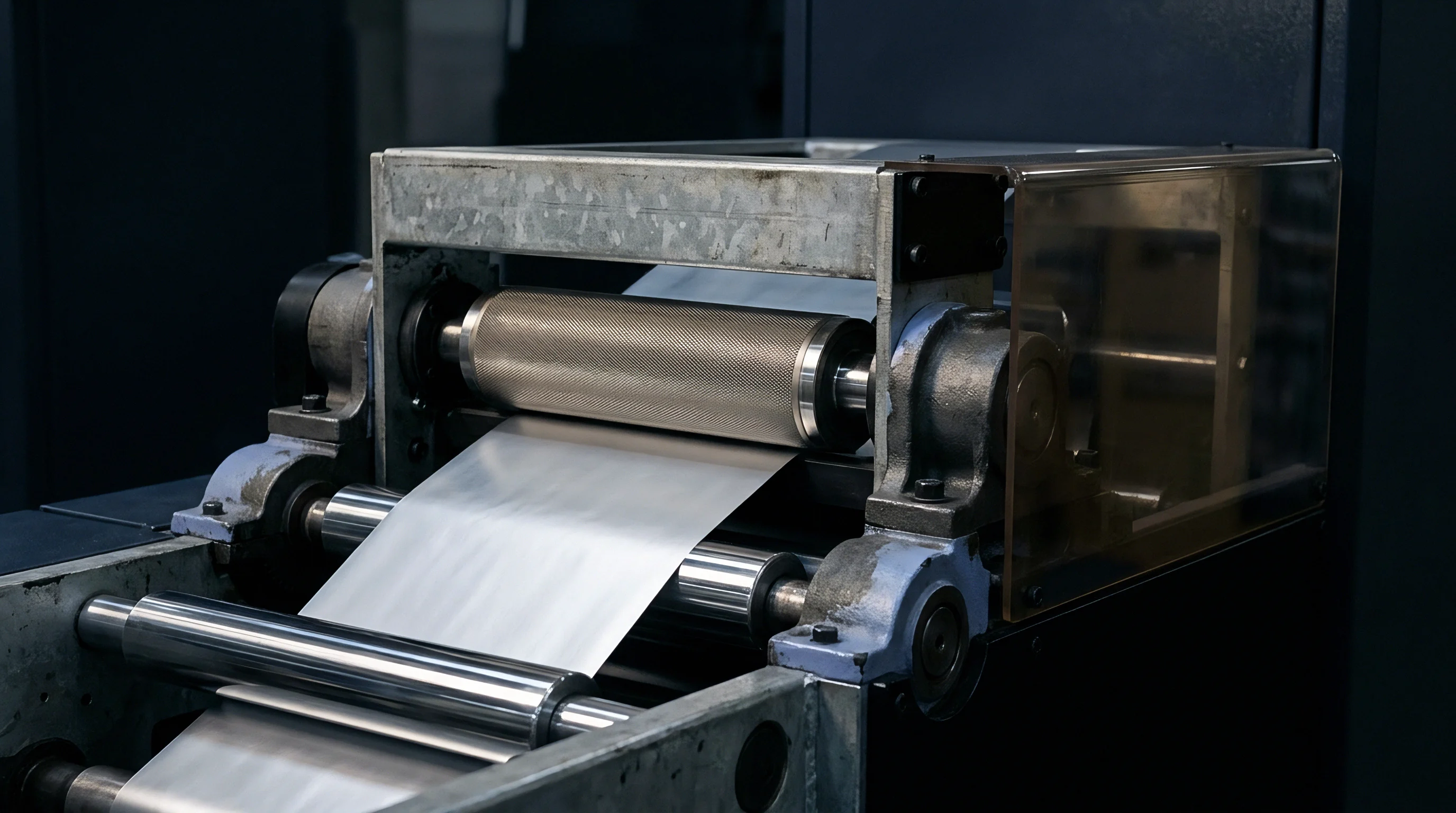
Standardized Testing for Crease Stiffness Retention
Apparatus operating under ISO 2493 evaluates the mechanical bending moment of scored board specimens over ninety-degree deflections. Test equipment clamps the crease line, deflecting the free carton panel at a standardized fifteen-degree angular rate. Concurrently, DIN 53121 establishes procedures for two-point bending methods, calculating the flexural modulus of laminated sheet composites.
Conditioning environments dictate outcome. Samples held at forty percent relative humidity crack consistently, whereas identical lots conditioned at fifty percent relative humidity pass visual inspection.
Laboratory data proves contentious when testing composite multi-pass boards. Technical datasheets cite folding endurance ratings under ISO 5626, measuring double folds until complete rupture. Virgin kraft pulp withstands over 1,000 double folds.
Multi-pass sheets bearing cross-linked acrylates fracture after fewer than fifty double folds. This 95% drop in endurance stems from localized shear notch sensitivity. The brittle surface coat initiates an external micro-fissure that slices straight through virgin pulp fibers on the initial fold pass.

Verification Parameters for High-Speed Carton Erecting
Automated packaging lines running six hundred cartons per minute detect micro-fissures through dynamic resistance sensors. The packaging line folder sweeps carton blanks through ninety-degree pre-breaks, returning panels to flat before final side-seam gluing. Pre-breaking relieves residual elastic memory in the hinge.
A ruptured score bead delaminates during pre-breaking, peeling the printed liner away from the glue flap. The glue seam fails to bond because cold-set emulsion adhesives adhere to loose surface fibers rather than the structural board core.
The field relies on a 15-day room temperature aging metric to verify crease stability before approving volume carton runs. That specific aging window rests on standard industrial carton storage protocols, but fluctuating warehouse temperatures and changing plasticizer migration rates continuously alter those baseline values. A sudden drop in ambient temperature below fifteen degrees Celsius shifts UV clear coats past their glass transition point, causing compliant cartons to crack on high-speed retail packaging lines weeks after passing factory quality checks.
The converting sector still debates whether dynamic viscoelastic modeling of cross-linked polymer films can ever accurately predict ambient crease fatigue on high-speed consumer goods cartoning lines.