Multiscale Modeling of Moisture Induced Delamination in Recycled Board Converting
Moisture-induced delamination in recycled board converting is prevented by matching nip shear profiles to moisture-softened z-directional strength parameters.
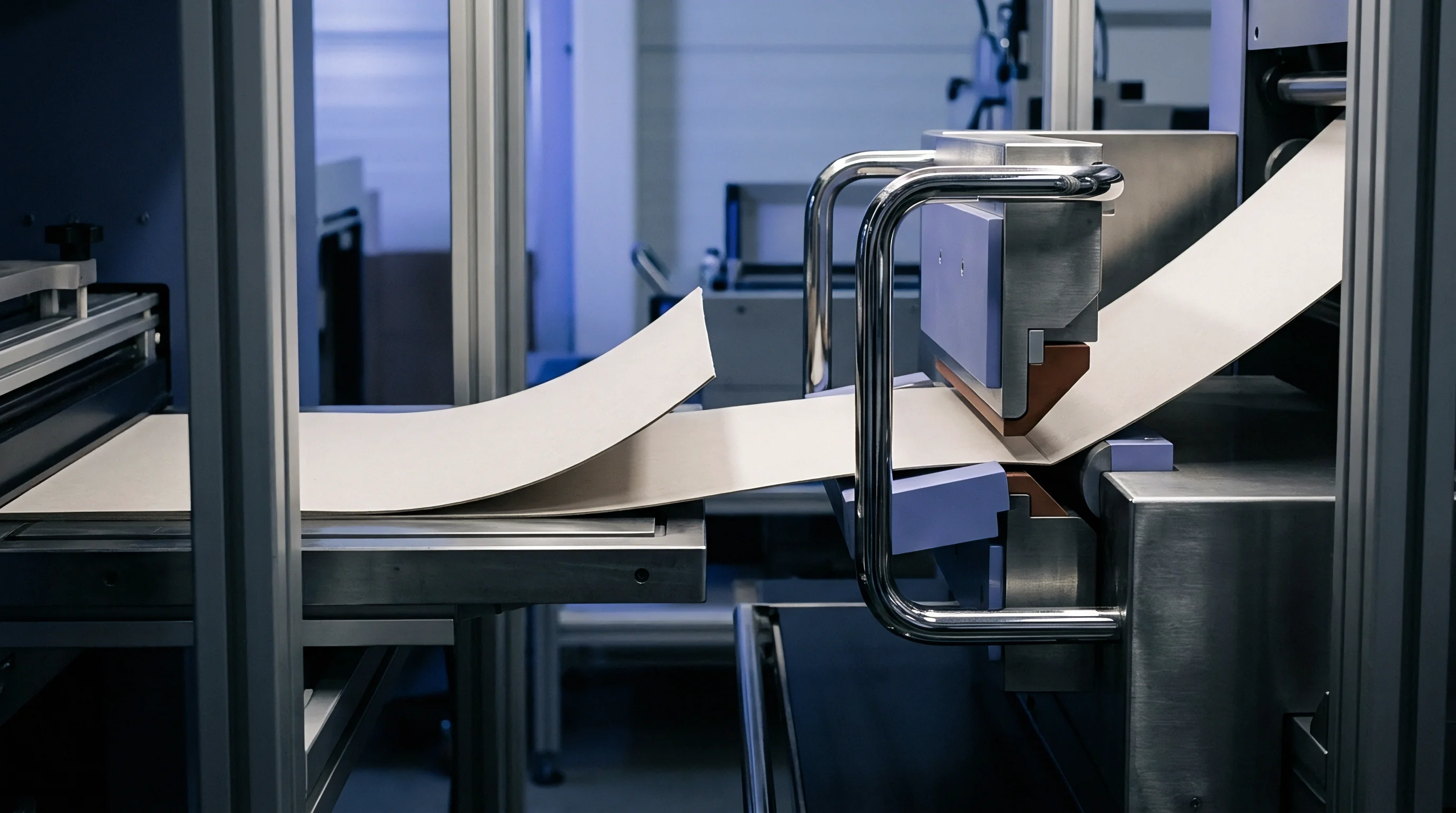

Pulp
Fibril Swelling and Starch Network Degradation
Recycled papermaking fibers degrade structurally through repeated drying and wetting cycles. Hornification collapses internal lumen walls, permanently closing pores within the secondary cell wall. When secondary fibers absorb water during converting, radial hygroexpansion dominates over axial elongation.
Virgin softwoods expand up to two percent radially at maximum water uptake, but multiply recycled furnish can show localized radial swelling above five percent because wall density is uneven across the fiber. This differential swelling creates micro-scale shear stresses where individual fibers cross in the sheet matrix.
Inter-fiber bonding depends on hydrogen bonds and enzymatic or cationic starches added at the wet end or size press. Native starch networks soften rapidly once ambient relative humidity rises past 65 percent, as water molecules replace hydroxyl attachments between adjacent cellulose chains. Recycled furnish contains degraded fines with high specific surface area, which consume excess binder during wet-end processing and leave less active starch at ply contact regions.
When relative humidity shifts from standard laboratory conditions of 50 percent to converting environments at 80 percent, the local elastic modulus of the inter-fiber matrix falls by more than 40 percent.
Relative humidity spikes from 50 to 80 percent reduce inter-fiber matrix elastic modulus by 42 percent in recycled boxboard plies.
Lumen collapse restricts the elastic recovery of hornified fibers after mechanical loading, making network stiffness distinctly non-linear during transient moisture sorption. Below six percent total weight moisture, recycled fibers respond elastically to applied shear. Once moisture exceeds nine percent, plastic deformation starts inside individual fiber walls before the sheet matrix yields globally.
Applying water through coatings or steam showers during converting induces localized plastic softening, weakening the fiber network before scoring or lamination.

Microscale Anisotropy and Structural Failure Modes
Paperboard has anisotropic mechanical properties dictated by fiber alignment during wet web forming. Alignment along the machine direction yields higher tensile stiffness than the cross-machine direction. In recycled multi-ply board, the ratio of machine-direction to cross-machine-direction elastic modulus ranges from two to one up to three and a half to one.
Moisture moves through these structural axes unevenly, diffusing faster through the cross-machine direction than through the sheet thickness because cell wall pores lie in the plane of the sheet. Moisture transport out of plane occurs mostly through inter-fiber voids rather than intact cell walls.
Delamination starts where local moisture accumulation coincides with stress concentrations. Weakened fiber-to-fiber contacts fail under combined out-of-plane shear and tension, forming micro-cracks along boundary zones between high-density fines and coarse structural fibers.
- Hygroscopic Shear Cracking occurs along fiber orientation boundaries where moisture differentials force unequal expansion across adjacent fiber clusters.
- Starch Gel Dissolution occurs when absorbed water breaks down soluble carbohydrate bonds, dropping z-directional tensile strength near zero inside localized voids.
- Micro-Fibril Splitting develops in heavily recycled fibers whose lumen cavities have repeatedly collapsed during prior refining and repulping.
- Pore Wall Collapse occurs under sudden compressive nips, trapping excess moisture and driving hydraulic pressure bursts that rupture neighboring inter-fiber bonds.
Converter delamination is frequently attributed to poor coating adhesion rather than non-compliance of raw substrate properties with standard off-machine burst test specifications prior to shipment.
Gradient
Transient Transport across Multi-Ply Interfaces
Moisture distribution in recycled multi-ply boxboard rarely reaches steady-state equilibrium during fast converting runs. Caliper ranges from 300 to 650 micrometers across folding boxboard and coated recycled board grades. When an aqueous barrier varnish or wet adhesive film hits the top liner, liquid water penetrates the porous coating within milliseconds.
Transient diffusion proceeds through the thickness according to Fickian laws modified by moisture-dependent diffusion coefficients. The top liner takes up moisture first and swells, while deeper middle plies stay dry at their original dimensions.
Multi-ply constructions mix different furnishes to balance board caliper and stiffness cost-effectively. Top and back plies generally use bleached chemical pulp or clean deinked pulp, whereas middle plies rely on unsorted mixed recycled paper stock. Mixed recycled plies carry high ash loads, short fibers, and variable residual size, altering the local moisture sorption isotherm.
A middle ply reaches saturation at lower relative humidity than an outer chemical pulp layer, creating sharp moisture concentration gradients across the ply boundaries.
| Ply Layer Type | Furnish Composition | Diffusion Coeff (10⁻¹¹ m²/s) | Hygroexpansion Coeff (mm/mm/%ΔMC) | Z-Direction Strength (kPa) |
|---|---|---|---|---|
| Top Liner | Bleached Chemical Pulp | 1.45 | 0.00085 | 410 |
| Under Liner | Deinked Recycled Pulp | 2.10 | 0.00120 | 340 |
| Middle Ply 1 | Mixed Waste Paper Stock | 3.80 | 0.00210 | 190 |
| Middle Ply 2 | Screened Mechanical Waste | 3.20 | 0.00185 | 220 |
| Back Liner | Unbleached Kraft Waste | 1.80 | 0.00095 | 380 |
Inter-ply bonding relies directly on moisture equilibrium through the sheet thickness. Rapid wetting generates internal strain mismatches: top plies try to expand laterally while held rigid by dry underlying plies. This induces high z-directional tensile stresses and out-of-plane shear concentrated right at the interface between the top liner and the first recycled middle ply.
If this internal shear stress exceeds local z-directional tensile strength, the board delaminates internally before exiting the press nip.
Measurement Protocols for Out-of-Plane Strength
Standard tests evaluate board strength under static, uniform moisture. The internal bond test (ISO 16260 or TAPPI T 569) uses an impact pendulum to split a sample taped between double-sided adhesive. Test pieces are conditioned at 23 degrees Celsius and 50 percent relative humidity for 24 hours beforehand.
Because standard protocols record total energy absorbed during fracture rather than stress distribution across dynamic moisture gradients, a high Scott Bond value in the lab does not ensure delamination resistance when transient moisture profiles form on the line.
- Cut representative specimens across the full deckle width of the raw board reel to capture cross-machine web variations.
- Condition samples inside an environmental chamber held at 23 degrees Celsius and 50 percent relative humidity for a minimum of 48 hours.
- Mount the board specimen between high-tack double-coated adhesive tapes using a calibrated mechanical pressure press at 0.6 MPa clamping force.
- Expose the top face of the mounted sample to a wet film application for a predetermined dwell time of 500 milliseconds.
- Release the pendulum hammer immediately to strike the top anvil, recording peak energy absorbed in Joules per square meter.
- Inspect the fractured surface under magnification to verify whether failure occurred within the recycled middle ply or across the tape interface.
ISO 16260 internal bond testing measures static impact energy under uniform conditions but fails to capture dynamic shear failure driven by moisture gradients.
Dynamic moisture profiles shift where the structural weak plane lies inside the multi-ply stack. Dry board fails at random within the weakest middle ply. Under wet converting conditions, water accumulating at the interface between the smooth top liner and coarse middle ply reduces local cohesion, shifting failure directly to that wet boundary.
Testing out-of-plane tensile strength across different moisture levels reveals a steep drop in strength once sheet moisture exceeds seven percent.
Thick recycled boards require longer equilibration times between moisture-adding process steps to prevent internal interface splitting.
Nip
Mechanical Stress Fields and Creasing Dynamics
Converting machinery subjects multi-ply board to severe local deformation. Printing presses, coaters, creasing units, and rotary die-cutters pass the web through narrow roll nips where mechanical compression generates heavy out-of-plane normal stresses combined with friction-driven shear. Nip pressure squeezes moisture from large inter-fiber voids into smaller micro-pores, accelerating capillary transport.
At elevated moisture levels, water acts as an incompressible fluid in saturated micro-zones, building hydraulic pressure that pushes plies apart.
Creasing and folding impose extreme loading. Creasing rules force the board into female die grooves to create controlled internal delamination along the score line, allowing clean, low-force folding without cracking the outer liner. Because recycled fibers stretch less before breaking than virgin fibers, excess moisture during creasing causes widespread, uncontrolled ply separation beyond the score channel.
The fold stiffens, crease recovery force increases, and carton geometry warps on high-speed cartoning lines.
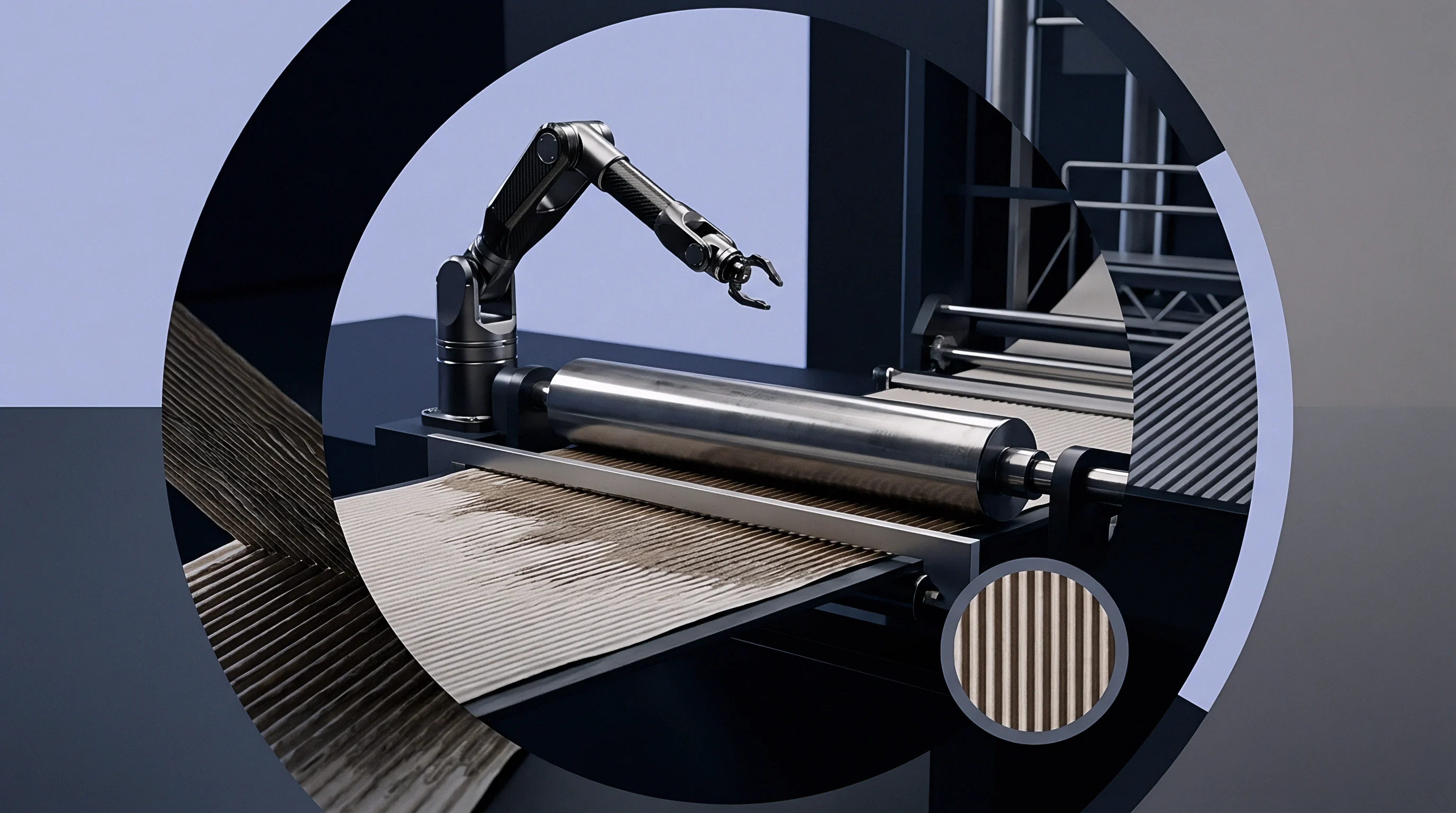
The image below illustrates the mechanical shear and moisture accumulation dynamics occurring inside a converting nip.
In-line wetting from dampening systems or aqueous coaters alters how recycled board responds under compression. Water softens the surface cellulose matrix, lowering the yield stress needed for mechanical deformation so that dampened surface layers compress more easily than dry core plies. This stiffness gradient shifts the neutral bending axis toward the dry back ply during creasing, increasing tensile strain on the top liner and causing micro-tears in top-liner coatings during high-speed folding.
When Does Interply Shear Exceed Cohesion Limits?
Critical shear stresses peak at the entry and exit of rubber-covered impression nips. Web speed, roll diameter, rubber cover hardness, and nip indentation depth shape the mechanical stress profile. As web speeds reach 300 meters per minute, the board’s viscoelastic relaxation times exceed its dwell time in the nip.
The sheet reacts with higher apparent stiffness, elevating peak compression and out-of-plane shear forces. High line speeds also leave less time for moisture to dissipate, trapping pore water inside recycled middle plies during compression.
Laminating adds further mechanical complexity via film tension and thermal gradients. Heated rolls at 90 to 130 degrees Celsius melt extrusion coatings or activate adhesive films, vaporizing free water in the top liner. This vapor flashes into gas and travels inward toward cooler middle plies, where it condenses into a localized wet zone directly beneath the hot laminating nip.
Combined mechanical nip pressure and vapor condensation weaken internal ply bonds immediately.
Thermal lamination drives vaporized moisture from hot outer liners into cold middle plies, inducing rapid internal condensation and localized interface breakdown.
Failure to match nip geometry, temperature profiles, and speed parameters to the moisture sensitivity of recycled board leads directly to catastrophic web breaks, blister formation during drying, and un-recyclable carton spoilage across downstream finishing equipment.
Solver

Multiscale Cohesive Zone Modeling Architecture
Predicting moisture-induced delamination requires connecting microscale fiber physics to macroscale converting performance. Multiscale finite element formulations bridge these domains by coupling Representative Volume Elements (RVE) to cohesive zone models (CZM). Micro-scale models evaluate fiber-joint mechanics, hygroexpansion tensors, and binder softening based on local water concentration, then homogenize those parameters up to the mesoscale to yield anisotropic constitutive relationships for individual plies.
Cohesive zone models govern interface delamination between layers. CZM formulations set non-linear traction-separation laws describing how bonds resist separation as deformation advances. Peak traction dictates interface strength, while the area under the traction-separation curve gives the critical strain energy release rate.
Both parameters are modeled as continuous functions of local moisture: higher moisture lowers critical fracture energy, reducing resistance to crack growth under Mode I opening and Mode II sliding.
| Relative Humidity (%) | Equilibrium Moisture Content (%) | Mode I Strength σ_max (MPa) | Mode I Fracture Energy G_Ic (J/m²) | Mode II Strength τ_max (MPa) | Mode II Fracture Energy G_IIc (J/m²) |
|---|---|---|---|---|---|
| 30 | 4.2 | 1.85 | 140 | 2.40 | 280 |
| 50 | 6.5 | 1.40 | 110 | 1.95 | 220 |
| 70 | 9.1 | 0.85 | 65 | 1.20 | 135 |
| 85 | 12.4 | 0.35 | 25 | 0.50 | 55 |
Transient moisture transport finite element routines solve Fickian diffusion equations across the board cross-section alongside mechanical stress solvers. Moisture fields update local stiffness matrices, thermal expansion coefficients, and cohesive interface parameters at each time step. Non-linear solver algorithms track progressive damage as micro-cracks coalesce into macro-scale ply separations during simulated converting passes.

Computational Assumptions and Worked Case Sensitivity
Constructing a predictive simulation requires explicit boundary conditions, mesh refinement, and constitutive properties. Consider a numerical simulation of a 450 micrometer coated recycled boxboard undergoing a 90-degree folding pass at a converting speed of 200 meters per minute. Assume an initial uniform board moisture content of 6.5 percent, rising to 11 percent at the outer surface following water-based coating application.
The mesh utilizes 8-node linear brick elements with reduced integration for continuum plies and zero-thickness 8-node cohesive elements at inter-ply boundaries.
Sensitivity analyses show that Mode II shear fracture energy dictates delamination onset during creasing, whereas Mode I opening fracture energy controls post-fold blister propagation. Increasing the moisture sensitivity exponent of the cohesive strength function by 20 percent expands predicted delamination along the crease line by 48 percent under identical mechanical loading. Standard mechanical simulations that ignore transient moisture softening underpredict real-world converting delamination rates by more than half.
Numerical convergence requires viscous regularization in the cohesive element formulation to prevent instability during sudden crack growth. High moisture flattens the traction-separation curve, shifting brittle fracture behavior toward ductile tearing. Solvers must accommodate large strain plastic deformations alongside geometric non-linearities as plies buckle independently after bond failure.
Which exact microstructural parameters govern the transition from stable inter-fiber slip to catastrophic inter-ply failure under ultra-high-speed converting conditions remains an open question in computational mechanics.
Waste
Commercial Yield and Conversion Spoilage
Uncontrolled moisture-induced delamination harms plant economics through higher spoilage and lost production runs. Recycled substrates carry lower per-tonne purchase prices than virgin bleached board, but that raw material cost advantage vanishes when converting lines must slow down to avoid ply separation or when finished carton reject rates spike. Line stoppages from delamination inside high-speed die-cutters create immediate scrap, lost machine hours, and expensive tooling repairs.
Finishing passes increase financial exposure. Adding foil stamping, film lamination, or spot varnishing puts substantial value onto raw board stock. If delamination occurs after three converting passes, lost value includes substrate, ink, operator labor, energy, machine wear, and film costs.
Spoilage at the final folder-gluer stage forces emergency re-runs, disrupting plant schedules and risking late-delivery penalties.
End-of-life packaging regulations add structural penalties for multi-material formats. Film-laminated recycled board cartons draw higher extended producer responsibility fees under European circular economy regulations if plastic film cannot be separated easily during pulping. Delamination in the paperboard core leaves paper fibers attached to rejected plastic film, lowering recycling yield and pushing the package into lower recyclability performance tiers.
Purchase Specification Clauses and Rejection Parameters
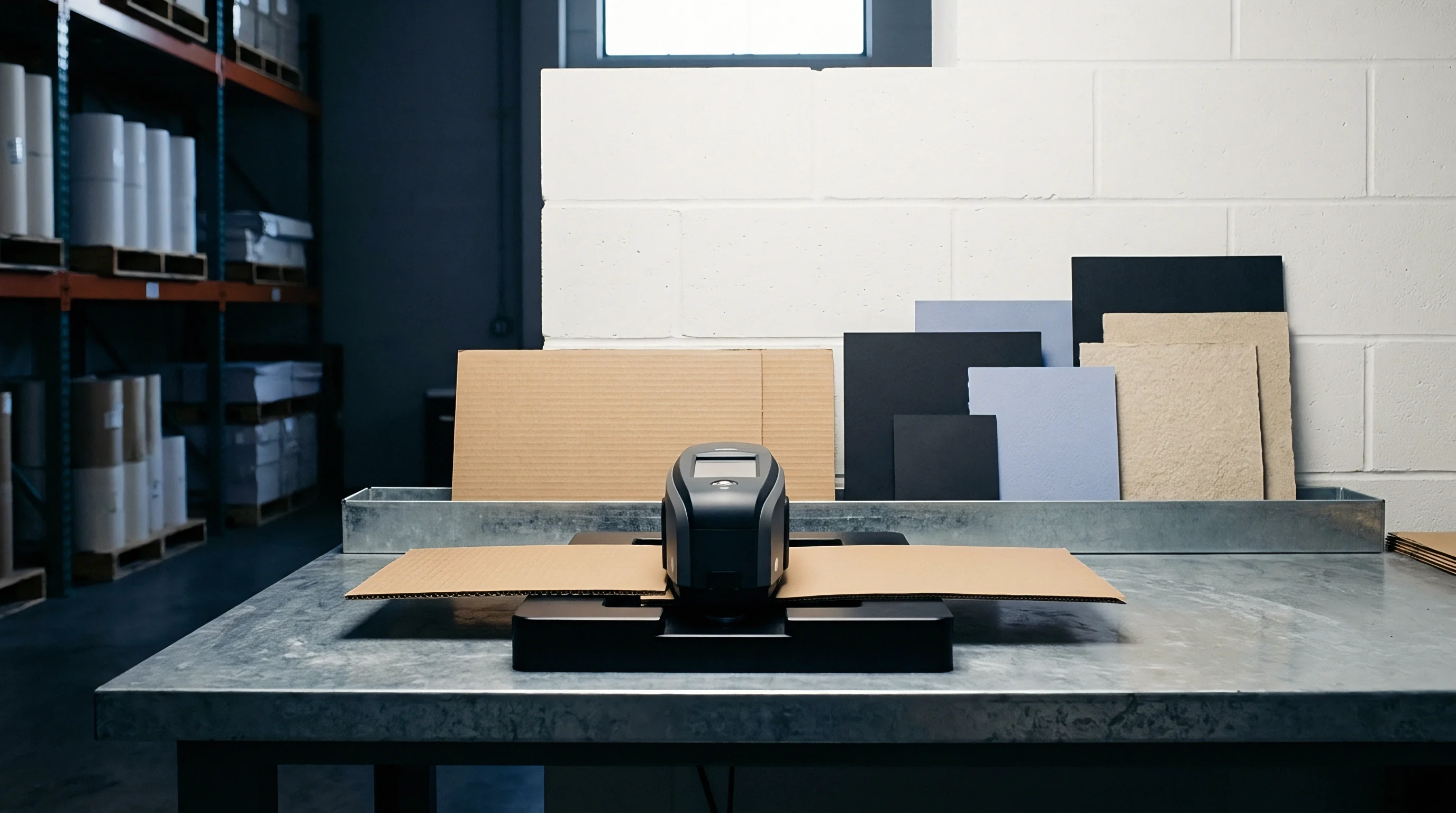
Managing commercial risk calls for precise technical terms in substrate purchase agreements. Standard board specs stating only nominal basis weight, caliper, and burst strength do not protect buyers against moisture-driven converting failures. Advanced procurement dockets set explicit limits for moisture variation, out-of-plane tensile strength, and hygroexpansion coefficients across delivered reels.
Standard quality control acceptance frameworks specify strict sampling plans and test metrics prior to production authorization.
- Delivery Moisture Limits require reel-average moisture content to remain strictly between 6.0 and 7.5 percent measured across full web width using calibrated near-infrared sensors.
- Z-Directional Tensile Minimums mandate an absolute lower limit of 250 kPa for internal bond strength under standard ISO 1924-3 test parameters across all recycled middle plies.
- Cross-Direction Hygroexpansion Thresholds cap allowable dimensional change at 0.12 percent per one percent change in sheet moisture content to restrict curl formation.
- Surface Absorbency Controls establish Cobb 60 water absorption values between 25 and 35 grams per square meter on coated surfaces to limit uncontrolled fluid penetration.
Commercial purchase contracts incorporating ISO 2859-1 acceptance sampling plans mandate total lot rejection whenever random reel testing identifies more than 1.5 percent of specimens exhibiting z-directional tensile strength below specified thresholds under elevated humidity conditioning.