Optimizing Thermal Nip Dynamics and Web Tension in Board Lamination
Matching nip temperature, line speed, and web tension to substrate caliper stops post-lamination curl while securing fiber-tearing film bond strength.
Calorie
Thermal energy transfer through thick paperboard during dry film lamination follows conductive heat transfer limits. Folding boxboard acts as a thermal insulator, retarding the flow of calories from the heated steel cylinder down to the adhesive interface layer. Solid bleached board with a caliper of four hundred micrometers presents a thermal conductivity value near zero point one three Watts per meter Kelvin.
Recycled multi-ply board displays lower thermal conductivity, ranging between zero point zero seven and zero point zero nine Watts per meter Kelvin, because internal air pockets between reprocessed fiber layers trap ambient air. Heat supplied by the laminating drum must pass entirely through the polymer film and melt the copolymer binder before reaching the board surface.
Line speed determines the exact dwell time available for thermal penetration inside the nip zone. At sixty meters per minute, a twenty-millimeter nip footprint provides a contact duration of twenty milliseconds. Lowering process speed to thirty meters per minute doubles this dwell duration to forty milliseconds, allowing adequate heat to reach the resin layer.
Ethylene vinyl acetate coatings require an interface threshold temperature of ninety-five degrees Celsius to achieve fluid wet-out. Ethylene acrylic acid polymers demand one hundred five degrees Celsius for full tack development. Running high-caliper board at excessive web speeds leaves the core of the adhesive layer below its flow point, creating microscopic air entrapment.
Heat transfers slowly through thick paperboard. Lowering machine velocity elevates interface thermal energy without raising cylinder surface temperatures to levels that distort thin oriented films. Biaxially oriented polypropylene softens rapidly above one hundred twenty degrees Celsius, experiencing longitudinal shrinkage.
Polyethylene terephthalate tolerates roll surface temperatures up to one hundred forty degrees Celsius before dimensional deformation occurs. Thermal nip control requires matching cylinder temperature directly to board grammage and line velocity.
| Substrate Grade | Caliper (µm) | Thermal Conductivity (W/m·K) | Target Speed (m/min) | Roll Temp (°C) | Interface Temp (°C) |
|---|---|---|---|---|---|
| Solid Bleached Board (SBB) | 300 | 0.13 | 55 | 115 | 96 |
| Solid Bleached Board (SBB) | 500 | 0.14 | 35 | 125 | 95 |
| Folding Boxboard (FBB) | 350 | 0.11 | 45 | 120 | 94 |
| Folding Boxboard (FBB) | 600 | 0.10 | 25 | 130 | 93 |
| White Lined Chipboard (WLC) | 400 | 0.08 | 40 | 125 | 94 |
| White Lined Chipboard (WLC) | 650 | 0.07 | 20 | 135 | 92 |
Extrusion-coated thermal polypropylene requires an adhesive interface temperature of ninety-four degrees Celsius at forty meters per minute to achieve full resin wet-out on coated paperboard.
Pre-heating systems alter this thermal balance by elevating the raw web temperature prior to nip entry. Infrared pre-heaters applied to the print surface raise the board skin temperature to sixty degrees Celsius before nip contact. Pre-heating reduces the thermal gradient requirement across the main laminating cylinder, permitting a twenty percent increase in throughput speed while holding the adhesive interface at ninety-five degrees Celsius.
Unheated board drawing heat instantly out of the molten adhesive layer creates brittle micro-bonds that fail during post-print folding operations.
Recycled fiber impedes thermal conduction. Dwell time governs resin flow. Does radiant infrared pre-heating alter board surface moisture rapidly enough to compromise adhesive wetting dynamics on clay-coated recycled sheets?
Drum
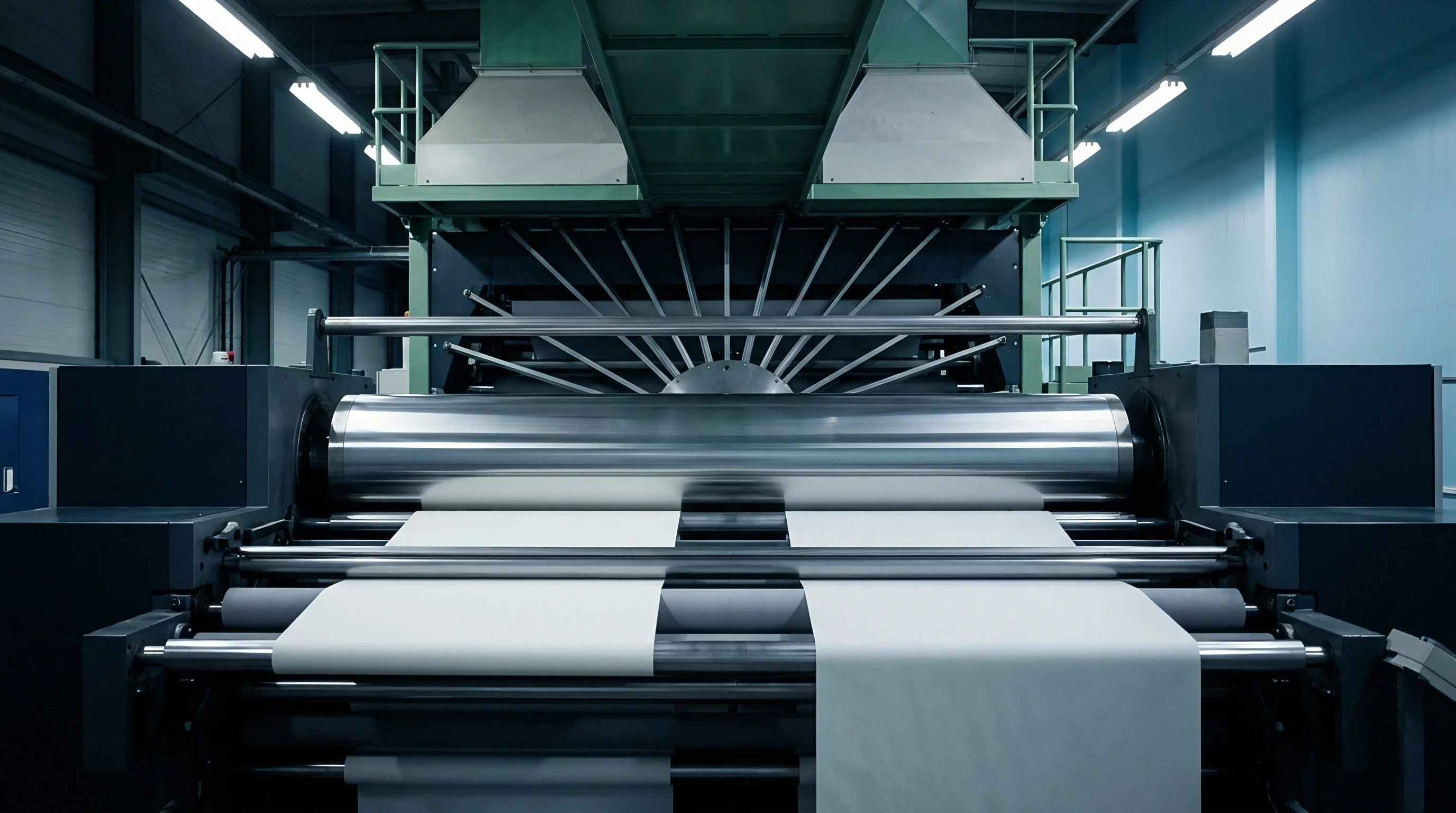
Mechanical pressure distribution across the laminating zone relies on the physical deformation of an elastomeric counter-pressure cylinder pressed against a rigid heated steel cylinder. Line pressure applied through hydraulic or pneumatic actuators forces the rubber cover to deform, generating a flat contact area known as the nip footprint. Rubber covers for folding carton converting typically range from seventy-five to eighty-five Shore A durometer.
A softer rubber cover of seventy Shore A broadens the nip footprint, extending contact dwell time at the expense of lower peak hydraulic pressure. A harder cover of ninety Shore A concentrates applied force into a narrow band, elevating peak pressure while reducing total contact dwell.
Linear nip pressure measured in Newtons per millimeter dictates the hydraulic forces forcing molten resin into board surface pores. Smooth solid bleached board requires a linear force of twenty to thirty Newtons per millimeter to achieve mechanical interlocking. Rough recycled board demands forty to fifty Newtons per millimeter to push thermal adhesive past raised surface fibers and clay coating ridges.
Insufficient linear load leaves unbonded voids across low spots in the board topography, while excessive pressure crushes internal bulk, destroying board caliper and stiffness.
- Elastomeric Cover Deflection creates uneven lateral pressure profiles, causing center-sheet blistering while board edges suffer caliper crushing.
- Excessive Peak Pressure fractures the top liner coating layer, creating micro-cracks that project through film during folding.
- Inadequate Footprint Dwell prevents molten copolymer resin from penetrating board micropores, leaving unbonded silvering pockets across high-coverage printed solids.
- Dynamic Thermal Softening reduces rubber durometer during extended multi-shift production runs, shifting peak nip location downstream.
Rubber covers deform under pressure. Harder rolls shrink the footprint. High internal friction within elastomeric roll covers generates internal heat during continuous dynamic deflection.
Continuous dynamic deflection elevates internal rubber temperature, causing durometer loss over extended operational shifts. An eighty Shore A synthetic rubber cover softening to seventy-two Shore A under dynamic thermal load widens the nip footprint by twelve percent, dropping peak pressure across the sheet centerline. Water-cooled counter-pressure cores maintain stable elastomeric durometer, ensuring uniform hydraulic pressure across five thousand sheet operational runs.
A broad nip footprint with moderate peak pressure secures film adhesion on thick board without sacrificing structural caliper.
Strain
Differential physical changes occurring between the plastic film and the paperboard during heat exposure and cooling generate severe post-lamination web distortion. The elasticity modulus of biaxially oriented polypropylene ranges around two point five Gigapascals, whereas oriented polyethylene terephthalate reaches four point five Gigapascals. Packaging paperboard exhibits an elasticity modulus between four and eight Gigapascals along the machine direction, but drops to two to three Gigapascals across the grain direction.
Thermal expansion coefficients differ by an order of magnitude: polypropylene expands at one hundred twenty times ten to the minus six per Kelvin, while cellulose fibers expand at ten to fifteen times ten to the minus six per Kelvin.
Heating both webs inside the nip causes the plastic film to elongate rapidly under thermal expansion and mechanical tension. Paperboard expands minimally from heat but loses internal moisture rapidly when exposed to temperatures exceeding one hundred degrees Celsius. As the laminated structure exits the nip and cools to ambient room temperature, the plastic film attempts to contract rapidly according to its thermal expansion coefficient.
The rigid paperboard resists this contraction. The resulting tension imbalance pulls the combined sheet into a curve, creating inward roll curl toward the laminated film face.
Mechanical web tension applied at the unwind stand multiplies this thermal strain differential. Tension force applied to the film web stretches the polymer matrix elastically prior to bonding. An unwind brake setting generating fifty Newtons of tension on a twelve-micron film web induces a structural mechanical strain of zero point two5 percent.
If this strain remains locked into the adhesive interface during cooling, the film exerts continuous shear force on the board surface. Controlling this behavior requires matching mechanical film elongation precisely to the thermal contraction of the substrate.
| Material Type | Thickness (µm) | Modulus E (GPa) | CTE (10⁻⁶ / K) | Tension Limit (N/m) | Hygroexpansion (%/%RH) |
|---|---|---|---|---|---|
| BOPP Gloss Film | 12 | 2.5 | 120 | 30 – 50 | 0.00 |
| BOPP Matt Film | 15 | 2.2 | 125 | 35 – 55 | 0.00 |
| PET Gloss Film | 12 | 4.5 | 20 | 60 – 100 | 0.00 |
| Cellulose Acetate | 14 | 3.8 | 80 | 40 – 70 | 0.08 |
| SBB Board (MD) | 350 | 7.5 | 12 | 200 – 500 | 0.015 |
| FBB Board (CD) | 450 | 2.8 | 15 | 150 – 350 | 0.045 |
Thermal expansion distorts thin films. Moisture loss accelerates sheet curl. Film strain pulls board edges upward.
Web tension control zones isolate the laminating nip from unwind and rewind torque disturbances. Closed-loop tension systems utilizing dancer rollers or load cells adjust magnetic particle brakes continuously to hold film strain under zero point one percent during roll diameter reduction.
- Thread film web through tension-sensing dancer assembly while holding unwind brake torque at fifteen percent of load capacity.
- Calibrate infeed nip load cells to eliminate cross-web tension skew before activating cylinder heating elements.
- Engage pre-heating drum surface at seventy-five degrees Celsius to stabilize thermal web expansion prior to nip contact.
- Adjust anti-curl breaker bar height until post-lamination sheet exit angle counters film thermal contraction pull.
- Monitor board moisture content at feeder using non-contact infrared sensors to match relative humidity set points.
Post-lamination anti-curl assemblies manage residual structural stresses by flexing the laminated web over an adjustable sharp breaker bar or small-diameter counter-roll. Drawing the board side of the laminate over a small radius forces the paperboard fibers to stretch plastically, matching the elastic strain present in the cooling film top layer. The exit breaker bar angle must increase when processing lighter board grammages or thinner film gauges, as lighter substrates possess lower structural flexural rigidity to resist film contraction forces.
Compliance with ISO 12647 surface finishing specifications obliges converters to verify flat lay state after seventy-two hours of equilibration under ISO 187 standard conditioning.
Moisture recovery post-converting further complicates long-term flat lay performance. Paperboard processed through high-temperature thermal nips loses up to two percent of its total mass in moisture content. Stacking hot sheets directly onto pallets seals this dried state inside the pile.
Over a forty-eight-hour storage window, sheet edges absorb ambient humidity from the surrounding room, expanding the paperboard matrix while the center of the sheet remains dry. This localized edge expansion creates wavy sheet borders. Storing laminated piles under moisture-impermeable plastic shrouds until full temperature and moisture equilibration occurs prevents differential moisture expansion across the stack volume.
Uncontrolled web tension combined with dynamic thermal strain causes severe stack warping, forcing automatic high-speed die-cutters to jam at the feeder head.
Defect
Interfacial failure in thermal board lamination manifests as optical defects or total physical separation of the film shell during converting passes. Silvering describes the appearance of hazy, reflective micro-voids beneath the plastic layer, caused by unbonded gaps where molten resin failed to touch the board surface. This issue stems from low nip pressure, insufficient roll temperature, or high ink coverage containing wax additives that lower surface energy.
Testing bond integrity requires performing a ninety-degree peel test according to ASTM D903 protocol; a compliant thermal lamination produces total fiber tear, pulling cellulose fibers cleanly out of the board surface rather than stripping resin off the print interface.
Blistering and tunneling appear when internal air or volatile solvents trapped inside the paperboard expand post-nip. High-speed offset inks containing heavy mineral oil solvents that are under-cured release gas under the high thermal energy of the laminating cylinder. This gas collects under the impermeable film barrier, blowing bubbles that mature into long tunnels along the grain direction.
Delamination along score lines during folding operations occurs when film elasticity exceeds the internal bond strength of the board substrate, pulling top liner layers apart at thirty-two-thousandths-of-an-inch score creases.
Smooth coated virgin fiberboard requires lower thermal resin mass than rough unbleached recycled board to achieve complete film adhesion.
How Does Surface Energy Dictate Thermal Film Adhesion?
Dyne levels measured on the substrate surface determine whether thermal adhesive resins can wet the paperboard surface cleanly. Wetting requires the surface energy of the solid board coating to exceed the surface tension of the molten copolymer adhesive by at least two dynes per centimeter. Standard clay-coated folding boxboards exhibit surface energies between thirty-eight and forty-four dynes per centimeter, which supports adhesion of ethylene vinyl acetate films.
Heavy solid ink coverage, metallic offset inks, or overprint varnishes lower board surface energy below thirty-four dynes per centimeter. Low dyne levels prevent chemical wetting, forcing the laminator operator to rely entirely on mechanical keying at elevated nip loads.
Silvering indicates inadequate thermal energy. Low dyne levels destroy bond strength. Score line cracking exposes substrate fibers.
Corona treatment units mounted directly on the laminator line pass high-voltage electric discharges across the film and board surface prior to nip entry. Surface oxidation elevates board dyne levels to forty-eight dynes per centimeter, splitting non-polar hydrocarbon chains and introducing polar hydroxyl groups that bond chemically with thermal extrusion resins. Skip corona oxidation on low-energy UV-printed sheets and adhesive bond strength degrades within twenty-four hours of process completion.
- Dyne Level Verification prevents low surface energy films from causing adhesive delamination during high-speed folding die-cutting operations.
- Board Moisture Audit confirms target humidity range before thermal processing to eliminate severe sheet bowing post-converting.
- Adhesive Melt Index Testing ensures thermal resin flows at set process temperatures without creating film distortion.
- Crease Depth Adjustment aligns male die rule width with total laminated caliper to avoid score splitting.
Film manufacturers frequently attribute edge delamination to unbonded print inks or excess board moisture rather than acknowledging variations in their own copolymer resin coat weights across the master roll width.
Balance
Commercial performance in board lamination requires balancing thermal energy input and press output speeds against post-converting waste and material compliance fees. Running a thermal laminator at high temperatures increases electrical consumption from heating elements while accelerating dynamic wear on elastomeric nip rollers. Electrical heating draws on oil-jacketed laminating drums range between twenty and forty kilowatts per hour of continuous operation.
Operating a thermal cylinder at one hundred thirty degrees Celsius to run five hundred micrometer board at maximum mechanical press limits consumes substantial electrical energy while increasing sheet spoilage during bring-up passes.
Waste calculations must include make-ready sheets, thermal bring-up scrap, and post-lamination edge trim loss. Thermal bring-up requires running non-grade substrate sheets through the nip until cylinder surface temperature stabilizes within plus or minus one degree Celsius across the face width. A typical thermal bring-up consumes eighty to one hundred fifty sheets of setup board.
Edge trimming removes five to ten millimeters of web width per side to prevent squeeze-out adhesive from contaminating counter-pressure rubber rolls. On a one-thousand-millimeter wide web, trimming ten millimeters per side represents a direct two percent loss in film yield.
| Film Type | Thickness (µm) | Film Cost (€/m²) | Energy (kWh/k-m²) | Recyclability Score | EPR Fee (€/Tonne) |
|---|---|---|---|---|---|
| Thermal BOPP Gloss | 12 + 12 EVA | 0.085 | 14.2 | Pass (EN 13430) | 140 |
| Thermal BOPP Matt | 15 + 15 EVA | 0.115 | 16.5 | Pass (EN 13430) | 140 |
| Thermal PET Gloss | 12 + 14 EVA | 0.145 | 19.8 | Conditional Fail | 480 |
| Thermal Soft-Touch PET | 18 + 15 EVA | 0.280 | 22.1 | Fail (CEPI Guideline) | 650 |
| Wet-Laminated BOPP | 12 (Waterbase) | 0.055 | 8.5 | Pass (PTS-RH 021) | 90 |
| Cellulose Acetate | 14 + 14 Solvent | 0.420 | 24.5 | Pass (EN 13432) | 0 |
Thick films increase recycling surcharges. Energy draw spikes at maximum speed. Pure cellulose films simplify fiber recovery.
Material recyclability grading under EN 13430 penalizes high-mass plastic lamination on paperboard packaging. Packaging containing plastic film layers exceeding five percent of total dry pack weight fails standard paper mill repulpability protocols like PTS-RH 021/97. Failed repulpability forces packaging converters into higher Extended Producer Responsibility tax brackets, adding hundreds of Euros per tonne in compliance charges.
Selecting thinner twelve-micron thermal films with optimized ten-micron adhesive coats maintains plastic content below the five percent threshold on four hundred grammage folding boxboard, protecting the pack’s mono-material recycling grade.
Film laminates exceeding five percent of total packaging mass incur maximum extended producer responsibility penalties across European sorting networks.
Standard purchase specifications dictate that thermal adhesive layer uniformity must remain within plus or minus five percent across the converted web, shifting all financial liability for surface delamination or silvering scrap back to the film coater.