Quantifying Rheological Leveling Dynamics and Surface Roughness in UV Curable Varnishes
UV varnish surface smoothness requires balancing zero-shear viscosity and surface tension against curing lamp delay before photopolymerization freezes leveling.

Flow
A first-off sheet pulled at the delivery pile under 60-degree directional lighting reveals periodic micro-topography well before full polymerization sets in. Patterns formed after transfer from an anilox roller or chambered doctor blade system stem from hydraulic split instabilities, where thin liquid films on paperboard substrates undergo surface-tension-driven smoothing controlled by viscosity and film thickness.
Surface wave decay in thin fluid layers follows the classic Orchard leveling model, where periodic disturbance amplitude decays exponentially over time based on fluid properties and layer dimensions. The decay rate scales directly with liquid surface tension and the cube of wet film thickness, while scaling inversely with zero-shear viscosity and the fourth power of the disturbance wavelength. Short-wavelength ridges damp out within milliseconds, whereas longer perturbations persist until crosslinking arrests fluid motion.
During roll application, the coating liquid encounters shear rates exceeding 100,000 reciprocal seconds inside the metering gap before dropping abruptly toward zero upon exit. The rheological profile demands rapid shear thinning for clean metering, followed by controlled viscoelastic recovery. Instantaneous structural recovery leaves high zero-shear viscosity that blocks capillary leveling, while an excessively slow viscosity recovery causes the liquid to slump or drip under gravity before reaching the UV curing station.
| Chemistry Type | Zero-Shear Viscosity (mPa.s) | High-Shear Viscosity (10^4 s^-1) | Equilibrium Surface Tension (mN/m) | Leveling Time Constant (ms) |
|---|---|---|---|---|
| Standard Polyester Acrylate | 450 | 65 | 32.5 | 380 |
| Low-Viscosity Epoxy Acrylate | 180 | 35 | 31.0 | 140 |
| Hyperbranched Polyol Acrylate | 850 | 80 | 34.0 | 920 |
| Cationic Cycloaliphatic Epoxide | 220 | 42 | 28.5 | 190 |
Doubling the wet film thickness reduces the time needed for surface wave decay by a factor of eight.
Rheological failures at high application speeds create surface defects that degrade final specular gloss. These structural instabilities stem directly from unbalanced fluid mechanics on the coater deck:
- Orange peel instability occurs when short-wavelength perturbations fail to damp out before polymerization freezes the film matrix.
- Ribbing defects form in the coating nip when hydrodynamic pressure exceeds capillary forces at high web speeds.
- Capillary cratering develops around surface contaminants when local surface tension gradients pull wet coating away from low-energy centers.
Initial fluid displacement meets resistance, but a low baseline viscosity accelerates surface smoothing as long as the film retains sufficient caliper over the substrate peaks.
Pulse
The interval between fluid application and radiation exposure governs final surface smoothness. Within tens of milliseconds, photopolymerization transforms a low-viscosity liquid into a crosslinked solid network. Free-radical acrylate formulations gel instantly once light intensity hits the threshold photoinitiator decomposition rate, jumping four orders of magnitude in viscosity and freezing the surface profile in whatever geometric state exists at photon impact.
Web speed and the distance between coating head and lamp housing dictate the open leveling window. Running at 150 meters per minute, a 1-meter gap between application roll and UV lamp gallery leaves 400 milliseconds of uninhibited fluid flow. Cutting that distance to 0.5 meters drops leveling time to 200 milliseconds.
When open time falls below the formulation’s characteristic rheological relaxation time, wave decay remains incomplete.
Atmospheric oxygen inhibition complicates free-radical curing kinetics at the liquid-air interface. Dissolved oxygen quenches triplet-state photoinitiators and scavenges radicals to form unreactive peroxy species. This slows surface crosslinking relative to the bulk layer, permitting extra flow at the surface while the interior solidifies.
Nitrogen inerting chambers eliminate oxygen quenching altogether, triggering instant surface gelation that locks in whatever micro-roughness existed before entry.
An application viscosity of 220 mPa.s at a shear rate of 100 reciprocal seconds requires a minimum dwell time of 450 milliseconds at 23 degrees Celsius to halve surface amplitude.
- Position the pinning lamp array between 300 and 500 millimeters downstream of the metering roller gap.
- Adjust web speed to maintain a minimum fluid relaxation dwell time of 600 milliseconds prior to high-intensity exposure.
- Set peak irradiance at the pinning station to 40 milliwatts per square centimeter to build yield stress without initiating full crosslinking.
- Align the final cure gallery two meters downstream to complete polymerization across the entire film depth.
Curing freezes the wet topography in place. Cutting the fluid relaxation window short yields permanent surface ridges, lowering specular gloss and altering tactile performance across the finished run.
Wetting
How Does Substrate Absorbency Compete with Capillary Leveling Flow?
Substrate absorbency pulls liquid coating volume from the surface layer into the porous fibrous network underneath. Coated solid bleached sulfate boards and folding boxboard feature complex capillary structures governed by pigment particle size and binder distribution. When liquid varnish touches the board, capillary pressure draws low-viscosity monomers into the pores following Lucas-Washburn absorption kinetics.
This absorption thins the effective wet film remaining above the board peaks. Because leveling velocity depends on the cube of film caliper, fluid loss into the substrate rapidly stalls wave decay: losing 30 percent of wet volume to substrate pores triggers a 65 percent drop in leveling rate. Low surface energy coatings spread quickly across latex binder domains, yet absorb faster into un-coated cellulose fibers.
Surfactants alter transient surface tension gradients during wetting and flow. Polyether-modified siloxanes lower equilibrium surface tension to 22 mN/m, boosting wet adhesion and lowering contact angles on hydrophobic inks. Fluorinated surfactants prevent cratering, but they can slow surface wave dissipation when concentration gradients create Marangoni stresses that work against leveling flow.
Compliance with ISO 2813 gloss benchmarks fails when board surface roughness Sa exceeds 0.45 micrometers regardless of varnish application weight.
Substrate properties and interfacial forces determine liquid retention and surface film geometry prior to radiation cure:
- Pore radius distribution governs the capillary pressure gradient that draws low-viscosity varnish components into the paper base board.
- Base coat holdout determines whether the applied wet film retains sufficient volume above the fibrous plane to sustain leveling flow.
- Dynamic contact angle reflects how rapidly the liquid varnish spreads across raw binder domains relative to uncoated cellulose regions.
Rapid curing speeds are often cited to mask poor substrate holdout on the premise that immediate gelation prevents strike-through on porous paperboard layers.
Texture
Quantifying surface roughness requires separating short-wavelength micro-roughness from long-wavelength macro-roughness. Mechanical stylus instruments measuring linear Ra profiles under ISO 4287 drag a diamond tip across the cured film, but stylus pressure risks scratching soft UV coatings and producing artificially deep valley figures. Non-contact optical profilometry using white light interferometry under ISO 25178 provides three-dimensional areal metrics without touching the surface.
Areal parameters Sa and Sq capture total surface height variance across a spatial domain: Sa gives the arithmetic mean height, while Sq represents the root mean square. Because roughness scatters incoming light, specular gloss measured at 60 degrees under ISO 2813 directly correlates with spatial amplitude variations. Wavelengths of micro-roughness smaller than the incident light wavelength suppress specular reflection and raise diffuse haze without creating visible orange peel.
| Coat Weight (g/m2) | Sa Surface Roughness (um) | Sq Surface Roughness (um) | Peak-to-Valley Height Sz (um) | 60-Degree Gloss (GU) |
|---|---|---|---|---|
| 2.5 | 0.58 | 0.72 | 4.20 | 68.5 |
| 4.0 | 0.31 | 0.40 | 2.15 | 84.2 |
| 5.5 | 0.14 | 0.19 | 0.98 | 92.6 |
| 7.0 | 0.09 | 0.12 | 0.62 | 95.1 |
Optical profilometers record micro-topography without disturbing un-cured or partially gelled polymer layers.
Spatial frequency filtering separates functional optical defects. High-pass filtering isolates fine micro-roughness caused by phase separation of photoinitiator byproducts or un-reacted oligomers, while low-pass filtering exposes long-wavelength waviness from coater roll vibration or hydraulic ribbing instabilities during application.
The exact boundary where spatial wavelength transitions from visible orange peel to sub-micron optical haze remains a point of debate among packaging engineers measuring high-gloss foil laminates.
Run
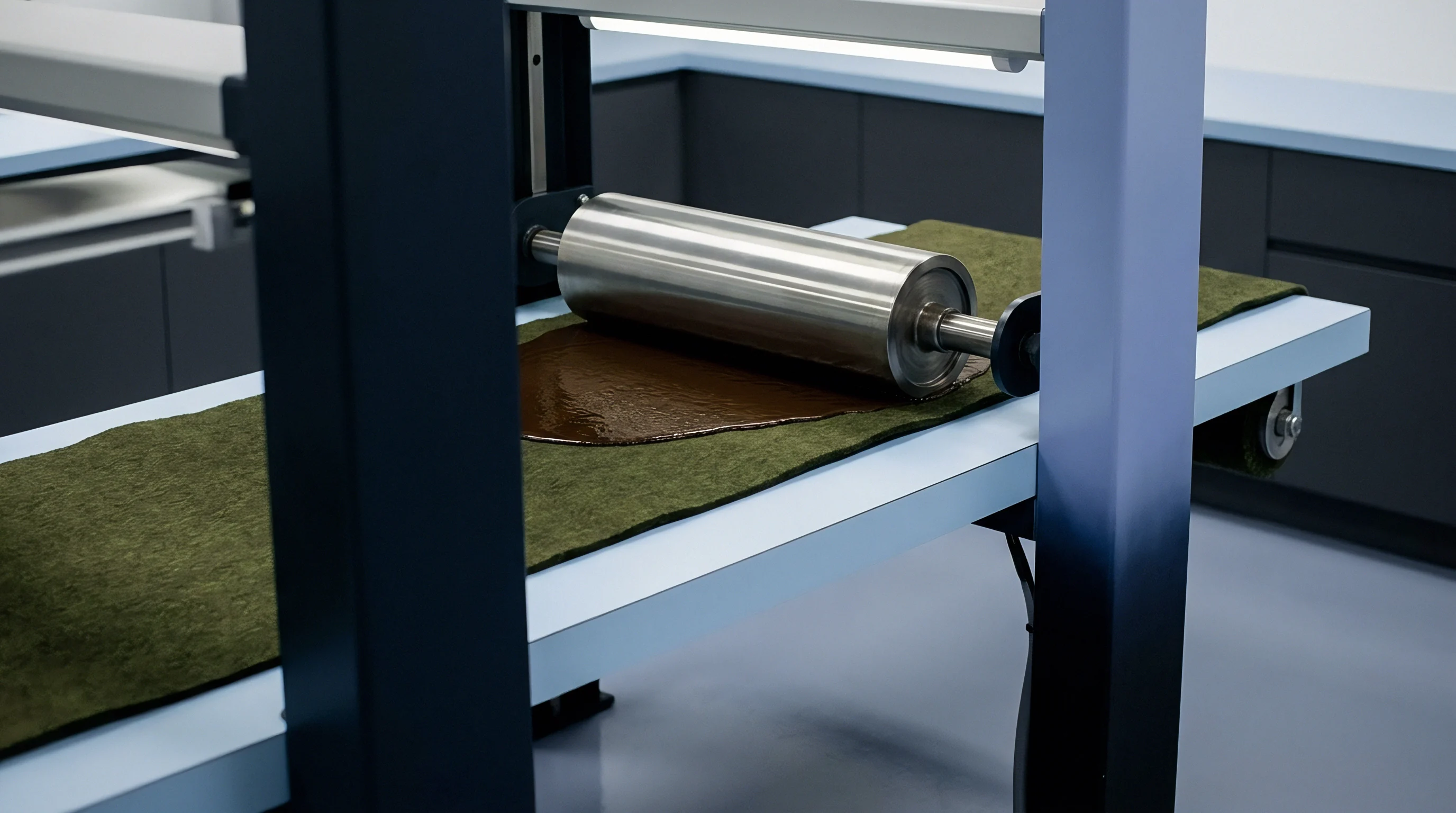
A commercial converting line running 350 gsm coated solid bleached sulfate board handles 50,000 sheets per shift. Meeting a specified minimum 60-degree specular gloss of 90 GU requires an Sa surface roughness ceiling of 0.15 micrometers, balancing application coat weight against machine velocity and power consumption.
Applying 3.5 grams per square meter of standard polyester acrylate varnish at 140 meters per minute yields an Sa roughness of 0.28 micrometers because wave decay remains incomplete within the 320-millisecond dwell window. The resulting gloss comes in at 81 GU, failing quality audit. Raising the coat weight to 6.0 grams per square meter lowers Sa to 0.11 micrometers and pushes gloss to 93 GU, though at higher material cost.
The financial ledger reflects this operational adjustment across the 50,000-sheet job lot. At a varnish cost of 4.80 USD per kilogram, applying 3.5 grams per square meter uses 107.6 kilograms of liquid, totaling 516.48 USD. Elevating coat weight to 6.0 grams per square meter increases consumption to 184.5 kilograms, bringing direct material cost to 885.60 USD per shift and adding 369.12 USD in raw material outlay per run.
Operating at lower coat weights while extending fluid dwell time offers an alternative balance. Reducing web speed from 140 meters per minute to 90 meters per minute extends dwell time from 320 milliseconds to 500 milliseconds. This extra window enables a 4.2 gram per square meter layer to reach the required 0.14 micrometer Sa roughness and 91 GU gloss.
Running at 90 meters per minute adds 1.8 hours to shift execution, incurring 216.00 USD in press hour machine fees while saving 276.80 USD in varnish consumption ~ a net gain of 60.80 USD per run, assuming static labor rates.
Recyclability scoring introduces downstream liabilities under European PTS method RH:021/97 testing protocols. Thick, heavily crosslinked acrylate layers resist disintegration during pulping, generating insoluble macro-stickies during mechanical screening. Substrates coated with UV film layers exceeding 5.0 grams per square meter face elevated Extended Producer Responsibility fees in multiple jurisdictions when pulping reject rates surpass 8 percent by dry weight.