Basic Conditioning Requirements for Paperboard Stiffness and Physical Evaluation
Standard atmospheric conditioning at 23°C and 50% RH under ISO 187 is mandatory to stabilize paperboard moisture content before stiffness bench testing.
Chamber
Caliper micrometer readings taken directly off a freshly unwrapped reel mean little until the internal cellulose matrix reaches equilibrium with standard laboratory air. Hygroscopic wood fibres absorb or desorb water vapor until the chemical potential within the fibre wall matches that of the surrounding air. Atmospheric conditioning for paperboard evaluation follows ISO 187 or TAPPI T 402 specifications, held strictly at 23.0°C (±1.0°C) and 50.0% (±2.0%) relative humidity.
As water molecules penetrate the amorphous regions of cellulose microfibrils, they weaken cell wall bonds, disrupt intermolecular hydrogen bonding, and plasticize the structural polymer network.
Flexural rigidity depends directly on the elastic modulus of the outer plies and their distance from the neutral bending axis. When relative humidity increases from 50 percent to 65 percent, board moisture content climbs from roughly 6.5 percent to 8.5 percent depending on furnish composition. This moisture gain reduces the elastic modulus of bleached kraft top liners by 15 to 22 percent, directly affecting bench measurements: Taber bending resistance falls 1.5 to 2.2 percent for every 1.0 percent increase in sheet moisture across standard folding boxboard grades.
Bleached softwood kraft pulp loses 18 percent of its flexural modulus when relative humidity shifts from 50 percent to 65 percent at 23 degrees Celsius.
The rate of moisture sorption varies with substrate density, internal sizing intensity, coating thickness, and total sheet caliper. Uncoated recycled boards with high porosity reach equilibrium within 4 to 6 hours, whereas heavyweight triple-coated solid bleached sulphate boards with dense chemical pulp plies can take up to 24 hours. Testing before full equilibration creates thermal and moisture gradients along the z-direction, corrupting flexural moment calculations and introducing artificial machine-direction stiffness variance.
Thermal and Moisture Gradients across Board Plies
Density variations through the z-direction govern how moisture moves into multi-ply structures. Bleached chemical pulp plies in Solid Bleached Sulphate (SBS) adsorb moisture rapidly because of accessible hydroxyl groups in amorphous cellulose regions. High-yield Chemi-Thermomechanical Pulp (CTMP) cores in Folding Boxboard (FBB) contain residual hydrophobic lignin, which slows vapor transport while maintaining bulk.
Coated Recycled Board (CRB) relies on short, highly beaten secondary fibres whose high swelling coefficients distort sheet planarity during rapid humidity shifts.
| Paperboard Grade Type | Nominal Caliper (µm) | Equilibrium Moisture at 35% RH (%) | Equilibrium Moisture at 50% RH (%) | Equilibrium Moisture at 65% RH (%) | Taber Stiffness Loss vs 50% RH Benchmark (%) |
|---|---|---|---|---|---|
| Solid Bleached Sulphate (SBS) | 350 | 4.8 | 6.2 | 8.1 | -14.2 |
| Folding Boxboard (FBB) | 450 | 5.2 | 6.8 | 8.9 | -17.5 |
| Coated Recycled Board (CRB) | 400 | 5.5 | 7.1 | 9.4 | -19.8 |
| White Lined Chipboard (WLC) | 500 | 5.8 | 7.4 | 9.8 | -21.2 |
Whether micro-fibrillar orientation in high-yield chemi-thermomechanical plies alters the rate of hydrogen bond relaxation above 75 percent relative humidity remains an open question for multi-ply board models.
Hysteresis
Path history determines the exact amount of bound water a sheet retains under standard testing conditions. A board arriving at 50 percent relative humidity from a drier state follows the adsorption curve, whereas one coming from a damp converting facility follows the desorption curve. Because of sorption hysteresis, a desorbing sheet holds a higher equilibrium moisture content than an adsorbing sheet at the same ambient temperature and humidity ~ at 50 percent relative humidity, a desorbing folding boxboard holds between 0.7 and 1.4 percentage points more moisture than when approaching along the adsorption path.
Preconditioning eliminates this path memory. TAPPI T 402 mandates placing evaluation samples in a low-humidity atmosphere maintained between 10 percent and 35 percent relative humidity at temperatures below 40°C for at least 24 hours before final equilibration. This forces every sample to approach the standard 50 percent relative humidity environment strictly along the adsorption path.
Skipping preconditioning introduces a systematic error of 5 to 8 percent in measured flexural resistance between samples stored in different warehouse zones before laboratory delivery.
Preconditioning board samples below thirty percent relative humidity eliminates path memory before final stiffness bench testing.
Dwell time inside the conditioning chamber governs sample stability. High-caliper multi-ply boards require extended conditioning windows because of the barrier created by extruded films, clay coating layers, and high-density top plies.
- Fiber wall contraction causes differential machine-direction shrinkage when dry air strips moisture from outer plies faster than inner mechanical pulp cores.
- Inter-ply delamination occurs when internal vapor gradients generate localized shear stress across starch adhesive lines during rapid desiccation.
- Z-direction density variations emerge as mechanical pulp fibres in the core retain bound water while bleached kraft liners reach equilibrium.
- Hygral curl formation develops when asymmetrical double-coated top surfaces restrict moisture transport relative to uncoated back plies.
Paperboard tested along the desorption path yields systematically lower elastic stiffness than board brought to equilibrium through preconditioning.
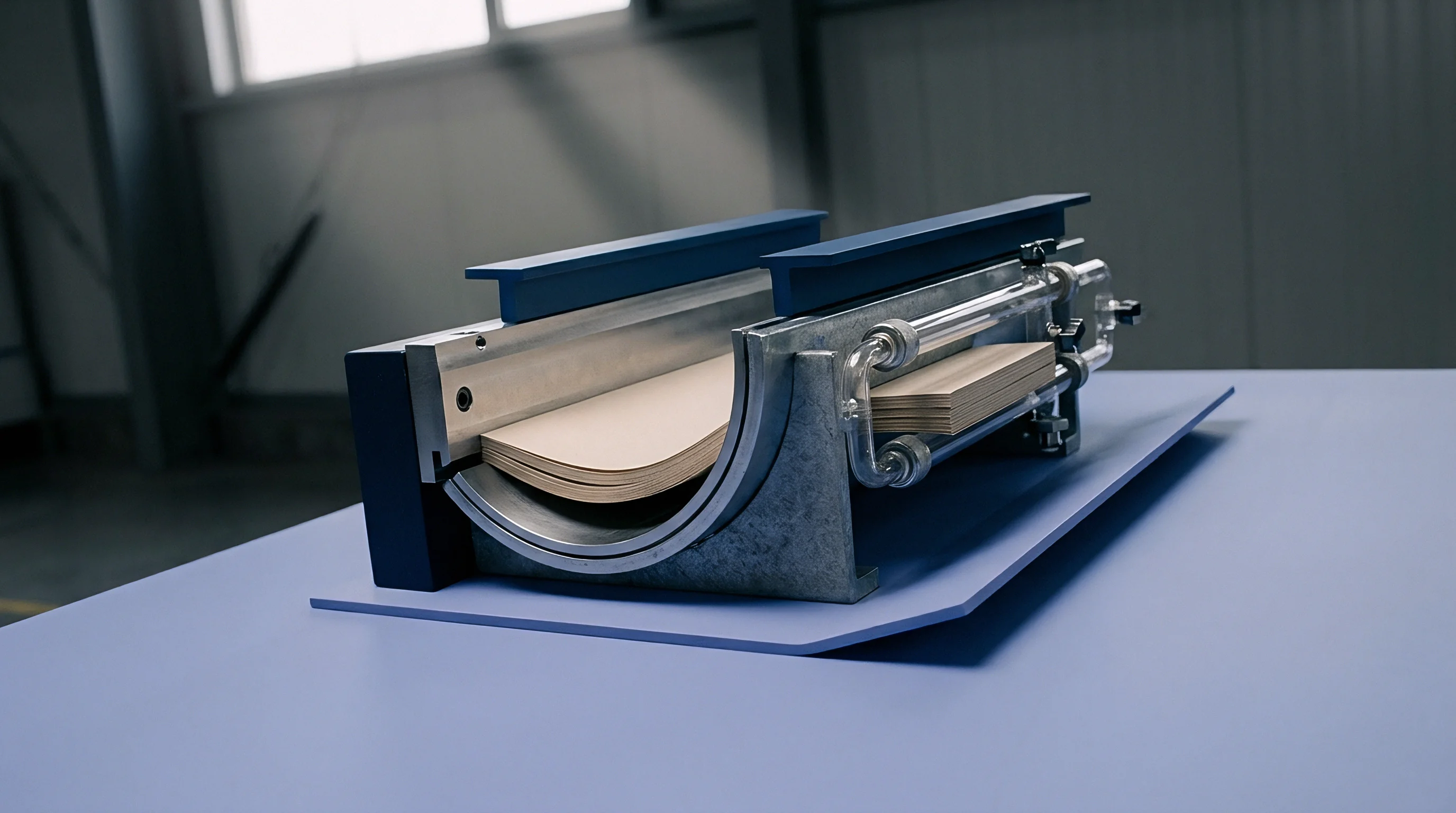
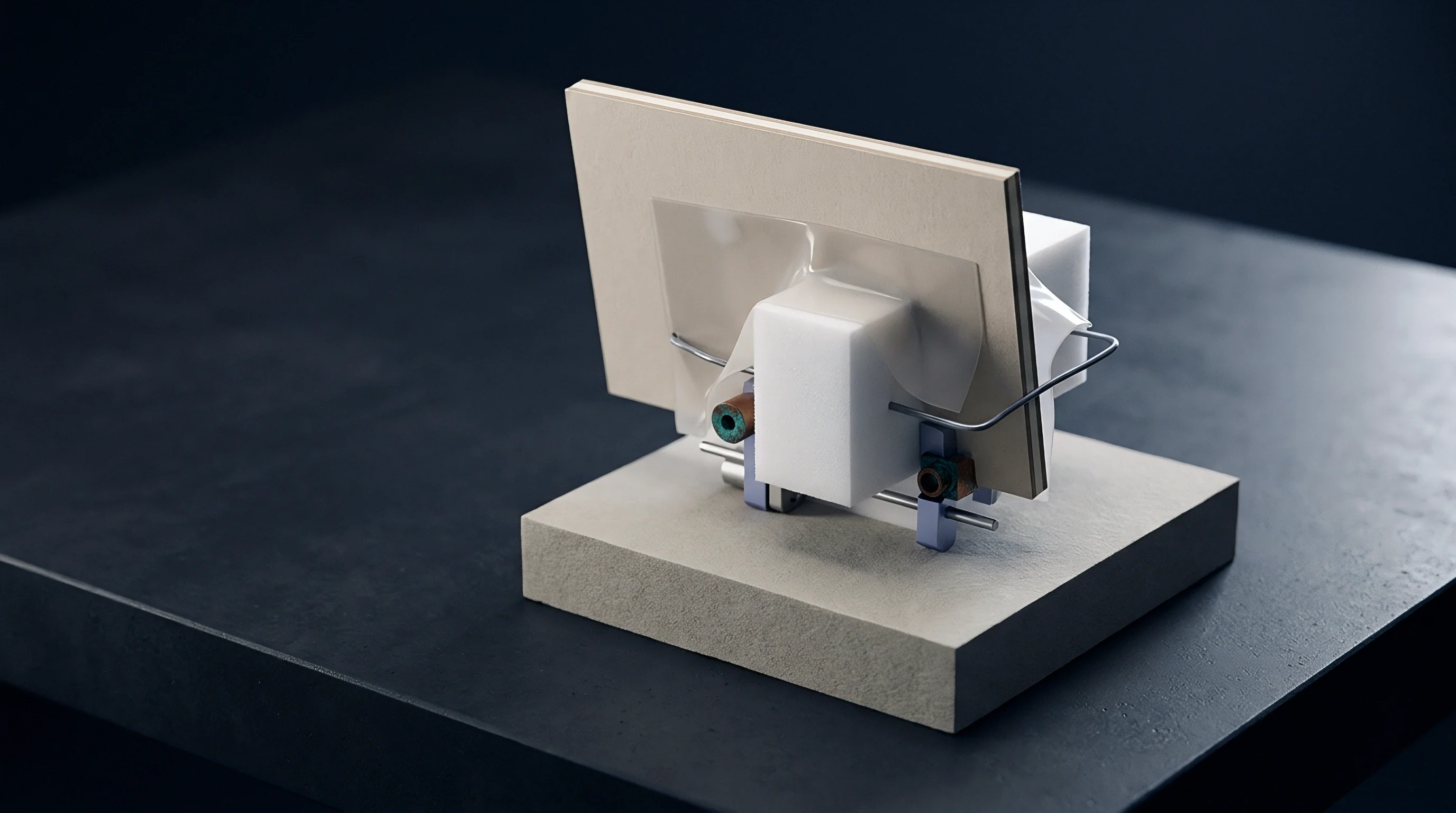
Bending
Physical evaluation of paperboard rigidity relies on flexural mechanics where structural resistance scales linearly with elastic modulus and cubically with sheet thickness, meaning caliper alone does not guarantee rigidity. Flexural stiffness per unit width equals the product of the elastic modulus in the bending plane and the cross-section’s area moment of inertia. Laboratory instruments isolate this property through mechanical deflection techniques categorized by loading geometry, specimen width, and deflection angle.
The two primary international testing protocols measure distinct physical behaviors. The Taber 15-degree bending resistance method under ISO 2493-2 and TAPPI T 489 forces a 38 mm wide specimen through a 15-degree angular deflection over a 50 mm gauge length. In contrast, the L&W 5-degree bending stiffness method under ISO 2493-1 deflects a 38 mm specimen by 5 degrees over a 50 mm length.
At a 15-degree deflection angle, thick packaging boards with mechanical pulp cores undergo plastic deformation along the outer compression face, which understates true elastic flexural modulus.
Why Do Taber and Kenley Stiffness Numbers Diverge?
Deflection magnitude determines whether testing stays inside the elastic region of the stress-strain curve. At 5 degrees of deflection, structural integrity remains intact and the recorded force reflects pure elastic deformation, allowing direct calculation of bending stiffness in millinewton-metres. At 15 degrees, outer fibre stress exceeds the sheet’s yield point, so Taber testing measures post-yield resistance, folding internal ply shearing and plastic compressive yield into the final stiffness value.
| Test Parameter | ISO 2493-1 (L&W 5-Degree) | ISO 2493-2 (Taber 15-Degree) | TAPPI T 489 (Taber) | ISO 5629 (Resonant) |
|---|---|---|---|---|
| Bending Angle | 5.0° ± 0.1° | 15.0° ± 0.1° | 15.0° ± 0.1° | Dynamic resonance (0°) |
| Bending Length | 50.0 mm | 50.0 mm | 50.0 mm | Variable resonance length |
| Specimen Width | 38.0 mm ± 0.2 mm | 38.0 mm ± 0.2 mm | 38.0 mm ± 0.2 mm | 15.0 mm ± 0.1 mm |
| Deformation Mode | Pure Elastic | Elasto-Plastic Yield | Elasto-Plastic Yield | Pure Elastic Dynamic |
| Standard Expressed Unit | mN | mN·m or Taber Units | g·cm or Taber Units | mN·m |
| Methods differ in strain rate application and elastic limit boundary conditions. ISO 5629 provides non-destructive dynamic elastic modulus without specimen contact pressure. | ||||
The choice of testing instrumentation dictates specification limits in commercial purchase contracts, making it essential that laboratory methods align with stress modes on the converting floor.
- Resonant frequency instruments measure non-destructive dynamic elastic modulus on high-speed laboratory production lines without permanent sample deformation.
- Two-point five-degree testers capture true elastic flexural behaviour required for finite element structural packaging modeling before yield points occur.
- Fifteen-degree Taber units provide benchmark figures for commercial cartonboard purchasing specifications across European and North American converter contracts.
- Four-point bending rigs isolate pure bending moments from shear forces when evaluating solid bleached board laminates above six hundred micrometres caliper.
Selecting an inappropriate deflection angle for thick mechanical-core boxboard produces false compliance figures that can trigger line jams during high-speed vertical filling.

Disruption
Converting operations run on narrow mechanical tolerances where substrate variance causes immediate press halts and die-cutter failures. When relative humidity in the plant drops below 40 percent, dry paperboard turns brittle as outer liner fibres lose bound water and decrease in ultimate elongation at break. During high-speed scoring and folding, these dry surface fibres split along the crease line, exposing raw furnish underneath and degrading carton appearance.
Excessive moisture causes the opposite failure mode. High relative humidity lowers the crease stiffness ratio ~ the force required to fold a scored crease relative to the bending resistance of the unbroken board ~ as wet fibres slip under strain. When humidity-induced stiffness loss in the main panel pushes the crease stiffness ratio above 0.50, automated carton erecting equipment fails to square the blank.
Tuck-flap memory then forces side panels outward, causing jam trips on 1,000-pack-per-minute cartoning lines.
- Check ambient relative humidity and temperature using a calibrated psychrometer directly above the feed station of the printing press or die-cutter.
- Measure substrate surface moisture across five points on the pallet using a high-frequency dielectric hand probe before unwrapping moisture-barrier film.
- Compare measured moisture values against the mill test certificate to establish whether moisture drift occurred during transit or staging.
- Reject pallets exhibiting moisture variations greater than one percentage point between core and outer wraps to prevent feed jam trips.
Stiffness directly governs box stacking strength. Moisture gain reduces both short-span compressive strength (SCT) and bending stiffness, compounding overall load loss in finished packaging. Under the McKee formula, a 15 percent drop in bending stiffness reduces top-to-bottom Box Compression Test (BCT) resistance by roughly 7.8 percent, risking stack collapse in cold-storage supply chains.
Contract terms enforcing ISO 187 atmospheric compliance void mill return claims when converter receiving bays test stock outside prescribed humidity limits.
Score line fracturing can stem from improper matrix channel depth at the converter rather than unconditioned dry storage.
Audit
Financial recovery for non-conforming paperboard relies on verifiable testing protocols executed strictly within certified environmental parameters, as unconditioned testing invalidates non-conformance claims. When a converter receives a 40-tonne shipment of 350 g/m² Folding Boxboard exhibiting carton bulge on press, formal acceptance sampling must follow ISO 186 or TAPPI T 400 rules. Samples drawn from inner pallet layers must enter the conditioning room immediately to prevent atmospheric contamination.
Yield calculation directly dictates profit margins. For example, if a packaging converter purchases 50 tonnes of 350 g/m² FBB at €1,400 per tonne specified for an MD Taber stiffness of 24.5 mN·m at 6.0 percent target moisture, and goods-in inspection measures delivered moisture at 8.1 percent due to compromised wrapping during ocean transit, the unconditioned stiffness measures only 21.0 mN·m ~ a 14.3 percent deficit below specification.
| Moisture Content Deviation vs Spec (%) | Measured Taber Stiffness Retention (%) | Press Performance Impact / Rejection Risk | Landed Yield Adjustment (€ / Tonne) | Total Financial Claim on 50-Tonne Lot (€) |
|---|---|---|---|---|
| + 0.5% (Target 6.0%) | 96.5% | Negligible impact; normal press adjustment | € 0.00 | € 0.00 |
| + 1.0% (Target 6.0%) | 92.0% | Minor crease springing; 3% press speed reduction | € 42.00 | € 2,100.00 |
| + 1.5% (Target 6.0%) | 88.5% | Moderate carton bulge; auto-cartoner jams | € 112.00 | € 5,600.00 |
| + 2.0% or greater | 84.0% | Severe structural failure; total pallet rejection | € 1,400.00 (Full return) | € 70,000.00 |
Moisture changes structural yield performance. Purchasing paperboard by weight while converting by surface area creates a direct financial penalty when excess water inflates delivered tonnage. A 2 percent moisture excess on a 50-tonne order represents 1,000 kg of paid water, erasing 2,850 square metres of usable carton surface area.
Moisture checks combined with ISO 187 conditioned stiffness verification provide the sole legal basis for securing credit notes or processing substrate rejections.
Commercial paperboard contracts index stiffness metrics to standard atmospheric equilibrium to prevent moisture gain from masking structural weight deficiencies.
Standard trade customs for paperboard supply specify that physical property claims are legally invalid unless bench verification occurs in an ISO 187 certified atmosphere within ten days of delivery.