Characterizing Softwood Hardwood Ratios in Recycled Folding Boxboard
Determining softwood and hardwood fiber ratios across plies ensures bending stiffness and score integrity in recycled folding boxboard specifications.

Strata
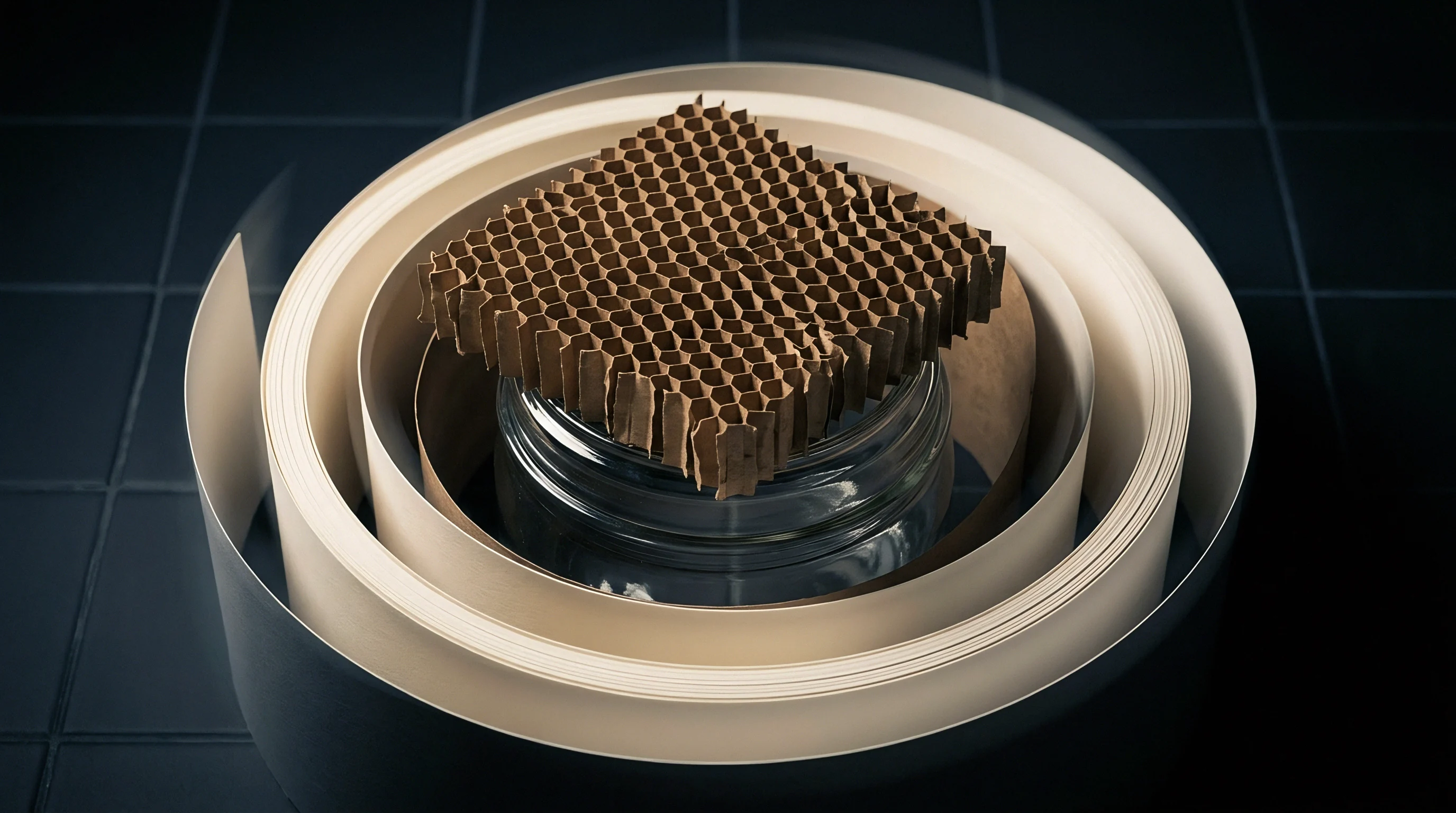
Multi-ply board construction relies on placing distinct raw materials into individual sheet positions during web formation on multi-former cylinder or Fourdrinier machines. In recycled folding boxboard, commonly categorized as CRB or GT2 grades, sheet thickness is built by combining a high-grade printable top liner, one or two thick inner core plies, and an unprinted or pigmented back liner. Each position demands a precise pulp blend to balance cost against structural performance.
Long softwood fibers generate the mechanical network required for tensile strength and crease endurance, while short hardwood fibers pack together to form a uniform, dense plane required for smooth ink transfer.
Layer Construction in Recycled Folding Boxboard
Top liner plies in white-lined chipboard typically utilize high-grade recovered office papers or deinked pulp blends. Smoothness dominates the structural target for this outer skin. Eucalyptus and birch fibers yield superior sheet formation and low surface roughness under Parker Print-Surf testing at 1000 kPa clamping pressure.
Hardwood content in this top fraction often reaches 70 to 80 percent by weight, minimizing optical show-through of the darker underlying core. Softwood supplies bending stiffness.
Middle filler plies draw from lower-cost recovered paper streams, including corrugated container fragments, old newsprint, and mixed packaging waste. These inner cores provide caliper and volume. Fiber length within the middle core fluctuates widely based on source material origin, but maintaining a minimum long-fiber softwood threshold prevents core shear failure when cartons are erected on automated packaging lines.
The back liner balances the sheet stress profile, utilizing a blend of unbleached softwood kraft and recycled containerboard stock to mitigate warp.
| Ply Position | Furnish Source | Grammage Target (g/m²) | Softwood Fraction (%) | Hardwood Fraction (%) | Primary Technical Function |
|---|---|---|---|---|---|
| Top Liner | Deinked sorting office waste / virgin pulp | 45 to 55 | 20 to 30 | 70 to 80 | Print surface and brightness stability |
| Under Liner / Sub-top | Sorted white ledger / mechanical woodfree clippings | 35 to 45 | 30 to 40 | 60 to 70 | Optical masking of dark inner core |
| Middle Core (1 or 2 plies) | Mixed wastepaper / old corrugated containers | 200 to 220 | 45 to 60 | 40 to 55 | Bending stiffness and caliper generation |
| Back Liner | Selected double-sorted corrugated / unbleached kraft | 40 to 50 | 50 to 65 | 35 to 50 | Tensile energy absorption and curl control |

Fiber Distribution across Plies
Engineers evaluate furnish distribution across individual plies by wet-splitting sheets on laboratory ply-separators. Disproportionate hardwood migration into the core plies drastically reduces cross-machine directional stiffness. Conversely, excessive softwood in the top liner elevates surface roughness, requiring higher latex binder additions in the coating formulation to achieve acceptable offset print fidelity.
Improper matching of fiber species across the multi-former headboxes introduces physical conversion defects on automated packaging machinery. High-speed carton erecting units expose board stock to complex multidirectional stresses.
- Delamination under shear arises when core plies lack adequate long-fiber softwood netting, causing internal web separation during high-speed 90-degree folding steps.
- Surface picking occurs during high-tack ink offset printing when hardwood fractions in the top liner lack sufficient refined softwood binder fibers to resist Z-directional tensile pull.
- Dusting during die-cutting stems from an excess of unbonded hardwood fines and short cell fragments breaking free along carton cut edges.
- Reverse crease splitting develops when back liner softwood ratios drop below 50 percent, preventing the outer liner from stretching around the female creasing matrix.
- Hygral cockle manifests when uneven softwood-to-hardwood ratios between top and back plies cause asymmetrical dimensional expansion during ambient humidity shifts.
When converting lines encounter severe delamination across the core plies during carton erection, mill technical representatives routinely cite raw material input variation across regional recycling collections as an unavoidable processing constraint.

Anatomy
Botanical distinctions between gymnosperm softwoods and angiosperm hardwoods establish the physical limits of paper stock performance. Softwood tracheids feature length measurements between 2.5 and 4.5 millimeters with coarseness ratings ranging from 0.15 to 0.35 milligrams per meter. Hardwood vessel elements and fibers exhibit lengths between 0.7 and 1.6 millimeters, accompanied by lower coarseness values between 0.07 and 0.15 milligrams per meter.
These physical dimensional bounds govern network consolidation and pore distribution inside the wet web.

Softwood and Hardwood Morphological Differences
Nordic pine and spruce supply long, flexible tracheids that collapse into wide, ribbon-like structures during mechanical refining. These ribbons generate extensive inter-fiber hydrogen bonding surfaces. Hardwood species, dominated by eucalyptus, birch, and beech, supply shorter, stiffer cylindrical fibers.
Short fibers pack tightly.
In recycled furnish streams, fiber walls have undergone repeated drying and re-wetting cycles. This process induces irreversible internal cell wall collapse, widely documented in pulp chemistry as hornification. Hornified softwood tracheids lose their original conformability, behaving mechanically like rigid tubes rather than flexible ribbons.
Consequently, recycled softwood fibers require higher mechanical refining energy to regenerate bonding area, which simultaneously risks shortening the fiber length through cutting actions in the refiner disc gaps.
Hardwood fibers generate smooth print surfaces while softwood tracheids build the load-bearing framework of the board structure.
Lumen Collapse and Fiber Degradation in Secondary Furnish
Repeated repulping alters the lumen structure of secondary fibers. Softwood lumens flatten permanently during press section consolidation and calendar roll thermo-compaction. Hardwood fibers, possessing thicker cell walls relative to their inner lumen diameter, resist complete flattening, preserving void volume inside the core plies.
Water retention value testing according to ISO 23714 documents a progressive decline in fiber swelling capacity over multiple recycling loops. Coarseness drops across recycling cycles.
Laboratory isolation of individual board plies allows precise morphological mapping across the sheet profile. The following sequential testing protocol isolates specific plies for microscopic fiber dimension measurement:
- Cut specimen sheets into 50 by 50 millimeter squares and record dry weight under ISO 187 standard conditioning at 23 degrees Celsius and 50 percent relative humidity.
- Submerge specimens in deionized water at 60 degrees Celsius for 45 minutes to soften inter-ply water-soluble starch and latex adhesive bonds.
- Mount the softened specimen onto a microtome stage cooled to minus 15 degrees Celsius to freeze interstitial moisture.
- Slice individual plies cleanly along the inter-ply interface using a sharpened microtome blade set to the target ply caliper.
- Disperse separated ply tissue in distilled water using a standardized disintegrator according to ISO 5263 at 30,000 revolutions.
- Measure fiber length distributions, width, coarseness, and fine content utilizing an automated optical analyzer complying with ISO 16065-2.
Unresolved questions persist regarding the precise rate at which recycled hardwood vessel elements fragment into non-bonding fines compared to softwood tracheids under intensive disc refining conditions at high consistency.


Optics
Quantitative determination of softwood and hardwood ratios within heterogeneous recycled furnish relies on microscopic counting methods and optical image processing. Standardized procedure ISO 9184 establishes microscopic fiber species identification based on morphological features and chemical stain reactivity. Herzberg stain, composed of zinc chloride, iodine, and potassium iodide, differentiates chemical pulps from high-lignin mechanical pulps by developing distinct colorations ranging from reddish-purple to deep blue and yellow.
Microscopic Fiber Counting via ISO 9184 Standard Procedures
Graff C stain serves as the primary analytical reagent for quantitative softwood and hardwood differentiation. Under light microscopy at 100x magnification, bleached softwood chemical fibers stain light pinkish-purple, while bleached hardwood fibers exhibit a dark blue-violet tone. Unbleached mechanical pulps turn yellow.
Lignin stains red under Herzberg reagent.
Calculations convert visual fiber counts into weight percentages utilizing species-specific weight factors, known as F-factors. Because softwood fibers weigh significantly more per unit length than hardwood fibers, raw count numbers underpredict softwood weight concentration if uncorrected. ISO 9184-1 mandates applying standardized F-factors relative to a reference cotton fiber baseline.
| Fiber Species / Origin | Mean Length (mm) | Coarseness (mg/m) | Standard F-Factor | Stain Reaction (Graff C) |
|---|---|---|---|---|
| Northern Softwood Kraft (Pine/Spruce) | 2.8 to 3.5 | 0.16 to 0.22 | 0.90 to 1.00 | Reddish-purple |
| Southern Softwood Kraft (Loblolly Pine) | 3.0 to 4.0 | 0.24 to 0.32 | 1.40 to 1.50 | Deep pinkish-purple |
| Eucalyptus Hardwood Kraft | 0.8 to 1.1 | 0.07 to 0.10 | 0.50 to 0.55 | Dark blue-violet |
| Birch Hardwood Kraft | 1.1 to 1.5 | 0.11 to 0.14 | 0.60 to 0.65 | Blue-violet |
| Recycled Newsprint / Groundwood | 1.0 to 1.8 | 0.14 to 0.20 | 1.00 to 1.10 | Bright yellow |
Automated Image Analysis and Chemical Staining Markers
Modern quality assurance laboratories employ high-speed automated fiber analyzers compliant with ISO 16065-1. These instruments pass dilute fiber suspensions through a narrow glass flow cell, capturing thousands of high-resolution digital images per second. Polarized light illumination highlights cell wall birefringence, separating genuine wood fibers from synthetic contaminants and shives.
Fiber length distributions skew left.
Chemical marker techniques supplement optical microscopy. Pyrolysis-gas chromatography-mass spectrometry (Py-GC-MS) measures the ratio of syringyl (S) to guaiacyl (G) lignin derivatives. Softwood lignin consists almost exclusively of guaiacyl units, whereas hardwood lignin contains both syringyl and guaiacyl structures.
The S/G peak area ratio provides a chemical signature that correlates directly with the botanical hardwood fraction, unaffected by mechanical fiber shortening during recycling loops.
Under ISO 9184-1 testing, softwood weight percentages require correction factors up to 1.50 to account for tracheid mass per unit length.

Should Furnish Ratios Be Specified by Layer?
Procurement agreements that state overall sheet softwood content without defining layer-by-layer distribution invite performance failures. A board containing 40 percent softwood concentrated entirely in the middle filler plies exhibits acceptable bulk but suffers severe surface rupture during 180-degree flat folding operations. Specification clauses must stipulate minimum softwood fractions for outer liners independently of core composite averages.
Purchase contracts incorporating strict furnish composition guarantees include standard clauses declaring that delivered stock falling more than five percentage points below specified layer softwood targets entitles the buyer to immediate rejection or a non-conformance credit adjustment.
Methods note: Fiber measurements in Table 2 reflect conditioned pulps tested under ISO 9184 protocols using polarized light optics calibrated against certified reference materials.


Score
Converting folding boxboard into functional cartons requires precise creasing and folding without outer liner cracking or core delamination. Bending stiffness obeys the E-I product relationship, where E represents the elastic modulus of the outer plies and I represents the area moment of inertia. Caliper controls box stacking strength.
Softwood tracheids positioned in the outer plies maximize elastic modulus, providing resistance against bending deformation.

Bending Stiffness and Caliper Relationships
Bending resistance measurements recorded under ISO 2493 at a 15-degree deflection angle demonstrate that stiffness scales proportionally with the third power of sheet thickness. However, thickness gained by increasing middle-ply hardwood ash-rich filler reduces internal cohesion. Substituting low-cost recycled hardwood newsprint into the middle core lowers the z-directional tensile strength, measured via Scott Bond testing according to ISO 15754.
Crease score evaluation utilizes matrix tools on laboratory platen presses. When a creasing rule forces the board into a female die channel, the sheet undergoes controlled internal layer rupture. Softwood supplies bending stiffness.
If middle plies contain insufficient long-fiber softwood, internal shearing becomes uncontrolled, causing unsightly cracking along the outer printed fold line.
ISO 2493 bending resistance testing confirms that board stiffness scales with the third power of caliper when outer ply elastic modulus remains constant.
Crease Durability and Internal Bond Strength
Mathematical modeling of a 380-micrometer recycled boxboard sheet demonstrates the mechanical consequence of altering middle-ply furnish ratios. Consider a 10-tonne packaging board lot specified at 350 g/m² grammage with a nominal caliper of 380 micrometers. Assume Case A incorporates a 50 percent softwood fraction in the middle core, yielding a Scott Bond internal strength of 180 J/m² and a cross-machine bending resistance of 14.5 millinewtons.
Assume Case B drops the core softwood fraction to 30 percent by substituting groundwood newsprint fines, maintaining identical caliper and grammage.
In Case B, Scott Bond internal strength drops to 115 J/m², and cross-machine bending resistance declines to 11.2 millinewtons, a 22.7 percent loss in structural stiffness. During high-speed folder-gluer conversion at 400 cartons per minute, Case B stock exhibits a 4.2 percent score line cracking rate compared to less than 0.1 percent for Case A. Make-ready spoilage increases accordingly. Tensile ratios dictate press speed.
Key physical parameters must be evaluated when qualifying recycled board for automated packaging applications:
- Taber stiffness ratio dictates carton panel bulging limits under vertical stacking loads in warehouse distribution environments.
- Scott bond internal strength measures energy absorbed during rapid z-directional delamination across the middle filler plies.
- Tensile energy absorption defines sheet elasticity under sudden mechanical shock loading on packaging lines.
- Surface Bendtsen roughness indicates top liner micro-contour smoothness required for uniform gravure or offset ink coverage.
- Cobb 60 water absorption measures liquid penetration resistance on outer coated surfaces exposed to refrigerated storage conditions.
Failing to verify middle-ply long-fiber content prior to committing high-volume production runs leads to severe carton crease splitting, high reject rates on automated packaging lines, and catastrophic warehouse stack collapses.

Margin
Paperboard transaction economics depend on balancing tonnage procurement costs against converted sheet yield. Mills sell board stock by weight, but box converters sell finished packaging units by surface area. Grammage control under ISO 536 and caliper uniformity under ISO 534 dictate the landed sheet count per metric tonne.
High bulk furnish configurations, achieved through mechanical softwood pulps and structured middle plies, allow downgauging without sacrificing functional stiffness targets.

Yield Mechanics and Downgauging Potential
Substituting virgin bleached hardwood kraft with secondary fiber lowers direct raw material input costs. However, secondary furnish carries lower bulk figures, typically requiring higher overall sheet grammage to match target bending stiffness. A converter specifying a 350 g/m² recycled board grade with a bulk value of 1.25 cubic centimeters per gram achieves a sheet caliper of 437 micrometers.
If secondary fiber hornification reduces sheet bulk to 1.12 cubic centimeters per gram, achieving that same 437-micrometer thickness requires increasing grammage to 390 g/m².
This 11.4 percent increase in baseline weight directly reduces sheet yield per purchased tonne. Freight costs per finished carton rise proportionally, eroding the initial price discount offered by the secondary furnish supplier. Recycled furnish carries ash variability.
| Furnish Specification | Grammage (g/m²) | Bulk (cm³/g) | Tonnage Required (t) | Base Price per Tonne ($) | Landed Stock Cost ($) | EPR Fee Tier ($/t) | Total Cost per 1,000 Sheets ($) |
|---|---|---|---|---|---|---|---|
| Virgin FBB (High Softwood Core) | 300 | 1.45 | 30.00 | 1,250 | 37,500 | 180 | 429.00 |
| Premium Recycled GT2 (Optimized Ratio) | 330 | 1.30 | 33.00 | 1,020 | 33,660 | 95 | 367.95 |
| Standard CRB (Low Softwood Core) | 370 | 1.15 | 37.00 | 880 | 32,560 | 95 | 360.75 |
Economic Impact of Fiber Ratio Deviations and Extended Producer Responsibility Fees
Extended Producer Responsibility (EPR) fee structures in major consumer packaging markets penalize non-recyclable or contaminated packaging grades. Regulators apply eco-modulation multipliers based on certified recycled content percentages and ease of repulpability. High softwood fractions in secondary board improve wet repulpability and fiber recovery rates in municipal recycling facilities, qualifying the board for favorable eco-modulation fee discounts.
Contract price adjustment clauses frequently link board invoice costs to regional pulp indices. When market softwood pulp prices spike relative to hardwood indices, recycled mills often adjust core furnish ratios, substituting hardwood mechanical waste to preserve operating margins. Unannounced furnish adjustments compromise converter score settings, triggering downtime on high-speed packaging equipment.
Substitutions that alter middle ply bulk force grammage increases that directly degrade sheet yield per metric tonne.
Optimum commercial efficiency occurs where sheet caliper requirements align with minimum allowable grammage thresholds, balancing fiber blend costs against converted unit area yield.