Downgauging Board Caliper through High Bulk Furnish Chemistry Mechanics
High-bulk BCTMP cores maintain boxboard bending stiffness during caliper downgauging while chemical wet-end additives prevent delamination under score creasing.

Bulk
Modifying wet-end slurry chemistry allows papermakers to increase sheet caliper without adding pulp mass per unit area. High-bulk furnish mechanics depend on altering fiber swelling, inter-fiber bond density, and internal void space within the wet web before it reaches press section consolidation. Because slurry freeness directly affects dewatering speed, controlling refining energy alongside targeted chemical additions lets paper machines hold specific volume while reducing raw material mass.

Fiber Structure and Wet End Additive Mechanics
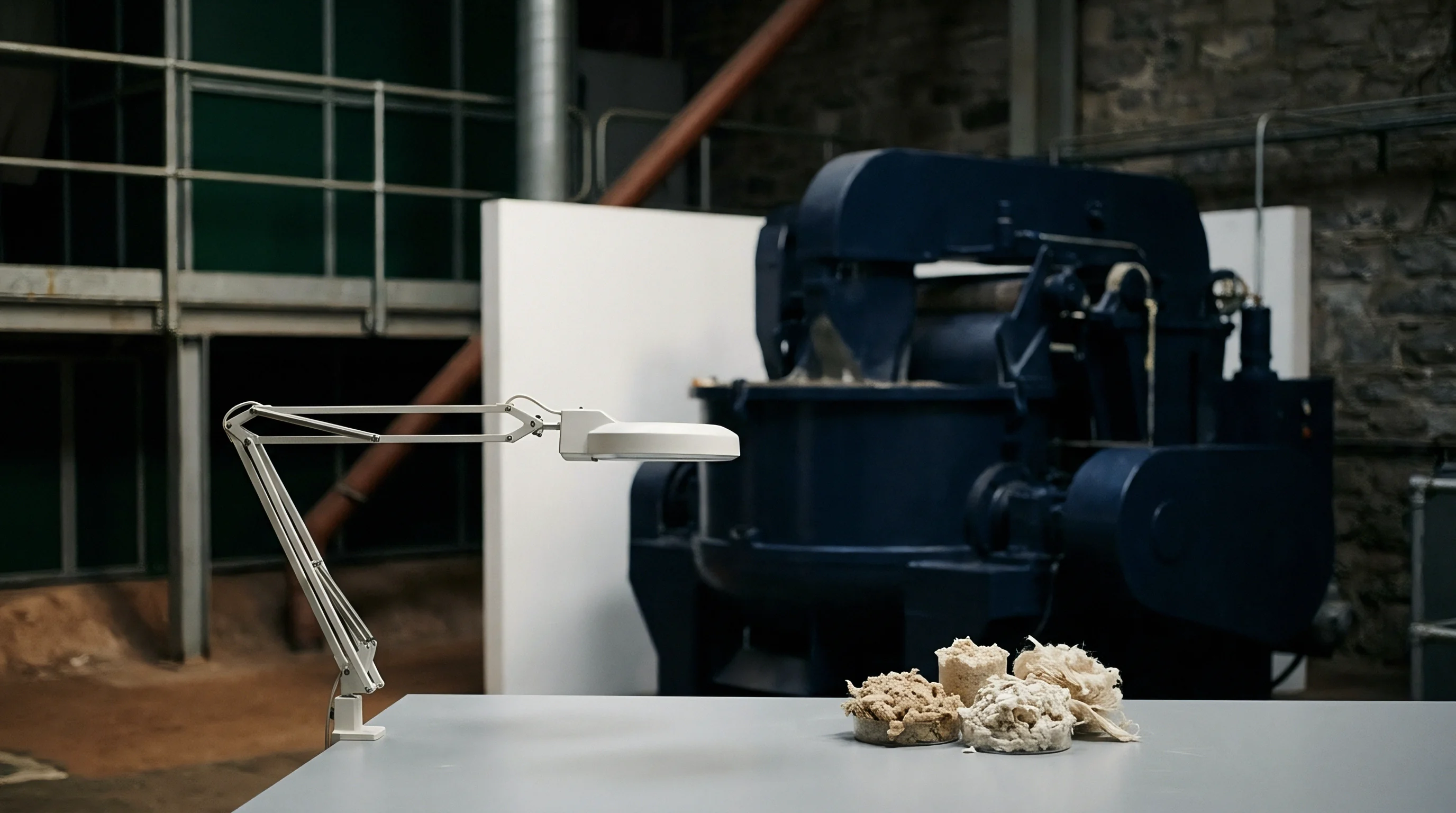
Mechanical pulps ~ particularly Bleached Chemithermomechanical Pulp (BCTMP) ~ form the backbone of bulk generation in modern boxboard. Unlike chemically cooked kraft fibers that collapse into flat ribbons during pressing and drying, BCTMP fibers retain a rigid, cylindrical cross-section. This open tubular structure produces a porous matrix with high z-directional spatial volume, which wet-end wet-strength resins and cationic starches protect against nip compression and wet-web compaction.
Freeness control is critical when preparing BCTMP fractions. Keeping refining to a minimum preserves fiber wall stiffness, maintaining freeness between 400 and 600 millilitres Canadian Standard Freeness (CSF). When chemical pulps are treated with enzymatic microfibrillation, external surfaces fibrillate without thinning the main fiber wall.
This targeted surface development creates localized hydrogen bonding sites while leaving the bending stiffness of individual fibers intact.

Surfactant Debonding and Pore Volume Expansion
Chemical bulking agents work by disrupting hydrogen bonding networks where fibers touch. Fatty acid quaternary ammonium surfactants adsorb onto cellulose surfaces, forming a hydrophobic hydrocarbon monolayer that weakens inter-fiber capillary attraction during dewatering, though dry tensile strength still depends on those underlying hydrogen bonds.
Chemical debonding agents reduce hydrogen bonding frequency across fiber contact points to inflate sheet volume without adding dry fiber mass.
Expanding pore volume alters both internal light scattering and fluid transport. Unrefined mechanical fibers combined with surfactant-treated chemical pulps form micro-voids one to five micrometres in diameter throughout the sheet core. These voids drive specific volume up from a baseline 1.1 cubic centimetres per gram in solid bleached chemical board to as much as 1.8 cubic centimetres per gram in high-bulk folding boxboard.
The main compromise is lower internal cohesion, which requires precise dosing of cationic retention aids and amphoteric dry-strength polymers.
Edge-wicking rate increases in high-bulk board stem primarily from unrefined mechanical pulp fractions rather than chemical debonding additive oversaturation.


Strata
Multilayer boxboard architectures isolate mechanical pulp fractions in interior layers while placing refined virgin bleached fibers on outer surfaces. This stratified layout functions like an I-beam: high-density outer plies take the flexural tension and compression, while the porous, low-density core acts as a shear-resistant separator.

Layered Density Profiles and Core Expansion
A typical three-ply folding boxboard (FBB) distributes furnish mass asymmetrically across the headbox system. The top ply relies on fully bleached hardwood and softwood kraft pulps refined to low freeness, producing a dense, smooth surface for blade coating and high-resolution printing. The core ply uses BCTMP blended with broke and mechanical tailing fractions to maximize caliper per unit grammage.
Microfibrillated cellulose (MFC) added to outer kraft plies increases tensile modulus without adding substantial weight. At dosages between 1.5 and 3.0 percent dry fiber mass, MFC forms a hyper-bonded nanofibrillar lattice that locks the sheet surface, offsetting structural yield loss in the expanded middle ply where core fibers must withstand compressive strain.
Conditioned at 23 degrees Celsius and 50 percent relative humidity, a three-ply folding boxboard core achieves a specific volume of 1.85 cubic centimetres per gram.
Ply Adhesion and Interlayer Bond Energy
High-speed converting can cause delamination at ply interfaces when mechanical pulp cores are used. Interlayer bond energy depends on fiber entanglement and chemical bridging across the wet contact zone. Dosing amphoteric polyacrylamides between headbox streams strengthens z-directional bonding so the multi-ply structure acts as a cohesive beam under flexural stress.
| Layer Position | Furnish Composition | Freeness Range (CSF) | Bulk (cm³/g) | Density (g/cm³) | Z-Tensile (kPa) |
|---|---|---|---|---|---|
| Top Liner | 100% Bleached Kraft Hardwood/Softwood | 250 – 320 mL | 1.15 – 1.25 | 0.80 – 0.87 | 380 – 420 |
| Middle Core | 85% BCTMP / 15% Chemical Broke | 450 – 550 mL | 1.75 – 1.95 | 0.51 – 0.57 | 180 – 220 |
| Back Liner | 100% Bleached Kraft Softwood | 300 – 380 mL | 1.20 – 1.30 | 0.77 – 0.83 | 340 – 390 |
Managing the interface between high-bulk cores and dense skins requires strict wet-end chemical balancing to maintain runnability and structural integrity.
- Microfibrillated cellulose enhances structural bonding in outer kraft layers to compensate for core fiber shortening.
- Cationic wet-end starch maintains internal z-directional bond strength across the pulp boundary during rapid sheet dewatering.
- Glyoxalated polyacrylamide accelerates initial dry strength development within the mechanical pulp core slurry.
- Alkyl ketene dimer provides hydrophobic sizing without degrading fiber surface charge dynamics at the wire.
Outer ply tensile stiffness dictates overall panel rigidity when mechanical core thickness expands.
Flexure
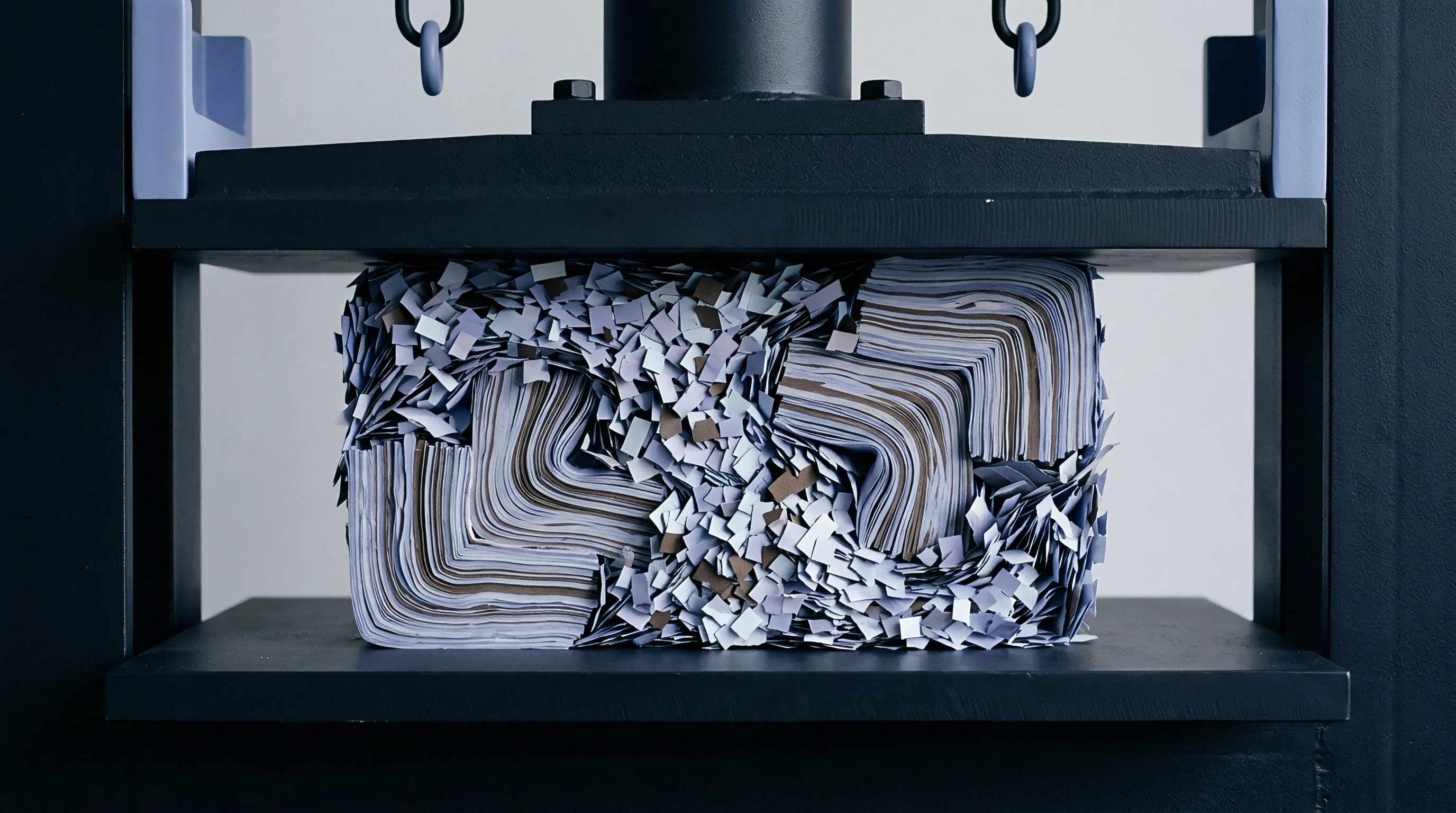
Structural rigidity in packaging board determines container stacking strength and performance on automated packaging lines. Flexural rigidity depends on both the elastic modulus of individual plies and their distance from the bending neutral axis, scaling directly with the cube of sheet caliper.
Why Does High Bulk Chemistry Impact Bending Stiffness?
When material elasticity is constant, bending stiffness scales with the cube of sheet caliper. High-bulk chemistry raises caliper (h) at a fixed grammage (w). Although chemical debonding agents slightly lower the elastic modulus (E) of the core, the exponential gain in distance (h3) from the BCTMP core produces a net increase in flexural rigidity (Sb).
The mathematical relationship governing bending stiffness per unit width for a symmetric multi-ply board follows the integral beam equation:
Sb = int-h/2h/2 E(z) · z2 , dz
Where E(z) represents the elastic modulus as a function of z-directional location relative to the neutral plane (z=0). Because z2 rises sharply toward the outer surfaces, maximizing E in the skin plies while expanding core caliper (zc) achieves the highest stiffness per unit mass, which prevents panel bulging in filled boxes.
Structural Flexural Rigidity Equations and Grammage Reduction
Consider a standard Solid Bleached Sulfate (SBS) sheet with a grammage of 300 grams per square metre and a caliper of 360 micrometres, exhibiting a bulk density of 0.83 grams per cubic centimetre and an elastic modulus of 4.2 gigapascals. The bending stiffness calculated across the solid cross-section yields a baseline value.
By substituting the central 60 percent of the sheet mass with a BCTMP high-bulk core treated with bulking surfactants, specific core volume expands from 1.20 to 1.80 cubic centimetres per gram. The total sheet thickness expands from 360 micrometres to 440 micrometres while total grammage remains fixed at 300 grams per square metre. Alternatively, the sheet caliper can be held constant at 360 micrometres while total grammage drops from 300 down to 245 grams per square metre, achieving an 18.3 percent fiber reduction without sacrificing structural stiffness.
ISO 2493 specifies a 15-degree flexural test angle for determining bending resistance on board machines operating above 200 grams per square metre.
| Board Construction Grade | Grammage (g/m²) | Caliper (µm) | Density (g/cm³) | E-Modulus (GPa) | L&W Bending Resistance 15° (mN) | Taber Stiffness (g-cm) |
|---|---|---|---|---|---|---|
| Standard SBS Baseline | 300 | 360 | 0.83 | 4.20 | 210 | 10.5 |
| High-Bulk FBB Equivalent Stiffness | 245 | 360 | 0.68 | 3.10 | 208 | 10.4 |
| High-Bulk FBB Expanded Caliper | 300 | 440 | 0.68 | 3.10 | 385 | 19.2 |
| Ultra-High Bulk Core Prototype | 220 | 360 | 0.61 | 2.60 | 185 | 9.2 |
Evaluating bending stiffness through standardized instrument comparisons shows that Taber 15-degree units (TAPPI T489) and Lorentzen & Wettre 15-degree mN force measurements (ISO 2493) track linearly provided sheet delamination does not occur during flexure.
Inadequate elastic modulus in outer plies causes permanent panel bulging under static top-load compression in pallet stacks.

Score
Converting operations put heavy mechanical stress on high-volume fiber structures when creasing tools deform board along fold lines. High-bulk grades exhibit lower z-directional tensile strength from surfactant debonding and unrefined mechanical pulp, making crease depth critical to getting clean folds without cracking the outer liner and ruining package appearance.
Crease Formation Mechanics and Flute Delamination
Creasing applies localized shear and compression to intentionally break internal bonds, forming a hinge inside the board. As the male rule forces the sheet into a female matrix channel, the outer liner stretches under tension while the core shears internally, where fiber length directly influences resistance to tearing.
If core ply cohesion is excessively weakened by bulking surfactants, shear failure spreads outside the designated crease zone, causing structural collapse and sloppy, uncontrolled fold lines. Conversely, if core ply shear resistance is too high, the outer bleached kraft liner fractures under tension, exposing unbleached or mechanical core fibers along the carton corner edges.
Die Clearance and Matrix Channel Selection
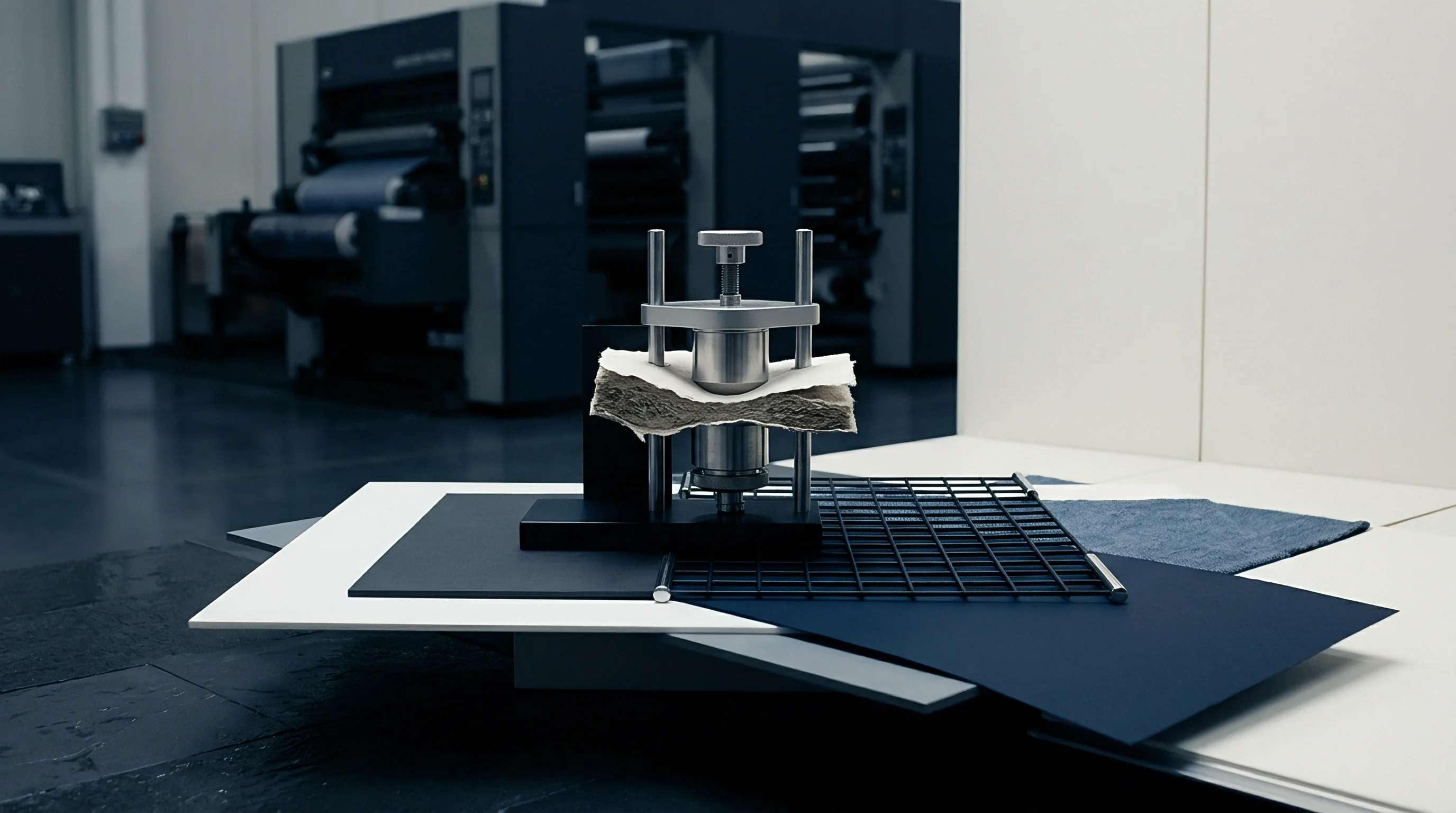
Converting machinery adjustments must account for the higher caliper-to-grammage ratio of high-bulk stock. Matrix channel width (W) and male rule depth (d) rely on empirical calculations tied directly to measured caliper (t), rather than sheet mass:
W = 1.5 · t + tr
Where tr represents the thickness of the male creasing rule. Because high-bulk boards compress more readily under initial tool contact, female channels sized for conventional kraft boards cause excessive side-wall pinching, leading to surface shear ruptures.
- Measure caliper across five sheet samples using ISO 534 dead-weight micrometer before setting anvil gap.
- Increase matrix channel width by ten percent relative to standard kraft board to accommodate expanded core volume.
- Reduce male crease rule penetration depth to prevent liner fracture along the score line.
- Perform 180-degree fold test under ambient moisture conditions to verify edge cracking limits.
Excessive core debonding agent concentrations produce clean folds but destroy score resistance during high-speed carton erection.
Whether chemical cross-linking agents can fully eliminate female matrix wear without increasing sheet stiffness variance remains open for converting trial verification.
Assay
Laboratory testing verifies that mill shipments meet published specification sheets for key physical dimensions. Evaluating downgauged board requires precise conditioning and instruments that can distinguish real volumetric expansion from surface roughness artifacts, while maintaining moisture equilibrium to prevent sheet curling.
Standardized Physical Measurement Methods
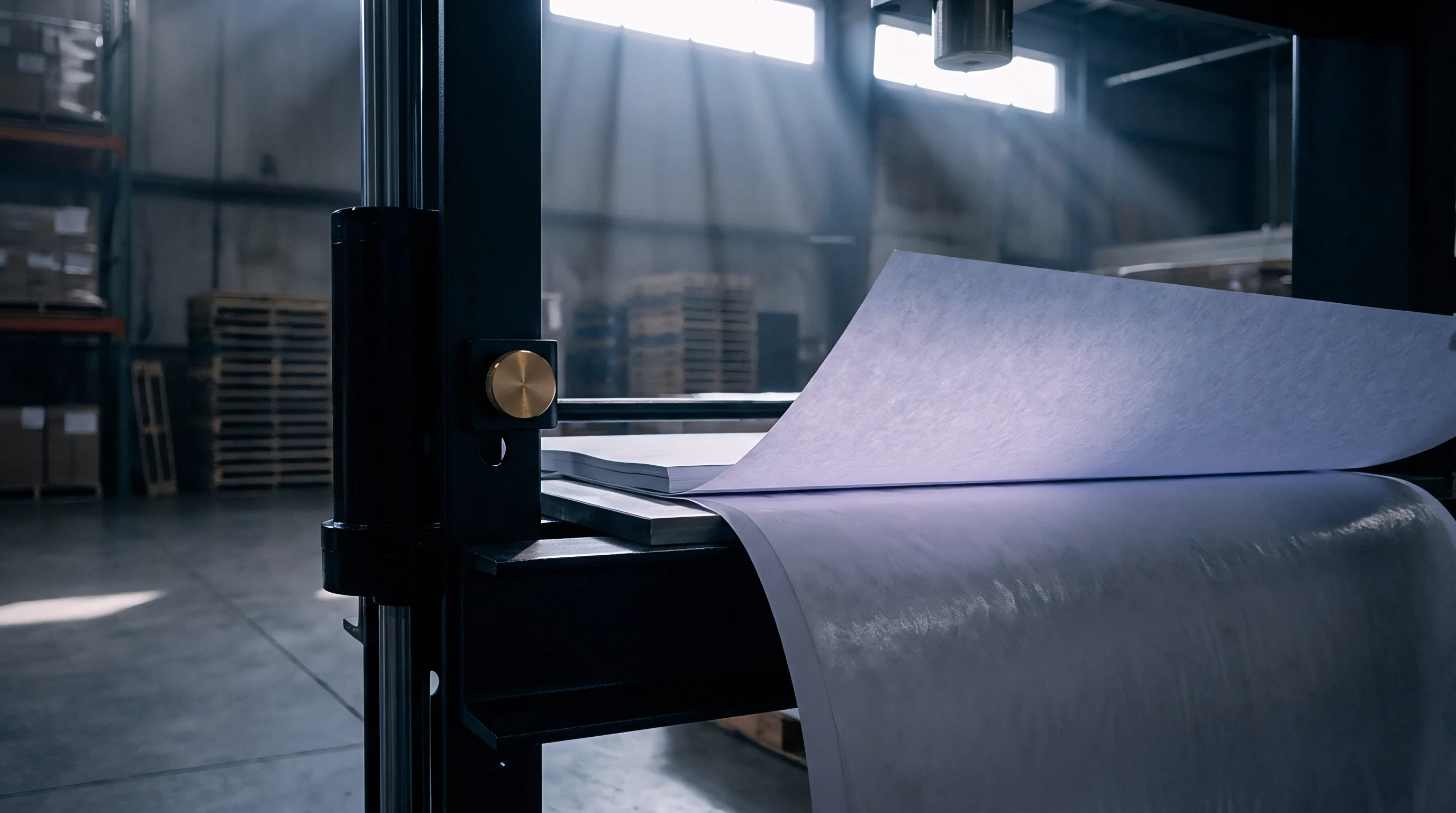
Caliper evaluation must follow ISO 534 specifications, employing a static dead-weight micrometer applying a continuous pressure of 50 kilopascals across a standard 200 square millimetre circular anvil contact area. Dynamic bench micrometers or non-contact optical sensors frequently misread soft, high-bulk cores by either crushing the porous fiber network or counting protruding surface fibers as solid thickness.
Internal bond strength must be measured via Z-directional tensile testing (TAPPI T541 or ISO 15754) rather than traditional Scott Bond impact energy methods. Impact methods measure total energy absorption during rapid delamination, which can mask micro-fractures inside surfactant-treated core layers. Static Z-tensile force application measures the exact stress threshold at which ply separation initiates.
| Property Parameter | Standardized Method | Conditioning Atmosphere | Target Standard Unit | Allowable Tolerance Band |
|---|---|---|---|---|
| Grammage Mass | ISO 536 | 23°C / 50% RH (ISO 187) | g/m² | ± 3.0% across roll width |
| Static Caliper | ISO 534 (50 kPa) | 23°C / 50% RH (ISO 187) | µm | ± 4.0% per pallet sample |
| Bending Resistance | ISO 2493 (15° L&W) | 23°C / 50% RH (ISO 187) | mN | ± 5.0% machine direction |
| Z-Directional Tensile | TAPPI T541 | 23°C / 50% RH (ISO 187) | kPa | Minimum 200 kPa threshold |
| Parker Print-Surf Roughness | ISO 8791-4 (10 S10) | 23°C / 50% RH (ISO 187) | µm | Maximum 1.5 µm top side |
Pallet Verification and Reel Sampling Protocols
Pallet acceptance sampling requires cutting test specimens from the top, middle, and bottom reams of delivered shipments. Moisture shifts alter BCTMP core thickness quickly ~ a two percent rise in moisture can swell or collapse the core depending on internal sizing, directly affecting the caliper uniformity needed for accurate print registration.
- Conditioning equilibrium requires twenty-four hours exposure inside an ISO 187 standard atmosphere prior to physical testing.
- Micrometer anvil pressure must maintain fifty kilopascals steady static force during caliper determination.
- Grammage determination relies on precision balance readings across ten representative one-hundred square centimetre cut samples.
- Z-directional tensile testing measures internal cohesion strength by separating double-sided adhesive tape grips at uniform speed.
Incorporating ISO 534 clause 6.2 into substrate purchase specifications establishes a maximum three percent caliper variation across reel widths.


Arbitrage
Commercial evaluation of packaging paperboard shifts financial calculations from raw mass purchasing to delivered surface area yield. Paperboard is manufactured and invoiced by the metric tonne, but package converters process discrete rectangular sheet units. Downgauging caliper through high-bulk chemistry expands printable surface area generated per unit mass bought.

Sheet Yield Mechanics and Fiber Tonnage Conversion
Consider an order specifying 1,000,000 carton blanks, each requiring a 700 mm by 1000 mm sheet format. Using a standard solid bleached chemical board at 350 micrometres caliper with a grammage of 310 grams per square metre, each sheet weighs 0.217 kilograms. Total order mass equals 217 metric tonnes of raw material.
Substituting a high-bulk BCTMP folding boxboard that provides the equivalent 350 micrometres caliper at a reduced grammage of 250 grams per square metre lowers individual sheet weight to 0.175 kilograms. Total order mass drops to 175 metric tonnes. At a market baseline price of $1,200 per metric tonne, raw material costs fall from $260,400 to $210,000 ~ a direct savings of $50,400 that reduces overall landed cost.

Freight Density Constraints and EPR Fee Impact
Shipping logistics introduce secondary economic consequences when shifting to high-bulk substrates. Freight trucks and sea containers hit volumetric transport limits prior to weight capacities when hauling high-bulk sheet reels. Standard trailer payload weight drops by up to fifteen percent, marginally increasing transport cost per delivered fiber tonne.
Extended Producer Responsibility (EPR) fee systems in major packaging markets levy tariffs based directly on post-consumer packaging weight placed on the market. Reducing sheet mass by 19.3 percent lowers corresponding producer packaging compliance fees proportionally across every shipping cycle.
Financial gains realized through sheet area expansion remain intact provided press speeds and die-cutting waste figures match conventional board operational metrics.