Dynamic Flexural Rigidity Decay Modeling across High Speed Board Converting Lines
Dynamic flexural rigidity decay models enable converters to predict score cracking and carton squareness loss caused by high-speed nip compression.

Substrate
Paperboard stiffness defines how a carton structural panel resists bending forces during high-speed packaging operations. Standard laboratory specifications report flexural rigidity under static equilibrium conditions, typically employing 15-degree Taber testing per ISO 2493-2 or 5-degree bending resistance per ISO 2493-1. These static values assume that paperboard behaves as a purely elastic continuum.
High-speed converting lines subject board webs to dynamic loading frequencies ranging between 50 Hz and 500 Hz. Under these strain rates, the viscoelastic nature of cellulose fibers causes a measurable decay in effective flexural rigidity, altering panel deflection during blanking, matrix scoring, and folder-gluer feeding.
Flexural Rigidity Fundamentals
The resistance of a sheet against mechanical deflection relies on the product of its elastic modulus and section moment of inertia. Flexural rigidity per unit width, expressed in newton-metres, dictates how structural panels withstand compression during stacking and converting. In multi-ply board structures, the out-of-plane z-direction shear modulus governs how stress redistributes across individual plies when the sheet bends.
Higher z-direction shear resistance maintains structural integrity across outer plies, preserving section depth. When internal ply shear resistance drops, middle plies slide laterally relative to one another, drastically lowering the effective moment of inertia and causing flexural rigidity to decay during rapid processing.

Multi-Ply Structure and Fiber Orientation
Layering distinct pulp stocks across the thickness profile optimizes mechanical performance while reducing overall furnish cost. Solid Bleached Sulfate (SBS) boards utilize long softwood chemical fibers throughout, yielding consistent elastic modulus values across all layers. Folding Boxboard (FBB) pairs bleached chemical fiber outer plies with a bulky mechanical pulp core, maximizing physical caliper for a given basis weight.
White Lined Chipboard (WLC) and Coated Recycled Board (CRB) rely heavily on recycled fiber furnishes, which contain shortened fibers and elevated filler contents. Chemical pulp outer plies experience peak tensile and compressive stresses during flexure, whereas mechanical or recycled middle plies absorb shear stress. If middle-ply fibers fail to transmit shear forces efficiently, the structural distance between the outer tension and compression skins effectively shrinks under dynamic strain.
| Grade Family | Furnish Construction | Grammage (g/m²) | Caliper (µm) | Taber 15° Stiffness MD (mN·m) | Elastic Modulus E (GPa) | Z-Shear Resistance (kPa) |
|---|---|---|---|---|---|---|
| Solid Bleached Sulfate (SBS) | 100% Virgin Chemical Kraft | 300 | 380 | 18.5 | 6.2 | 420 |
| Folding Boxboard (FBB) | Bleached Kraft Skins / Mechanical Core | 300 | 460 | 24.0 | 4.8 | 310 |
| White Lined Chipboard (WLC) | Recycled Liner / Recycled Middle Ply | 350 | 450 | 17.0 | 3.9 | 220 |
| Coated Unbleached Kraft (SUB) | Unbleached Softwood Kraft Base | 310 | 420 | 22.5 | 5.8 | 390 |
Static bench stiffness measured at 23 degrees Celsius does not account for all operational structural integrity, and dynamic converting losses cannot be dismissed as mere setup variances on the converter floor.
Nip
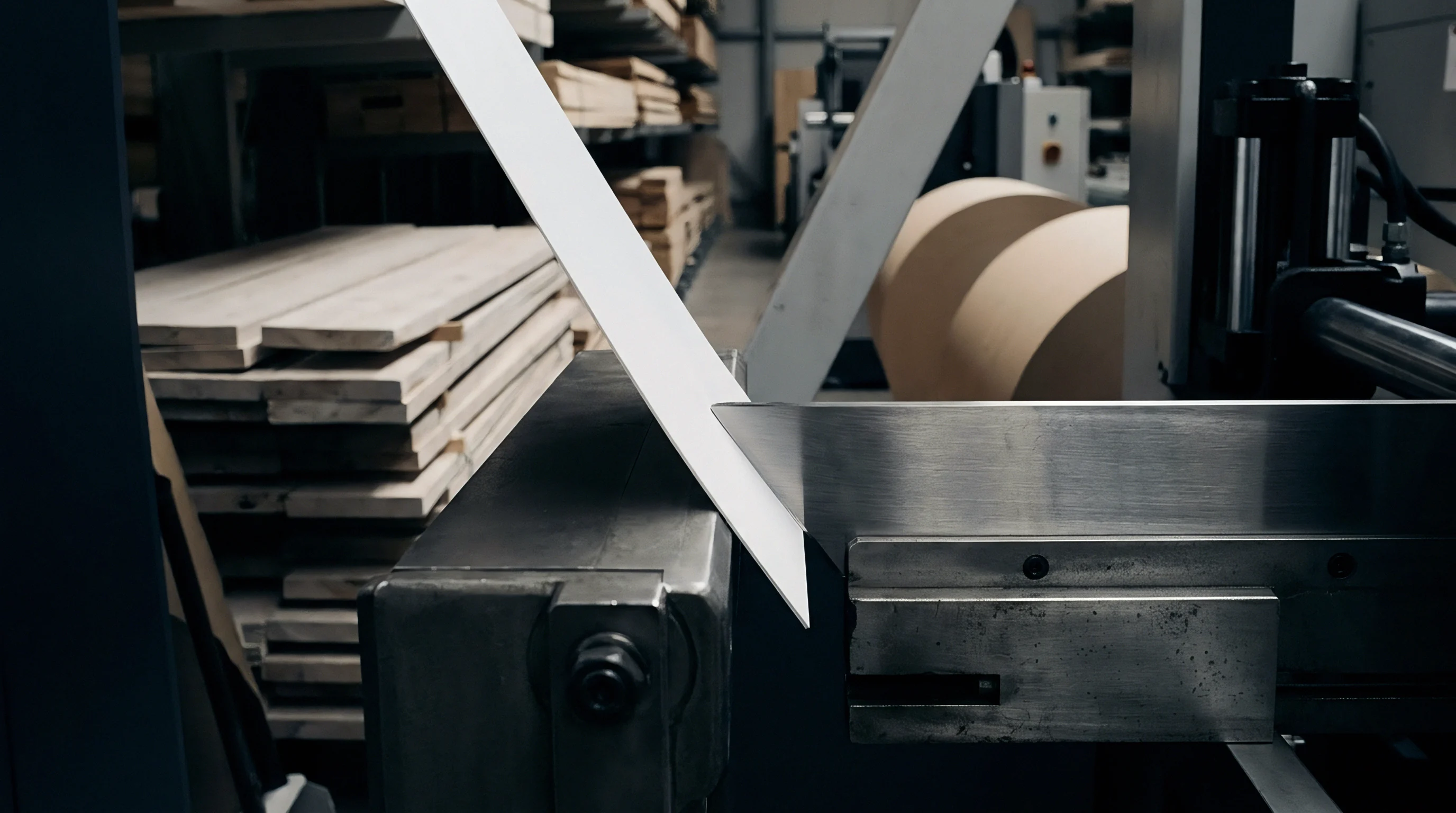
Passing paperboard through high-speed converting rollers subjects the fiber network to intense shear strain and out-of-plane compression. Draw rolls, rotary die stations, and impression cylinders impose rapid pressure peaks that alter the internal density profile of the web. As processing speeds increase from 200 metres per minute to over 800 metres per minute, the time a web segment spends inside the roll nip drops to microsecond durations.
This rapid mechanical strain alters the hydrogen-bonded cellulose network, triggering structural degradation before the sheet reaches downstream folding and gluing operations.

Compressive Stress Dwell Time
At web speeds exceeding 600 metres per minute, structural deformation occurs over sub-millisecond durations. The instantaneous peak compressive stress inside a roller nip can exceed 3.5 megapascals. Paperboard is porous and viscoelastic, containing both air voids and moisture bound within fiber walls.
Fast compression prevents internal air pressure from dissipating gradually through web pores, generating micro-scale internal pore pressure gradients. This trapped air pressure forces plies apart at the nip exit, breaking inter-fiber bonds within low-density middle plies. Consequently, the sheet emerges from the nip with a permanently compromised Z-direction shear modulus, reducing flexural rigidity even if the caliper recovers elastically.
Board passing through a 120 millimetre diameter nip roller at 750 metres per minute experiences a compressive stress dwell time under 1.5 milliseconds at 23 degrees Celsius and 50 percent relative humidity.
Structural Micro-Damage Mechanisms
Repeated mechanical pressure ruptures inter-fiber hydrogen bonds and fractures outer mineral coating layers. Mineral coatings consisting of calcium carbonate or kaolin clay bound by synthetic latex possess low failure strain thresholds. Dynamic bending around small-radius guide rolls creates high surface strain, forcing micro-fissures to form in the pigment layer.
These micro-cracks act as stress concentrations during subsequent folding steps, accelerating flexural rigidity decay across conversion processes.
High-speed converting operations trigger multiple distinct failure modes within paperboard structures:
- Fiber Bond Disruption occurs when localized shear stress exceeds internal hydrogen bond energy within mechanical core plies.
- Coating Micro-Fissuring develops when mineral pigment topcoats exceed ultimate tensile strain limits during rapid guide roll wrap passage.
- Z-Direction Delamination Strains arise from air pore pressure build-up and structural rebound at the nip exit zone.
- Elastic Modulus Loss results from progressive structural softening of cellulose fiber networks under repeated mechanical stress cycles.
Failing to compensate for dynamic nip compression causes board thickness collapse, which leads to folder-gluer jamming, improper carton squareness, and immediate rejection of finished packaging lots.
Hysteresis
Viscoelastic materials absorb mechanical energy during cyclic bending, dissipating stress as internal heat rather than returning stored elastic energy. Cellulose fibers, hemicellulose matrices, and lignin binders exhibit pronounced rate-dependent mechanical responses. When high-speed converting lines flex board webs thousands of times per minute, flexural rigidity decays along a non-linear viscoelastic relaxation curve.
Quantitative decay modeling enables predictive adjustments to web tension and tooling geometry.

Mathematical Formulations of Dynamic Decay
Classical elastic flexural models fail when line speeds cause rapid strain cycles. Modeling dynamic flexural rigidity requires introducing a rate-dependent decay factor into the elastic modulus calculation. The instantaneous flexural rigidity Sb(v, t) as a function of web velocity v and continuous strain history t is expressed through a modified viscoelastic relaxation function:
Sb(v, t) = E0 · I0 · left
where E0 is the static elastic modulus measured via ISO 534 caliper and bench testing, I0 represents the uncompressed moment of inertia, α is the structural damage coefficient specific to furnish composition, β is the velocity scaling exponent, and τ denotes the characteristic stress relaxation time of the fiber network. For virgin softwood fibers, τ ranges between 0.05 and 0.12 seconds, whereas short recycled fibers exhibit smaller τ values between 0.01 and 0.04 seconds, causing rapid stiffness drop-offs under high frequencies.
Burgers Viscoelastic Network Model
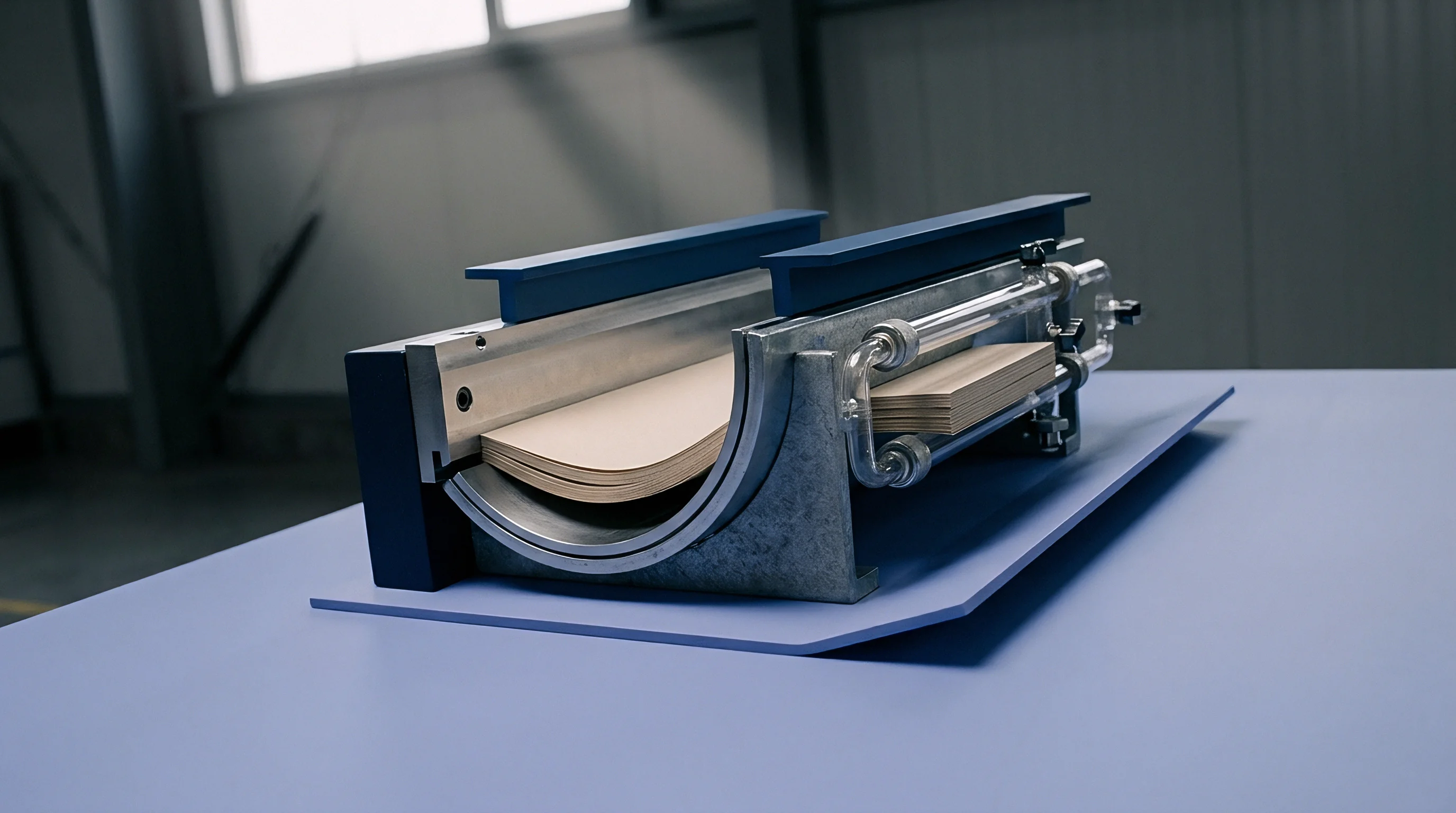
Combining spring and dashpot elements in series and parallel captures instant elastic recovery alongside delayed viscous deformation. The Maxwell component accounts for immediate elastic reaction and long-term unrecoverable viscous flow, while the Kelvin-Voigt component models delayed elastic recovery. When paperboard experiences dynamic flexure across high-speed packaging equipment, the dashpot elements absorb mechanical work.
This absorbed energy raises localized web temperature, softening amorphous hemicellulose regions and reducing overall sheet resistance to subsequent bending forces.
High mechanical pulp content in inner plies increases viscoelastic damping, causing higher flexural stiffness decay than pure chemical pulp under rapid strain cycles.

Worked Dynamic Rigidity Decay Calculation
Assumptions: A converting line runs a 350 g/m² Folding Boxboard (FBB) with an uncompressed caliper of 480 µm and an initial static flexural rigidity S0 of 28.5 mN·m. The line operates at a web velocity v = 750 m/min (12.5 m/s) against a baseline testing speed v0 = 10 m/min (0.167 m/s). Empirical testing establishes a damage coefficient α = 0.08, a scaling exponent β = 0.35, and a relaxation time τ = 0.06 seconds.
The web experiences dynamic strain over an elapsed line contact time t = 0.15 seconds.
First, evaluate the velocity ratio exponent term:
left( fracvv0 right)β = left( frac75010 right)0.35 = (75)0.35 ≈ 4.512
Next, determine the time-dependent relaxation factor:
1 – e^{-t/tau} = 1 – e^{-0.15 / 0.06} = 1 – e^{-2.5} approx 1 – 0.0821 = 0.9179
Now, calculate the total dynamic decay multiplier:
text{Decay Factor} = alpha cdot 4.512 cdot 0.9179 = 0.08 cdot 4.512 cdot 0.9179 approx 0.3313
Finally, compute the effective dynamic flexural rigidity under operational converting conditions:
S_b(v, t) = 28.5 text{ mN·m} cdot (1 – 0.3313) = 28.5 cdot 0.6687 approx 19.06 text{ mN·m}
This calculated drop from 28.5 mN·m down to 19.06 mN·m represents a 33.1 percent loss in effective flexural rigidity. Converter tooling must compensate for this reduced resistance during high-speed crease forming to maintain square carton folding profiles.
Whether bio-based nanofibrillated cellulose sizing can alter internal ply shear relaxation fast enough to eliminate dynamic flexural decay at speeds above 1000 metres per minute remains an open question for substrate researchers.

Creasing
Forming clean folding lines requires controlled localized delamination within the central plies of paperboard. A steel rule forces the board sheet into a recessed counter-matrix channel, creating an internal crease bead. Dynamic creasing at speeds exceeding 40,000 blanks per hour alters shear force distribution, significantly lowering the residual bending resistance ratio measured per ISO 9825.

Why Does High Line Speed Accelerate Score Stiffness Loss?
Short contact times between the scoring rule and matrix generate incomplete ply separation. Under slow matrix penetration, cellulose fibers slide and realign within the internal delamination zone, creating a well-defined hinge. High-speed impact forces fibers to fracture across their length rather than separating along ply boundaries.
Broken fibers cannot absorb rotational bending moments during carton erection, causing score cracking, irregular crease resistance ratios, and panel bow during final cartoning.
Score Matrix Geometry and Bending Moment Decay
Matching channel width and male blade thickness determines the shape of the internal crease bead. Standard matrix selection relies on static formulas where matrix channel width equals board thickness multiplied by 1.5 plus rule width. High-speed converting lines require wider matrix channels to accommodate dynamic volumetric expansion.
If matrix channels are too narrow for dynamic operation, high strain causes unrecoverable shear damage outside the crease zone, degrading structural stiffness across adjacent flat panels.
| Substrate Grade | Caliper (µm) | Matrix Width (mm) | Matrix Depth (mm) | Static Score Ratio (%) | Dynamic Score Ratio (%) | Flexural Loss Difference (%) |
|---|---|---|---|---|---|---|
| SBS Kraft | 400 | 1.20 | 0.50 | 48.2 | 34.1 | 14.1 |
| FBB Mechanical Core | 450 | 1.40 | 0.55 | 52.0 | 39.5 | 12.5 |
| WLC Recycled Content | 450 | 1.40 | 0.60 | 41.5 | 24.8 | 16.7 |
| SUB Unbleached Kraft | 420 | 1.30 | 0.50 | 50.1 | 36.8 | 13.3 |
Calibrating dynamic score matrix gaps on high-speed flatbed autoplaten blankers follows a sequential operational progression:
- Measure delivered sheet caliper across five web positions under ISO 534 standards to establish true baseline thickness drift.
- Select matrix depth matching nominal caliper while adding ten percent to matrix channel width formulas to accommodate high-speed viscoelastic strain expansion.
- Mount the counter-matrix plate and perform low-speed impression checks to confirm precise concentric alignment between male creasing rules and female grooves.
- Accelerate the blanking press to target operational speed while running sample test sheets to generate dynamic score beads under full production inertia.
- Measure residual bending resistance using an automated crease stiffness tester to verify that score resistance ratios remain within prescribed engineering limits.
Incorporating ISO 9825 score stiffness ratio parameters directly into supply agreements establishes verifiable thresholds, allowing converters to debit board mills for material lots that experience dynamic stiffness loss exceeding 25 percent.
Prototyping
Traditional laboratory testing measures board properties under static or low-speed conditions that do not reflect high-speed converting lines. A Taber instrument deflects a test specimen at a slow angular velocity of 15 degrees per second, taking over a second to complete a measurement. In contrast, high-speed rotary dies and folder-gluers bend paperboard panels in under 5 milliseconds.
Prototype evaluation must employ advanced dynamic diagnostic methods to capture real-time flexural rigidity decay.
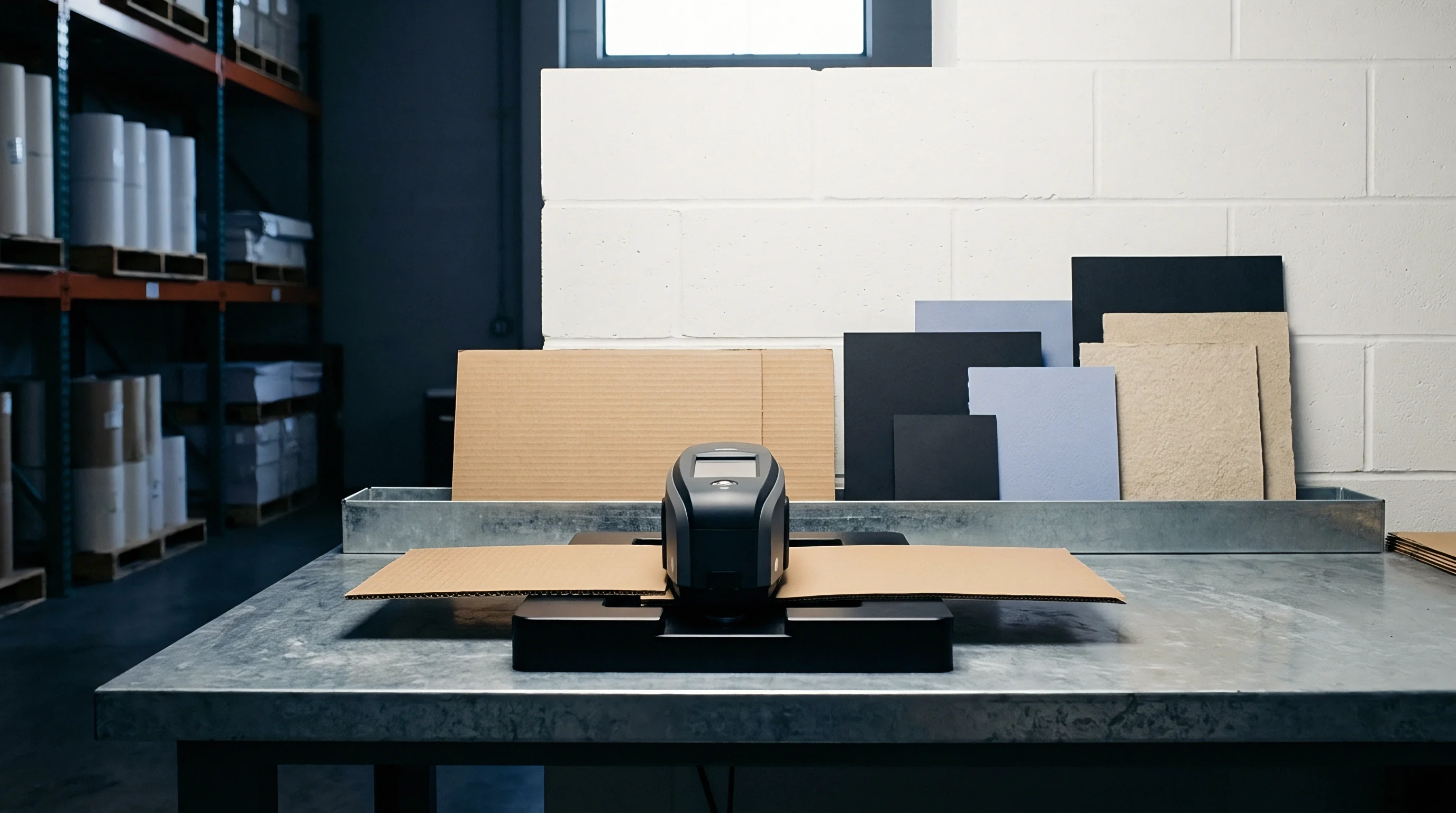
Benchtop Static versus Dynamic Inline Measurements
Standard Taber instruments apply bending forces at standardized slow angular velocities of 15 degrees per second. High-speed converting lines operate at deformation rates three orders of magnitude faster than benchtop instruments. Static testing measures simple elastic resistance, ignoring rate-dependent structural relaxation, internal shear heating, and fast moisture transport.
Inline dynamic monitoring systems deploy non-contact laser sensors alongside high-frequency force transducers directly onto converting equipment, capturing structural performance under real operating strains.
Compliance with ISO 187 conditioning standards before dynamic strain testing prevents humidity-induced false readings that alter accepted strength specifications.
Laser Doppler and Optical Strain Instrumentation
Non-contact measurement tools detect web deflection across converting rollers without touching the moving sheet. Laser Doppler Vibrometry (LDV) tracks out-of-plane web vibrations occurring down to megahertz frequencies. High-speed digital image correlation systems photograph paperboard surfaces at 100,000 frames per second, mapping strain distributions during matrix indentation.
Optical strain mapping reveals localized micro-shear zones that benchtop instruments completely miss, empowering engineers to adjust machine tension before structural delamination occurs.
| Performance Metric | Standard Taber (ISO 2493) | L&W Bending Tester 280 | High-Speed Inline Laser System |
|---|---|---|---|
| Deformation Rate | 15° per second | 5° to 90° per second | Up to 15,000° per second |
| Strain Dwell Duration | 1,000 to 3,000 ms | 200 to 500 ms | 0.5 to 5.0 ms |
| Environmental Control | Conditioned Room Only | Conditioned Room Only | Active Machine Ambient Tracking |
| Z-Direction Shear Capture | Calculated Indirectly | Not Measured | Direct Multi-Axis Strain Mapping |
| Data Sampling Rate | 10 Hz | 100 Hz | 100,000 Hz |
Implementing inline dynamic stiffness monitoring requires specific analytical hardware configurations:
- High-Frequency Laser Displacement transducers measure sub-micron web deflections between converting nip rollers in real time.
- Multi-Axis Web Tension Transducers calculate instantaneous web strain variations across high-speed machine sections.
- Acoustic Emission Stress Sensors detect micro-fracturing of outer coating layers during rapid bending operations.
- Thermal Anomaly Tracking cameras identify localized viscoelastic heat buildup within internal pulp plies.
A paperboard furnish engineered with strong inter-ply bonding resists dynamic flexural decay far more effectively than a sheet relying primarily on heavy surface mineral coatings.


Valuation
Specifying paperboard based on nominal static caliper often hides significant economic losses on high-speed packaging machinery. Purchasing engineers frequently downgrade basis weight to cut raw material costs, assuming static flexural stiffness will meet structural needs. When dynamic flexural rigidity decays at high speeds, lighter sheets lose panel flatnesses, triggering machinery jams, edge misalignment, and high scrap rates on folder-gluers and cartoning lines.
Downgauging Economics and Runnability Yields
Reducing basis weight lowers raw material expense but increases risk of dynamic box failure during cartoning. A ten percent caliper reduction cuts raw substrate purchasing expenditure per tonne, yet it drops section moment of inertia by nearly twenty-seven percent. If the converter attempts to run downgraded board at full operational speed, dynamic rigidity decay exacerbates panel deflection, forcing operators to slow line speeds down by fifteen to twenty percent to avoid feeder jams.
The financial loss from reduced production output far exceeds raw material savings.
Selecting a lighter virgin boxboard grade often yields higher net converting speeds and lower overall line spoilage than running a heavier recycled board.
Landed Cost Modeling for Converting Spoilage
Total carton manufacturing expenses depend directly on converting throughput and scrap percentages. Grade substitution economics must evaluate landed yield per thousand finished cartons rather than raw substrate price per tonne. Incorporating dynamic flexural decay factors into cost models clarifies the true operational boundaries of recycled versus virgin fiber substrates.
Worked Cost Comparison under Dynamic Rigidity Decay
Consider a production run requiring 50 tonnes of paperboard for folding carton manufacturing on a high-speed line operating at a target speed of 700 metres per minute. Two candidate board grades are evaluated under real operational parameters:
Option A: Solid Bleached Sulfate (SBS), 300 g/m², priced at 1,450 EUR per tonne. SBS experiences a 12 percent dynamic flexural rigidity decay at 700 m/min, allowing the converting line to operate at full target speed with a baseline spoilage rate of 1.5 percent.
Option B: White Lined Chipboard (WLC), 360 g/m² (selected to match SBS static stiffness), priced at 1,100 EUR per tonne. Due to shorter recycled fibers, WLC experiences a 32 percent dynamic flexural rigidity decay at 700 m/min. To prevent folder-gluer jams caused by panel deformation, the line speed must be reduced to 500 m/min, increasing hourly labor and press overhead, while spoilage increases to 4.8 percent.
Calculate material purchase costs:
text{Option A Material Cost} = 50 text{ tonnes} cdot 1,450 text{ EUR/tonne} = 72,500 text{ EUR}
text{Option B Material Cost} = 50 text{ tonnes} cdot 1,100 text{ EUR/tonne} = 55,000 text{ EUR}
Calculate net usable yield after accounting for dynamic converting spoilage:
text{Option A Usable Tonnes} = 50 cdot (1 – 0.015) = 49.25 text{ tonnes}
text{Option B Usable Tonnes} = 50 cdot (1 – 0.048) = 47.60 text{ tonnes}
Calculate converting machine time costs. Assume press operating costs are 350 EUR per hour. The 50-tonne job corresponds to 166,666 square metres of web area.
At web width 1.0 metre, Option A requires 238.1 minutes (3.97 hours) at 700 m/min. Option B requires 333.3 minutes (5.56 hours) at 500 m/min.
text{Option A Press Cost} = 3.97 text{ hours} cdot 350 text{ EUR/hour} = 1,389.50 text{ EUR}
text{Option B Press Cost} = 5.56 text{ hours} cdot 350 text{ EUR/hour} = 1,946.00 text{ EUR}
Factor in the cost of wasted substrate tonnage:
text{Option A Spoilage Waste Cost} = 0.75 text{ tonnes} cdot 1,450 text{ EUR} = 1,087.50 text{ EUR}
text{Option B Spoilage Waste Cost} = 2.40 text{ tonnes} cdot 1,100 text{ EUR} = 2,640.00 text{ EUR}
Calculate effective total landed production expense:
text{Option A Total Expense} = 72,500 + 1,389.50 = 73,889.50 text{ EUR}
text{Option A Cost Per Net Usable Tonne} = frac{73,889.50}{49.25} = 1,500.29 text{ EUR}
text{Option B Total Expense} = 55,000 + 1,946.00 = 56,946.00 text{ EUR}
text{Option B Cost Per Net Usable Tonne} = frac{56,946.00}{47.60} = 1,196.34 text{ EUR}
While Option B yields a lower total nominal cost per usable tonne, the net throughput loss of 1.59 press hours creates a capacity bottleneck that reduces plant-wide gross profit margins. If downstream packaging lines experience downtime due to carton squareness defects from WLC panel bow, the cost of customer claims eliminates the initial substrate price advantage entirely. Calculating total landed carton costs using dynamic rigidity decay profiles ensures accurate material selection, protecting converting efficiency while maximizing finished package structural performance.