Recycled Fiber Furnish Topography Influence on Polymer Barrier Continuity
Recycled fiber surface peaks exceed thin polymer melt curtains, creating pinholes that require pre-coating or heavier resin laydown for barrier continuity.
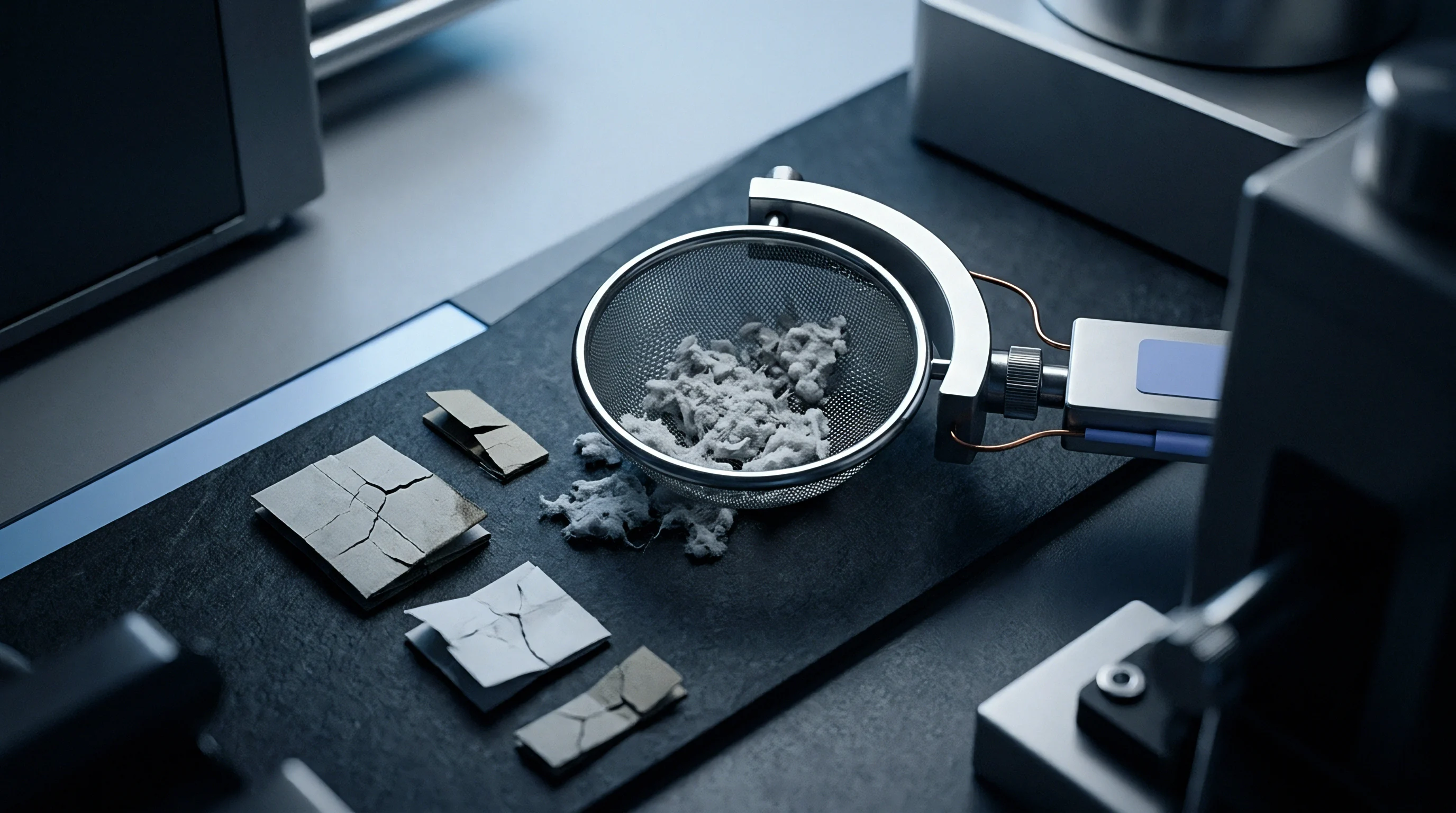

Profile
Extrusion coating and aqueous dispersion barriers applied across secondary fiber webs encounter structural variations absent in virgin kraft sheets. Recycled furnish contains broken fibers, hornified fines, residual mineral fillers, and unpulped shives. These constituents alter the micro-topography of the paperboard, creating local variations in peak-to-valley height that govern whether a continuous polymer film can form across the web.
Surface roughness measurements dictate barrier performance far more reliably than average air permeance metrics. When evaluating recycled liners or folding boxboards, air-leak roughness under ISO 8791-4 using the Parker Print-Surf instrument at 1000 kPa clamping pressure isolates the compressibility and void volume of the top ply. A virgin solid bleached sulfate board achieves Parker Print-Surf values between 1.2 and 2.0 micrometers, whereas a double-lined recycled boxboard with 100 percent recovered fiber frequently measures between 3.5 and 6.8 micrometers.
This elevation differential directly alters the minimum laydown mass needed to achieve film continuity.
A surface roughness exceeding 4.5 micrometers under ISO 8791-4 at 1000 kPa doubles the critical polymer coat weight necessary to eliminate microscopic pinholes.
Optical interferometry and 3D stylus profilometry quantify the micro-scale distribution of high points across the web. The root mean square surface roughness, designated as Sq, alongside the maximum height of the surface profile, known as Sz under ISO 25178-2, map the extreme topography features. Unrefined secondary fiber bundles produce localized peaks extending 15 to 35 micrometers above the mean plane.
An extruded polymer melt curtain drawn down to an average thickness of 12 micrometers fails to cover these isolated elevations, exposing raw fibers to ambient atmosphere.
| Furnish Grade | Parker Print-Surf (µm at 1000 kPa) | Maximum Surface Height Sz (µm) | Base Sheet Density (g/cm³) | Threshold LDPE Coat Weight (g/m²) |
|---|---|---|---|---|
| Solid Bleached Sulfate Virgin Hardwood/Softwood | 1.4 to 1.8 | 8.5 to 14.0 | 0.78 to 0.86 | 12.0 to 14.0 |
| Folding Boxboard Virgin Top Recycled Back | 2.2 to 2.9 | 16.0 to 22.0 | 0.62 to 0.70 | 16.0 to 18.0 |
| White Lined Chipboard 100 Percent Recovered | 3.8 to 5.2 | 28.0 to 42.0 | 0.58 to 0.65 | 22.0 to 26.0 |
| Testliner Recycled Corrugated Medium Furnish | 5.5 to 7.2 | 38.0 to 55.0 | 0.52 to 0.59 | 28.0 to 34.0 |
The spacing of topographic peaks determines whether liquid polymer or aqueous barrier coatings bridge the valleys or drain into the interior porous network. Secondary fibers exhibit reduced conformability during web consolidation. Hornification, caused by repeated drying cycles in prior papermaking loops, stiffens individual cell walls, preventing fiber collapse during wet pressing.
The resulting sheet exhibits elevated bulk alongside profound local height variance.
Coating thickness follows local fiber heights.


Defect
Microscopic pinholes and localized barrier rupture develop when the applied polymer layer thins over elevated fiber asperities. During extrusion coating, low-density polyethylene or polybutylene succinate draws across the web as a hot melt curtain. Surface tension draws the cooling melt toward adjacent depressions, causing the polymer film to stretch to sub-micron thicknesses over high-standing shives.
When the web cools, differential thermal contraction between the cellulosic fiber bundle and the synthetic polymer generates shear stress, shearing the thin film away from the fiber peak.
Aqueous dispersion coatings face distinct physical hurdles on recycled surfaces. Waterborne polyacrylate or ethylene acrylic acid dispersions rely on capillary action and evaporation to form a cohesive matrix. High surface porosity in unrefined secondary fiber matrices drains liquid vehicle rapidly, stranding polymer particles before coalescing temperatures are achieved.
This dewatering phenomenon leaves open voids around raised fiber nodes.
- Capillary dewatering strips solvent from the coating interface before synthetic latex particles fuse into a closed barrier film.
- Thermal tear develops when crystalline polymer contracts against rigid hornified secondary fiber bundles during chill roll contact.
- Shive puncture pushes unrefined wood fragments through the drawn melt curtain, establishing direct atmospheric channels.
- Floc voiding occurs in low-drainage stock where irregular fiber flocs create deep macro-pores exceeding fifty micrometers in diameter.

Can Pre-Coating Mask Recycled Shive Elevation?
Mineral pre-coatings containing calcium carbonate, clay, and styrene-butadiene latex smooth the recycled surface prior to polymer deposition. Applying 8 to 12 grams per square meter of a high-solids formulation fills macro-pores between recycled fiber flocs, reducing the Parker Print-Surf roughness below 2.0 micrometers. The pre-coat creates an engineered interface, shielding the melt curtain from protruding fiber shives.
Applying ten grams per square meter of mineral pre-coat suppresses peak surface height Sz from forty micrometers down to twelve micrometers on recycled testliner.
Water absorption rates drop when base sheets receive mineral pre-treatments. Under ISO 535 testing, sixty-second Cobb values fall from over 80 grams per square meter on raw recycled board down to 22 grams per square meter on pre-coated surfaces. This controlled absorptivity prevents aqueous barrier vehicle drainage, allowing dispersion particles to coalesce into uninterrupted films without pinholes.
Overlooking base topography variations leads directly to rejected production lots, catastrophic grease migration through packaging walls, and lost customer accounts.

Nip
Mechanical pressure inside the coating applicator compresses surface irregularities to promote polymer adhesion. In extrusion coating, the nip consists of a steel chill roll and an elastomer-covered pressure roll operating under linear loads between 20 and 50 kilonewtons per meter. This mechanical force drives the molten polymer into the open surface pores of the recycled board, establishing mechanical interlocking.
Excessive compression crushes low-density recycled boards, destroying internal shear strength. When nip pressure exceeds 45 kilonewtons per meter on recycled stock with low z-directional tensile strength, the internal plies delaminate during winding. The balance requires sufficient pressure to conform the polymer melt around fiber peaks without exceeding the Scott Bond threshold of the secondary fiber furnish.
- Caliper baseline mapping verifies initial sheet thickness and cross-direction profile across untrimmed parent reels at standard testing conditions of 23 C and 50 percent relative humidity.
- Hardness matching selects a backing roll rubber cover between 80 and 90 Shore A to distribute load uniformly over furnish floc variations.
- Hydraulic load calibration sets nip force incrementally from 15 to 35 kilonewtons per meter while observing board z-directional compression.
- Chill roll thermal balancing locks cooling drum surface temperature between 15 C and 20 C to freeze the polymer matrix before adhesion failure occurs.
Does Calendering Restore Base Sheet Uniformity?
Hard-nip and soft-nip calendering flatten surface peaks before the substrate enters the barrier application line. Passing recycled paperboard through a heated soft-nip calender at 150 C and 30 kilonewtons per meter plastically deforms lignin and secondary fibers. This thermal softening reduces Parker Print-Surf roughness by up to 40 percent without compromising stiffness as severely as cold hard-nip calendering.
Calendering creates density gradients. The surface plies densify while the core retains bulk. This localized densification seals open capillary networks, preventing excessive soak-in of waterborne barrier dispersions and maintaining coating holdout across the web.
Paperboard behaves according to mechanical law rather than marketing claims.
Converters frequently claim that standard extrusion lines can run any paper grade without adjustment.
Permeation
Diffusion pathways for gas and vapor molecules expand when polymer coatings vary in local thickness. Fickian diffusion models assume a uniform polymer thickness across the substrate. On recycled paperboards, local barrier thickness fluctuates from zero to twice the nominal target value, rendering bulk diffusion calculations inaccurate.
Gas molecules exploit thin regions, accelerating transmission rates across the finished laminate.
Water vapor transmission rate testing under ASTM F1249 at 38 C and 90 percent relative humidity reveals non-linear barrier degradation on rough recycled substrates. A nominal 18 gram per square meter extrusion coating of low-density polyethylene yields a water vapor transmission rate of 4.5 grams per square meter per day on virgin solid bleached sulfate board. That identical polymer laydown applied to an un-calendered recycled boxboard yields transmission values exceeding 28.0 grams per square meter per day due to micro-channel permeation over protruding fiber tips.
| Substrate Class | Surface Roughness (PPS µm) | WVTR (g/m²/day at 38 C, 90% RH) | Oxygen Transmission (cm³/m²/day at 23 C, 50% RH) | Grease Resistance (3M Kit Rating) |
|---|---|---|---|---|
| Bleached Virgin Kraft Sheet | 1.5 | 4.2 to 5.1 | 180 to 220 | Kit 12 |
| Coated Recycled Board (Double Coated) | 2.1 | 6.8 to 8.4 | 290 to 360 | Kit 12 |
| White Lined Chipboard (Uncoated) | 4.6 | 24.5 to 32.0 | 950 to 1400 | Kit 5 |
| Recycled Kraft Linerboard (Unsized) | 6.8 | 65.0 to 92.0 | 2800 to 4100 | Kit 2 |
Grease resistance evaluation under TAPPI T559 reveals localized barrier discontinuities within seconds of reagent contact. Low surface tension castor oil, toluene, and n-heptane mixtures penetrate microscopic crevices where the polymer film failed to coat fiber high points. A substrate with high peak-to-valley variance registers low Kit ratings despite carrying heavy nominal polymer mass.
Pinholes bypass bulk barrier chemistry.
What remaining thermodynamic threshold prevents aqueous dispersion particles from bridging extreme recycled fiber valleys without adding pre-coat mass remains subject to ongoing mill trials.
Tariff
Material costs escalate when converters increase polymer laydown to compensate for rough base sheet topography. Adding synthetic resin mass to cover fiber peaks increases raw material expenses while diminishing web yield per metric ton. A converter applying 30 grams per square meter of polymer onto unrefined recycled board incurs higher total production costs than a converter running 16 grams per square meter over a pre-coated, smoother grade.
Extended producer responsibility fees penalize excess synthetic polymer content in fiber packaging streams. In European markets operating under EN 13430 standards, packaging containing over 15 percent synthetic polymer by weight faces elevated recycling disposal surcharges or loses repulpability certification entirely. Sourcing high-roughness recycled stock forces higher polymer laydown, pushing the total laminate beyond standard fiber recovery thresholds.
- Substrate pricing delta measures raw board expense per square meter against required resin consumption.
- Extrusion yield loss calculates the reduction in finished surface area per ton of polymer as coat weight rises.
- Repulpability compliance checks whether synthetic resin content stays below the 15 percent total pack weight limit.
- Waste disposal surcharge tracks extended producer responsibility fees tied to non-recyclable laminate fractions.
Virgin hardwood top plies provide commercial advantages over raw secondary fiber sheets for barrier applications. A smooth top ply reduces required polyethylene laydown from 28 grams per square meter down to 14 grams per square meter. Over a production run of one million square meters, this reduction eliminates fourteen metric tons of polymer consumption, offsetting the initial cost difference between virgin and recycled base paperboards.
Supply agreements specify surface roughness limits under ISO 8791-4 with penalties for deliveries exceeding agreed micrometric thresholds.