Transient Moisture Diffusion Rates in Uncoated Kraftliner Stocks
Transient moisture diffusion in uncoated kraftliner drives rapid surface plasticization and cross-direction strain, undermining converting accuracy and box stack life.


Transport
Direct exposure of dry virgin kraftliner to humid air initiates sorption across the sheet boundary within milliseconds. Ambient water molecules collide with the porous external face, condense into sorption sites on exposed cellulose microfibrils, and establish a steep concentration gradient through the sheet thickness. Uncoated virgin kraftliner stocks between 125 g/m² and 440 g/m² grammage exhibit effective through-thickness diffusion coefficients (D_z) ranging from 1.2 × 10⁻¹¹ m²/s to 8.5 × 10⁻¹¹ m²/s when conditioned according to ISO 187 from 50 percent relative humidity at 23 °C to an 80 percent relative humidity atmosphere.
The in-plane diffusion coefficient (D_x,y) operates between four and ten times faster than D_z because machine-direction fibre alignment creates continuous axial pathways along lumen channels and inter-fibre contact areas.
Transient moisture intake proceeds through two concurrent physical regimes. Vapour phase diffusion dominates macro-pore transport inside inter-fibre voids at relative humidity steps below 65 percent. Surface diffusion along cellulose fibrils and bound-water diffusion within swollen cell walls govern transport when relative humidity exceeds 70 percent.
Fickian models describe the early uptake stages accurately up to approximately half the equilibrium moisture content. Deviations emerge during the latter half of the sorption curve due to the finite relaxation rate of the hemicellulose-lignin amorphous matrix. Kraft pulp with high residual lignin content exhibits slower matrix relaxation than bleached kraft pulp, delaying equilibrium during sudden climatic transitions.
Sorption equilibrium under ISO 187 atmospheric shifts requires up to four hours of unstacked exposure for heavy kraftliner grades exceeding 300 g/m².
Mass uptake kinetics follow non-linear paths during sudden ambient humidity steps. A dry 175 g/m² unbleached kraftliner sheet exposed to 90 percent relative humidity absorbs over forty percent of its ultimate equilibrium moisture within the first ninety seconds. This rapid transient phase softens surface fibres before internal bulk regions register any moisture change.
The resulting plasticization gradient weakens inter-fibre bonds near the perimeter while the dry sheet core retains high elastic modulus, inducing internal shear stresses that precipitate premature surface failure during converting processes.
| Stock Grammage (g/m²) | Caliper (µm, ISO 534) | Apparent Density (g/cm³) | Effective D_z (m²/s) | Half-Sorption Time t_0.5 (s) |
|---|---|---|---|---|
| 125 | 168 | 0.744 | 1.8 × 10⁻¹¹ | 23.5 |
| 175 | 242 | 0.723 | 2.4 × 10⁻¹¹ | 36.8 |
| 200 | 280 | 0.714 | 3.1 × 10⁻¹¹ | 38.2 |
| 300 | 418 | 0.718 | 5.2 × 10⁻¹¹ | 50.4 |
| 440 | 625 | 0.704 | 7.9 × 10⁻¹¹ | 74.2 |
Thicker stocks exhibit longer absolute sorption half-times despite higher through-thickness diffusion coefficients. Lower apparent sheet density in heavier multi-ply cylinder or fourdrinier formations creates larger pore channels that facilitate gas-phase vapour movement. Slower total mass equilibrium remains governed by square-law sheet thickness relations.
Converters feeding web lines directly from unconditioned staging areas encounter steep moisture differentials between outer reel wraps and the core stock.
Linear sorption assumptions fall apart when relative humidity fluctuations occur across short time intervals. Surface fibres reach saturation while inner plies remain dry.


Void
Internal network porosity dictates the relative velocity of gaseous vapour movement through kraftliner sheets. Papermaking refining levels, quantified by Schopper-Riegler degrees according to ISO 5267-1, compress lumen cavities and split external fibril walls, lowering total void fraction from approximately sixty percent down to thirty-five percent in densely consolidated sheets. Heavy refining tightens the pore size distribution, shifting mean pore diameters from five micrometres toward sub-micron scales.
Gas molecules undergo Knudsen diffusion when pore diameters approach the mean free path of water vapour molecules, decreasing vapour transmission velocities below standard molecular diffusion values.
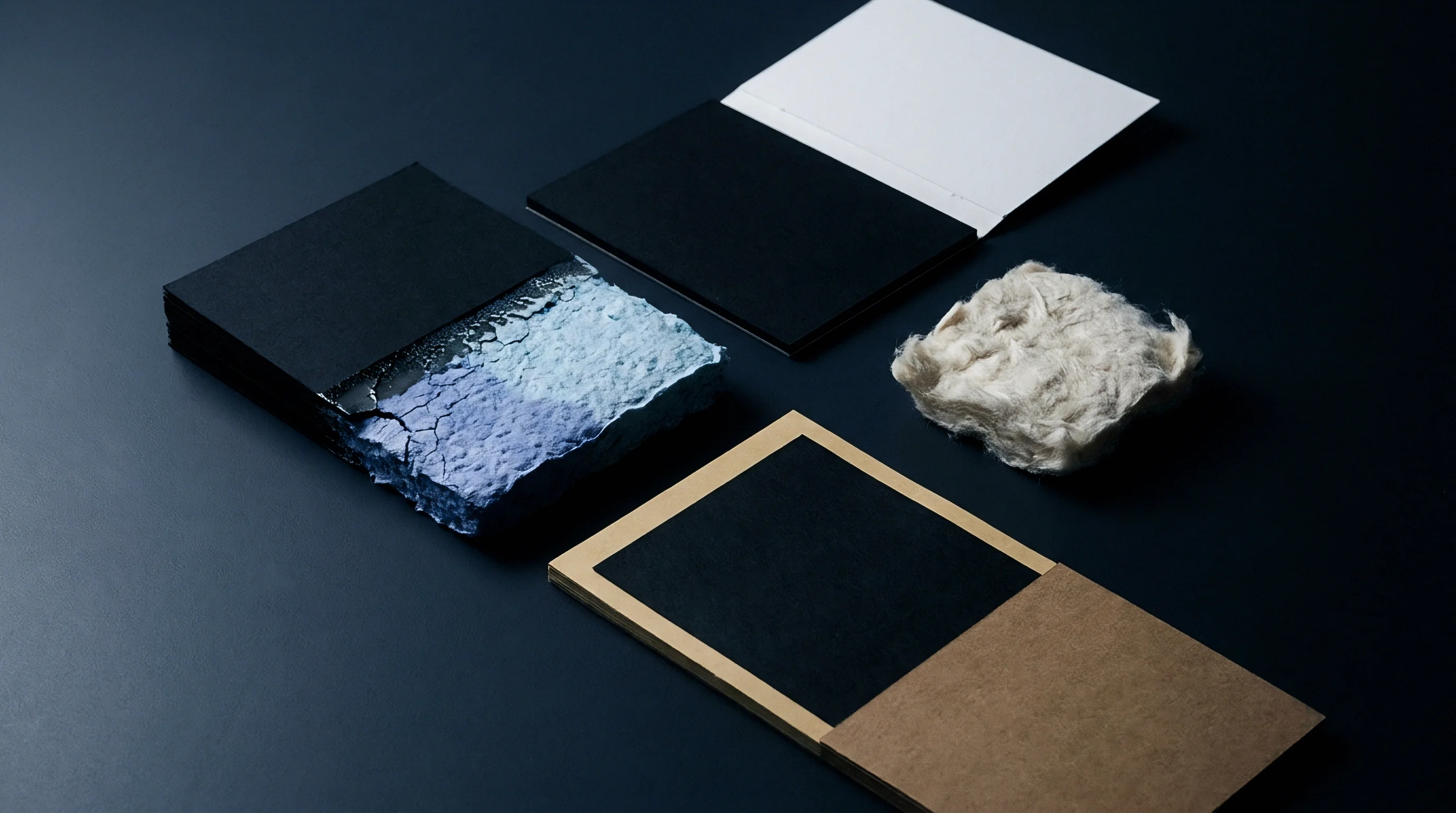
Porosity Effects on Internal Penetration
Sheet density profiles created at wet presses govern local vapour resistance across the thickness. High-intensity press nips generate dense outer skins with porous mid-ply regions in multi-ply fourdrinier boards. Vapour penetration decelerates at these compacted exterior zones, shielding inner layers from immediate humidity shocks during short environmental excursions.
Conversely, low-density single-ply kraftliner provides uniform void connectivity, permitting rapid, unhindered moisture migration deep into the cross-section.
Dense sheet surfaces delay internal sorption without altering final equilibrium values.
Internal sizing agents introduce hydrophobic boundaries that modify moisture uptake pathways. Alkyl ketene dimer and alkenyl succinic anhydride sizing systems applied at the wet end cover hydroxyl sites on fibre surfaces. These sizing chemistries leave bulk void geometry unaltered while dramatically suppressing liquid water capillary uptake measured by standard Cobb60 evaluations according to ISO 535.
Sizing agents exert negligible resistance against vapour diffusion. Water molecules in vapour form bypass surface energy barriers, entering the cell wall via gas-phase pore transport and sorption into sub-microscopic amorphous regions.
- Inter-fibre void diffusion transfers gaseous water molecules across interconnected air spaces without chemical sorption events.
- Intra-fibre lumen flow channels vapour along hollow fibre axes, bypassing dense network bottlenecks.
- Fibril surface migration carries condensed water monolayers across cellulose chains through hydrogen bonding hops.
- Cell wall solution diffusion forces bound water through swollen polymer matrices governed by matrix relaxation kinetics.
Cross-directional vapour transmission remains uniform until density variations arise from basis weight profiles across the machine width. Edge reels with lower apparent densities absorb humidity faster than centre reels wound under higher press consolidation. Sourcing managers examining web flutter or caliper variations across converting lines trace these dimensional faults back to uneven void consolidation during wet pressing.
Section 7 of ISO 535 restricts liquid uptake determinations to liquid contact phases, leaving gas-phase moisture movements entirely unmonitored in standard purchasing specifications.


Warp
Asymmetric moisture uptake induces immediate out-of-plane distortion in combined corrugated board. When an uncoated kraftliner outer face absorbs moisture faster than the inner liner, differential hygroexpansion generates bending moments across the flute tips. Virgin softwood kraft fibres expand transversally up to thirty times more than their longitudinal axis upon absorbing moisture.
The pronounced fibre orientation along the machine direction concentrates transient expansion along the cross direction, causing severe up-warp or down-warp across corrugator lines running at line speeds above 250 metres per minute.

What Limits Fickian Diffusion in Uncoated Liners?
Glass transition temperature shifts in amorphous hemicellulose interrupt standard transport mathematics. At moisture contents below six percent, the hemicellulose matrix remains rigid and glassy at room temperature. Absorbed water molecules act as plasticizers, depressing this transition temperature below ambient conditions once local moisture content crosses nine percent.
The sudden structural softening of the matrix accelerates polymer chain mobility, creating new sorption sites that disrupt steady-state diffusion rates and trigger non-linear hygroexpansion spikes.
| Grade Grammage (g/m²) | Fibre Alignment Ratio (MD:CD) | Cross-Direction Hygroexpansion Coefficient (%/Δ%MC) | Initial Transient Strain Rate (%/s) | Equilibrium Cross-Direction Strain (%) |
|---|---|---|---|---|
| 125 Virgin Kraft | 2.8:1 | 0.088 | 0.014 | 0.58 |
| 175 Virgin Kraft | 2.5:1 | 0.082 | 0.011 | 0.52 |
| 200 Virgin Kraft | 2.4:1 | 0.079 | 0.009 | 0.48 |
| 300 Multi-Ply Kraft | 2.1:1 | 0.074 | 0.006 | 0.43 |
| 440 Multi-Ply Kraft | 1.9:1 | 0.068 | 0.004 | 0.39 |
Starch adhesive lines at flute tips create rigid moisture sinks. During corrugator combining, the wet starch film introduces water directly onto the inner face of the linerboard, establishing an internal transient gradient opposite to the external atmospheric exposure. Unequal drying rates across double-facer heating sections freeze differential strains permanently into the combined board structure.
- Atmospheric boundary sorption elevates the surface moisture content of the exterior liner within seconds of warehouse unwrap.
- Cross-directional sheet expansion forces compressive stresses against the adhesive bonds joining liner to flute crests.
- Plasticization of surface fibres lowers elastic modulus, concentrating bending strains into unsupported flute spans.
- Permanent structural warp locks into the finished container board once adhesive sets across the strained interface.
Board warp creates massive converting complications. Jammed die-cutters, misaligned slotting heads, and vacuum feed dropouts on folder-gluers occur when cross-direction curl exceeds eight millimetres over a one-metre span. Sourcing engineers specify symmetric grammages and balanced refining degrees on both board faces to suppress differential transient expansions during production.
Unresolved questions persist regarding whether dynamic matrix relaxation rates during rapid two-sided humidity cycling can be effectively countered by mechanical web tension adjustments alone.

Converting
High web velocities across flexographic printer-slotters and corrugators introduce transient environmental shifts within fractions of a second. An unprinted 175 g/m² kraftliner sheet moving at four hundred metres per minute spends less than fifty milliseconds over open vacuum transfer belts between print units. Water-based ink application deposits liquid films containing up to eight grams of water per square metre directly onto the unprinted liner face.
The solvent carrier diffuses through surface pores instantly, lowering surface friction and altering web tracking dynamics across precision vacuum cylinders.
Tension variations cause registration errors across multi-colour print units. Dry sheets possess high tensile stiffness. As moisture penetrates the load-bearing network, Young’s modulus drops by twenty to thirty-five percent within three seconds.
Web stretches under constant line tension, shifting print registration out of commercial tolerances. Printers running tight graphical designs on uncoated kraftliner balance ink film thickness against drying air temperatures to preserve dimensional integrity through sequential press sections.
Contractual tolerances for corrugated box compression strength depend directly on ambient conditioning history under TAPPI T 402 prior to physical crush testing.
Creasing and scoring operations demand precise moisture targets. Kraftliner running below six percent moisture cracks open along crease lines when scored parallel to the machine direction. The brittle outer fibres fracture rather than rolling inward to form a clean mechanical hinge.
Conversely, moisture levels above ten percent cause scoreline rollover and wall crush under creasing wheels. Controlled moisture diffusion during staging periods establishes the narrow window needed for intact, high-strength box joints.
Sourcing engineers face commercial pushback when attempting to enforce strict ambient boundaries across transport operations. Suppliers frequently claim that rapid moisture uptake remains entirely reversible once finished boxes enter climate-controlled distribution facilities.

Cargo
Containerized ocean shipments expose palletized kraftliner reels to severe humidity cycling. Temperature swings inside closed steel shipping containers drive relative humidity past dew point levels during diurnal cycles, creating container rain that coats outer packaging films with liquid condensation. Polyethylene pallet wraps prevent bulk liquid ingress but fail to eliminate vapour pressure gradients across seal laps.
Water vapour diffuses past film overlaps, initiating localized moisture absorption into reel edges and bottom pallet layers.
Reel edge swelling generates severe edge-flaring defects. The exposed outer edges of tightly wound rolls absorb moisture and expand along the cross direction. Core paper remains at manufacturing moisture contents between six and seven percent.
This localized expansion stretches the sheet edge past its yield point while wound under tension, creating permanent edge slackness across unrolled webs. Slack edges flutter violently in high-speed rotary die-cutters, causing web wander, trim choke-ups, and repeated press shutdowns.
Moisture variations across unwound reels produce permanent web tracking deviations that no pneumatic brake system can correct.
Compression capacity decays rapidly under sustained moisture absorption. Edge crush resistance values determined under ISO 3037 decline approximately eight percent for every single percentage point increase in equilibrium moisture content between six and twelve percent. Stacking strength calculations must incorporate worst-case transient moisture peaks encountered across export routes.
Warehousing cartons in unconditioned tropical ports reduces safety factors, causing lower carton tiers to buckle under dead loads that dry packaging supports easily.
Economic models confirm that downgauging virgin kraftliner specifications without accounting for transient moisture diffusion risks complete structural failure. A ten-tonne lot of converted 175 g/m² fruit packaging absorbing three percent excess moisture during unconditioned marine transit loses up to twenty-five percent of its pallet stacking capacity, crushing bottom cartons, damaging contents, and generating extensive commercial chargebacks across export supply networks.